
A planned large city in the California desert never bloomed the way it was hoped:
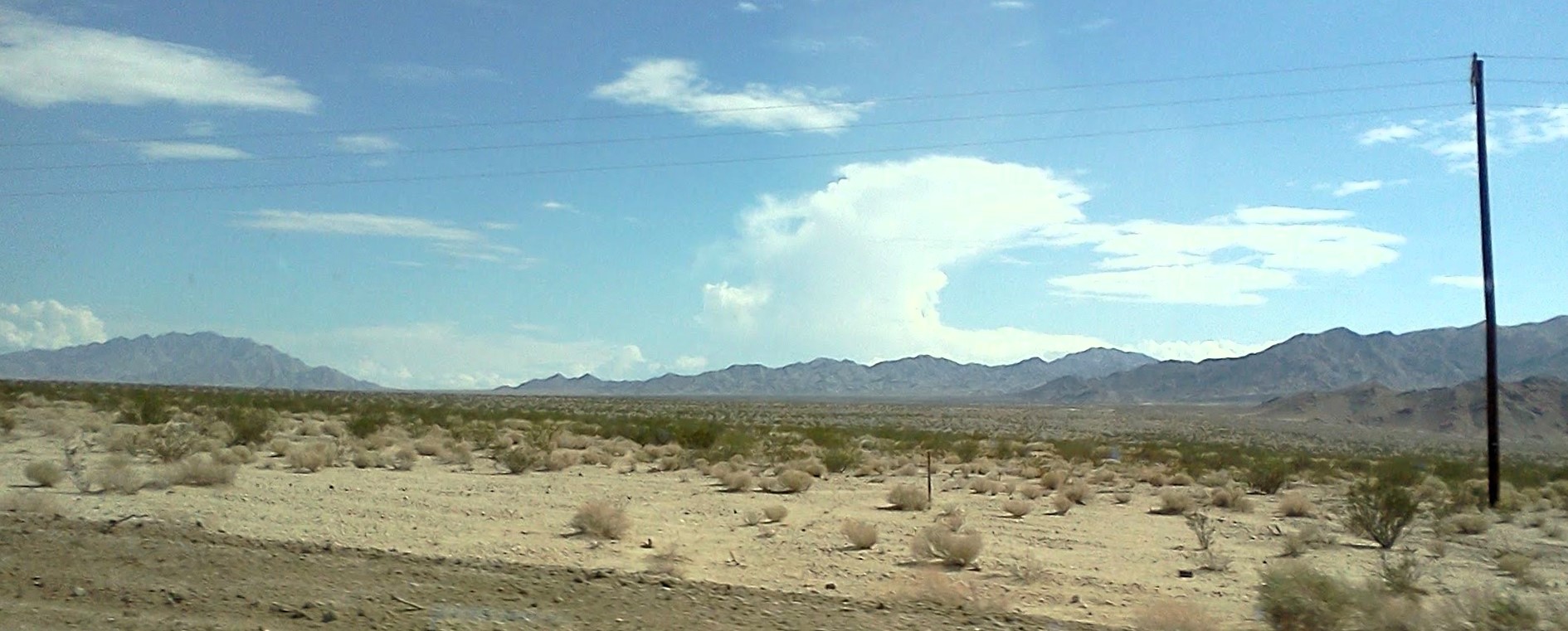
“For lack of a better description, [developers] really understood and pitched California City as an alternative and potentially competing city with Los Angeles,” Shannon Starkey told SFGATE. Starkey is an associate professor of architecture at University of San Diego and has spent years researching the city.
Piecemeal development was responsible for Los Angeles’ traffic problems, California City’s developers thought. They believed that LA, which appeared to be pressing against its population ceiling, was unprepared for California’s postwar population boom. New communities would need to pick up the slack. California City was designed to fit the bill: a sprawling, self-sufficient city in the desert. In the original plan, Starkey said, the city was projected to hold 400,000 people…
The town was incorporated in 1965 with a population that hovered around 600. According to Gorden, who moved to California City early in the decade, nearly everybody gathered in the newly built elementary school, which hadn’t yet opened, for a big dance. Mendelsohn and California’s lieutenant governor took turns sharing remarks. The mood in the 1960s, Gorden said, was one of “absolute expectations.”…
Grievances over false advertising culminated in a civil penalty issued against Great Western by the Federal Trade Commission. The FTC found Great Western responsible for deceptive sales practices, requiring the company to refund $4 million to over 14,000 of its customers. (Great Western Cities also had developments in Colorado and New Mexico.) At the time, it was the largest refund ever issued by the commission.
Shortly afterward, the Hunt brothers, who were heirs of an oil tycoon, acquired the company through a hostile takeover. According to Efford-Floyd, the Hunts only bought the company to drain its accounts, which they did as fast and as hard as they could…
Perhaps part of the reason that the city’s population never exploded is that it never developed an economic base of its own. “For many years, this was considered a bedroom community,” Jim Creighton, who serves on California City’s City Council, told SFGATE.
This would not quite be a ghost town as people do live there. However, it is an example of another common feature of the American landscape: a developer once had big plans but they did not pan out. Here, the eventual development did not match the grand vision. Elsewhere, other development might have eventually landed on top of what had once been planned. Either way, the community did not reach the lofty goals once set.
Should there be a name for such places? We would have to account for the scale of the plans. The ambitions here of a big city with hundreds of thousands of residents is different than a big subdivision that never quite got off the ground. We retell the stories of some of the planned communities that did happen, such as Levittown, New York or Columbia, Maryland or River Forest, Illinois. How many other places did not make it in the same way?
 Legally Sociable