
Highway drivers sometimes struggle to use full lanes to merge when a lane is closing or ending. This is known as the “zipper merge.” Thankfully,McDonald’s has helped show Americans they can do it?
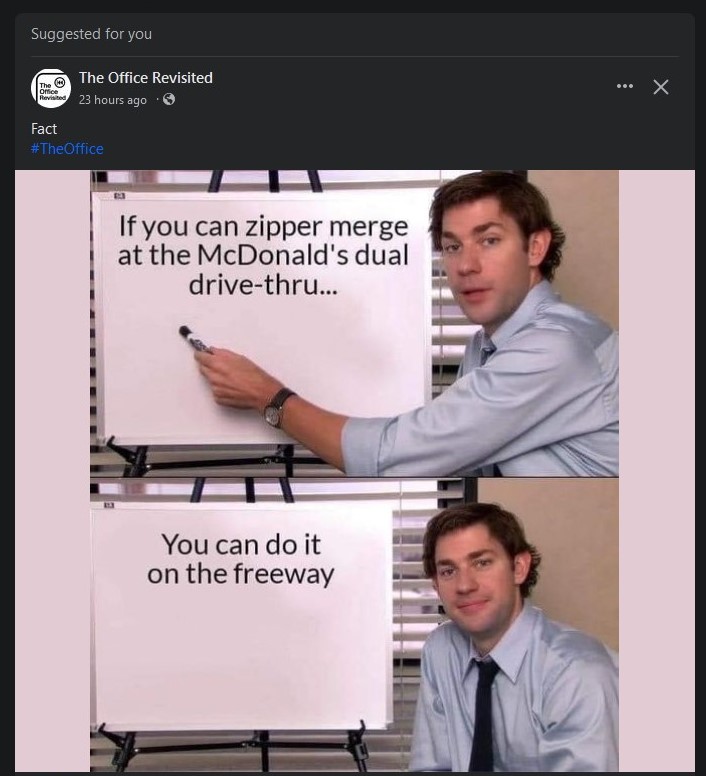
McDonald’s has several advantages in encouraging a smooth zipper merge process:
- A shorter runway to merging. You often go around a turn, order, and immediately merge. In contrast, highway merges can sometimes be seen from a mile or more away and some want to block all that space.
- A physical separation of the lanes before merging. The vehicles are ordering before merging and the need to have a display board and speaker means the lanes cannot be crossed into. Even if a driver wanted to block the other lane, the physical barriers make that difficult.
- People want to get their food. While driving on the highway, the goal is to get somewhere quickly. Different motivations.
- Might it matter that McDonald’s is private property while highways/roadways are more of open or public space?
Some of these principles could be applied to highways. Imagine temporary physical barriers between the lanes to force a merge closer to the end of the lanes. Or, reminders that blocking lanes has (legal?) consequences even though it is more public space.
 Legally Sociable