
When Americans decided on time zones in the late 1800s, where did they gather to formalize the boundaries and clocks? Chicago, a railroad center:
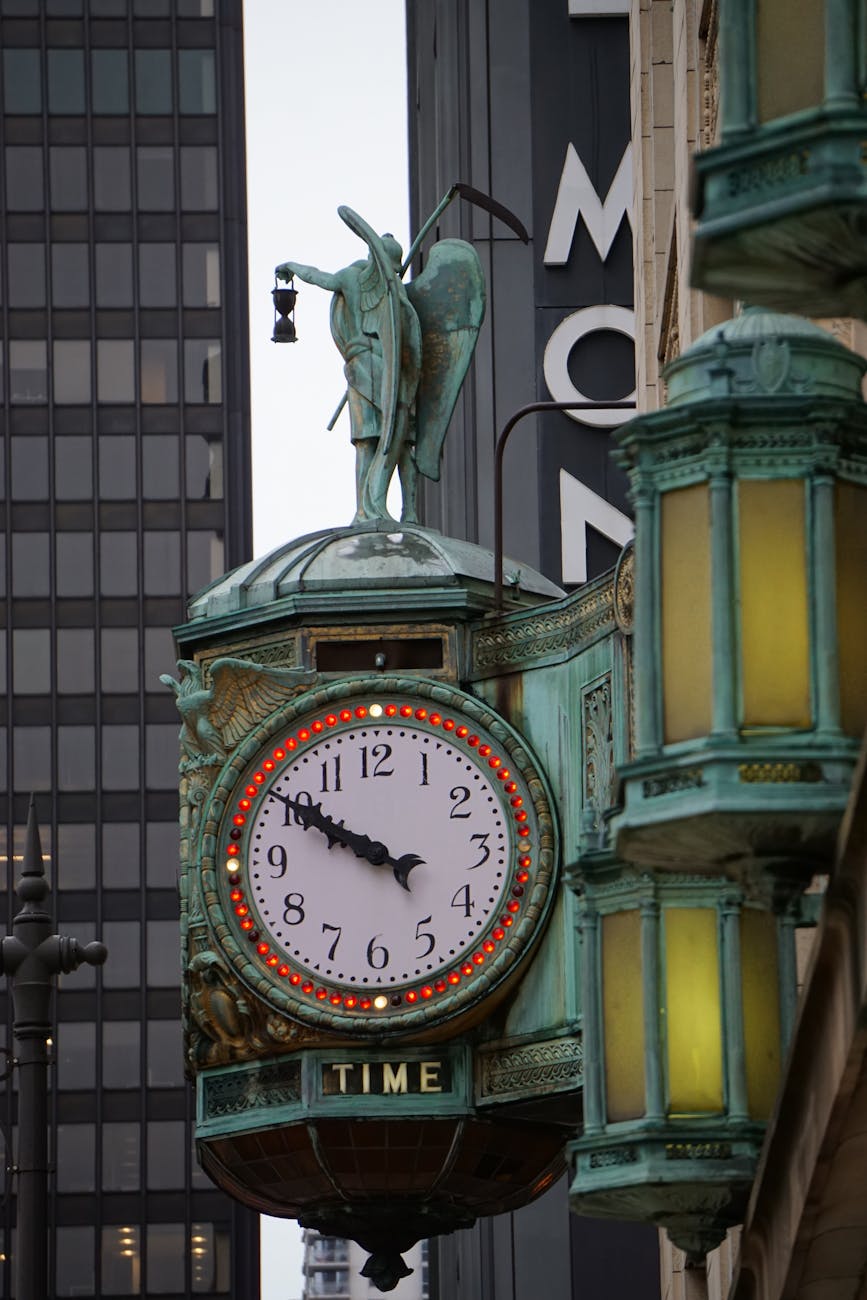
Until 1883, a Chicagoan asked to tell what time it was could give more than one answer and still be correct.
There was local time, determined by the position of the sun at high noon at a centrally located spot in town, usually City Hall. There was also railroad time, which put Columbus, Ohio, six minutes faster than Cincinnati and 19 minutes faster than Chicago. Scattered across the country were 100 different local time zones, and the railroads had some 53 zones of their own.
To do away with the inevitable confusion, the railroads took the matter into their own hands, holding a General Time Convention in the fall of 1883 at the Grand Pacific Hotel at LaSalle Street and Jackson Boulevard. (Today, a plaque at the location — which is just north of the Chicago Board of Trade Building — notes its significance).
Its purpose: to develop a better and more uniform system of railroad scheduling. The Standard Time System — based on the mean solar time at the central meridian of each time zone — was formally inaugurated on Nov. 18, 1883, a day that came to be known as the “Day of Two Noons.”
Another summary of the same story ended this way:
But it was an astonishingly rapid and successful shift, syncing up almost the entire country in the space of a week, with all roads leading back to Chicago.
Three interrelated features of Chicago stand out to me as contributing to being the place where time zones were agreed upon:
- A railroad center with numerous major railways running in and through the city and region.
- Business leaders, specifically railroad leaders, pushing for standard time zones in order to help their commercial activity. Chicago was a center for commerce and industry.
- The ease of getting in and out of Chicago – lots of railroads, central location in the United States – helped facilitate a meeting there.
These features of Chicago still hold today. The city continues to be a railroad center with lots of traffic throughout the region. It is still a business center, a leading global city. And it still serves as a transportation hub. Just as the railroad executives found it a good place to gather, see the number of important meetings that take place near O’Hare Airport, in the city, and throughout the region.
Might such a meeting in 1883 taken place elsewhere? Perhaps. If something as consequential as time zones were to be decided in 2025, which American city might we expect to host the discussion: the political center of Washington, D.C.? The leading global city of New York? The tech capital in San Francisco?
 Legally Sociable