
I worked at WETN 88.1 FM, Wheaton College’s radio station, for all four years as an undergraduate and for several years later as a faculty member. This is the start to a non-consecutive series of posts regarding the valuable lessons I learned while doing this. #1:
You are alone in a radio studio. You sit down in front of the mixing board and computer display. Various audio equipment surrounds you. You put on headphones, press a button to turn on the microphone, push the fader up, and start speaking.
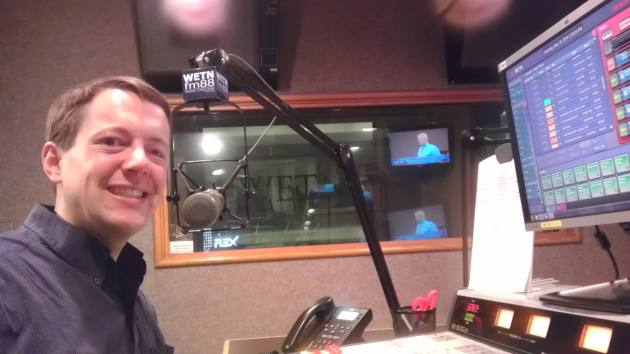
This is a common occurrence in a radio studio but it is an odd situation compared to most of life. Typically when you start talking there is a visible audience. You are talking to a friend or a family member or to a coworker. They can see you and you can see them.
One of the first things I learned as a first-year student in college at the college radio station was to talk into a microphone with an audience in mind but no one in front of you. No immediate reactions from people or a visible audience. You can hear yourself in your headphones but that is about it. You just have to keep going until your segment is over.
What does one say in such a situation? Can you carry on a conversation with yourself? Can you imagine who might be listening? It took time to feel comfortable doing this, to have a sense of what you could feel comfortable saying and how long it might take. Even if many people have experiences talking to themselves in their heads or out loud, it is a different experience doing it into a microphone for public consumption.
And it is a skill that I think has served me well. In comparison, such an experience makes talking in front of people look more attractive. They react. They are not imaginary. You get quick feedback regarding how what you are saying is landing. There might be opportunities for dialogue. If you can keep a conversation going with yourself, having material to work with in conversation often provides better opportunities.
I do not know how many hours I ended up talking by myself into a microphone. I did spend a lot of solo time in a basement on-air studio or recording for on-air and creating ads and promos in a recording studio. The on-air studio had a few methods for interacting with the outside world – a phone line that could also be placed on-air, the computer (AOL Instant Messenger and email in my early days), and the campus “Blanchard Cam” that showed outside conditions in front of our main building. A lot of time to figure out how to be comfortable with that microphone.
I also had enjoyable radio experiences with conversation partners. I co-hosted a talk show one academic year and we regularly invited guests for conversation. I read news on our morning show and had more off-the-cuff interactions with multiple hosts. I did play-by-play of football and soccer games with partners. Radio was not only a solitary experience but learning to talk alone was critical to the experience and for other areas of life.
 Legally Sociable