How to “win” at civilization (according to Civilization VII)

What does it look like for a civilization to “win”? The game Civilization VII has five paths to victory (with quoted descriptions from here):

Photo by Marco Alhelm on Pexels.com

-Domination: defeat all other civilizations.

-Scientific: “You must complete 3 Space Race Projects. After completing them all, you unlock the First Staffed Space Flight victory condition.”

-Cultural: “You must house 15 Artifacts in your empire. Completing this Legacy Path unlocks the World’s Fair victory condition.”

-Economic: “You must gain 500 Railroad Tycoon Points from manufacturing goods in your Factories. You gain points each turn for each Factory Resource slotted into a Settlement with a Factory and connected to your Rail and Port network. When this is completed, you unlock the World Bank victory condition.”

-Military: “You must gain 20 points from conquering Settlements. However, before you adopt an Ideology, conquered Settlements count as only one point. After adopting an Ideology, conquered Settlements count as two, and if you conquer Settlements from an opponent with a different Ideology from you, they count as 3. When this Legacy Path is completed, you unlock the Operation Ivy victory condition.”

What if people around the world were asked how their civilization or nation or people group might “win.” Would it be peace and collaboration? Would it be mobility and success for individuals? Would it be amassing military victories and territories?

Some of these are captured in the Civ 7 conditions and some are not. And what people across the world want in “winning” (and this language may strike many as strange) could differ quite a bit.

While this is just a new version of a game in a long-running series, this could easily move to a larger and important conversation: what are humans doing through their efforts? Don’t contexts strongly influence our desired goals (and how we regard the goals of other groups or civilizations)?

(Back to the game: across the various iterations over the years, I have spent time pursuing different victory paths. For example, if one wants to win via culture, they need to make numerous choices along the way that limit success along the other paths.)
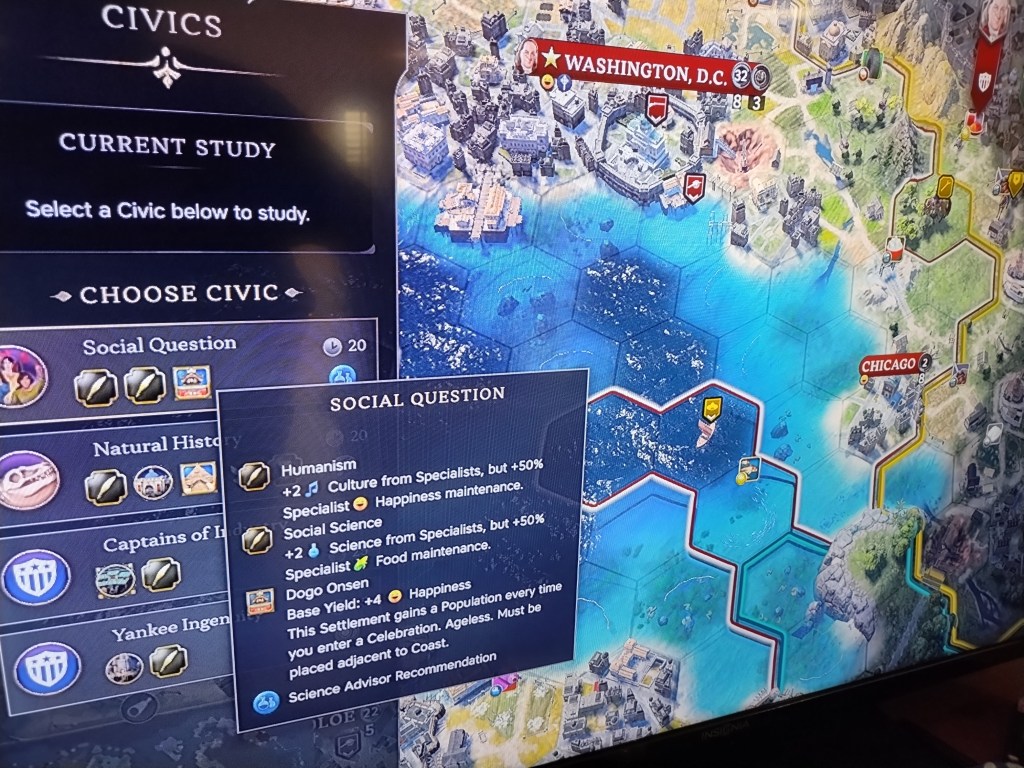
Researching social science in a video game

In Civilization VII, players can research and have the civic “Social Question.” Upon doing so, they gain the benefit of social science:

From a Civilization wiki regarding the Social Question:

Civic life in the 19th century was in a state of flux, as the old medieval order began to decay and former farmers flooded into the city. Under feudal arrangements, local lords were at least putatively responsible for the well-being of their subjects, but in the city, no such noblesse oblige existed: workers were alone to face exploitation, squalid living conditions and poverty – the profits and industry that drove the industrial revolution were directly dependent upon the exploitation of those working the machines. Perhaps more influentially, those with power could see directly the suffering of those around them.

This, then, raised the “social question:” what is to be done? Is there a sense of justice that the state must respond to, or is this a matter for churches and humanitarian organizations? Workers began to see themselves as a collective force, to whom some justice was owed. From here came a wide variety of responses: welfare, humanitarianism, socialism, etc., which had in common a notion that squalor and suffering were not a natural occurrence that extends from the soil, but something that society both caused and could remedy. It is a question with which we still contend today.

The start of sociology and other social sciences came around the same time as industrialization, urbanization, revolutions, the rise of the nation state, and rationality. I wonder how many players would see this civic as key to progressing through the game; does a society need to address this social question or can we just get on to other exciting features of modernity?

I may just have to report back on what happens when the civic Social Question is enabled and social science is possible. While I have logged many hours of playing Civilization II earlier in my life, I have little experience with more recent iterations of the game. As a sociologist, shouldn’t a robust social science sector lead to a civilizational victory?