The awesome ability to see Earth from above

I can only imagine what it feels like to see the Earth from truly far away. From the first person who walked on the moon:

It suddenly struck me that that tiny pea, pretty and blue, was the Earth. I put up my thumb and shut one eye, and my thumb blotted out the planet Earth. I didn’t feel like a giant. I felt very, very small

The closest I have come to that is a view like this:
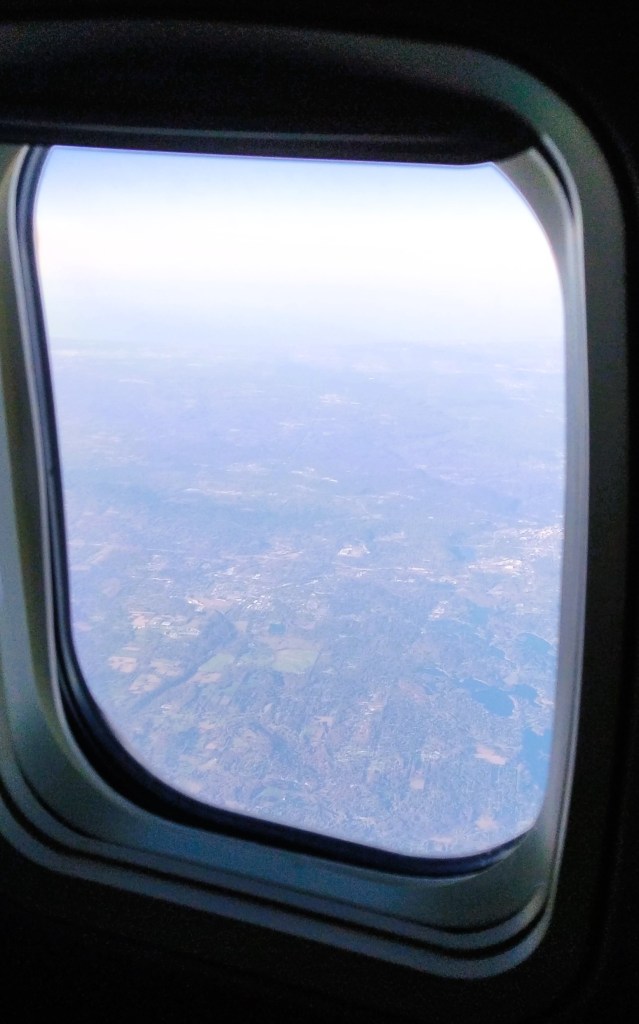
This was my view from an airplane window on a recent trip. The landscape is not particularly special (no big mountains, no big cities, no big bodies of water, etc.) nor is the sky or atmosphere particularly noteworthy (it was cloudless and in the afternoon).

Yet, I enjoy looking out the window every time. To be able to fly thousands of feet above the ground and see it from this angle is exciting. A map can provide an overview from an above perspective but this is not the same as looking at the landscape as it moves below you.

From the ground, planes look very small flying through the air. But the view from the plane makes the landscape as a whole look big as it trails off to the horizon. I do not think I could get tired of this perspective from above and adding it to the very human experiences we all have rooted firmly to the ground.
Finding the end of the airport

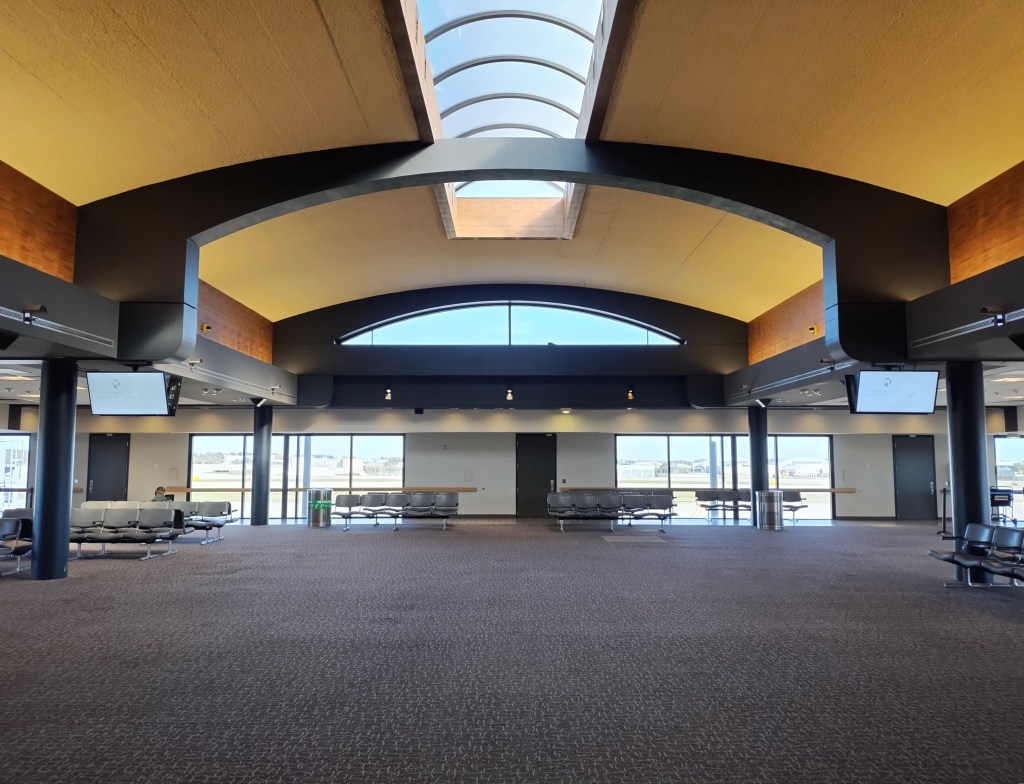
With time to spare on a recent trip, I walked all the way to the end of the airport:

This is both what I expected to find and not what I expected to find. On one hand, there are few spaces that look quite like an airport. The big open space surrounded by banks of chairs, a particular kind of carpet, and plenty of windows to see outside interspersed with a lot of doors no one can enter unless they are officially open.

On the other hand, there was no one at the end of the airport. Well, one person on the left taking advantage of the relative solitude. No planes waiting at this area and actually no used gates even near the end. This is not what I commonly see in the two Chicago airports where it seems the opposite issue is present: there are not enough gates for all the flights and airlines and some people have to wait on a tarmac.

Depending on your point of view, this might be an oasis or an opportunity or a waste of resources. Could this provide a refuge from the hustle of the airport near the center where all the concourses branch out? Could the airport do with fewer gates, thus leading to lower costs for maintenance and staff? Or might this lead to a future of more flights with room to grow? Is this space best experienced when filled with activity and travel?

Predicting more Thanksgiving traffic due to a closed car-to-plane gap?

One way to predict traffic on the roads at Thanksgiving is to look at the car-to-plane travel gap:

Drivers will make up about 89.5 percent of holiday travelers this year, a gain of 0.1 percentage point from 2013, while air passengers will drop by the same amount to 7.5, forecasts prepared by Englewood, Colorado-based IHS Inc. show. A 0.1 point increase may not seem like a lot, but based on last year’s estimate that 39.6 million people traveled by car for Thanksgiving, that would roughly equate to at least another 40,000 people piling onto America’s highways.

The car-over-plane travel choice is made easier by the fact that airfares aren’t coming down like gasoline pump prices are. While the plunge in oil has driven down wholesale jet fuel prices 17 percent since August, almost matching the 18 percent drop in retail gasoline, airfares have risen 3.4 percent over that time, data compiled by industry groups show…

“Right now the airlines aren’t in the sharing mood,” Rick Seaney, chief executive officer of the Dallas-based travel website FareCompare.com, said. “They just went through six years of multi-megamergers and dividing the country up by city with little or no competition, so they’ll pocket whatever difference they may get for a while.”

Gasoline’s drop will save the average U.S. driver about $500 annually, helping boost consumer spending, according to IHS. U.S. auto sales have risen 5.5 percent to 13.7 million in the first 10 months of 2014, on pace to be the strongest in eight years, Woodcliff Lake, New Jersey-based data provider Autodata Corp. said.

A few thoughts:

1. Having 40,000 more people on the roads at Thanksgiving is going to complicate traffic all across the United States? Spread these people cross hundreds of metropolitan areas and assume they aren’t all leaving at the same time (Wednesday after work) and adding that kind of volume may not matter much at all.

2. The prediction of future traffic is interesting to me. This reminds me of Carmageddon fears, first in Los Angeles (twice) and then in Chicago earlier this year. This seems like the creation of news: get prepared for more Thanksgiving traffic now! It is the kind of fear-based reporting done by many local news outlets about things like weather or traffic, fairly mundane events that occasionally turn out to be horrible.

3. The Carmageddon cases hint at another piece of this prediction: making such claims could change future behavior. If Americans hear that there will be more drivers at Thanksgiving, even just a few of them changing their plans (not driving or changing their departure times) might go a long ways toward relieving the predicted traffic. Perhaps this forecast is all part of some plan to actually reduce Thanksgiving traffic?

4. Just from personal observation: plane tickets appear to be really high during Thanksgiving, Christmas, and New Year’s this year. As the article notes, airlines are looking to make money and haven’t budged much in their prices even with the recent gas price drops.


A world where people can travel between any two cities in two hours

Basic modes of transportation have not changed much in the last half-century. Sure, planes are bigger, cars are more fuel efficient and have more features/gadgets, and trains can go faster. But harnessing space travel could make it possible to move between any two cities in the world in two hours:

Michiel Mol, 42, a Dutchman who co-owns the Force India Formula One team and made his fortune in computer software, said over the weekend, “Being able to travel from London to Sydney in an hour and 45 minutes, that is the future. It is also the reason why KLM joined our firm [Space Expedition Curacao, or SXC] as a partner.”…

Mol intends to follow [Sir Richard Branson] in early 2014 and says he has already sold 35 tickets at $93,000 for flights from the Caribbean island of Curacao. Regulatory approval is still under negotiation…
Passengers, who will be entitled to call themselves astronauts if they reach an altitude of 62 miles (100km), will be required to pass physical tests which he says are no more stringent than would be expected of an air steward. The first generation spaceship will travel at 2,200mph (3,540kph), but the second generation will need to reach a velocity of 13,750mph (22,100kph) to achieve the desired orbit…
“Flying from London to Barcelona would still take an hour or so while London to Tokyo would be about one hour and 30 minutes and London to Sydney, one hour and 45 minutes. “

This sounds like something different than just space tourism where wealthy people take off, float weightless for a short while, snap some pictures of the earth while in a quick orbit, and then descend. This could be the basis for a new transportation system that makes traveling from New York to China just like a drive from Chicago to Milwaukee. It would take some time to set up a viable system, to put the infrastructure together, but this would be a big step forward from the Dreamliner and high-speed rail.

Is this the physical answer to the “instant” connectedness of the Internet? Currently, it still takes a decent amount of time to travel between major cities but it is still valuable for business, politics, and deeper relationships.

Beyond space commuting, what could be quicker? A mass-produced flying car? Teleporting?

The importance of perceptions: thinking about the golden age of flying

There seems to be a lot of grousing about air travel these days, particularly with a flood of recent stories about full-body scanners and more aggressive pat-downs. These complaints raise a question: is flying today more troublesome and less glamorous than in the past? Some experts say today is actually the golden age for flying:

Whether it’s fees, crowded planes, no food or surly service, people will complain about the current state of air travel.

They’ll talk wistfully about the good old days of flying, of a bygone era when a glamorous stewardess delivered white-glove service with a smile, they had meals with real silverware and a courtesy cocktail was offered free on such carriers as Pan Am, TWA, Braniff or Eastern.

The so-called golden age of air travel in the 1950s, ’60s and ’70s has passed, they’ll say, just as those airlines have.

But has it? No, say some veteran fliers and industry analysts. With historically affordable fares to nearly everywhere, greater options for service if you’re willing to pay, and new information and entertainment technology, there’s never been a better time to fly, they say.

So some experts that suggest by some objective measures, such as price and service level, flying is now better than it was in the past. But the issue really seems to be whether passengers feel that this is the case. And this is what matters for airlines – if potential customers perceive that flying is difficult and then choose other forms of travel, these perceptions are real indeed.

What could be going on here? A few thoughts:

1. Memories and nostalgia are tricky things. People can romanticize the past and forget the troubles they experienced then.

2. Some of the security procedures instituted after 9/11 seem to irritate people. It adds an extra level of hassle and can make people feel like they are not trusted. On the other hand, there has not been a major airline incident in the US since 9/11.

3. Service and entertainment options may have increased but perhaps passengers expect even more. Does having more entertainment options offset sitting in cramped airplane seats?

4. I would be curious to know how many people actually enjoy flying versus feeling that it is the best, or perhaps only, transportation option to get them where they want to go.

h/t The Infrastructurist

Graphing flight delays by airport and airline

The Infrastructurist displays a great graphic that summarizes flight delays at major US airports. A quick interpretation: be prepared to be behind when traveling to New York, San Francisco, and Philadelphia or when flying on Northwest, JetBlue, AirTran, and American.