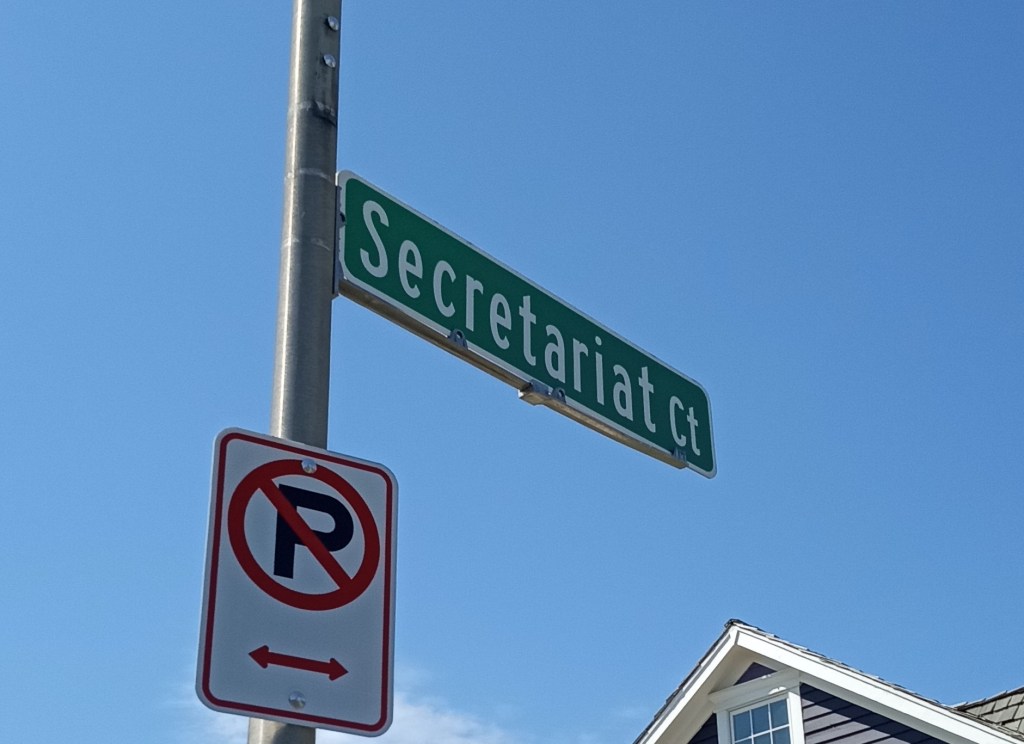
I recently had a reason to drive by the nearest roadway named after Secretariat:
This is a short roadway. True to being a “court,” it is a cul-de-sac with roughly seven houses along it. According to Google Maps, it is about 250 feet long.
When I wrote about this one month ago, I had this road in mind. Did the name transform the surroundings and/or elevate the late 1980s suburban neighborhood due to the prestigious athlete? Not particularly. Is it a unique name? Yes, but one shared by over 200 other locations in the United States.
Perhaps the biggest difference between this specific street and those nearby is that it is a recognizable or more unique name. For example, here are some of the more anonymous streets within a mile or so in sprawling suburbia: George Street, Jeffrey Court, Hamilton Drive, Rose Court, and Christina Circle. These might be named after specific people but it is hard to know decades later.
Secretariat lives on in this suburb in a way that LeBron James or Tom Brady or other people in the running for the best in their sports probably never will.
But perhaps nothing drives home the impact of Secretariat’s life more than looking at a map. Like, any map. We know because we’ve looked at them. All of them. In an effort to identify roads in the U.S. named for athletes, ESPN cross-referenced 2010 Census data with Google Maps. We were stunned to uncover 263 roads named after the horse — far more than for any other athlete, human or otherwise. “I’m not that surprised,” says Kate Chenery Tweedy, whose mother, Penny, raised and owned Secretariat. “Secretariat came along at a time of great crisis in this country — Watergate, the Vietnam War, Nixon’s impeachment. And unlike any other athlete ever has, he restored our sense that there is beauty and good in the world.”…
Born in Virginia. Won Triple Crown races in Kentucky, Maryland and New York. So it makes perfect sense that the states with the most Secretariat streets are … Florida and Texas?…
Road experts say there is little rhyme or reason to the way our streets get their names. It’s mostly just real estate developers who submit names to their town, there’s usually a relatively easy approval process, and voilà. Case in point: Somebody in Butte, Alaska, sure likes horse racing. You can take Sea Biscuit Lane to E. Man o’ War Drive, then hang a right onto E. Secretariat Drive — the most northerly road named for Secretariat. And if you wanted to ride Secretariat the 3,920 miles back to his burial site? At the record 37.8 mph he ran the Belmont in, he’d have gotten you there in a little over four days.
As someone who studies suburbs, here is my own theory for this naming pattern. Developers often want names for nicer subdivisions connected to tradition, certain lifestyles, and success. Why not reference both horse racing and one of the most successful horses ever? Horse racing requires money to participate and the audience for horse racing might fit particular demographics. Additionally, horse racing hints at nature. Secretariat is a well-known athlete. Such names will help establish their subdivision as an exciting place for people with means.
My own community has at least a few street names that connect to horse racing. This is not just a connection to racing in the abstract; our suburb has links to horse racing near these sites with a racetrack that was in existence in the early 1900s and another farm with wealthy owners who bred and raced horses in the second half of the twentieth century.
By linking single-family homes to horses and one of the most famous American athletes, how can a developer go wrong?
“At one point we had a transportation system that had horses,” said Penn State University geologist Richard Alley. “And the horses made horse ploppies. If our CO2 came out of the car as horse ploppies, it would sort of be a pound per mile. And if you put that on the roads of America, in a year it would average an inch deep. And as I like to say, we would have no more joggers in America. We’ll all be cross-country skiers.”
I have read several accounts by urban historians who have described just how much horse manure was in the streets of major cities in earlier centuries. The smell. The sight. The need for people to clean it up. In comparison to roads in past eras, our streets are clean: free of garbage and waste, typically only for fast-moving vehicles.
But, having a car makes that carbon dioxide emission less visible. The average driver doesn’t really see anything and the waste produced by individual vehicles are dwarfed by large facilities like factories or power plants. Of course, add up all the cars and vehicles in the United States and it is a sizable output. See some of the pictures of Los Angeles on days of major smog.
Thus, the analogy might be useful to remember. Although we wouldn’t stand for horse ploppies on our streets today, our vehicles emit carbon dioxide whether we regularly see it.
Horses killed in other, more direct ways as well. As difficult as it may be to believe given their low speeds, horse-drawn vehicles were far deadlier than their modern counterparts. In New York in 1900, 200 persons were killed by horses and horse-drawn vehicles. This contrasts with 344 auto-related fatalities in New York in 2003; given the modern city’s greater population, this means the fatality rate per capita in the horse era was roughly 75 percent higher than today. Data from Chicago show that in 1916 there were 16.9 horse-related fatalities for each 10,000 horse-drawn vehicles; this is nearly seven times the city’s fatality rate per auto in 1997.
Of course, as the article notes, there were other issues with having thousands of horses on the street each day.
I’ve written before about the risks of driving today, particularly compared to other behaviors which many might think are more dangerous but are not. Yet, these figures are a reminder that we are safer today on the city streets, at least while driving something in the streets, than in the past. It may not seem to be true but I suspect this has more to do with how much we hear about accidents (and crime) more than the actual reality of how dangerous it is.


 Legally Sociable