
Not many takers of money available to Cook County suburbs to help migrants

Money is available to suburban communities in Cook County to help migrants. Only two have applied for it:

Photo by Pixabay on Pexels.com

As of now, only Oak Park and Ford Heights applied for the fund Cook County created last fall. The lack of effort is frustrating some non-profit leaders who see the need in their communities…

The Cook County Board created a $100 million disaster response and recovery fund last fall, and of that $20 million was earmarked for suburbs if they wanted to play a bigger role in helping migrants. The money can be used for a variety of services, from shelter and short-term rental assistance to helping migrants enroll their children in school or apply for public benefits, according to the application.

Suburbs can pass the money through to other organizations, such as non-profits or community health centers…

She has her theories about why suburbs aren’t applying for the county’s big pot of money. She points to Joliet Township, which was awarded money from the state, then didn’t take it after blowback from residents

But some suburbs are frank about why there’s been little interest — they say they’re already overwhelmed by their existing needs. In west suburban Forest Park, Mayor Rory Hoskins said he already has a lot on his plate. His community is the last stop on the CTA’s Blue Line. He said his small fire department is stretched thin responding to mental health calls, overdoses and assaults.

This is not surprising given the lack of interest suburban communities have shown in having migrants in the community beyond a drop-off and train trip to Chicago. In other words, local officials are likely worried about what residents will say if they take the money. This could lead to them being voted out of office.

Another way to think about this is what incentives would prompt a suburb to provide help to migrants. Is there a dollar amount? Some sort of special project or program could be brought to the community?

It would be interesting if similar funds were made available throughout the Chicago region. How many suburbs would accept money? More than five?

“There are no known organized efforts in the suburbs for residents to take in asylum-seekers.”

As municipalities in the Chicago region develop regulations to limit migrants from staying in their communities, one local leader wonders if residents would house migrants in their homes:

Photo by khairul nizam on Pexels.com

McBroom said Naperville has provided migrants safe passage to Chicago without spending taxpayer dollars to house or aid them.

But with more migrants arriving in the area, McBroom says the city should look into whether any residents or organizations are willing to help.

“My idea would be let’s find out … let’s find out who’s willing to help,” he said, adding that Naperville is an affluent community with many large homes. “If there are people who would do that, God bless them.”

There are no known organized efforts in the suburbs for residents to take in asylum-seekers…

Meanwhile, McBroom acknowledges there are many unanswered questions about his idea to have Naperville residents voluntarily house migrants. Some of those include the impact the proposal may have on local schools and what role the city would play in managing a list of volunteer hosts.

Thus far, few communities have indicated much interest in helping migrants find opportunities in the suburbs. I have only seen efforts in this direction from Oak Park. Most communities in the news have been developing regulations so that migrants do not stay and/or they are making sure migrants dropped at suburban train stations make their way to Chicago.

This idea has the potential to bypass community-level initiatives and instead coordinate efforts of residents and property owners. How much space might be available in homes and buildings in a suburb with nearly 150,000 residents? How many people would volunteer?

I could only imagine what might happen among (1) neighbors of people who are willing to house migrants and (2) if names and addresses of individual hosts became known to the public.

We will see where this goes, but I imagine it would not go too far if there is the possibility of state money available to communities in the near future.

The formula to resettle refugees in European countries

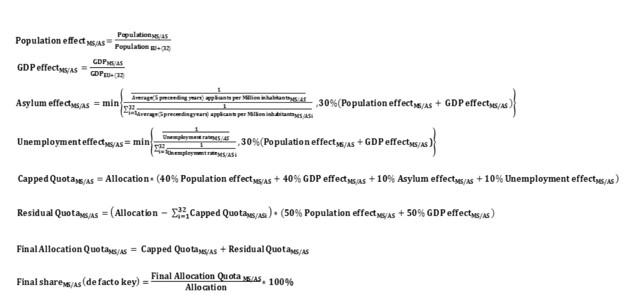
How will refugees be dispersed among European countries? This formula:

On Wednesday, shortly after European Commission President Jean-Claude Juncker announced a new plan to distribute 120,000 asylum-seekers currently in Greece, Hungary, and Italy among the EU’s 28 member states, Duncan Robinson of the Financial Times tweeted a series of grainy equations from the annex of a proposed European regulation, which establishes a mechanism for relocating asylum-seekers during emergency situations beyond today’s acute crisis. Robinson’s message: “So, how do they decide how many refugees each country should receive? ‘Well, it’s very simple…’”

In an FAQ posted on Wednesday, the European Commission expanded on the thinking behind the elaborate math. Under the proposed plan, if the Commission determines at some point in the future that there is a refugee crisis in a given country (as there is today in Greece, Hungary, and Italy, the countries migrants reach first upon arriving in Europe), it will set a number for how many refugees in that country should be relocated throughout the EU. That number will be “not higher than 40% of the number of [asylum] applications made [in that country] in the past six months.”…

What’s most striking to me is the contrast between the sigmas and subscripts in the refugee formula—the inhumanity of technocratic compromise by mathematical equation—and the raw, tragic, heroic humanity on display in recent coverage of the refugees from Syria, Afghanistan, Eritrea, and elsewhere who are pouring into Europe.

The writer hints at the end here that the bureaucratic formula and stories of human lives at stake are incompatible. How could we translate people who need help into cold, impersonal numbers? This is a common claim: statistics take away human stories and dignity. They are unfeeling. They can’t sum the experiences of individuals. One online quote sums this up: “Statistics are human beings with the tears wiped off.

Yet, we need both the stories and the numbers to truly address the situation. Individual stories are important and interesting. Tragic cases tend to draw people’s attention, particularly if presented in attractive ways. But, it is difficult to convey all the stories of the refugees and migrants. Where would they be told and who would sit through them all? The statistics and formulas help give us the big picture. Just how many refugees are there? (Imagine a situation where there are only 10 refugees but with very compelling stories. Would this compel nations to act.) How can they be slotted into existing countries and systems?

On top of that, you can’t really have the nations of today without bureaucracies. We might not like that they are slow moving or inefficient at times or can be overwhelming. How can you run a major social system without a bureaucratic structure? Would we like to go to a hospital that was not a bureaucracy? How do you keep millions of citizens in a country moving in a similar direction? Decentralization or non-hierarchical systems can only go so far in addressing major tasks.

With that said, the formula looks complicated but the explanation in the text is fairly easy to understand: there are a set of weighted factors that dictate how many refugees will be assigned to each country.