
Did Norman Lear change American culture through the television shows he created? Here is one headline hinting at this:
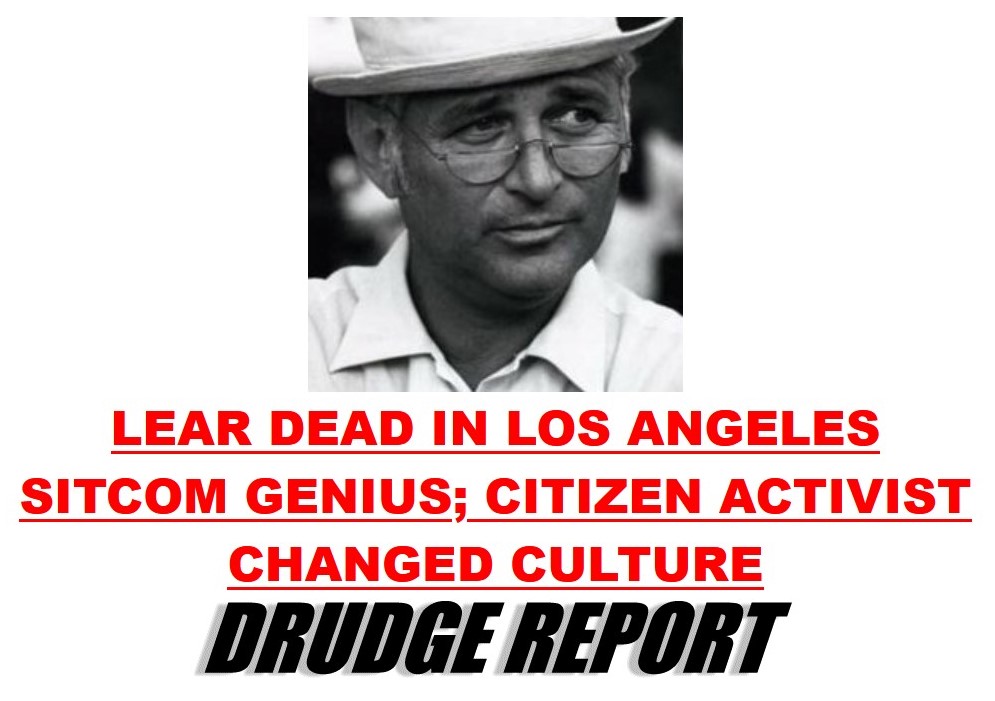
From the linked article, here are some of the ways Lear was influential:
Lear had already established himself as a top comedy writer and captured a 1968 Oscar nomination for his screenplay for “Divorce American Style” when he concocted the idea for a new sitcom, based on a popular British show, about a conservative, outspokenly bigoted working-class man and his fractious Queens family. “All in the Family” became an immediate hit, seemingly with viewers of all political persuasions.
Lear’s shows were the first to address the serious political, cultural and social flashpoints of the day – racism, abortion, homosexuality, the Vietnam war — by working pointed new wrinkles into the standard domestic comedy formula. No subject was taboo: Two 1977 episodes of “All in the Family” revolved around the attempted rape of lead character Archie Bunker’s wife Edith.
Their fresh outrageousness turned them into huge ratings successes: For a time, “Family” and “Sanford,” based around a Los Angeles Black family, ranked No. 1 and No. 2 in the country. “All in the Family” itself accounted for no less than six spin-offs. “Family” was also honored with four Emmys in 1971-73 and a 1977 Peabody Award for Lear, “for giving us comedy with a social conscience.” (He received a second Peabody in 2016 for his career achievements.)
Some of Lear’s other creations played with TV conventions. “One Day at a Time” (1975-84) featured a single mother of two young girls as its protagonist, a new concept for a sitcom. Similarly, “Diff’rent Strokes” (1978-86) followed the growing pains of two Black kids adopted by a wealthy white businessman.
Other series developed by Lear were meta before the term ever existed. “Mary Hartman, Mary Hartman” (1976-77) spoofed the contorted drama of daytime soaps; while the show couldn’t land a network slot, it became a beloved off-the-wall entry in syndication. “Hartman” had its own oddball spinoff, “Fernwood 2 Night,” a parody talk show set in a small Ohio town; the show was later retooled as “America 2-Night,” with its setting relocated to Los Angeles…
One of Hollywood’s most outspoken liberals and progressive philanthropists, Lear founded the advocacy group People for the American Way in 1981 to counteract the activities of the conservative Moral Majority.
The emphasis here is on both television and politics. Lear created different kinds of shows that proved popular as they promoted particular ideas. He also was politically active for progressive causes.
How might we know that these TV shows created cultural change? Just a few ways this could be established:
-How influential were these shows to later shows and cultural products? How did television shows look before and after Lear’s work?
-Ratings: how many people watched?
-Critical acclaim: what did critics think? What did his peers within the industry think? How do these shows stand up over time?
But, the question I might want to ask is whether we know how the people who watched these shows – millions of Americans – were or were not changed by these minutes and hours spent in front of the television. Americans take in a lot of television and media over their lifetime. This certainly has an influence in the aggregate. Do we have data and/or evidence that can link these shows to changed attitudes and actions? My sense is that is easier to see broad changes over time but harder to show more directly that specific media products led to particular outcomes at the individual (and sometimes also at the social) level.
These are research methodology questions that could involve lots of cultural products. The headline above might be supportable but it could require putting together multiple pieces of evidence and not having all the data we could have.
 Legally Sociable