Who is moving to cities? Young, educated, wealthy, childless, white

Certain people – not everyone – are moving to American cities:

Americans aren’t moving back to the cities. Just 20- and 30-somethings.

But actually, not all 20- and 30-somethings are moving back to the cities. Only those with a four-year college degree and incomes in the top 40 percent are.

And not even all 20- and 30-somethings with a four-year college degree and incomes in the top 40 percent are moving back into cities. Mostly the ones without school-age kids are.

And if you thought that was it, it turns out that not all 20- and 30-somethings with a four-year college degree in the top 40 percent of income without school-age children are moving back into cities. It’s mostly just the ones that are white.

And does this group receive disproportionate attention from (1) city leaders who want a new generation of wealthy city residents and (2) the media who may identify well with these particular demographics? If the people moving to cities did not share these traits (such as immigrants), would they get as much attention?

Thompson also suggests geographic segregation by class: the wealthiest clustering in the densest cities with everyone else setting for suburbia. It has been this way for a while…

Real estate agents and steering today

Many real estate agents today won’t answer certain questions but does this eliminate steering?

Agents such as Foster and Thakkar are hypersensitive because they don’t want to run afoul of the Fair Housing Act, which prohibits discrimination on the basis of race, color, religion, gender, national origin, familial status, disability or handicap. The law is administered by the Department of Housing and Urban Development. Penalties for violating fair housing rules can be costly, so many real estate brokerage firms train agents on what constitutes “steering” of homebuyer clients as well as what could be interpreted as showing any form of bias against any “protected class.”

What can agents do when clients ask certain questions? Here are several of the examples provided:

“We can’t answer,” Foster said. “It’s all too subjective.” Instead, she refers them to online information sources about whatever they’re asking — websites that rate schools, statistical compilations on crime rates and the like…

“It’s a very common question,” he says: “Can you tell us how many other Indian families live on this street?” Even though he thinks he understands the thrust of the question — are there people like us around? — he declines to answer directly. Instead, he supplies them a list of the names of current owners on the street, allowing his clients to decide for themselves whether the names indicate that they are Indian or not.

Referring people to other sources may lead to issues:

But some fair housing advocates are concerned that the online information available today may actually enable a subtle form of racial steering when agents name specific sites that offer highly localized racial and ethnic breakdowns and refer clients to them. Lisa Rice, executive vice president of the National Fair Housing Alliance, a nonprofit group that has fielded teams of white and minority “testers” to detect bias in homes sales, thinks that in the event of fair housing complaints against those agents, the fact that they made such specific referrals could be held against them.

It seems to me that one of the best ways to eliminate this issue is to educate homeowners about all the potential information they can access. Stop them from asking in the first place. Realtors could even make this clear at the beginning. The Internet certainly presents a lot of available information to possible home buyers ranging from the Census to other data aggregators to message boards to municipal websites. In other words, it is not hard to find out this sort of information. Yet, this would go against the argument that realtors make about why they are still necessary: they have inside information about the home and the entire process. Additionally, all the online information is not necessarily easy to interpret. Say a homeowner is interested in future property values: can they make a prediction based on what is online? Or, say that an online message board suggests one thing is happening while the local newspaper claim something else is taking place. How could someone unfamiliar with the area make a judgment regarding conflicting information?

In the long run, if people want to fight residential segregation and housing discrimination (which are legitimate concerns), would it be better to remove real estate agents from the process or not?

Some NJ suburbanites not happy with Orthodox influx

The New Jersey suburb of Toms River is up in arms regarding numerous Orthodox families moving in:

These days, though, most homeowners draw the blinds, retreating from brushes with a fast-growing Orthodox Jewish community that’s trying to turn a swath of suburban luxury 10 miles (16 kilometers) from Atlantic beaches into an insular enclave. The rub, a township inquiry found, is “highly annoying, suspicious and creepy” tactics used by some real-estate agents…

“It’s like an invasion,” said Thomas Kelaher, Toms River’s three-term mayor, who’s fielded complaints from the North Dover section since mid-2015. “It’s the old throwback to the 1960s, when blockbusting happened in Philadelphia and Chicago with the African-American community — ‘I want to buy your house. You’ll be sorry if you don’t.’ It scares the hell out of people.”

The upset has its roots in adjacent Lakewood, home to yeshivas including Beth Medrash Govoha, among the world’s biggest centers for Talmudic study. Scholars typically marry young and start large families that maintain strict gender roles and limit interaction with secular society…

The opposition, he said, has nothing to do with dislike of Jews, but with a fear that Toms River will become like Lakewood’s more tattered sections, with cars parked on lawns, overgrown landscaping, trash piled at curbs and residents crowding single-family homes.

As the article notes, this sounds similar to the tactics employed against different racial and ethnic groups in the first half of the 20th century: fear, worries about changing the character of the community and providing new social services, enforcing zoning laws, pushy slash creepy real estate agents, the potential for declining property values. Yet, this story hints that residential segregation is alive and well. Even though Americans regularly talk about the geographic mobility everyone can access, it doesn’t quite work this way as existing residents can be resistant to change and different racial and ethnic groups tend to cluster not just in cities but also in suburbs.

Predicting resegregation in 35% of metro area neighborhoods

A new study looks at the possibility of numerous metropolitan neighborhoods becoming less diverse in the coming decades:

Neighborhood integration is a great goal, but just because a place is currently home to more than one race doesn’t mean it will retain this diversity in the decades to come. A new study published in Sociological Science explores this potential future for New York, Chicago, Los Angeles, and Houston. It finds that 35 percent of all neighborhoods in these cities—around 3,800 total—are likely to resegregate in the next two decades…

Bader’s analysis predicts that, in the next two decades, many of the neighborhoods in the pale green (“steady black succession”), navy blue (“Latino enclaves”), royal blue (“early Latino growth, white decline”), teal (“early Latino growth, black decline”), sky blue (“recent Latino growth”), and pink (Asian growth) categories are the ones where a single racial group will become dominant over time. Here’s Bader on that process, again via the study website:

“We were disappointed to learn that many integrated neighborhoods were actually experiencing slow, but steady resegregation — a process that we call “gradual succession.” The process tended to concentrate Blacks into small areas of cities and inner-ring suburbs while scattering many Latinos and Asians into segregating neighborhoods throughout the metropolitan area.

Meanwhile, the fuchsia “quadrivial” neighborhoods, located in the suburbs like Aliso Viejo, California, and Naperville, Illinois, are likely to retain their diversity for some time. (Of course, as my colleague Amanda Kolson Hurley has noted, in general, diverse suburbs aren’t immune to the threat of resegregation.) Despite fair housing and civil rights legislations, housing discrimination is an ongoing problem with multigenerational effects—and one of the possible reasons behind the trends Bader has highlighted in the study. Another is the tendency of white Americans to self-segregate.

Given the complexity of race and ethnicity in the United States plus its regular manifestation in residential patterns, this makes sense. Just because certain locations were once diverse doesn’t mean they will remain so in the future. City neighborhoods provide plenty of examples of this, whether looking at places that have had waves of immigrant groups or other locations where blacks moved in and whites never returned. And that these patterns will be reproduced across suburban areas has already been happening for decades.

What seems to be new here is the possibility of predicting these changes. If a suburban community knew that demographic change was likely, would they do things differently? Or, how about a city neighborhood that had a particular character and identity? Now that there are scholars out there working on this, might the research itself have an effect on future population changes?

Recovery best in wealthiest zip codes

A new analysis looks at the recovery of the US economy by zip codes and finds that the wealthiest areas have rebounded the most:

The report found that for the bottom fifth of U.S. zip codes—which the researchers term “distressed”—the medium income only reaches 68 percent of the state-wide median and 27 percent of adults live in poverty. These communities saw employment decline by 6.7 percent during the recovery. Not the recession—the recovery. In the nation’s median and prosperous zip codes, the situation is much brighter. Employment in median zip codes rose by 2.3 percent, while in prosperous communities—the top fifth of U.S. zip codes—employment rose by an incredible 17.4 percent.

EIG’s analysis supports the notion that in the U.S. economic gains continue to be captured by those at the top. “The data outlines two different Americas from an economic standpoint,” said Steve Glickman, the co-founder and executive director of EIG. “The communities taking advantage of the knowledge economy are booming, but the areas where the industrial economy has traditionally held firmest have really suffered. These trends predate the Great Recession, but the recovery has continued to accelerate the fortunes of the most-prosperous areas and the downturn of the most distressed.”

Another piece of evidence to add to plenty of existing material: where people live has a large effect on their lives. And if the United States has persistent residential segregation – particularly by race but also by social class – then these differences by geography will continue to be pertinent.

Can’t ignore race when discussing poverty in America

Ta-Nehisi Coates cites several sociologists in making the argument that white and black poverty is different in the United States:

In its pervasiveness, concentration, and reach across class lines, black poverty proves itself to be “fundamentally distinct” from white poverty. It would be much more convenient for everyone on the left if this were not true—that is to say if neighborhood poverty, if systemic poverty, menaced all communities equally. In such a world, one would only need to craft universalist solutions for universal problems…This chart by sociologist Patrick Sharkey quantifies the degree to which neighborhood poverty afflicts black and white families. Sociologists like Sharkey typically define a neighborhood with a poverty rate greater than 20 percent as “high poverty.” The majority of black people in this country (56 percent) live in high-poverty neighborhoods. The vast majority of whites (94 percent) do not. The effects of this should concern anyone who believes in a universalist solution to a particular affliction…

But the “fundamental differences” between black communities and white communities do not end with poverty or social mobility.

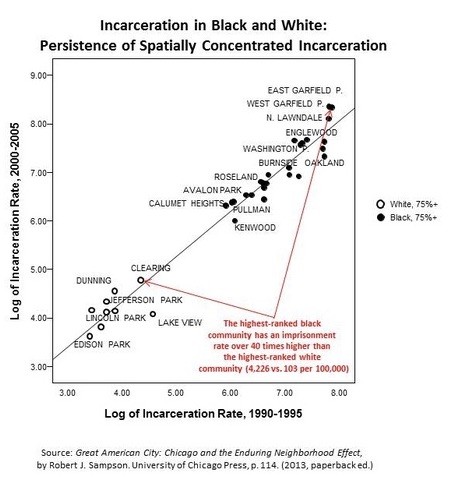
In the chart above, Sampson plotted the the incarceration rate in Chicago from the onset imprisonment boom to its height. As Sampson notes, the incarceration rate in the most afflicted black neighborhood is 40 times worse than the incarceration rate in the most afflicted white neighborhood. But more tellingly for our purposes, incarceration rates for white neighborhoods bunch at the lower end, while incarceration rates for black neighborhoods bunch at the higher end. There is no gradation, nor overlap between the two. It is almost as if, from the perspective of mass incarceration, black and white people—regardless of neighborhood—inhabit two “fundamentally distinct”worlds.

Coates might also cite Massey and Denton’s classic American Apartheid that convincingly shows residential segregation between whites and blacks is of a different magnitude than residential segregation between other groups. Additionally, there is evidence that whites and blacks with equal characteristics are not treated equally (see a number of audit studies involving mortgages, renting, car loans, and jobs) and even that blacks who are wealthier than whites do not have access to the same opportunities. Ultimately, Coates uses these sociological findings to argue policies intended to float all lower-class boats won’t really work because they ignore the fundamental differences between black and white poverty.

Put another way, given America’s history perhaps we should require scholars and policy makers to show that race doesn’t matter in the issue they are addressing rather than the other way around.

Urban residential segregation continues to decline

Analysis of recent Census data suggests residential segregation is decreasing in many cities:

Between 2000 and 2014, segregation between blacks and whites declined in almost all of the nation’s 53 metropolitan areas with a population of over a million, the analysis shows.

Some of the biggest declines occurred in cities long divided by race, including Detroit and Chicago, but the progress was more modest in New York and Los Angeles, the nation’s two largest metropolitan areas…

But the migration into suburbs isn’t the whole story. Detroit and Kansas City, Mo., for instance, had the two biggest gains in integration, but while the change in Kansas City came from a large movement of blacks from the central city to the suburbs, the drop in Detroit’s segregation level reflected many blacks leaving the region entirely, said John Logan, a sociologist at Brown University who studies residential diversity.

Logan attributed most of the decline in segregation to what he called the phenomenon of “global neighborhoods” — areas that were once all white where blacks have moved into, typically after Latinos, sometimes along with Asians, had integrated the neighborhood.

Three quick thoughts:

  1. This is a reminder that the effects of race and ethnicity on neighborhoods and communities has changed in recent decades from a strong white-black divide to a more mixed movement of people.
  2. On the other side, even with the spreading out of Latinos and Asians, there are persistent divides between blacks and whites. In other words, we cannot point to many (any?) neighborhoods that have gone from black to white though some black neighborhoods have become less black.
  3. It is interesting to monitor these changes over time but I would be interested to know what the “desirable” desegregation numbers are. For example, the dissimilarity index suggests what percent of the minority group would need to move to be spread out throughout a region. Do sociologists expect the dissimilarity index to hit 0 or is there a threshold that would be good for society and the groups involved?

The effects of residential segregation on kids

Sociologist Carla Shedd describes some of her findings about what children in segregated neighborhoods learn about the world:

I’m looking at young people in a very similar predicament, and their vantage point is outside their window. I interviewed one kid and asked, “What do you think about police in your neighborhood?” He said, “I think they’re fair. When I look outside my window I see black gangbangers, I see people doing things they shouldn’t be doing.” Whereas the kids who move across these boundaries of race and geography, they’re saying, “Wow, the police downtown, they wave at people and give the thumbs up. They don’t do that to me. They actually go in the shops and buy stuff. These aren’t things I see in the South Shore.”

The protective piece is so key. A kid asks, “Don’t the police stop everyone?” If you shatter that and say, “No, it’s actually just in your neighborhood,” or “No, it’s people who look like you,” what does that do, if they feel like they can’t really respond against it, or change that reality?…

So when it comes to looking at someone under the guise of criminalized suspicion, younger and younger black kids are caught under that same gaze. That’s one piece where they say, “I have to learn that I can’t run and race with my friends, since I might be seen as running from the scene of a crime.” Or, “I have to be careful about how I use my body in public spaces.”

Think about all the opportunities adolescents have to figure out who they are and try different things. These kids don’t get that same freedom to do that. To try different looks, to range farther from home, to be around different types of people. That’s not a mark of their adolescent experience, and it ages them.

In my estimation, it makes them skip that step of exploration, because there are consequences to stepping outside of those boundaries, or perhaps being received in a certain way by authoritative figures in what could be free spaces, like in school or particular neighborhoods.

While the attention urban neighborhoods receive may typically focus on large or traumatic events, Shedd and a number of other scholars have revealed day to day life and its consequences.

This reminds me that one of the goals of relocation programs – like Moving to Opportunity – was to provide better opportunities for kids. Some of the research has found such moves help.

American cities that are no longer hypersegregated

Between 2000 and 2010, eleven American cities moved off the hypersegregation list as defined by sociologist Douglas Massey:

Cincinnati may offer a compelling example of what it takes to desegregate. It progressed enough toward desegregation from 2000-10 to fall off a list of “hypersegregated” cities. Princeton University sociologist Doug Massey, who released the list this year, uses five traditional measures of black-white segregation, and he considers areas that score highly on at least four of those measures to be hypersegregated.

Eleven other cities have fallen off Massey’s list since 2000: Atlanta; Buffalo, N.Y.; Fort Wayne, Ind.; Grand Rapids, Mich.; Indianapolis; Louisville, Ky.; Pittsburgh and York, Pa.; Springfield, Mass.; Toledo, Ohio; and Washington, D.C.

Metro areas that have made the least progress – still with high marks in all five segregation measures – are Birmingham, Ala.; Baltimore, Chicago, Cleveland, Detroit; Flint, Mich.; Milwaukee; and the St. Louis metro area, which includes Ferguson, where the shooting of an unarmed black teenager by a white police officer last year sparked nationwide protests.

According to Massey, what works to decrease hypersegregation?

Other than zoning for affordable housing in the suburbs, segregation is less about policy and more about economic opportunity and “the degree of local racial prejudice,” Massey said.

May more cities have such success even as dealing with these two issues – providing more economic opportunity and limiting racial prejudice – are not easy tasks.

“How [residential] segregation destroys black wealth”

A recent New York Times editorial highlights the ongoing effects of residential segregation:

Despite being better qualified financially, black and Latino testers were shown fewer homes than their white peers, were often denied information about special incentives that would have made the purchase easier, and were required to produce loan pre-approval letters and other documents when whites were not.

Moreover, real estate agents enforced residential and school segregation by steering home buyers into neighborhoods based on race. Whites were encouraged to live where the schools were mainly white; African-Americans where schools were disproportionately black; and Latinos where schools were disproportionately Latino…

This history of discrimination has taken an enormous toll on black wealth, as is shown in research by Douglas Massey and Jonathan Tannen at Princeton University’s Office of Population Research. In 1970, two years after the passage of the Fair Housing Act, for example, the average well-off black American lived in a neighborhood where potential home wealth, as measured by property values, stood at about only $50,000 — as opposed to $105,000 for affluent whites and $56,000 for poor whites.

By 2010, affluent African-Americans had passed poor whites in potential home wealth but had fallen further behind affluent whites. There is more than money at stake, Mr. Massey and Mr. Tannen write, because home values “translate directly into access to higher quality education given that public schools in the United States are financed by real estate taxes.”

From de jure to de facto segregation. The resources of the past went to white suburbia and the deck is still often stacked against black and Latino urban residents. And the wealth differences are large and this has consequences for subsequent generations.

This editorial appears to be motivated by a recent housing discrimination complaint. This reminds me of the conclusion of American Apartheid where the authors argue that although the United States has the laws on the books that would even out housing opportunities, we often lack the political will to enforce them. This book was published over twenty years ago and there appears to be truth to it still today…