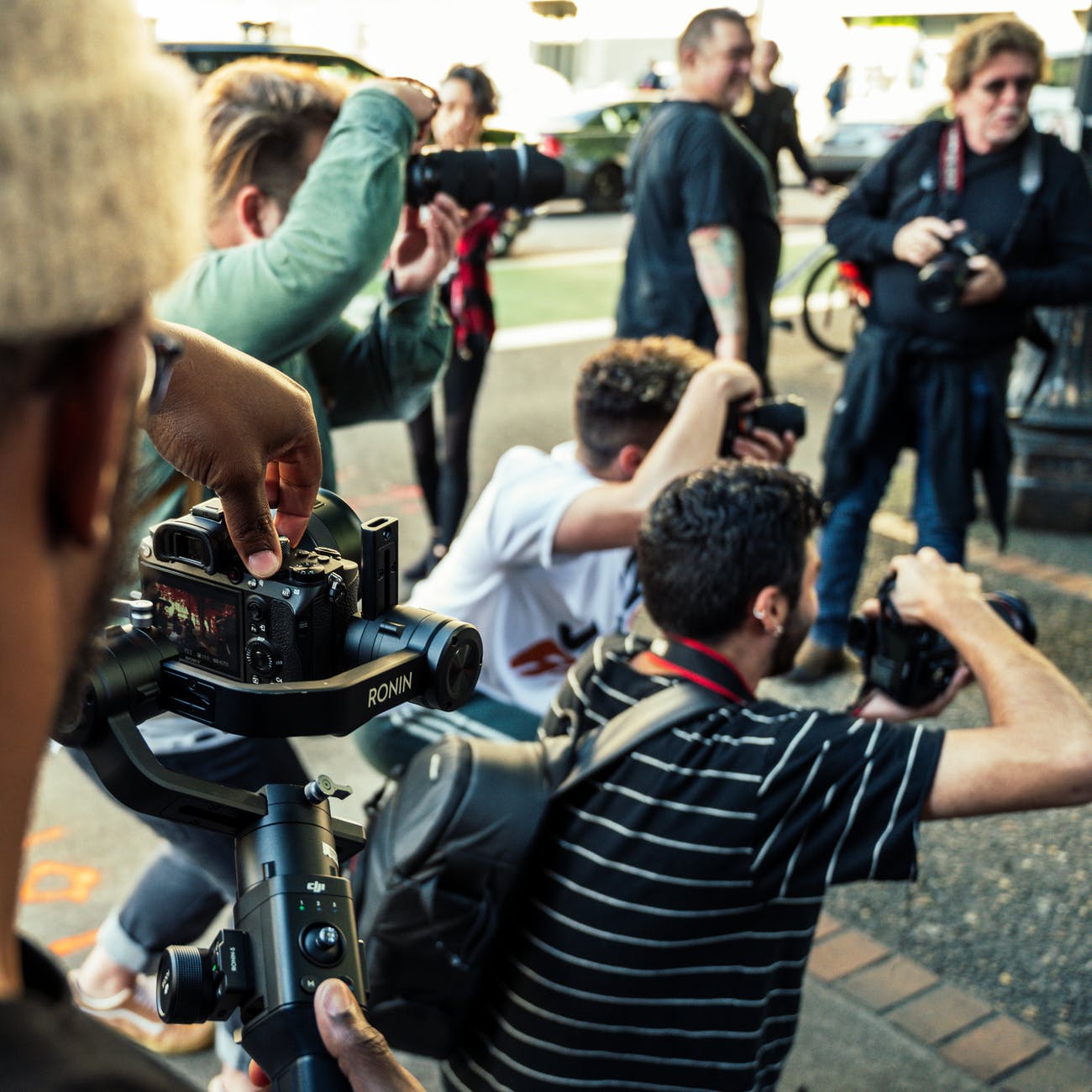
At the daily late-morning editorial meeting, the photo editor brought in images, many taken by paparazzi, that had come in over the wires overnight. He spread the color print-outs of celebrities all over the table: movie premieres, vacations, nights on the town. Bonnie sifted through them and focused on a photo of Drew Barrymore leaning over to fetch a coin off the sidewalk.
“Look at Drew Barrymore picking up a penny,” she said. “It’s like, stars, they’re just like us.”
Drew Barrymore picking up that penny went on to change Us Weekly, tabloid media, the paparazzi economy, and the celebrity ecosystem as a whole. A photo of an actress casually bending over on the street was suddenly interesting to readers and valuable to editors, which incentivized photographers to capture more everyday moments, and ultimately nudged celebrities to become willing participants in the process. A penny shot quickly turned into a money shot.
The 65-year-old actor told the magazine that he wore his custom camouflage getup to The Grove LA, a popular outdoor mall in Los Angeles. Amongst all the visitors, he blended in.
“Nobody recognized me,” he said.
But, living out his dream wasn’t what he imagined.
“People were kind of pushing past me, not being nice,” he recalled. “Nobody said, ‘I love you.’ I had to wait in line to, I don’t know, buy a f––ing coffee or whatever.”
He swiftly realized he wanted to return to his A-list status.
“I was like, ‘This sucks. I want to go back to being famous,’” he added.
This is just one experience. But once you are at some level of social status – whether the leader of a known organization or a Hollywood star or a member of the 1% – how possible is it to live a “normal” life, whether judged from one’s own experiences or by those around you?
There is a new cultural history of Johnny Cash out this week and I quickly read several reviews. Reading this review, it struck me that one of the important roles celebrities play in American society is they become symbols for particular causes, positions, and groups. But, what exactly they stand for or represent might be hard to pin down as Johnny Cash exemplified:
In a sense, the paradox lives to see yet another day in Citizen Cash: The Political Life and Times of Johnny Cash, which sets Cash’s contrariness in a new light. Cash, the cultural historian Michael Stewart Foley argues, was not just a country-music icon, but a rare kind of political figure. He was seldom a partisan in any traditional sense, and unlike Woody Guthrie and Pete Seeger, he rarely aligned his music with a progressive agenda. Nonetheless, “Cash, without really intending it, fashioned a new model of public citizenship, based on a politics of empathy.”…
Some readers may walk away convinced that Cash was a Whitmanesque giant, containing multitudes. I often found myself wondering if he wasn’t a two-faced equivocator. The book is a welcome corrective to the tendency to treat the man as so internally contrary as to be a complete enigma. But the cost of rescuing Cash from the metaphysical fog has been to turn him into a plaster saint. Neither does justice to the actual extent of his weirdness…
Drawing on his own experience, Cash might have broken up the central falsity of the archipelago of glass and steel known as the New South: its equation of whiteness with self-sufficiency and Blackness with dependency. What did he do instead? He smiled grimly and talked out of both sides of his mouth. When Nixon asked Cash to play the White House, he accepted the invite, but politely refused the White House’s request to cover “Welfare Cadillac,” a racist novelty song…
Thanks in no small part to Rubin, Cash has been a blue-state hero ever since. Citizen Cash pulls, in a salutary way, a reverse Rubin and reminds us that the hipster-acceptable Cash, who hung with Bono and premiered his American Recordings songs at the Viper Room on the Sunset Strip, represents less than half the man. But Foley amasses exactly the right facts, only to draw exactly the wrong conclusion.
Who was Johnny Cash? There are multiple ways to approach this but since he was a celebrity, a well-known figure for decades, it may not matter who he really was but rather what the larger public made him to be and continues to make him to be. The celebrities have agency and can make particular decisions but to be famous or well-known means that narrative might be out of their hands. Any new commentary or writing about Cash contributes to an ongoing narrative that could continue to change.
More broadly, celebrities can become representations of particular points of view or experiences. Whether in music, sports, entertainment, politics, or other arenas, the celebrities can have individual experiences – and this is part of why they are intriguing to the celebrity industry and the public as they follow their latest moves – but they also connect to larger patterns of interest in society. Where do celebrities fall in terms of COVID-19 and vaccines? Which celebrities align with which political parties and candidates? What do they think about the latest hot topic?
This often means that celebrities become part of ongoing political and cultural struggles because they represent something. They become proxy figures for larger societal questions. Who was Johnny Cash? We are still figuring that out and the social forces and conditions around the conversation influence our answer to this question.
Rodriguez and all the residents of his posh high rise will get tax breaks for 10 years under the city’s 421A tax abatement program. Luxury developers get tax breaks in exchange for making sure affordable units get built elsewhere. Rodriguez is one of some 45,000 New Yorkers who have scored the tax break.
“I think it’s outrageous,” Lewton said.
When Rodriguez’s moves into his $6 million, five-bedroom penthouse his tax bill will be $1,150. In contrast, Stephen and Phyllis Franciosa pay $3,100 in taxes one their one-family home in the Pelham Bay section of the Bronx…
The councilman said the law needs to be changed because this year alone the program will cost the city $900 million in lost revenue.
A-Rod’s taxes are so low that if he paid the going rate his tax bill would be 50 times higher. He should get such a break when he faces the Red Sox pitching staff.
City officials claim the tax breaks on Rodriguez’ building helped build over 575 units of affordable housing in the Bronx.
This is not an uncommon tactic for communities to encourage affordable housing: grant some tax breaks in exchange for the builder or developer constructing some units of affordable housing. It is often a struggle to get developers and builders to construct affordable units on their own as profit margins are lower. So communities have searched for incentives that would still allow builders to make their money while also providing for the public good.
In the long run, will this story simply be commentary about how the rich and famous get to play by different rules (and New York loves to pick on A-Rod) or can there be a reasonable discussion about how cities go about promoting affordable housing? I am guessing that the first option will easily win out. Why can’t New York news organizations go to those 575 units of affordable housing in the Bronx and talk to the other people who benefited from this tax break?


 Legally Sociable