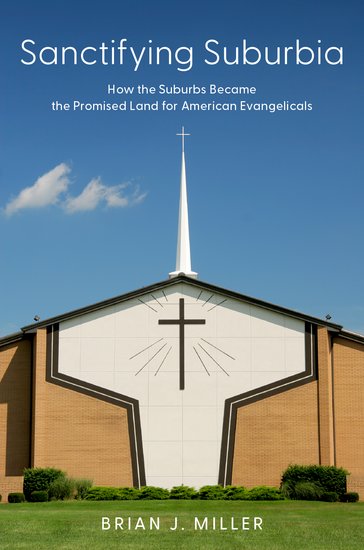
Sanctifying Suburbia reviewed in Review of Religious Research, The Anxious Bench year end best books

My book Sanctifying Suburbia has recently been reviewed in two places. First, in the academic journal Review of Religious Research, Jennifer O. Laderi of Baylor University writes:
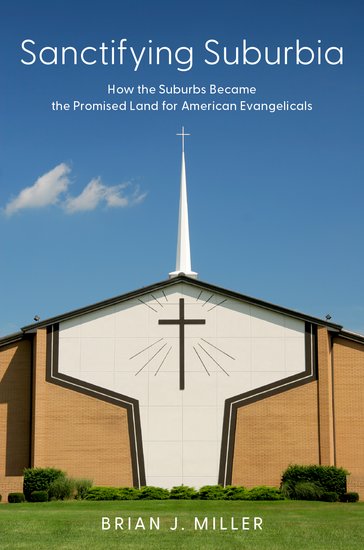
Through meticulous research, he convincingly demonstrates that the convergence of evangelicalism and suburbia was not accidental, but the result of complex social, racial, economic, and theological forces that have shaped both evangelicalism and suburban life in America since World War II.

Second, historian Joey Cochran includes Sanctifying Suburbia in his “Best Books of 2025” at The Anxious Bench blog. Cochran describes the book this way:

This book examines Chicago case studies related to white evangelical flight in the twentieth-century and astutely describes the phenomena of white evangelical suburbia. Carefully cited research and meticulous analysis of data found only in this study makes Miller’s study a vital one to consult for both historians and sociologists.

Thank you to both scholars for taking the time to read the book and consider its argument.

Sanctifying Suburbia reviewed in Christianity Today

My book published in early 2025, Sanctifying Suburbia: How the Suburbs Became the Promised Land for American Evangelicals, was just reviewed in Christianity Today. I found two quotes from the review helpful for summing up the argument of the book and its implications. From earlier in the review:

In light of all this, it would be surprising if suburban sensibilities have not shaped evangelical faith and practice. As Miller argues, “It is not enough for researchers and pundits to consider the theological positions and political behavior of evangelicals; accounting for their spatial context is part and parcel to understanding the whole package of white evangelicalism” (italics mine).

And from a later part of the review:

Miller’s point is that the evangelical cultural toolkit appears to have been calibrated by patterns, experiences, and commitments common to suburban life. He’s careful to avoid claiming a direct, causal relationship between suburban norms and prevailing traits among evangelicals. But he makes a compelling case for drawing arrows of motive, means, and opportunity.

It should be easy enough to accept a narrower version of Miller’s thesis that suburban evangelicalism is “formed in regular moments in daily life and in interaction with the social and physical realities of the American suburbs.” It will be harder for many to accept that American evangelicalism in general is essentially suburban in its values and sensibilities…

In the aggregate, as Miller sees it, these institutions take a fundamentally suburban vision and prescribe it as an objectively Christian vision that can guide evangelical faith and practice in any environment. This doesn’t feel like a stretch to me. My own ministry experience and professional work has primarily involved churches in rural and urban environments. Pastors in both places frequently lament that the resources they rely on are clearly tuned to social realities outside their own. It’s fair to say, at minimum, that suburban sensibilities dominate American ministry materials.

Thanks to the magazine and Brandon O’Brien for reviewing the book.

The normal suburban buildings where the National of Association of Evangelicals operated from for decades

In Sanctifying Suburbia, I look more closely at the locations of the National Association of Evangelicals in Chapter 4. As a group that purported to represent the interests of a growing evangelical movement from the 1940s onward, where did they locate their headquarters?

For decades, their headquarters were in two adjacent suburban communities roughly 25 miles from Chicago: Wheaton and Carol Stream. These two suburbs contain a cluster of evangelical organizations (discussed further in Chapter 5 and 6 of the book). In the late 1950s and early 1960s, the NAE had multiple locations in downtown Wheaton. According to the local phone books, their location in 1957 was 108 N Main. Here is a Google Streetview image of that address from June 2019:

This is the same block that was briefly shown in a Walmart Super Bowl ad a few years ago. When I walked past the location earlier this week, the building is undergoing a massive renovation.

In the 1960s, the NAE moved a few miles north to Carol Stream. They concluded their time in the suburb in an office building within an office and light industrial area. Here is what the property looked like a few years ago (a Google Streetview image from October 2016):

The organization was there until 1999 when they had a short sojourn to suburban southern California before moving the headquarters to Washington, D.C. in 2002.

These headquarters fit in a suburban landscape, the first in a two story brick building in an older suburban downtown with the second looking like many other small office buildings dotting suburbia, with little more than a sign marking them as spaces occupied by a religious organization. And from these suburban locations, the National Association of Evangelicals supported a growing evangelical movement across the United States.

Sanctifying Suburbia out early in 2025

I am looking forward to the release of my book Sanctifying Suburbia: How the Suburbs Became the Promised Land for American Evangelicals on January 14, 2025. Preorder at Oxford University Press and Amazon. Throughout the early part of this year I will be publishing posts about the argument of the book and its implications, surprising things I found while researching, and ongoing possibilities for analyzing religion and the suburbs.

Here is the description of the book:

The suburbs are home to the majority of Americans, including millions of evangelical Christians and thousands of evangelical congregations and organizations. And while American evangelicals are a potent force in society and politics, their connection to and embrace of the suburbs are rarely examined. How did white evangelicals come to see the suburbs as a promised land, home to the evangelical good life and to dense concentrations and networks of evangelical residents, churches big and small, and nonprofit organizations? This book systematically assesses how evangelicals became intertwined with the suburbs and what this means for evangelical life.

Brian Miller shows how evangelical views of race and ethnicity, social class, and gender led to anti-urban sentiment, white flight, and the pursuit of racial exclusivity-all of which has led evangelicals to make the suburbs their physical and spiritual home. At the same time, clusters of evangelical organizations were planting themselves in the suburbs, drawing evangelicals out of the cities. Through sociological analysis, case studies of multiple communities with clusters of evangelical residents, and examinations of evangelical culture, Miller shows that in order to fully understand American evangelicals we must take a deeper look at how evangelicals embraced suburbs and how the suburbs shaped them.

More to come.