An expanding Bay Area megaregion moving toward Sacramento…

How big could a Bay Area megaregion get?

Photo by David Henry on Pexels.com

The Bay Area exodus may be mostly a myth, but the trend of people moving inland, leaving coastal metros in search of more space at better prices, is growing. There are more people moving to Sacramento from the Bay Area than anywhere else in the country, according to Redfin data. People moving from the Bay Area to Sacramento isn’t a new phenomenon, but COVID-19 sped up a process that experts say was inevitable, and it could have long-lasting effects on the state…

They’re far from the only ones who have made the move, and all the new transplants are having a significant impact on Sacramento’s population, which grew 26% between 2000 and 2019, according to census data. The Bay Area’s grew just 14.6% during the same period. A recent study conducted through a collaboration between the University of Southern California, Occidental College, and UC Davis suggests increased migration could even be creating a “megaregion,” breaking down barriers that traditionally separated the coastal cities of the Bay Area from the inland region around Sacramento.

The “megaregion” and the resulting demographic shifts will have an outsized impact on traffic and infrastructure, creating new needs for California’s future. While the study showed there was a small dip in the proportion of people commuting to the Bay Area from Sacramento County, the percentage of people “supercommuting” — defined as a commute of more than 50 miles — had grown from 17% in 2008 to 20% in 2018. That percentage grew in every Central Valley county studied and is likely to continue as high-wage earners with jobs centered in the coastal metros seek larger homes inland…

The issues are not limited to Sacramento and the surrounding suburbs, according to Rodnyansky, and his research suggests the megaregion could stretch all the way to Fresno. Past Sacramento, people are also spreading out to surrounding El Dorado and Amador counties, where they will likely face challenges they’re not prepared for, like managing their land for increasing wildfire risk.

Three thoughts come to mind:

  1. Is there anyone these days seriously opposed to megaregions? I could see some concerns rising about distinct identities of particular cities and communities or addressing increasingly complex problems in a growing region. Yet, having a larger region means a larger economy, a bigger population, and an increased status.
  2. It would be interesting to hear more about communities in between these areas. What is it like to live between Oakland and Sacramento that might feel a pull one direction or another?
  3. Now is the time to be planning ahead to the issues an expanding region brings. Can the infrastructure handle this? How should disputes between communities and major actors be resolved? Are there new population and business nodes that will develop? (Is there a point where development should not continue? This is not the kind of question that tends to be asked in the United States when growth is good.)


Finding religion in group athletics

As more Americans eschew religion, they can search for meaning and community elsewhere. This includes exercising and moving with others:

Photo by Leon Ardho on Pexels.com

Some readers mentioned fandom as a bonding mechanism — World Cup enthusiasts and participants in fantasy football leagues, for instance, are creating ongoing relationships. But mostly I heard from people who bonded through athletic activities. Some talked about clubs that formed organically in their neighborhoods or towns, like that Colorado hiking group. But many who answered the questionnaire I launched in April about moving away from organized religion talked about replacing their weekend worship with SoulCycle, CrossFit or Orangetheory, and finding friends and even some spiritual solace in those activities. (In case you’re wondering, I’m an Orangetheorist and a SoulCycle dropout, though I can’t say I’ve ever felt a metaphysical connection to either one.)…

Casper ter Kuile, the author of “The Power of Ritual: Turning Everyday Activities Into Soulful Practices,” studied CrossFit and SoulCycle when he was a student at Harvard Divinity School, and told me that he observed some of the “mutuality” that Johnson experienced when he talked to CrossFit devotees. CrossFitters write down their fitness goals on a whiteboard and, whether a goal is comparatively big or small, “goals are honored with the same amount of dignity and celebration.” There’s a feeling that you have the agency to meet your goals and that the community is also involved in your success. There’s also a lot of evangelizing for CrossFit that can parallel the outreach or recruitment aspect of religious worship…

SoulCycle even mimics some of the emotional beats and physical qualities of a church service. Ter Kuile and Thurston have described the “soul sanctuary,” where classes are held, and the way “Every SoulCycle ‘journey’ has a similar arc, which peaks during a hill ballad when riders turn up the resistance dial on their stationary bike and climb uphill in the dark.” The reader Susana Odriozola, 40, who lives in California and was raised Catholic, though she no longer goes to church, said that parts of the SoulCycle experience reminded her of going to Mass: They throw water out to you and you turn to your neighbors and greet them…

One part of churchgoing that’s tougher to satisfy with group fitness is the multigenerational inclusiveness of those spaces. You’re not going to bring a little kid to a CrossFit box. And though Schnurr told me that people bring their families hiking, her own experience is that some of her grandkids love it, but others, not so much. I’ve tried to drag my kids along on various hikes and climbs and, similarly, it’s not always a hit. Like me, Odriozola said she’s still trying to figure out how to give her children “spiritual strength without religion,” and that is an ongoing journey. And there are fitness spaces that are difficult to access or inaccessible for those who have mobility and health challenges.

Functional religion is an interesting topic. I have blogged about work replacing religion, politics looking like religion, and sports fandom mimicking religion.

Not mentioned here is the involvement of bodies in these activities. As sociologist Randall Collins suggests in Interaction Ritual Chains, the movement of bodies together and the emotional energy that develops is important. These physical activities help by asking people to move their bodies in sync. Religious activities do this as well; people do not gather and worship as a bunch of brains but they involve their bodies and emotions. Additionally, none of the stories in the piece above mention transcendence or interacting with forces/being beyond the people in the room.

How many of these groups/activities explicitly advertise these particular benefits? They cannot guarantee certain communal experiences but they could point to the potential for it to develop.

The Chicago suburbs have 99 million square feet of office space

The suburbs are not just places where people live. The Chicago suburbs have a lot of office space:

Photo by 500photos.com on Pexels.com

While higher-end properties are outperforming less expensive options among the suburbs’ 99 million square feet of office space, they still saw a decline in the year’s second quarter, ending a yearlong run of gains, according to data collected by the Chicago-based firm.

The Pentagon has 6,500,000 square feet of space so the suburban office space is over 15 times that of the Pentagon. The Willis Tower in Chicago has roughly 4,000,000 square feet of space so the suburbs have roughly 25 times more space. A football field is 57,600 square feet is the office space covers over 1,718 football fields. If the average new American home is about 2,500 square feet, this office space is nearly 40,000 new average homes.

Note: another website suggests the Chicago suburbs have 162 million square feet of office space, putting the Chicago suburbs behind the Washington D.C. suburbs, the Dallas-Forth Worth suburbs, the Bay Area suburbs, and the New Jersey suburbs.

Whichever number is correct, it is hard to put this much space in perspective. The suburbs may be primarily about single-family homes but they have plenty of space for business.

New American homes on average 56 square feet smaller

The long-term trend in the United States has been toward larger new homes. But, early 2023 data shows slightly smaller new homes:

Photo by Alena Darmel on Pexels.com

The average square footage of a new home stood at 2,469 square feet in the first quarter of 2023, almost in line with the fourth quarter of 2022, but down 2.2% from the previous six quarters when the square footage averaged 2,525 square feet, according to data from the Census Quarterly Starts and Completions by Purpose and Design and NAHB analysis. That’s a difference of 56 square feet or about the size of a generously proportioned full bathroom.

This is not a large decline. As the paragraph above notes, the average new house is smaller by roughly the size of a full bathroom. But, here is what might be more important about this number:

-Does this imply the price of a new home is also lower? Several homebuilders are mentioned in this story and the need for cheaper homes is discussed but there are no prices mentioned. Presumably a slightly smaller new home is a cheaper home.

-Where does this 56 square feet tend to come from? Slightly smaller first floor/gathering rooms (great room, kitchen, family room, etc.)? Slightly smaller closets?

-Have we passed peak square footage in the United States? There will always be a market for large new homes but if the average is down a bit for multiple quarters, does this mean it will go down slowly for years?

Why not try more memorable speed limits – like 13 mph?

Could more unusual speed limits help improve safety on the roads? Here is one speed limit I saw recently along a road coming out of a shopping plaza:

Most speed limits are in increments of 5. I assume this is, in part, due to standardization of roadways throughout the United States. But, why not throw in some more unusual numbers to catch the attention of drivers? Would I be able to stick to the occasional 13 or 31 or 67 more easily than the standard 15, 30, or 65? If every speed limit was a number off of the 5/10s pattern, they might make the problem worse. The key could be to have some numbers off from typical numbers.

The switch to more digital speedometers in cars could help with this. A good number of speedometers are also in increments of 5 and 10 so matching 13 mph could be hard. If more drivers have digital displays where a 5/10 increment does not exist, then escaping the rigidity of 5/10s could be easier.

Capping the population of suburbs

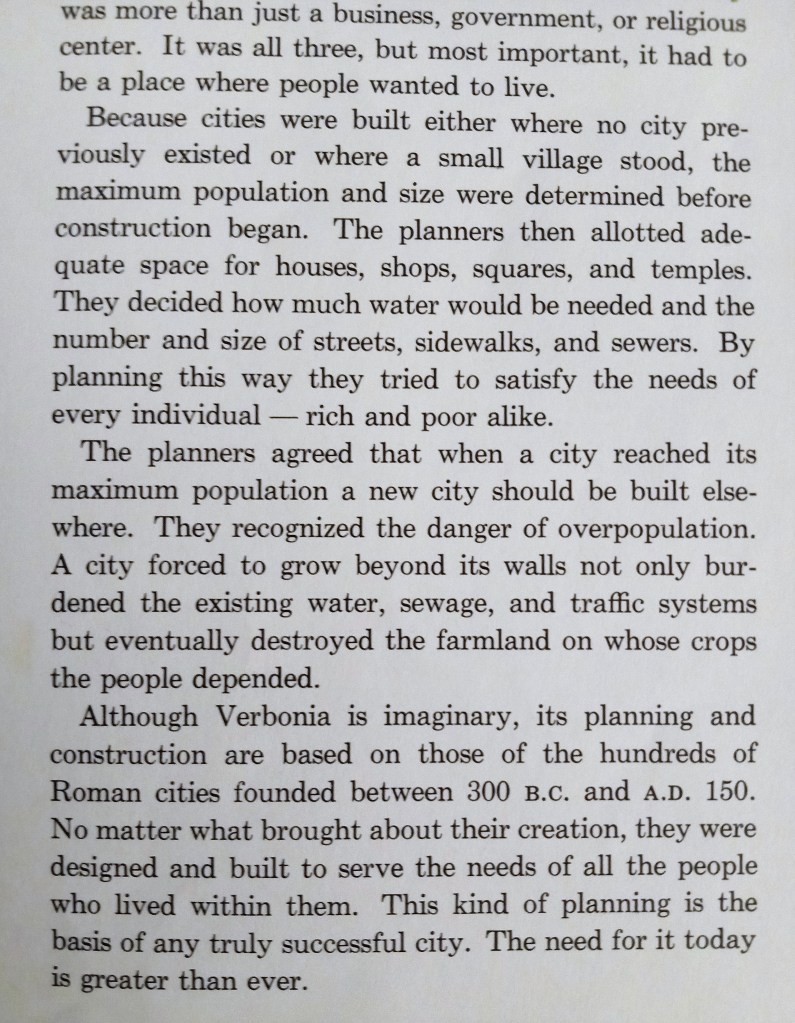
What if each of the thousands of American suburban communities had a maximum population? I had the idea after rereading David Macaulay’s City:

What could the benefits be for American suburbs? As described here, the problems that come with more residents than resources would not occur. Suburbs could be a similar size. Each suburb could have facilities for residents to access and infrastructure they need.

This would go against the American ideal that growth – including population growth in suburbs, cities, and communities – is good. Some suburbs are bigger than others. Americans might often assume because those communities are more successful and desirable. They have competed well. But, that might not be the full story. Are some communities small for particular reasons? Is growth always good?

I am under no illusions that most Americans would want a population cap for suburbs or any other community. And simply capping the population does not address all the issues communities and their residents face. But, it is interesting to consider what good might come from planning ahead for meeting needs in communities with a maximum population.

Jonathan Franzen on “the smell of infrastructure”

In his second novel, Strong Motion, Jonathan Franzen describes “the smell of infrastructure.” Here is the description:

Photo by Brandon Benedict on Pexels.com

There’s a specific damp and melancholy ancient smell that comes out in Boston after sunset, when the weather is cool and windless. Convection skims it off the ecologically disrupted water of the Mystic and the Charles and the lakes. The shuttered mills and mothballed plants in Waltham leak it. It’s the breath from the mouths of old tunnels, the spirit rising from piles of soot-dulled glass and the ballast of old railbeds, from all the silent places where cast iron has been rusting, concrete turning friable and rotten like inorganic Roquefort, petroleum distillates seeping back into the earth. In a city where there is no land that has not been changed, this is the smell that has come to be primordial, the smell of the nature that has taken nature’s place. Flowers still bloom, mown grass and falling leaves and fresh snow still alter the air periodically. But their smells are superimposed; sentimental; younger than those patiently outlasting emanations from the undersides of bridges and the rubble of a thousand embankments, the creosoted piers in oil-slocked waterways, the sheets of Globe and Herald wrapped around furry rocks in drainage creeks, and the inside of every blackened metal box still extant on deserted right-of-way, purpose and tokens of ownership effaced by weather, keyhole plugged by corrosion: the smell of infrastructure.

It was out in force when Louis and Renée came up Dartmouth Street from the Green Line stop at Copley Square.

I feel I may have experienced a similar smell before in the city in similar conditions: in the big city in the evening with a bit of dampness. The smell from the roads, buildings, mass transit, and built environment is a particular one. Would I chalk it up to infrastructure? Does this require relatively few people around so that the smell of infrastructure is accentuated?

But, this might not be the exact smell of Boston. All cities have some unique features and histories that contribute to a specific milieu, including the smell. Trying to describe that in words is a difficult task and not one that I would want to take on.

Why not make tiny houses as shorter houses?

A recent excursion to an adventure farm included looking at a small house meant for children’s play:

I realize this might not work for taller people but shorter spaces could work when trying to maximize space. Why do ceilings have to be 8 foot tall (or even taller for a good number of places)?

The primary place I have seen shorter ceilings in houses involves two situations:

  1. Tiny houses that try to incorporate a loft or second floor so they have a lower ceiling for part of their unit.
  2. Older basements.

Shorter buildings could be enhanced with vaulted ceilings or skylights or do not necessarily have to come with smaller furniture as depicted above. Could shrinking the whole scale of a home, including the height, help free up space or enhance the coziness of a space?

(I enjoyed thinking about this for the few minutes I spent in this building. It was a similar experience to exploring the tiny apartments featured at Ikea.)

Suburbs as diverse, welcoming to all (but not criminals), and open for business

The village president of Oak Brook touted the suburb’s approach to crime as part of its success. He ended the op-ed with this:

Photo by Ketut Subiyanto on Pexels.com

Oak Brook is a diverse community, welcoming to everyone except criminals. We’re open for business!

A little bit more on each of the three pieces of diversity, welcomes, and business activity.

Regarding diversity, the U.S. Census Bureau QuickFacts say the community of just over 8,000 residents is 61.8% white, 30.3% Asian, 4.5% Hispanic or Latino, and 0.6% Black or African American. The median household income is $146,409, the median housing value of owner-occupied units is over $801,000, and the poverty rate is 4.9%.

Many suburbs say they are welcoming and few, if any, would say they welcome criminals.

The community has plenty of business activity as it is home to Oakbrook Center and numerous offices along I-88.

Is this formula – diversity + welcoming + business – the secret to suburban community success? Or, is this a viewpoint from suburbs with certain features and character?

What counts as “good science,” happiness studies edition

Looking across studies that examined factors leading to happiness, several researchers concluded only two of five factors commonly discussed stood up to scrutiny:

Photo by Jill Wellington on Pexels.com

But even these studies failed to confirm that three of the five activities the researchers analyzed reliably made people happy. Studies attempting to establish that spending time in nature, meditating and exercising had either weak or inconclusive results.

“The evidence just melts away when you actually look at it closely,” Dunn said.

There was better evidence for the two other tasks. The team found “reasonably solid evidence” that expressing gratitude made people happy, and “solid evidence” that talking to strangers improves mood.

How might researchers improve their studies and confidence in the results?

The new findings reflect a reform movement under way in psychology and other scientific disciplines with scientists setting higher standards for study design to ensure the validity of the results.

To that end, scientists are including more subjects in their studies because small sample sizes can miss a signal or indicate a trend where there isn’t one. They are openly sharing data so others can check or replicate their analyses. And they are committing to their hypotheses before running a study in a practice known as “pre-registering.” 

These seem like helpful steps for quantitative research. Four solutions are suggested above (one is more implicit):

  1. Analyzing dozens of previous studies. When researchers study similar questions, are their findings consistent? Do they use similar methods? Is there consensus across a field or across disciplines? This summary work is useful.
  2. Avoid small samples. This helps reduce the risk of a chance finding among a smaller group of participants.
  3. Share data so that others can look at procedures and results.
  4. Test certain hypotheses set at the beginning rather than fitting hypotheses to statistically significant findings.

One thing I have not seen in discussions of these approaches intended to create better science: how much better will results be after following these steps? How much can a field improve with better confidence in the results? 5-10% 25% More?