In the hands of American Christians after World War Two: atomic bombs, the cross, newspapers, the Bible

What should American Christians have in their hands in the years after World War Two? I recently read one answer to this in the book Jesus Springs by religious studies scholar William Schultz:

Photo by Luis Quintero on Pexels.com

“Senator Edward Martin (R-PA) spoke for many when he declared, “America must move forward with the atomic bomb in one hand and the cross in the other.”” (14)

This is an interesting contrast for a country: military/scientific might in one hand, the cross, a religious symbol of suffering, in the other.

This reminded me of a more common quote about holding a Bible and a newspaper in separate hands. For example, this was linked to Billy Graham:

“What a moment to take the newspaper in one hand and the Bible in the other and watch the unfolding of the great drama of the ages.” Billy Graham in The Jesus Generation in 1971

“The 82-year-old preacher from Montreat, N.C., has been said to give his sermons “with a Bible in one hand and a Time magazine in the other,” says A. Larry Ross, his media director.” 2001 story in The Times-News

This quote supposedly goes back to theologian Karl Barth. It is a different contrast: the Word of God in one hand, reports of what is happening in the world in the other.

Both quotes get at similar ideas. Hands can only hold so much so what is there should be important. What a person holds in both hands can complement each other. They reflect particular eras. The quotes could apply to specific actors – America, pastors/evangelists – or to people more broadly.

What would be the updated version for American Christians in 2025?

Costco, American consumption, and relationships with adversarial nations

The Trump administration may limit the ability of Iranian officials to visit Costco and Sam’s Club when they visit the United Nations in New York City:

Photo by Teju on Pexels.com

The movements of Iranian diplomats are severely limited in New York, but one proposal being floated would bar them from shopping at big, members-only wholesale stores like Costco and Sam’s Club without first receiving the express permission of the State Department.

Such stores have been a favorite of Iranian diplomats posted to and visiting New York because they are able to buy large quantities of products not available in their economically isolated country for relatively cheap prices and send them home.

It was not immediately clear if or when the proposed shopping ban for Iran would take effect, but the memo said the State Department also was looking at drafting rules that would allow it to impose terms and conditions on memberships in wholesale clubs by all foreign diplomats in the U.S.

Americans may be used to Costco and big box stores but they are not necessarily available all over the world.

When I saw this story, I was reminded of the so-called “Kitchen Debate” between Nixon and Khrushchev in 1959. At an exhibition in Moscow, the United States constructed a model of an American home with the idea of showing off all that an average American household had. Khrushschev did not appear impressed but the display illustrates one of the ways the United States expanded its power and reach in the second half of the twentieth century: through consumerism and a particular lifestyle.

Put another way, pursue policies like the United States and the average home could have a kitchen like that one displayed in 1959 or the average resident could shop at a Costco in 2025. Resist the American way of life or be belligerent toward the United States and those things will not be available.

Just out of curiosity, I searched Google Maps for the Costco locations nearest to the UN Headquarters in Manhattan. There are at least 3 locations within 11 miles. This means when the diplomats and the leaders of the world come together at the UN, getting to Costco might not be too difficult.

The United States will celebrate 250 years in 2026 and postwar suburbia will be roughly 80 years old at the same time

However the United States celebrates 250 official years in 2026, the year could mark another important anniversary: eight decades of postwar suburbia.

Photo by RDNE Stock project on Pexels.com

With World War Two ending, the United States shifted more focus to domestic concerns. Returning veterans wanted houses. The economy which had been hit with a depression and then global war looked to rev up and wanted new outlets. Americans already had a ideal of suburbia and single-family homes though relatively few people could access it. The population started growing faster again. People needed housing.

Over the next few decades, postwar suburbia took shape. Big developers. Highways. Land annexations. Single-family home subdivisions. Driving all over the place. Fast food stores and shopping malls. Expanding metropolitan regions. Suburban music and TV shows. New structures for mortgages.

All of this required policies, resources, and cultural shifts. It did not happen all at once or necessarily have one origin point in time. Did it start with the beginning of construction of Levittown, New York? Did it begin with a new idea? Did it start with a particular policy (which may have happened before the late 1940s but did not have the other pieces)? How about the invention of the Model T or balloon frame housing?

Thus, we may have to settle for roughly 80 years of postwar sprawl in 2026. Perhaps some group or movement could argue for a particular year. But this also means that almost one-third of the time since the United States started (ignoring the history leading up to that) involves sprawling suburbs. Is this a big amount of time or relatively little?

The amount of water Americans use to water lawns

In this season of growing and mowing lawns, the EPA has a number regarding the amount of water Americans use to water their lawn:

Photo by Jonathan Cooper on Pexels.com

The average American family uses 320 gallons of water per day, about 30 percent of which is devoted to outdoor uses. More than half of that outdoor water is used for watering lawns and gardens. Nationwide, landscape irrigation is estimated to account for nearly one-third of all residential water use, totaling nearly 9 billion gallons per day.

The American lawn is alive and well – in part because of all this water. To get the lawn Americans typically want, green, well-manicured, and free of weeds, much is required. And without watering, it might not even get off the ground. Some parts of the country have regular rain that can support this kind of grass. But, it may not meet the standards of Americans and other areas do not have this rainfall. I, too, have had the experience of flying over the West and then seeing Las Vegas emerge with its telltale green lawns.

The American lawn is also alive and well because of expectations and values attached to this lawn. It signifies success and middle-class suburbia. Yes, it requires water. But if the water supply was severely diminished, would the lawns necessarily disappear? Or would people adjust their behavior to make sure the lawns remain in some smaller or similar form? Just how much water would Americans be willing to devote to green lawns?

Housing issues are incredibly local – and they follow patterns across places

The issues of housing in the Chicago region are very local. How Chicago selected public housing sites and later handled the demolition of public housing high-rises. The discussions of affordable housing go in suburbs and the protection of single-family homes from perceived threats. Municipalities get to set their zoning maps, local officials make decisions regarding development, and residents weigh in.

Photo by Dmytro Koplyk on Pexels.com

But at the same time, these are not just local issues. There are patterns across places. What happened with public housing in Chicago may not have been exactly the same as what happened in other major cities but the effects of federal legislation and monies and public perceptions about public housing influenced numerous cities. Suburbs have unique characters but types of suburbs – say edge cities or inner-ring suburbs – can have similar experiences and trajectories. The ways zoning is used to privilege single-family homes and exclude people and undesirable uses is common. National ideologies regarding desirable and undesirable housing influences leaders and residents.

Figuring out how to link these two realms regarding housing – national and state-level policies and meanings and local action and sentiment – is very important to addressing any large-scale housing issues. Abandoning larger-scale efforts because all housing is local is not helpful. Focusing efforts only at the state or national level can ignore complexities within communities and regions.

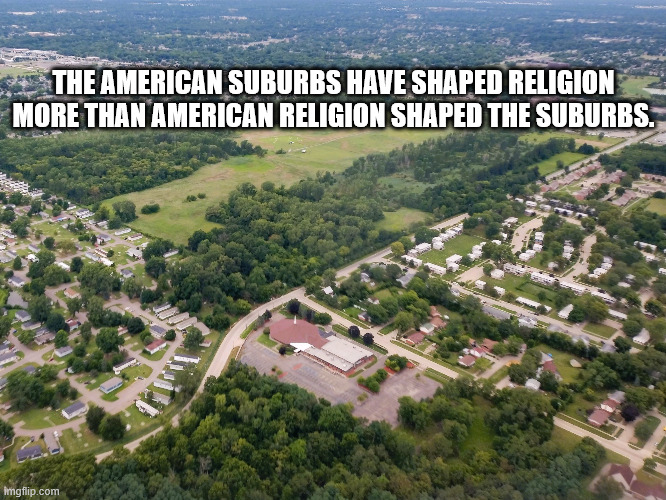
The American suburbs shaped religion more than American religion shaped the suburbs

I have been studying and writing about religion in the American suburbs for about ten years now. After recently publishing a book on evangelicals embracing suburbia – Sanctifying Suburbia – and more recently also looking at a variety of religious traditions over time in the Chicago suburbs, I had this thought:

This is a broad statement. But if I were to put the two social forces side by side – suburbanization in the United States and religion (and all that entails) in the United States – I would come down on suburbs affecting religion more than the opposite. Here is a couple of ways to think about:

  1. As religious groups have moved to the suburbs, whether Catholic, Protestant, Muslim, Jewish, or others, they often have to adapt to suburban settings.
  2. How much do religious congregations, organizations, and adherents in suburbia shape community life or social life at the structural level (beyond individuals, small groups, some social networks, more micro level)? Another way to put it: if these religious groups were not present, how different would suburban life be?
  3. The reasons Americans love suburbs and the way of life involved therein can override religious values and concerns such as loving their neighbor, serving the good of the whole community, and pursuing religious and spiritual goals.

I am going to keep thinking about this claim and may write more about it. Even as religion has served to provide meaning and structure for many humans and societies across time and space, suburbia is a powerful place and ideology.

US a nation of aspiring readers

New survey results suggest Americans want to read:

Photo by Lisa from Pexels on Pexels.com

According to the poll, 82% of respondents think reading is a useful way to learn about the world, 76% say reading is relaxing and a whopping 98% of respondents with children in their household want their children to “develop a love of reading.”

Reading is “certainly aspirational,” said Mallory Newall, vice president of Public Polling at Ipsos. “We certainly want to be a reading nation.” And yet 51% of people read a book in the past month, according to the poll. In comparison, about 80% of people watched streaming services, used social media or watched a short-form video.

Interestingly, respondents who classify themselves as readers are also more likely than non-readers to consume other forms of media. So it’s not necessarily a direct competition between, say, reading and scrolling on your phone. When asked about the “reasons you don’t read more,” “other life activities” was the most common answer, which could mean anything from doing chores to sleeping to hanging out with friends…

But for many Americans it’s not going to take precedence. When asked what they’d do with one extra hour of leisure time, the top of the list is spending time with family. Below that is a tied race between watching TV, reading and exercising.

This can happen in many areas of life: we might have a high regard for something but day to day life does not reflect these ideals. Think New Year’s resolutions: stated goals but maybe short on follow through.

So if someone wanted to promote more reading among adults in the United States, where would they start? One could appeal to people’s aspirations – but they already think highly of reading and do not necessarily read a lot. Is it about making it easier to read (more affordable, more accessible, more compelling texts, etc.)? Or helping people meet their other interests – spending time with family, as noted above – so they can then read? Or making reading cool?

American toolkits for marriage and relationships amid social change

How are changes in American education by gender affecting how American adults approach relationships?

Photo by Valentin Antonucci on Pexels.com

According to her calculations, in 2020, American husbands and wives shared the same broad level of education in 44.5 percent of heterosexual marriages, down from more than 47 percent in the early 2000s. Of the educationally mixed marriages, the majority—62 percent—were hypogamous, up from 39 percent in 1980. Crunching the numbers slightly differently, Benjamin Goldman, an economics professor at Cornell University, found that among Americans born in 1930, 2.3 percent ended up in a marriage where the woman had a four-year degree and the man did not. Among the cohort of those born in 1980, that figure was 9.6 percent. (This trend is hardly unique to the United States; hypogamy is becoming more common all over the globe.)

It’s a fragile time for gender relations in the United States. Young women and men appear to be diverging politically. Fewer people are dating, marrying, or having kids. Some commentators argue that there aren’t enough suitable bachelors to meet the standards of accomplished modern women. Meanwhile, a growing “manosphere” claims that women’s advancement is to blame for all manner of struggles experienced by lonely, unmoored men. Yet for all the worry that a chasm is opening between men and women, the rise in the number of hypogamous couples suggests that some men and women are doing what men and women have always done: coupling up regardless of differences and figuring out a way to get along. “It’s clear,” Goldman told me, “that understanding the dynamics of these couples is key to understanding the future of marriage.”

This reminds me of two sociology books I’ve used in classes that use the concept of cultural toolkits to help explain how people in the United States address love and relationships. One describes how Americans draw upon ideas of romantic love and covenantal love at different points of marriage. The second considers how evangelicals seek pragmatic solutions to everyday family life amid their commitments to Christian perspectives and a changing society around them.

The description of the article above sounds similar: social, political, and economic conditions are changing. Ideas about relationships are changing. More women are getting college degrees. Yet a good number of Americans still desire to be part of relationships and marriages. “Making it work” might require applying different tools in their toolkits about relationships and life or developing new toolkits.

In other words, marriage continues in the United States with some changes and how Americans approach it and the toolkits they have regarding it changes.

One marker of American life: eating lots of peanut butter

Life in the United States may be marked by many things, including the consumption of peanut butter:

Photo by Polina Tankilevitch on Pexels.com

The only invention that did more than hydrogenation to cement peanut butter in the hearts (and mouths) of America’s youth was sliced bread—introduced by a St. Louis baker in the late 1920s—which made it easy for kids to construct their own PB&Js. (In this century, the average American kid eats some 1,500 peanut butter and jelly sandwiches before graduating from high school.)

Rosefield went on to found Skippy, which debuted crunchy peanut butter and wide-mouth jars in the 1930s. In World War II, tins of (hydrogenated) Skippy were shipped with service members overseas, while the return of meat rationing at home again led civilians to peanut butter. Even today, when American expats are looking for a peanut butter fix, they often seek out military bases: They’re guaranteed to stock it.

But while peanut butter’s popularity abroad is growing—in 2020, peanut butter sales in the United Kingdom overtook sales of the Brits’ beloved jam—enjoying the spread is still largely an American quirk. “People say to me all the time, ‘When did you know that you had fully become an American?’” Ana Navarro, a Nicaraguan-born political commentator, told NPR in 2017. “And I say, ‘The day I realized I loved peanut butter.’”

Though the United States lags behind China and India in peanut harvest, Americans still eat far more of the spread than the people in any other country: It’s a gooey taste of nostalgia, for childhood and for American history. “What’s more sacred than peanut butter?” Iowa Senator Tom Harkin asked in 2009, after a salmonella outbreak was traced back to tainted jars. By 2020, when Skippy and Jif released their latest peanut butter innovation—squeezable tubes—nearly 90 percent of American households reported consuming peanut butter.

How many lists of American food would include peanut butter?

How many images of American life would include peanut butter in them?

Or what would Americans replace peanut butter with if it was gone?

How does the number of PB&Js kids eat compare to other kinds of sandwiches they eat?

And why do so many seem to like Uncrustables?

Claim: “salesmen built the American economy, and by extension, America itself”

Without salesman to cross the country in the nineteenth century, would the United States of today exist? The argument:

Photo by Pixabay on Pexels.com

But in a very real sense, salesmen built the American economy and, by extension, America itself. In his book, Friedman notes that in the mid-19th century, more than half the U.S. population lived on a farm. Consumer markets were nonexistent. Salesmen went out and made them from scratch, a sale at a time, and not simply by bringing quality goods to eager buyers; they took them by their lapels and didn’t let go until they signed on the dotted line. Fortune magazine observed, in the mid-20th century, “Mass production would be a shadow of what it is today if it had waited for the consumer to make up his mind.” But because of what scholars call “supply-side bias,” we regard 19th-century tycoons like Rockefeller, Carnegie, and Vanderbilt as Übermensch, while erasing the accomplishments of the legions of lowly salesmen. Why? Economists, generally insulated from the dirty realities of turning a buck by tenure and/or wealth, think of demand as a vast natural force to be harnessed, like wind or oil—a conception that fits hand in glove with the equally simplistic “great man” theory, which posits that some people (men) are just born great. Sounds nice, but things look a little less elegant to the salesmen in the trenches. They know: Demand is more like blood, and it has to be mercilessly extracted, drop by drop, by an army of sweaty little goblins who don’t eat unless they hit their quotas. Suddenly, the economy looks more like an infinite series of tiny frauds than a harmonious ecosystem. And if the Greatest Economy in the World is little more than a shill mill, the implications for the Greatest Country in the World are dismaying, to say the least.

For this argument to work, what social conditions were present?

  1. The United States is more rural, or at least non-urban. A lot more people are engaged in farming or agricultural work.
  2. Brands, mass production, and access to information do not exist in the same way as today.
  3. Might there have been a different response to interacting with strangers or visitors or sales people? Today, people might be nervous about opening their doors but in the 1800s would a visitor prompt hospitality and/or interest in hearing about the broader world?

Another way to put this: how does the role of sale person shift as social conditions change? If telemarketers of the 1990s used phones and machines to rapidly call people in the United States and those in the mid-1800s traveled to farms and small towns, what do sales people look like in the 2030s? Or are there ebbs and flows in the activity and influence of sales people?

But perhaps the broader picture is this: o Americans – as individuals, communities, a country – embody the spirit an activity of sales people more than other countries? Are we always selling something, even when we are not?