The ongoing transformation of the Bell Labs site that helped create modern Naperville

A large office building is coming down at the northwestern corner of Naperville and Warrenville Roads in Naperville. This is not just any office building; this is the site that helped jumpstart Naperville’s growth and status. Here are some details on the changes:

Constructed in 2000 at the northwest corner of Naperville and Warrenville roads, the five-story glass and steel complex at one time was touted as a technological hub with the potential to sustain thousands of jobs.

But with the recent arrival of cranes, excavators and other heavy equipment, a new era is beginning for the 41-acre site that’s part of the city’s Interstate 88 corridor.

Oak Brook-based Franklin Partners — which in April finalized the purchase of 1960 Lucent Lane for $4.75 million — in June received a demolition permit from the city to raze the 500,000-square-foot building and the three-story parking garages on either side…

Discouraged by city officials to develop warehouses on the property, Franklin Partners replied by saying it would seek a technology-based alternative.

I describe this property’ contribution to Naperville in a 2016 article titled “A Small Suburb Becomes a Boomburb” in the Journal of Urban History:

The arrival of a high-status tech company on this suburban plot helped give rise to more white-collar employers in Naperville plus numerous subdivisions.

This property has been ripe for change for a while now. Last year, I noted the amount of available parking behind the facility and a new subdivision back there as well (sign for the development, a new park).

It is too simple to say that the fate of this land could do much to affect Naperville’s future trajectory. At the same time, it is a large parcel of land that once helped affect Naperville’s future. It sounds like the city clearly does not want the property to become warehouses, but what could arise here that contributes to a vibrant future?
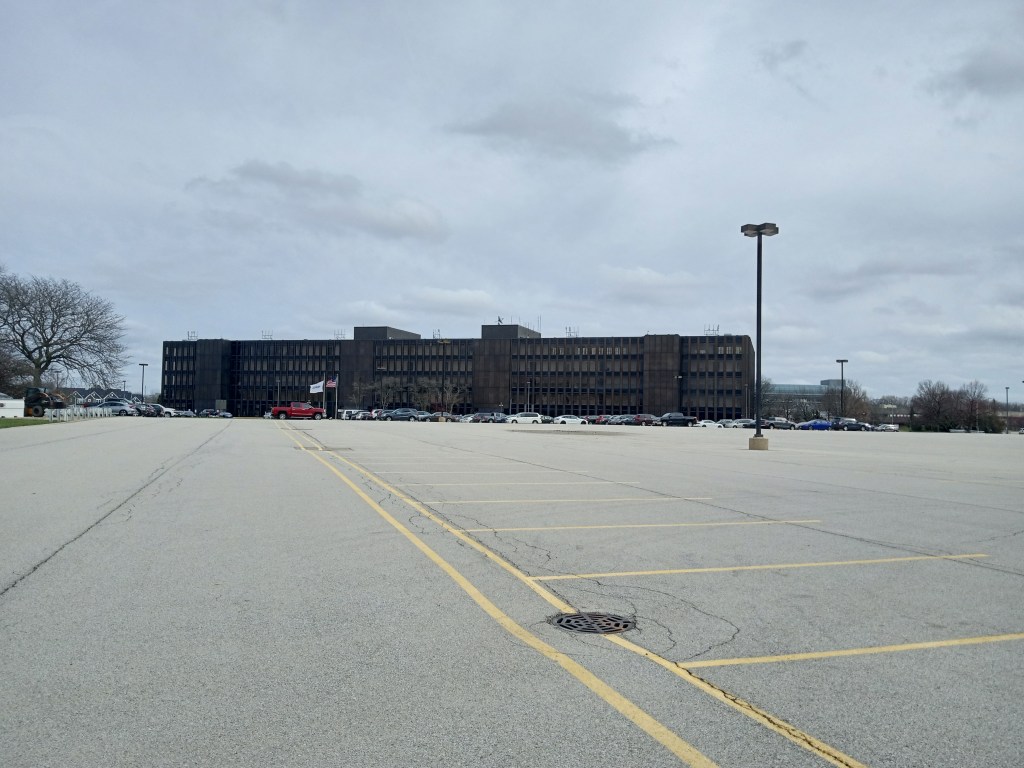
An influential Naperville office building now with plenty of available parking

In 1964, Bell Labs announced plans to construct a new building just north of Naperville, Illinois and near an interchange on the East-West Tollway. That facility would later come to contain thousands of workers; “about 11,000,” according to Wikipedia. As I discuss in “A Small Suburb Becomes a Boomburb: Explaining Suburban Growth in Naperville, Illinois,” this suburban property helped set Naperville on a particular trajectory.

Here is a recent view of the back parking lot:

I know this is a far out view of the parking lot but it struck me that there were a limited number of cars here for such a large set of buildings. The number of workers on site is a lot smaller in recent years:

The 175-acre property near the intersection of Naperville and Warrenville Roads has the address of 1960-2000 Lucent Lane.

Nineteen-sixty Lucent Lane includes a vacant five-story 613,620-square-foot steel and glass office building, two three-story parking decks and surface parking lots. Nokia has consolidated its offices into the five-story 1-million-square-foot steel and glass building at 2000 Lucent Lane. The company occupies about 33% of the building, according to city documents.

At the north end of this property, behind where this picture was taken, is a new residential neighborhood of townhouses and single-family homes from Pulte.

What will become of this full property in the next few decades? Could it become a “metroburb” like another Bell Labs facility in a northwest Chicago suburb? The same property that helped lead Naperville to white-collar jobs and office buildings could become part of numerous transformations of suburban office parks into new uses.

Transforming a Bell Labs complex into a mixed-use development

The famous Bell Labs complex in Holmdel, New Jersey is due for a makeover into a mixed-used development:

Developer Somerset Development has tapped Alexander Gorlin Architects to convert the 1.9 million-square-foot facility into a contained island of retail, dining, residential, hotel, performance, and office space—providing new amenities, from a town library to an outdoor sports complex, for the sprawling suburban community. Two New Jersey–based firms, NK Architects and Joshua Zinder Architecture + Design, will also collaborate on the design of the interior tenant space.

“It is almost like the Romans have left the arena. How do you re-inhabit the coliseum? How do you inject new life in a space that is waiting for something to happen?” said Gorlin. “It symbolized America at its post-war peek in 1962.”

The colossal, quarter-mile-long atrium will be the cornerstone of the renovation. Gorlin imagines that this vast, open space will serve a similar function to that of the Armory, and host a variety of events such as large and small-scale performances, a farmer’s market, and pop-up shops…

So far the development has one tenant, Community Healthcare Associates, which plans to take over 400,000 square feet of the building. The developer envisions the complex will house a variety of tenants that meet the needs of the rather affluent surrounding community. “Everything has to mesh and come together: the clientele, the target market. There is room for many different levels,” said Zucker.

A fascinating building where much technological progress took place will be converted into another sort of lifestyle center for wealthy suburban residents. On one hand, it is a good idea to use the building for something the community can utilize now rather than let it fall into disrepair. On the other hand, the building could be treated like any other big box facility. There is potential here to market the new offices and uses as part of technological history – but this may not fit the theme of farmers markets, pop-up shops, and boutiques.

As the article notes, this building may just symbolize America at its post-war peak: big business, modern architecture, technology, all in a bucolic suburban (median household income over $140k) office campus setting. Perhaps after its redesign it will symbolize America of the 2010s: consumption, entrepreneurship, mixed-income developments, still in a bucolic suburban setting.