Not knowing about significant local events, bridge collapse edition

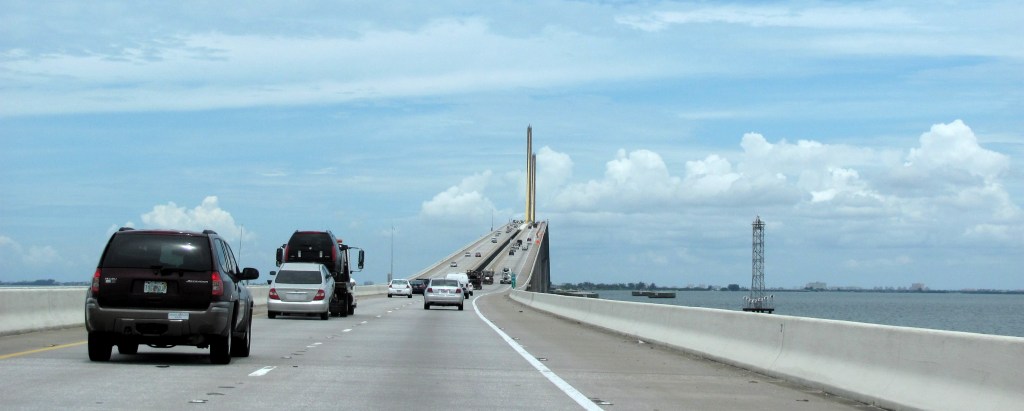
I have driven over the Sunshine Skyway Bridge a number of times when flying into Tampa and driving south. Here is an image of the roadway leading onto the bridge from 12 years ago:
Recently looking through used books at a local library, I learned that part of the prior span collapsed after being hit by a boat in 1980:
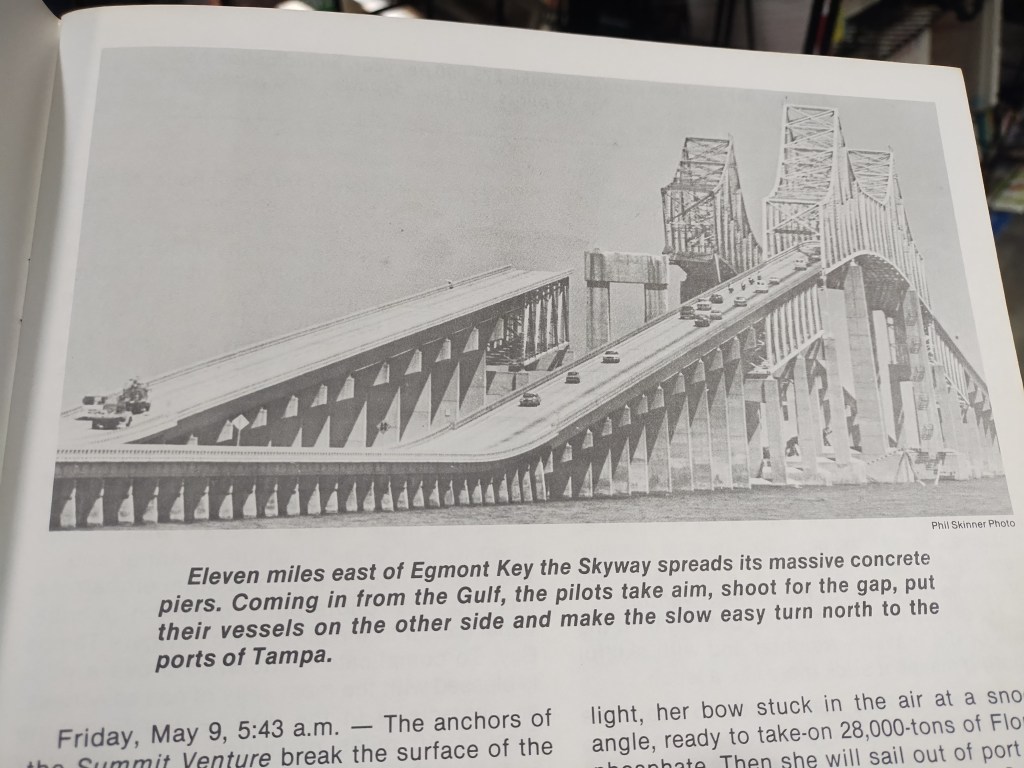
Wikipedia’s description of the disaster:

The second incident came on the morning of May 9, 1980, when the freighter MV Summit Venture collided with a support pier near the center of the bridge during a squall, resulting in the catastrophic failure of the southbound roadway and the deaths of 35 people when several vehicles, including a Greyhound bus, plunged into Tampa Bay.[13] Traffic was diverted onto the surviving two-lane span for several years until the replacement Skyway Bridge was completed, at which time the old bridge was partially demolished and converted into two[14] long fishing piers.

This is a significant local event that I had not heard of before. Such events are rare and likely stick in people’s memories for a long time. But as a visitor to the area, even one who has been there at least a few times, I did not know that this bridge had once collapsed.

What else am I missing when visit places near and far? In my research on suburbs, I have focused on key moments involving character, times when communities had public discussions about the choices they faced. Looking back, it was clear that these choices then shaped subsequent decisions and the character of the community.

Could local disasters have a similar effect on local character? Catastrophic events can rally a community, impacting people far beyond just those direct affected. Do people remember when they heard about the bridge collapsing? How many people wondered about their own drive over the bridge?

The most likely ways I could imagine finding about such events is either through reading about what happened or talking with someone who lived in the area. And some events might be more important than others; a major hurricane in an area is going to have a larger effect than a smaller matter.

A new bridge in Wheaton highlights problems with the railroad tracks, north-south routes

The Wesley Street bridge in Wheaton recently reopened after being completely rebuilt. Here is how it was changed:

The project involved several components including demolishing the existing bridge and reconstructing the approach roads, according to a press release..

A stoplight has been added where Manchester Road, Bridge Street and Wesley Street intersect, and a change in traffic pattern will allow drivers to turn left onto Bridge Street. This turn was previously prohibited due to the structural deficiencies with the old bridge, the release said.

The new structure also does not have weight restrictions, opening it up to emergency vehicles, school buses and trucks.

This is the only news story online I could find that actually had a picture of the bridge (though it is not a great angle to show off the new road bridge). Particularly compared to the old bridge, the new one has some nice styling and is a nice addition to the landscape.

But the reopening of the bridge also highlights two long-running issues in Wheaton:

1. This is the only bridge/underpass near the downtown and when the bridge is out, drivers would have had to go west to County Farm Road and or to the east side of Glen Ellyn to avoid an at-grade crossing. For decades, the City of Wheaton has looked at possible plans to avoid the railroad tracks downtown. Unfortunately, any major construction would have altered the existing buildings near Main and Front Street, the heart of the historic downtown. (Wheaton has approved plans for a pedestrian underpass at Chase Street but this requires losing an at-grade crossing plus it is east of the downtown.)

2. One possible bridge/underpass solution touched on another issue: the lack of north-south routes through Wheaton. This is partly a legacy of the hub and spoke model of the Chicago area where railroad lines (and Wheaton was built on the first one) radiate out from the center of Chicago but the connections between these lines are rare. Several decades ago, the city considered linking up Naperville Road, which dead ends just south of the railroad tracks to Main Street so that there would be a single major road through downtown Wheaton. Again, this would have required a lot of work so plans never moved forward. Another option was to push Gary Road further south but this also would have required a lot of work. While this bridge is helpful in navigating around the railroad tracks, it still requires driving around the downtown and isn’t part of a north-south path through the city.

A new bridge just beyond Hoover Dam

The road from Phoenix to Las Vegas crosses right over the top of Hoover Dam, one of the engineering marvels of the United States. Now travelers have a bypass route: a new bridge, the second tallest in the United States, was recently completed allowing travelers to avoid the slow, two-lane road over the dam.

Read more about the project at its official page.

Will the new bridge include guides who will tell you “take all the Dam photos you want!”?

A battle over replacing a bridge

The Ambassador Bridge linking Detroit and Windsor, Ontario has drawn attention as public officials discuss building a new bridge instead of undertaking costly repairs. The twist: the existing bridge is privately owned. Both the private owner and public officials are discussing where they might build a new bridge – the private owner wanting one under his control, the public officials wanting one under their control.