Castle houses and McMansions

How might a large suburban house that looks like a castle fit the definition of a McMansion?
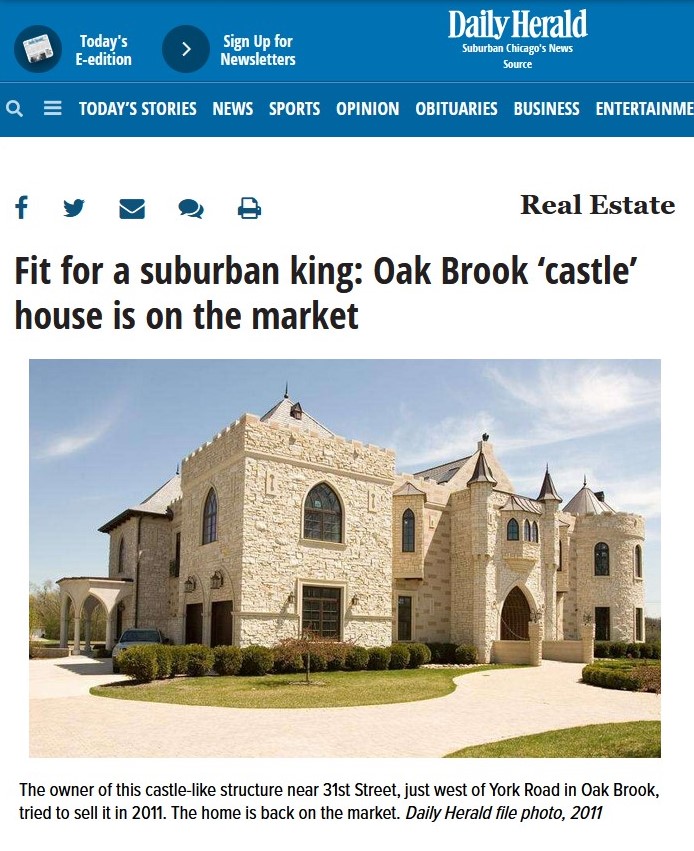
The home is large, roughly 12,000 square feet. It has lots of rooms and amenities:

The five-bedroom, seven-and-a-half-bath house, which is in the 3000 block of Lincoln Street, features a master-bedroom suite that takes up about 2,500 square feet. The listing says the house is 12,000 square feet.

It has a wine cellar, a movie-screening room, room for a pool table and a Ping-Pong table, a bar and an exercise area, all in the basement, an outdoor swimming pool, and a four-car garage.

This is the first trait of McMansions: they are large. I have suggested that being over 10,000 square feet should be considered mansions as they are beyond McMansions.

The other primary trait that might connect this home to McMansions is the architecture. It is a suburban home intended to look like a castle. Is it a pastiche or gimmick? How about the quality of the construction?

The walls average more than 20 inches thick, and there is 10-inch reinforced concrete between the floors.

Perhaps the builders were serious about making this a castle? This may not be the builder-designed cookie-cutter home that McMansions are often said to be; this could be a house more carefully designed to look outside and inside like a castle.

Thus, I am inclined to suggest this is not a McMansion castle. It is a mansion castle designed in a more coherent way.
“A man’s home is his castle,” McMansions, and the “castle” that houses a McDonald’s

Let me try to put together a few ideas:

  1. Americans tend to subscribe to the phrase “a man’s home is his castle” and all that means for a private home owner.
  2. Plenty of Americans like McMansions, large homes with dubious architecture often found in sprawling neighborhoods or as much larger houses compared to their neighbors.
  3. McDonald’s is a famous American brand and helped give rise to fast food that goes well with driving and the private single-family homes of suburbia.

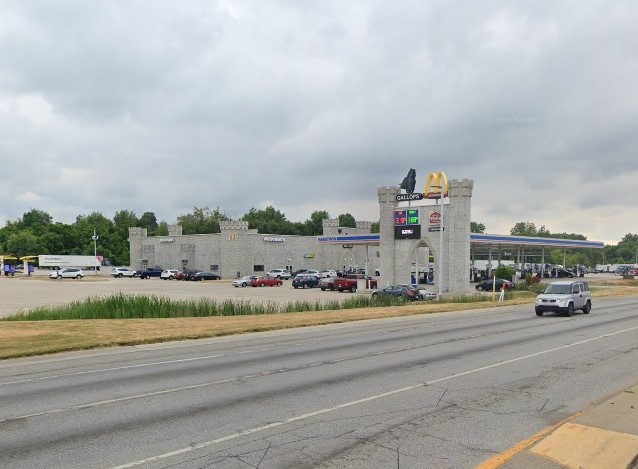
Put these together and you have a McDonald’s in a castle in northern Indiana:

Image from Google Street View

Only in America might someone build a gas station castle (it looks like a castle but in a McMansiony way) that contains a McDonald’s. I wonder if it attracts any more customers just because it is a castle.

(This building has apparently been around a while but I recently saw a story about it that caught my eye because I have seen other castle gas stations in other northern Indiana trips.)

A suburban McMansion that looks like a castle

This is the sort of McMansion that can give the whole category of large suburban homes a bad name:

Words. There are none to describe this suburban mansion. This thing is literally a castle with a three car garage. We imagine you may be just as confused as we are, but there’s just something about being the king of this 10 acre domain that could be appealing to the right buyer. Built in 1990, this three story castle is no Neuschwanstein, but with four bedrooms and five and a half bathrooms spread over 8,500 square feet, you could lord over all of the other McMansions in the suburbs. Some of the more exciting features of the home include a swimming pool fit for royalty, a separate 10,000 square foot heated barn with eight horse stalls, and a spiral staircase in the master bedroom that leads to a freakin’ private turret overlooking the estate. This mansion-castle was initially listed in June 2011 for $1.8 million, and after taking three price cuts the home was removed from the market last December. It made its return to the market last Friday with an ask of $1.099 million and an option to purchase a total of 39 acres.

Quite the home. At least the castle motif is pretty consistent all the way around the house – not too much of an architectural mish-mash, just unusual to start.

Given the size of the home and property, it seems relatively cheap. However, it is only 59.5 miles to the middle of Chicago’s Loop…

Hiding an illicit castle behind a tarp and bales of hay

An English man built a castle without a permit and successfully hid it for several years:

In 2001, Fidler began constructing the home, which is now called Honeycrock Farmhouse and resembles a castle, but he did not get permission to build it from the Reigate and Banstead Borough Council. He secretly lived in the castle, which he hid under a large blue tarp and behind giant 40-foot-high bales of hay. In 2007, Fidler was ordered to tear down the four-bedroom home.

The guidelines from the council state that any structure built without planning permission but unchallenged for four or more years does not have to be demolished. Reigate and Banstead refused to grant retrospective planning permission, and after six years of fighting through the appeals system, Fidler and his wife, Laura, are being told that the four-bedroom castle must come down. The high court’s reasoning is based on the fact that Fidler kept the home concealed and he “set out deliberately to deceive.”

The legal issues could be interesting but I’m more intrigued by the fact he was able to hide this home for years with a tarp and hay bales. A story from 2008 has both a picture and helps answer the question of whether any neighbors noticed:

After building the castle on the site of two grain silos at a cost of £50,000, he and his wife Linda went to extraordinary lengths to keep it secret. That included keeping their son Harry, now seven, away from playschool the day he was supposed to do a painting of his home in class.

“We couldn’t have him drawing a big blue haystack – people might asked questions,” said 39-year-old Mrs Fidler.

Mr Fidler, who has five children from a previous marriage, said: “We moved into the house on Harry’s first birthday, so he grew up looking at straw out of the windows.

“We thought it would be a boring view but birds nested there and feasted on the worms. We had several families of robins and even a duck made a nest and hatched 13 ducklings on top of the bales.”

But neighbours were unimpressed.

One said: “Nobody thought anything of it when the hay went up. It was presumed he was building a barn or something similar.

“It was a complete shock when the hay came down and this castle was in its place. Everyone else has to abide by planning laws, so why shouldn’t they?”

This seems like a place where neighbors leave each other alone.