Reporting the average credit card debt by household tells us something – but the median might be better

Headlines yesterday reported on a rising average credit card debt among American households:
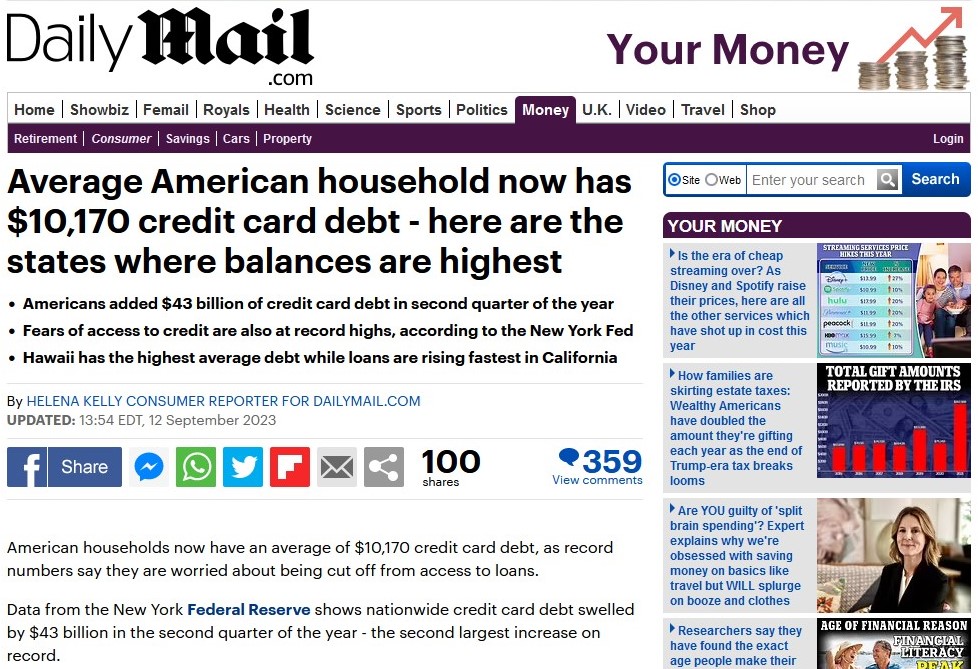
Is the average the best measure? With credit card debt possibly ranging from $0 to who knows how much, is the average a good measure of what is typical?

Previous data I have seen suggest the average might not be very helpful. A July 2023 story based on survey data reported this:

A recent GOBankingRates survey found that 30% of Americans have between $1,001 and $5,000 in credit card debt, 15% have $5,001 or more in credit card debt and about 6% have more than $10,000 in credit card debt.

From 2022 data:

Unfortunately, most people with an active credit card account don’t always pay their bills in full. A November 2022 LendingTree survey found that just 35% of cardholders say they always pay their credit card balance in full every month, while 65% say they carry a balance at least some of the time. Nearly half (46%) of those cardholders who have card debt say it would take them at least a year to pay it off.

And tables on this site based on 2019 Federal Reserve survey data suggest the median credit card debt is quite a bit lower than the average.

I am guessing the median credit card debt is a better measure of the typical debt as it better accounts for all the households without any credit card debt. There is a place for the average or the total amount of credit card debt, particularly if one wants to emphasize the growing amount of debt.

Is Visa a network more than a credit card?

Visa has a new campaign where they say they are a network. Here is what it looks like on their front page yesterday:

What is a social network? Here is how one sociology source talks about social network analysis:

Social network analysis is a way of conceptualizing, describing, and modeling society as sets of people or groups linked to one another by specific relationships, whether these relationships are as tangible as exchange networks or as intangible as perceptions of each other.

Visa argues that they connect people. Because people can use Visa at a wide range of stores, restaurants, and other settings, this brings people together. Imagine all of these organizations as different nodes in a network and Visa provides the connecting link. Without Visa, they would not connect.

Yet, is the social network sustained by Visa or used by Visa? Now that the network exists, Visa claims they are the network but similar things could be said for Mastercard or paper money. Without Visa, would many of these actors still connect, perhaps through other economic means?

It would be interesting to know whether and/or this economic network facilitates other kinds of network interactions. Does Visa use lead to new social networks? Is this not just about economic exchange but also exchange of information, experiences, and culture? This gets at larger processes, like globalization, that depend on familiar economic means across places.

Inequality due to credit card fees

A study from the Federal Reserve Bank of Boston argues that credit card reward programs contribute to income inequality. According to the Yahoo story:

Merchants usually don’t charge different prices for card users to recover the costs of fees and rewards, but instead, mark up the prices for all consumers.

As a result, people who pay cash — and who are more likely to be lower income — end up subsidizing those who pay by credit card…

After accounting for rewards paid by banks, households who earn more than $150,000 annually receive a subsidy of $756 on average every year, while the households earning $20,000 or less pay $23.

On one hand, this seems fairly obvious: those with more money to spend will use credit cards in order to earn more rewards. On the other hand, the impact on prices of the fees on business owners pay to the credit card companies is generally hidden.

Perhaps more places could offer discounts for people who pay in cash? The only time I have encountered this on a large scale is at gas stations in New Jersey.