Photo essay demonstrating LA’s mansionization

Here is a photo essay that shows the incongruity of a number of teardown McMansions in Los Angeles:

A developer wants to make as much money as he can as quickly as he can, where the only people whose feelings or quality of life he cares about are himself and whoever buys his newly-built mansion. A normal, thinking, feeling person could find many reasons why she would not want to rob her neighbor of privacy or sunlight by building a looming addition onto her house, with perhaps the most powerful reason being that her neighbors would hate her for it. A developer who will never live in a house he has built doesn’t have any relationships with neighbors to preserve. He actually stands to benefit from being indifferent/contemptuous to neighbors’ concerns, especially if it means he is able to build a bigger, more expensive, more obtrusive structure without the impediment of a guilty conscience. And don’t forget the long, noisy, messy, utterly unpleasant experience of living near a house under construction…

And that’s perhaps the biggest danger of mansionization. Regardless of what you think about mansionization and how it should or shouldn’t be regulated, there’s something about it that I’ve found to be consistently true.

When the first mansion goes up on a block of more modestly-sized homes, it sticks out like a garish eyesore. But if a second mansion is built on the same block, that first mansion suddenly doesn’t look nearly as big and out of place as it did before…

2015-07-01-1435742962-2381680-3inaRowGOOD.jpg
Three of a kindAnd at that point, the entire block might as well be mansionized — and chances are it will be. Having one mansion next to you is bad enough, but if the house on the other side of you gets mansionized, blocking sun and privacy from two sides, who would want to stay? Better to take what you can get and sell, leaving the house to a developer or new buyer who would inevitably go big — and another reminder of the now “old” neighborhood will be gone.
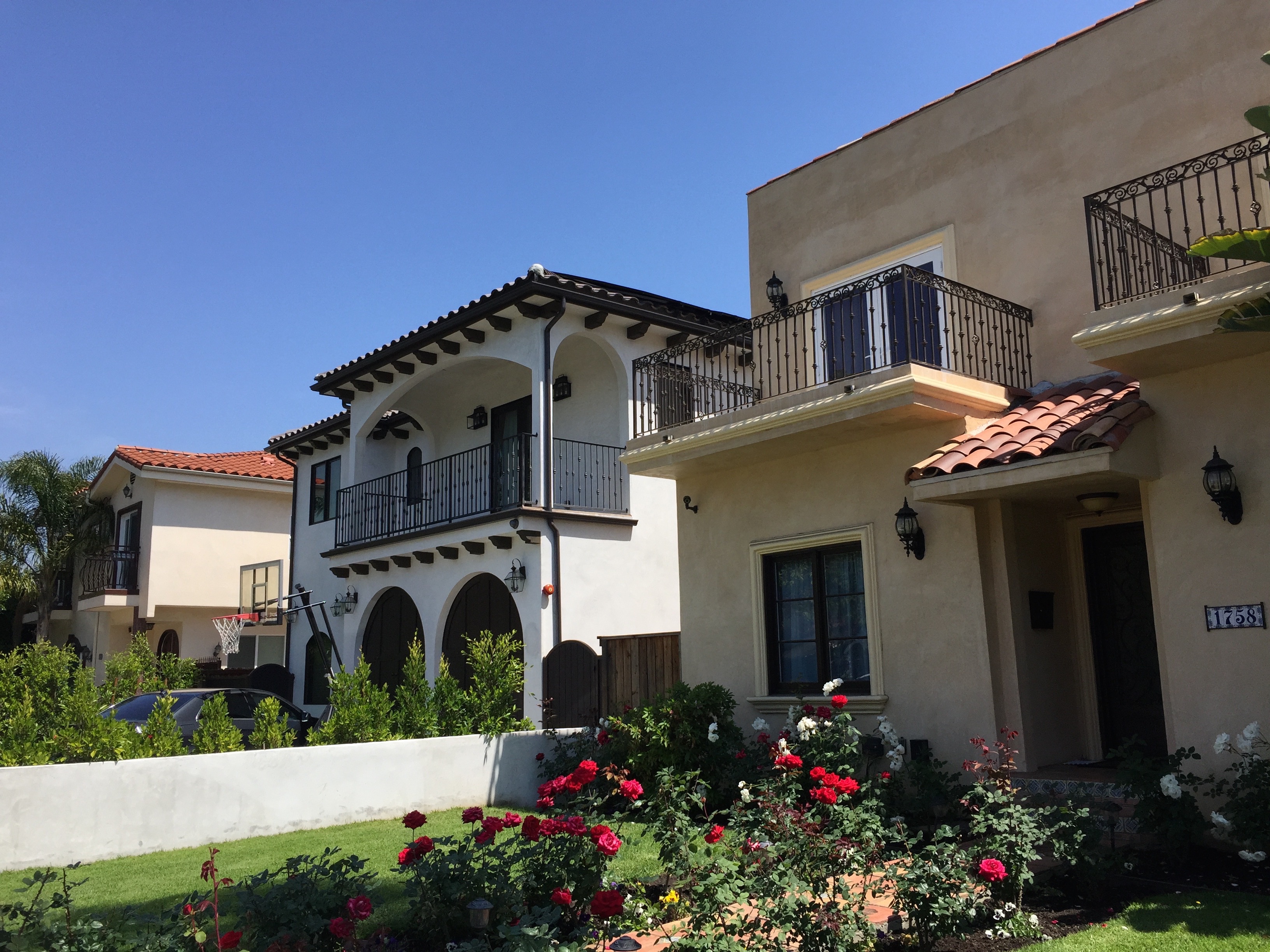
The critique of these new homes focuses on three areas:

1. It is often developers, and not neighbors, who go forward with the oversized homes. Neighbors might be more sensitive to the needs of others but developers are simply trying to maximize the property for profit. This may be true though there are plenty of cases where people buy properties with smaller homes and then make the decision to build a huge home. Developers aren’t the only ones to blame here.

2. The architecture and design of these new large homes are lacking. The homes are unnecessarily large and depart from traditional Southern California styles (stucco, clay tile roofs, etc.). These new homes clash with the older, smaller homes.

3. McMansions spread like a contagion: once a neighborhood or block has one, newer ones are soon to follow. The hint is that the teardowns need to be stopped at the start. A number of LA neighborhoods have been pushing for housing restrictions. But, it may be that one of these homes has to be built before neighbors really rally around the cause.

Rising development costs in American cities

It is getting more and more expensive to build new developments in American cities:

Land costs in the urban cores have dramatically escalated, making it difficult for developers to find developable parcels that pencil. Adding to the issue of expensive land prices, in December 2014, the Wall Street Journal reported that construction costs are rising faster than the inflation rate: the U.S. Labor Department’s consumer price index had risen only 1.3 percent above the previous year, while the construction index was higher by 5.2 percent.

Land is scarce and expensive

In most major U.S. urban markets, the cost of land has risen aggressively, in line with the greater demand for urban living by millennials and empty nesters. In Los Angeles, for example, land for industrial developments—many of which are changing from industrial use to residential mixed-use—have averaged approximately $23 per sq. ft. at the beginning of 2014 and  by year‘s end, asking prices were as high as $32 per sq. ft. There has been and continues to be keen competition for every developable site, with the urban core expanding into previously blighted areas.

Current shortage of construction professionals and skilled labor

Construction employment was disproportionately affected by the recession. As a result, many construction professionals—both labor and management—left the industry. Across the country, there are 1.4 million fewer people employed in construction than there were at the peak in 2007, according to the U.S. Bureau of Labor Statistics. Many in the construction industry who lost their jobs during the recession have found new careers, and many skilled tradesmen left the industry all together. Compounding the shortage is the lack of high-quality training available to young people entering the construction workforce today…

Materials costs have little impact

Countering some of the rise in construction costs is the fact that most materials costs, apart from glass, have not greatly increased. Associated Builders and Contractors Inc. reported in April 2015 that, although concrete products prices are up 4.1 percent on a yearly basis, total input prices have fallen by 3.6 percent since the same time last year. For example, iron and steel prices are down 11.5 percent and softwood lumber prices are 7.4 percent lower than one year ago. Current crude petroleum prices are down 55 percent and crude energy materials prices are down by 43.7 percent from the same time last year.

If this is the case, this could have negative consequences in a number of areas including: it might take more to get the construction industry going to overcome these costs; this limits the incentives for developers to construct cheaper or affordable housing (such as starter homes); and only the really wealthy can purchase and utilize urban land.

Paying for Austin’s permitting backlog which may be partly due to its McMansion ordinance

Several years ago, Austin enacted an ordinance intended to reign in McMansions. But, that ordinance may have contributed to a backlog of permits which the city is now trying to tackle:

The directors of the city’s planning and permitting departments estimate it would take $400,000 to hire temporary workers and pay for overtime to eliminate the current backlog in the next 90 days…

Next year the department plans to ask for $1.6 million in additional money to fund 11 new positions. This memo comes as the city is just launching its annual budget process. Over the next few weeks, every department is going to be compiling a budget wish list, which eventually is sent to the City Council…

Some of the blame for the three-week delay in residential planning and permitting was placed on the “complexity” of the city’s McMansion ordinance, which limits housing sizes in certain neighborhoods. “As such the department will recommend changes to the (land development code) that will simplify the McMansion provisions and will extend turnaround times for those types of reviews to ensure that there is sufficient time to perform a thorough review,” the memo states.

The planning and permitting departments, which used to be one department called Planning and Development Review, are responsible for approving all real estate development in the city, from housing remodels to new subdivisions.

It can take some time to see how ordinances actually play out and perhaps the initial ordinance can be “smoothed out” for this sort of process. Communities can also run into this problem if they have high rates of growth. Austin is a desirable place for construction so it may make sense that it has a lot of permits to deal with.

I wonder how much these decisions to speed up the permitting process are driven by builders and developers who generally want to move as quickly as possible. If there is a bit of a delay in the process, would these builders actually cancel their projects or go elsewhere? Builders and developers are often powerful and are viewed as important harbingers of economic growth. Yet, isn’t Austin so desirable that a delay won’t harm things much? Granted, lots of people might want more efficient government but that also may just require more government employees.

Over 2,000 new housing units in CHA proposal for Cabrini-Green site

Redevelopment at Cabrini-Green continues with the Chicago Housing Authority’s unveiled proposal this week for over 2,000 new housing units:

Last night, the Chicago Housing Authority formally unveiled its most recent and fully detailed proposal for the nearly 65 acres of land that once belonged the massive Cabrini-Green housing project. Earlier this year, the CHA unveiled a draft plan for the site, which sought to draw out an idea of where housing, retail and new park spaces would be located, however, last night’s meeting offered a clearer picture of how many housing units are planned for the area. The large area will be redeveloped in three phases, and will ultimately produce 2,330 to 2,830 new residences.

Currently, developers are swarming in with new retail and apartment projects, but some are arguing that the new plans don’t offer enough density. Private developers will compete to build new structures on the large parcel of land, with the first phase delivering 970-1,270 units, according to DNAinfo. The balance between market rate, affordable and public housing has not been unveiled, however the CHA could get started on the first as early as late next year.

This is valuable land as larger parcels like this, particularly on the North Side and near other desirable locations, are rare. I would imagine there will be no shortage of developers who have ideas of how lots of money can be made. Of course, this was one of the arguments of residents and critics of the plan to tear down the high-rises: was this really about providing better public housing and housing opportunities for residents or was this about opening land on the North Side for developers?

Developers give reasons why they won’t construct starter homes

Here are some of the reasons given by developers regarding their lack of interest in starter homes:

The market for new “starter homes” is drying up, mostly on the supply side. As credit markets recover, there are more and more people who could be buying their first homes … if only builders could build them. But for a host of reasons, they can’t:

  • Materials costs have risen.
  • They lost a lot of their labor force during the economic downturn.
  • Communities entitled large lots during the boom, and now they won’t zone them for smaller parcels.
  • Cash-strapped local governments have raised permitting and other fees.
  • Building codes and other requirements make it harder to build cheap.

This makes it extremely difficult to build a house for less than $200,000 in many places, which is a hefty multiple of local median incomes.

Three quick responses:

1. I know this doesn’t get much discussion in many industries but when they say it is difficult to build for less than $200k, what exactly does this mean? A home at that price won’t meet their profit goals? What kinds of profits do developers and builders make at the lower end of the housing market as opposed to the higher end? Builders can’t make any money off new started homes or they can’t make enough money for them to see it as worth their time?

2. As noted, communities have some influence on this process. How many are really willing to zone for starter homes and/or have different guidelines for starter homes?

3. Isn’t this an opportunity to construct homes more efficiently? It sounds like there is some turmoil in costs – material, more uncertain labor, higher fees and requirements – but this is where the housing industry could find some new solutions.

Suburban communities add business district taxes but what are developers doing with the money?

A number of Chicago suburbs have instituted business district taxes that partially funnel money to developers:

The business district tax is becoming more common as municipalities struggle to recover from the Great Recession and loss of shoppers to the Internet. Leaders in both Roselle and Villa Park initiated 1 percent business district taxes within the past year, the maximum rate on districts that cannot exceed 1 square mile. In some suburban locations, the additional business district tax can raise the sales tax to 9.25 percent, equal to the sales tax in Chicago…

Bloomingdale has two such districts. One adds a 1 percent sales tax to purchases inside Stratford Square and another adds the same percentage at Indian Lakes Resort, where it’s used to help pay off $4.8 million in village-issued debt that went to the resort for improvements…

Last year, the village paid the owners of the mall $1,199,151, which is more than 95 percent of all the money generated by the business district tax. Since the tax was implemented, the village has paid the mall owner more than $8 million. According to village finance records, the mall owner still is owed more than $11 million…

Lombard has a similar deal with its mall owner. The village instituted a 1 percent business district tax almost a decade ago. It helps push the sales tax rate at Yorktown Center mall to 9.25 percent.

Lombard’s deal allows up to $25 million in business district taxes to be rebated to Yorktown’s owner through 2024, in exchange for an addition that was built onto the mall where an abandoned Montgomery Ward once stood. So far, the mall’s owner has received almost $4.2 million from the business tax…

Taxpayers in Oakbrook Terrace are the ones with skin in the game. The city borrowed nearly $8.2 million to spur development of the Oakbrook Terrace Square Shopping Center. City officials did not return calls seeking comment about the city’s stake in the shopping center. However, according to the city’s budget documents, the investment has yet to pay off.

Given the problems facing the American shopping mall as well as the financial difficulties facing many suburbs, perhaps these suburbs think such taxes are necessary to help keep sales tax generators in the community. Yet, if the extra money generated is given to developers who then line their own pockets, how much is the local taxpayer helped? This raises similar questions to giving corporations tax breaks to locate their headquarters or facilities in suburban communities. Few politicians or residents want to lose a potential tax revenue generator – especially a large shopping mall, even if they are relatively ugly and detract from local businesses given their reliance on chain stores – but there is often little public discussion of the trade-offs involved with the tax breaks.

Are there suburban shopping centers that don’t have such a tax and if not, do they advertise to this effect?

Is smart growth inevitable?

A piece titled “Why Are Developers Still Building Sprawl?” explores the fate of smart growth in American urban areas:

It may be surprising to hear that so little has changed in the homebuilding industry since the recession, especially in Las Vegas, one of the epicenters of the housing bust. After all, low gas prices aside, surveys suggest that both Boomers and younger generations are interested in living in more urban places where they don’t have to spend so much time in the car getting to and from work. They also don’t mind smaller homes, especially if they’re close to public transit or retail or restaurants. And studies have shown that sprawl has negative health impacts: People who live in far-out suburbs walk less, eat more, and exercise less than those who live in urban environments.

Urban planners and “smart growth” advocates argue that builders should eschew the practice of buying empty land further and further out and building on it, and should instead build more compact, walkable communities near public transit, rehabbing existing land to fit new projects. Doing so is important for the environment, they say, and will save valuable resources and money in the long run…

“Exposing” sustainable development might seem laughable, but it points to a growing divide about how different people think Americans want to live in the future. Do they want to continue to live in spread-out, single-family homes with lawns and garages and spare bedrooms? Or do they want smaller, compact houses where they can easily hop on a train or walk to the coffee shop, without even needing a garage, or a car to park in it?…

Other areas may continue to eschew ‘smart growth,’ and just as America is divided politically, it could become a more divided country in the way its residents live. People in cities such as Washington D.C., Boston, and Seattle, will want more walkable developments, while consumers in what Leinberger calls “the laggards,” including Phoenix, Dallas, and Las Vegas, will continue to live in sprawling suburbs.

But it’s also possible that Boomers and Millennials in the laggard cities will come around. After all, even in Las Vegas and Atlanta, some builders are starting to shift their mentality. Zappos founder Tony Hsieh has poured $350 million into downtown Las Vegas, creating a shopping center built from shipping containers, mixed-use residential development, and a host of walkable amenities like a donut shop and a bookstore. And in Atlanta, a developer is in the midst of converting a former Sears building near downtown to a mixed-use community of apartments, restaurants, and retail.

Three major sets of actors are involved here and it is not clear to me that they all will want smart growth:

1. Politicians. All sorts of zoning policies, tax structures, and other things would have to change to adjust to smart growth. If politicians did want more smart growth, they could adjust policies accordingly. However, they do answer (at least nominally) to voters. While some may talk about this as a free market issue, municipal policies always help dictate housing options.

2. Builders/developers. The short answer is that building larger homes right now offers more profit. Denser projects invite headaches like opposition to redevelopment, bureaucratic red tape, and possible selling smaller units or spaces.

3. Consumers. Would they buy denser, smaller housing if this is what builders provided? Maybe but don’t discount the long-standing American commitments to the single-family home in the suburbs. Many Americans like their private spaces and may not be terribly interested in public spaces or sacrificing for the community. Tastes don’t change overnight though new policies and housing choices could steer people in particular directions.

All together, it would take time, coordinated efforts, and decisions from key actors to truly push smart growth policies. Even then, it is not inevitable that Americans would accept this as the desired outcome, even if it has certain positive outcomes.

Bad building names in NYC

Curbed has put together a list of some of the worst building names in New York City. Here are some of the contestants:

Weird Spellings of Addresses

260N9 leads us into our first category: buildings that are almost just going by their addresses, but have decided to randomly spell out numbers, or abbreviate and/or combine words to create some monstrosity that no one will ever say out loud. 2ND7TH is a recent offender in this category, as is Five FortyOne, and, less recently, Twenty9th Park Madison. These types of buildings also sometimes like to combine a random word with the number from the address, such as Colony 1209, which sounds like it’s on the moon.

Human Names

Another very common approach often taken by building namers is to name them as one would a human child, with a “the” in front. This can result in condos that sound like your grandfather (The Seymour, The Leonard) or a pop star (The Adele, The Robyn) or…just some guy…that you live inside of. (That one, The Nathaniel, gets an additional dishonorable mention for being named after the protagonist in an Ayn Rand novel.)…

Anything With the Word “Mews”

A mews is a row of stables and carriage houses constructed around a paved courtyard. The few that still exist in New York City have, for the most part, seen the stables torn down and replaced by houses which essentially now exist on a private and secluded dead-end street—a rarity, obviously, in Manhattan. This makes them quite coveted. It has also led a number of condo developers to call their buildings, erroneously, Soho Mews, Chelsea Mews, Carlton Mews, etc.

Names That Sound Like Things They’re Not Supposed To

Had no one involved in the creation of Jade8 ever heard of J-Date? Did no one on the development team behind Mantena think to Google that word? Other honorable mentions in this category include BKLYN Air, which sounds like an off-brand sneaker, and MiMa, which sounds like something you call your grandmother. And then there’s the Isis Condominium on the Upper East Side (h/t to commenter newkyz). Though that one isn’t exactly the developers’ fault (it was developed in 2008), it has declined to change its name, unlike the Isis in Miami.

This list suggests buildings suffer from the same name problems that face subdivisions or suburban streets. Builders are looking to brand their construction so the names often deliberately invoke other liked objects, such as a well-regarded address (it’s the location to be in!) or the past (we’re invoking the grandeur of history!). Does the branding itself reveal much about the architecture or design of the building and its units? Probably not. Do the mews buildings have more garden/leisure space? Do the address buildings make a unique contribution to the neighborhood? Of course, more functional or accurate names would have to be longer and wouldn’t be able to quickly invoke such images.

The next step here in this analysis might be to look at the relative values of these different properties by name. Take two buildings in similar settings: does having mews in the title add value or would the owners be better offer with an address name?

Fighting the “King of McMansions”

Some well-known residents of Southampton Village, New York are opposed to plans for a new big house proposed by the “King of McMansions:”

What do commodities trader John Paulson, real estate tycoon Harrison LeFrak, CNN morning news show co-anchor Christopher Cuomo, and  President Dwight D. Eisenhower’s granddaughter Anne Eisenhower have in common?

They share an opposition to the “Farrelization” of their neighborhood in historic Southampton Village, where Joe Farrell has proposed building a 5,531 square foot house on a 1.2 acre parcel on Hill Street according to an article in Wednesday’s Wall Street Journal.

Dubbed “King of McMansions,” Farrell, who was profiled last summer in The New York Times is described as being “a local version of Donald Trump, without the history of debt, the lush hair or the insults.”

Mr. Paulson, Mr. LeFrak, Mr. Cuomo,  and Ms. Eisenhower are just a few of the 85 names who penned letters to a local village review board. The letter writers variously objected to “the size, scale, scope and ‘visual incompatibility’ of a speculative home” proposed for the vacant lot at 483 Hill Street—a neighborhood where ” nearly a dozen nearby residences are more than a century old and roughly half or a third the size.”

And who is this King of McMansions? A developer of big homes in the Hamptons:

But there is no surer sign that the big-spending ways that characterized the pre-financial crisis era have returned to the Hamptons than the blue “Farrell Building” signs multiplying across the pristine landscape here, along with the multimillion-dollar houses they advertise. It is a process some are calling “Farrellization,” and not necessarily happily.

“We’re as busy as we’ve ever been,” said Joe Farrell, the president of Farrell Building, during a recent interview and tour of his $43 million, 17,000-square-foot home here. The estate, called the Sandcastle, features two bowling lanes, a skate ramp, onyx window frames and, just for fun, an A.T.M. regularly restocked with $20,000 in $10 bills…

With a customer base composed largely of Wall Street financiers, Mr. Farrell has more than 20 new homes under construction, or slated for construction, at a time, making him the biggest builder here by far. He has plans for more, many of them speculative homes built before they have buyers.

Some of the biggest controversies about McMansions seem to take place in areas where residents have plenty of money. It is one thing when a teardown McMansion is constructed in an older neighborhood and less wealthy residents are pushed out as the housing stock becomes newer and more expensive. (At the same time, an influx of new big homes could also raise property values and give some options to cash out.) But, this is an example where everyone is pretty well off and it is more about the character of the neighborhood. Perhaps it is about old money versus new money, that an outsider is coming in with new plans and disturbing an area that others paid big money to buy into.

The “King of McMansions” is going to be a negative term for many people yet it also implies a level of success. I haven’t seen too many individuals tagged with such terms and even companies like Toll Brothers who were well-known for building McMansions didn’t necessarily acquire such monikers.

Discussing the dangers of retention ponds in Naperville

Retention ponds are plentiful in suburban developments as a means to handle excess water. But, officials in Naperville may soon look at regulations for retention ponds after a 6 year old recently drowned:

The pond, near the Glenmuir Luxury Rental Homes complex where Amer lived, reaches about 10 feet at its deepest point and is one of more than 200 bodies of water in Naperville — many of them man-made ponds created in recent decades to ease flooding when subdivisions were built, Naperville Fire Chief Mark Puknaitis said.

“Most of the ponds don’t have fencing or barriers,” Puknaitis said. “It’s highly impractical to do that with every pond. Even if you did, there’s nothing stopping somebody from scaling it.”

Several city council members agree that requiring fencing isn’t the best way to prevent future tragedies.

While fencing may seem an obvious way to prevent children from getting too close to retention ponds or falling in, Novack said there is a stormwater management reason not to install them: they block the flow of water during floods and slow the drainage process.

When single-family homes are constructed in the sprawling American manner, retention ponds are a necessity. Developing land and building homes often involves flattening land and disrupting the natural drainage. This is particularly an issue in swampier or low-lying areas where water already collected. They are so common that they are a ubiquitous “natural” presence that are often used as play areas or places to walk dogs. But while these ponds may seem natural, they are a carefully constructed part of the suburban infrastructure.

However, there are means by which to make retention ponds safer:

She said the recent trend toward letting natural vegetation grow along the shores of ponds helps to keep people — and Canada geese — away from the water and could contribute to increased safety.

So could using streams landscaped with native plants instead of large ponds to store water, Brodhead and Novack said.

In other words, it might take a little extra planning or effort but there are ways to “naturalize” the drainage. Communities could require developers to utilize these methods around retention ponds. And even if accidents in ponds are rare, it is hard to argue against safety in suburban settings.