Building up mental maps with paper maps and atlases

Paper maps and atlases may be more than just backups to digital navigation tools:
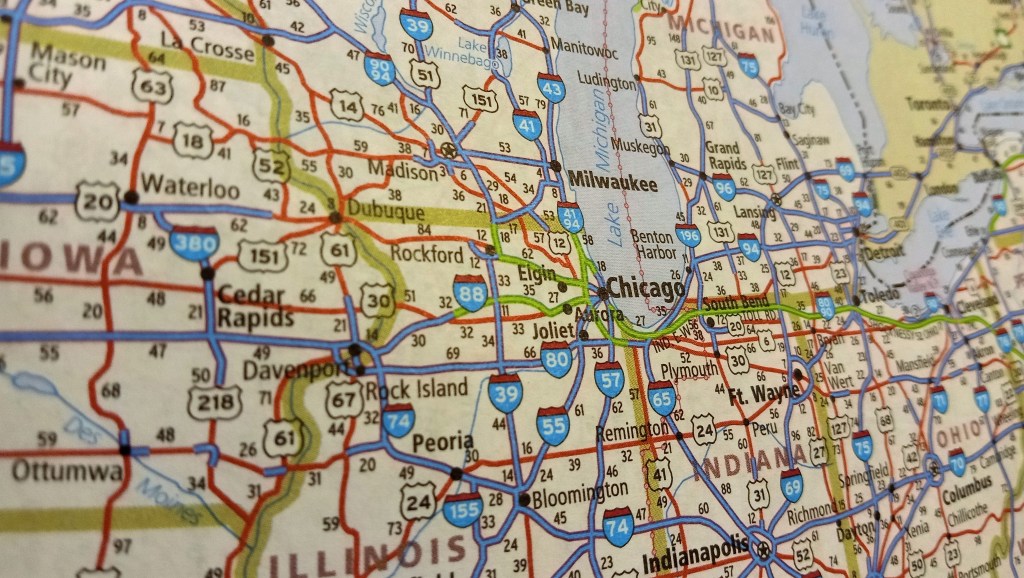
Apps are invaluable when you miss your exit on the interstate or need the quickest route through gridlock. But dispensing directions in 10-mile increments on a tiny screen is not the same as spreading a U.S. map out and visualizing a journey.

Everyone has a “mental map … made up of both factual information about a place and also our own understanding and imagination about the place,” Maitha said. Paper maps help build that mental map and provide spatial awareness, he explained.

All of these options are aids to help humans. With a paper map or Waze, the external object is helping a person make sense of the physical world around them. Our brains could use the help as we get our bearings.

My sense is that the digital devices are very helpful in immediate information – what is the next step I take? – but not so great in providing the big picture. You can see a list of turns or a broad map. But, their primary value is right in front of the vehicle. The paper atlas or road map provides the big picture while not saying as much about what is right outside the vehicle.

Just recently, I spent some time examining a 1718 map of North America made by a French cartographer. In working on some research involving these areas, the paper map provided a sense of how the French viewed this part of the world. It does not provide granular detail but it hints at what they thought was important.

Like some of the people interviewed in this article, I will keep both my atlas and my devices with me while driving. Until the device can unfold a larger image of the full scope of a journey, I want that option and will continue to enjoy maps and atlases.
Bringing a physical place to the brain in a mind palace

I heard about the idea of a mind palace years ago but this recent description reminded me of the interesting idea of putting a physical place into one’s brain:

Photo by EKATERINA BOLOVTSOVA on Pexels.com

The most popular technique to improve memory is the method of loci, also known as the mind palace (or memory palace). This ancient Greco-Roman technique can help you improve your memory in ways you never thought possible.

Greek and Roman orators memorized lengthy speeches by building structures (such as a palace) inside their imagination. They would then strategically place each word or idea they needed to remember in a specific location inside their mind palace. They could then later mentally retrace their steps and recall the details when they needed them.

This practice might then lead to physical changes in the brain structure:

Using MRI scans, researchers could see that mnemonic training elicited changes within the brain’s network. They also saw discernable differences in connectivity patterns that weren’t present in participants without training.

This reminds me of the idea of “distributed cognition” where humans use external devices to record information. Think of a notepad or a voice memo on a phone. The information is moved from the brain in acknowledgment that we cannot remember everything.

While the mind palace does not put the information outside the brain, it imports a device in which to record the information. It encodes it in the abstract concept of a building. Humans know what it is like to walk through buildings and/or follow directions to a desired goal. The conceptualized building is not real but it holds the information within the brain in a way that makes it easier to recall.

Physical structures do not just exist in a material reality, subject to construction, erosion, and other forces. They can live in our minds in ways that mean not just the information stored in them stays but also likely the buildings themselves live on there.

New phone, new laptop, and disoriented

I had the opportunity this past week to replace both my smartphone and my work laptop. One had to happen, the other was a scheduled replacement.

Photo by Life Of Pix on Pexels.com

Both experiences were disorienting in multiple ways. They required time that I did not necessarily have in my schedule to acquire the new device and set it up in ways consistent with the old devices. Because they are newer machines, they have some new options to consider. I was temporarily without access to each and what they provide access to in parts of the setup.

And the transition process went rather smoothly. Copying over contacts, apps, and files just took some time. I had to tweak a few settings but they now look and operate similarly (with some nice upgrades) to what I was used to before.

These are not just machines. For many daily tasks, they are extensions of my self. They enable my work and embody my work. They are distributed cognition devices – extending my ability to think, reason, and write – and portals to interactions with people and systems. For them to be altered or unavailable, even for a short time, shakes up my day.

Ultimately, I am glad to have the new devices. My daily activities are back on track. Almost all of the wrinkles of adjusting to new machines has happened. And I hope I do not have to do it again for a while.

Overblown concern about Google “replacing” or “destroying” our memory

The headlines read: “Google ousts brain,” “Google replaces the brain,” “Here’s how Google search is destroying our memory.” These are all based on a new study:

The Internet is becoming our main source of memory instead of our own brains, a study has concluded.

In the age of Google, our minds are adapting so that we are experts at knowing where to find information even though we don’t recall what it is.

The researchers found that when we want to know something we use the Internet as an ‘external memory’ just as computers use an external hard drive…

‘The Internet has become a primary form of external or transactive memory, where information is stored collectively outside ourselves.’

This an example of “distributed cognition,” the idea that humans use other sources to extend their brain’s capacity. In this case, memory space in the brain may be freed up by relying on Google and computers to store certain information. Instead of “replacing” the brain, Google is extending the brain and helping humans offload certain information that can helpfully be stored elsewhere. Google isn’t the first technology that allows this; so does the printed page. Rather than storing a bunch of arcane and typically unhelpful information in our head, we could look up basic information in a reference book.

Perhaps people are more concerned about Google itself and the idea that a corporation, an organization more interested in profit than our well-being, may be behind changes in our brain.