Enjoying late summer warm waters in Lake Michigan

A late summer swim in Lake Michigan can be exciting. It is early September or even later and you test out the water. Dip a toe in. See if it is warm. And sometimes it is. Warm enough to jump in, swim, play. Even if school has started or fall seems to have already begun (even if it is not “officially” started by the calendar) or municipal pools have already closed, the warm waters of the lake prolong summer.

As someone who has visited Lake Michigan throughout my life, these are good moments. Lake Michigan is not always warm enough for swimming, whether testing out the chilly waters at Memorial Day or finding that a change to a north wind overnight has cooled the water temperature too much.

There may be more late summer days like this in the future as the Great Lakes are warming:

Lake Michigan is heating up. The lake’s surface temperature has surpassed the running average dating back to 1995 nearly every day this year, according to National Oceanic and Atmospheric Administration (NOAA) data. And it’s not just one Great Lake. All five are warming. The massive bodies of water, which provide drinking water to more than 30 million people, are among the fastest-warming lakes worldwide, according to the federal government’s Fifth National Climate Assessment.

It’s a trend that doesn’t show any sign of slowing. As heat trapping-greenhouse gasses continue to accumulate in the atmosphere, the Great Lakes region is projected to grow warmer and wetter in the years and decades to come. Over a fifth of the world’s supply of non-frozen freshwater flows through the five connected Great Lakes, forming the Earth’s largest freshwater ecosystem.

Beyond a longer swimming season, might this lead to more Great Lakes tourism? Different conditions (algae, different fish, etc.) for swimmers and other recreational users of the lake? Will the lake remain an attractive place to visit?

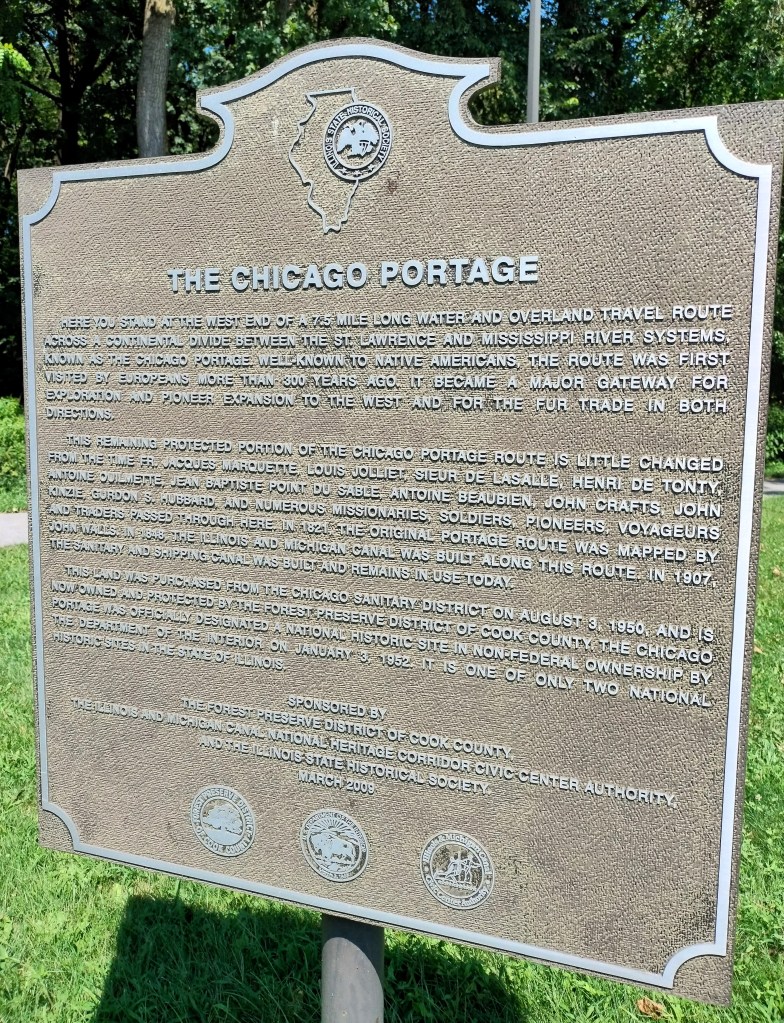
Commemorating the portage that led to the creation and flourishing of Chicago

I recently visited the Chicago Portage National Historic Site in Lyons, Illinois. Here are some images from the site:

The importance of traveling via water meant that portage sites were important. This site was one of the places where it was easier to move watercraft from the Great Lakes system to the Mississippi River system. It was not the only portage site allowing that connection but it became known and then improved on in the mid-1800s with a canal.

The site now is somewhat obscured off a major local road and close to a major interstate. The area is mostly industrial land with few houses nearby. Chicago is a transportation center but a portage is no longer needed. There are still canal waterways nearby but these have receded in importance to and status in Chicago compared to railroads, highways, and airports. Chicago is still a transportation center but a portage is no longer needed.

The Chicago Portage Wikipedia page has lots of details.

Stopping California and others from taking Great Lakes water

California may be facing a serious drought but the Chicago Tribune details how regulations have tightened access to Great Lakes water:

Can the Midwest repel demands from afar for its water? The eight states (Illinois included) and two Canadian provinces that border the lakes hope no outsiders can breach the invisible, 5,500-mile wall they’ve erected: In 2008, President George W. Bush signed into law — let us draw a breath — the Great Lakes-St. Lawrence River Basin Water Resources Compact. All eight states and Congress approved the compact, with the Canadians applauding. It’s intended to severely, although not absolutely, block new diversions of water outside the Great Lakes’ vast drainage basin (see accompanying map). A 1909 U.S. treaty with Canada also could thwart big diversions.

Whatever protection Washington giveth to any of us, of course, Washington conceivably can taketh away. Congress typically doesn’t meddle with regional water compacts. But yesterday isn’t forever: The steady erosion of U.S. House seats from Illinois and other Northern states to the Sunbelt invites peril if droughts punish those states. And the Chicagoan sworn to protect Lake Michigan may, um, evolve if arid Arizona tries to conserve water by outlawing construction of her dream retirement condo…

Yes, there’s hypocrisy for Chicagoans: This city reversed a river’s flow so Lake Michigan water would wash away its wastes. And many suburbs that draw from the lake sit outside its watershed; rain that falls on them flows to the Gulf of Mexico via the Illinois and Mississippi rivers. One mitigating factor is that water diversions in Ontario put more water into the lakes than Chicago flushes out.

The compact doesn’t cruelly forbid emergency outflows. David Naftzger, executive director of the Chicago-based Council of Great Lakes Governors, tells us it permits short-term humanitarian diversions if, say, a hurricane ravages water systems in Southeastern states.

In other words, the water isn’t completely protected but it would take a legislative act to start shipping Great Lakes water all over the country. This could become quite the political battle between Sunbelt and Rust Belt states. Which argument would win out: the Sunbelt has more people and potential or the Rust Belt has communities with much longer histories and might be more ecologically sustainable?

Two other quick thoughts related to this:

1. Interestingly, much of the Chicago suburbs are not in the Great Lakes basin as their water drains west to the Mississippi and to the Gulf of Mexico. This reminds me that the divide of the watersheds is not that far from Lake Michigan as Native Americans and traders would need portage over a ridge to get from the Chicago River to those flowing west (like the Des Plaines River). Yet, one group suggests over 75% of residents in northeastern Illinois get their water from Lake Michigan.

2. In another editorial on the same page, the Tribune noted that watching the drought in California could help remind Great Lakes area residents that water conservation should be a priority, even with the seemingly inexhaustible supply in the Great Lakes. There is no guarantee the Great Lakes will always exist.

A proposal to unite the Great Lakes region

The idea of the megapolis describes uniting metropolitan regions. But what about bringing together an entire region? A Chicago architecture firm has made a proposal to bring together both the American and Canadian sides of the Great Lakes:

The bi-national blueprint from Chicago-based Skidmore, Owings and Merrill is still in its infancy, but the concept has garnered support from several mayors in Canada and the United States. The proposal calls on the two nations to re-imagine the Great Lakes and St. Lawrence River region as a shared space, where Canadians and Americans work together to protect waterways, ease traffic congestion, promote tourism and develop new economic ventures…

The bi-national vision, presented this week at a global green-building conference in Toronto, isn’t so far-fetched. The Brookings Institution in Washington and Mowat Centre in Toronto have been studying the idea, consulting 250 business, government and community leaders. The public-policy think tanks will present their regional blueprint at an international Great Lakes water-quality meeting in Detroit next week…

The Great Lakes-St. Lawrence River region is massive, encompassing Ontario, Quebec and eight U.S. states. It contains about 84 per cent of North America’s fresh water and almost 18,000 kilometres of lake frontage. Nearly a third of Canadians and about a tenth of Americans live here, in more than 15,000 towns and cities…

But with the manufacturing sector waning in many parts of the Great Lakes and glum forecasts of a deepening economic downturn, Mr. Hjartarson says the region should forge closer ties to capitalize on its assets. Those would include top-notch educational institutions, a wealth of corporate head offices and a population of 105 million people. New industries could be created through stronger co-operation. Mr. Enquist, the urban designer, points to renewable energy and green technology as possible opportunities for the region.

This article seems to suggest that environmental concerns, such as clean water and air, would provide the backbone for this partnership with later opportunities for joint infrastructure and economic initiatives.

My biggest question: how in the world could all of the government bodies agree so that things could get done within this partnership? Take the Chicago region as an example: there are many separate taxing bodies so putting together regional plans is very difficult. This proposal would up the ante, putting together many metropolitan regions, Chicago, Milwaukee, Grand Rapids, Detroit, Toronto, Cleveland, Toledo, Buffalo, Hamilton, Montreal, Quebec, and more. And this doesn’t even account for two different nations that would need to make concessions for the region rather than national interests.

On the other hand, this sort of proposal  should be applauded for pushing a new way of thinking about things even if they may be difficult to implement. It could lead to some interesting questions. Again taking Chicago as an example: is Chicago more tied to other Midwestern cities like St. Louis, Indianapolis, Minneapolis, and Omaha or more to Great Lakes cities?

It is also intriguing that this proposal comes from an architecture firm. Have urban planners or government types not thought of something like this?