
Here is a sign of increasing diversity in the increasingly complex American suburbs: the world’s second largest Hindu temple just opened in suburban New Jersey:
The official inauguration for BAPS Akshardham, the massive 87,975 square-foot, 191-feet tall temple in Robbinsville, New Jersey, is scheduled for Sunday…
Spanning 185 acres, the grand temple is dedicated to Bhagwan Swaminarayan, a revered Hindu spiritual leader from the 19th century.
The temple is made of stoned of Marble, granite, and limestones – sourced from various places in Europe and shipped to India, where artisans carved intricately.
Stone pieces were then shipped to the U.S. and assembled by volunteers from all over the world under guidance of artisans from India…
The New York tri-state area is known for its large Hindu American population and community of Hindu devotees.
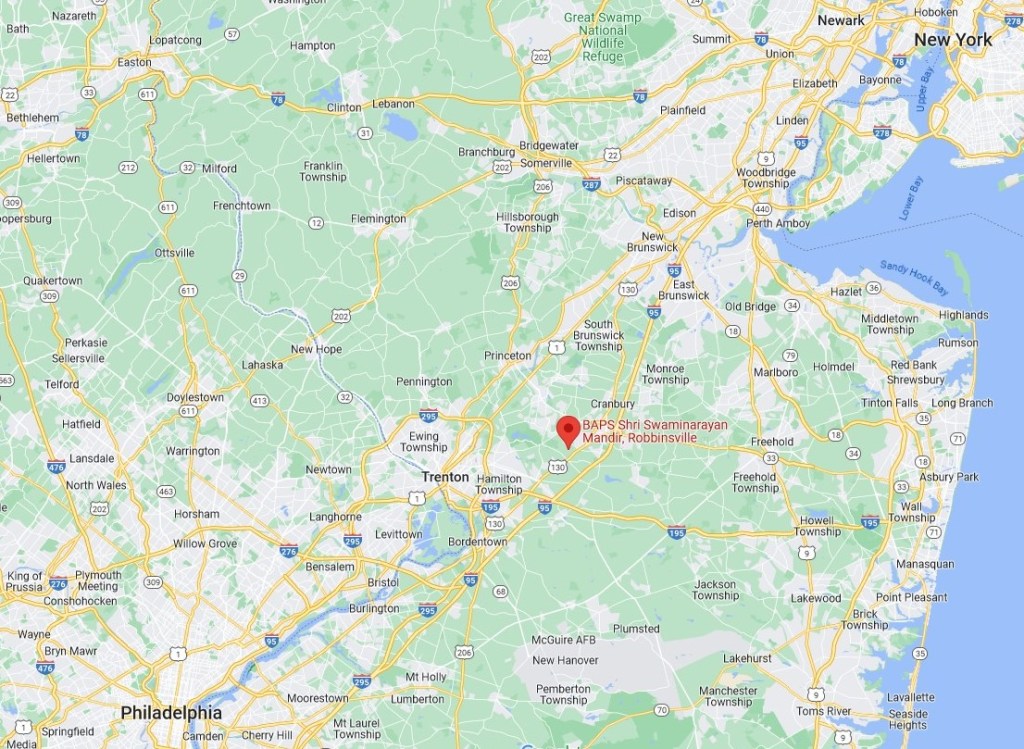
According to Wikipedia, this suburban location is part of the New York City region but it also right next to the Philadelphia region:
Robbinsville Township is a township in Mercer County, in the U.S. state of New Jersey. Located at the cross-roads between the Delaware Valley region to the southwest and the Raritan Valley region to the northeast, the township is considered part of the New York Metropolitan area as defined by the United States Census Bureau,[21] but directly borders the Philadelphia metropolitan area and is part of the Federal Communications Commission‘s Philadelphia Designated Market Area.[22]
Recent research helps explain the increasing amount of religious diversity within metropolitan regions. For example, Religion & Community in the New Urban America details this in the Chicago region and I detail patterns in debates about zoning and land throughout the New York region and involving multiple religious traditions.
Yet, I suspect such a building would surprise many who do not think of suburbs in the United States this way. With new populations in the suburbs and new religious groups, many suburban communities have changed in recent decades. Suburbs do not only consist of white bedroom communities; suburbs are more racially, ethnically, and religiously diverse.
 Legally Sociable