If Chinatown’s ending forces the audience to sit in a feeling of hopelessness, it should also disturb anyone invested in Los Angeles’s future. The history of water in 20th-century California was defined by mammoth feats of engineering and an enduring belief that someone like Mulholland would eventually come along and enable the impossible. Each new dam or aqueduct only guaranteed the arrival of the next one—the population growth allowed by Mulholland’s aqueduct, for example, later resulted in L.A. tapping other water sources, such as the Colorado River. California has had a few good years of rain recently, but the long-term sustainability of the state’s water supply depends on collective conservation efforts: drastically reducing the amount of water used by Big Agriculture, moderating suburban tasks such as watering lawns, regulating the state’s groundwater.
“There is no more water to capture with big projects. There just isn’t. The future is really about much smarter water management,” Stephanie Pincetl, a UCLA professor who specializes in urban policy and the environment, told me. Conservation measures, she argues, are the way forward even if politicians wish they could stump for some grand technological innovation the way their 20th-century predecessors did: “The approach to the 21st century has to be a lot more subtle, a lot more place-based, and a lot more guided by the realization that water is a scarce resource, and so we need to treat it like a scarce resource.”
Finding water in Los Angeles, the Southwest, the West, and the United States more broadly may become more paramount in the coming decades. Which cities and regions would do well in competing for water? Would a lack of water in some places lead to growing populations in places with plenty of water?
While we are at it, why not tell more exciting stories in these categories:
Origin stories of modern places. Take any of the big cities in the United States and put its origin story in a movie or a miniseries. How about the rise of Phoenix?
It would be interesting to popularize more stories about water and other necessary resources in daily life. How about a thrilling tale about concrete? It is hard to imagine modern life without out. Or air conditioning. Can’t have a lot of the global development of the last century without it. Or salt. Where do we get all this salt in our daily lives from?
If Chinatown can entertain and inform about place, why not engage in more storytelling that explains where places have come from and where they might be going?
Atlanta’s Department of Watershed Management announced water service would be halted at 5 p.m. Friday in much of Atlanta, including all of downtown, so crews can work to repair breaks on a 48-inch and 36-inch transmission line “that carries large volumes of water to the metropolitan area.”
Just after 2 p.m., the Watershed Management Department issued a boil water advisory “out of an abundance of caution.” The advisory affects any Atlanta water customers who have experienced a water outage or low water pressure. The order was still in place on Sunday afternoon, even though repairs were completed on the major break near Joseph E. Boone Boulevard. Other repairs were continuing.
More details on water main breaks and pipes in Atlanta:
The problems began Friday morning where three large water mains intersect just west of downtown. Wiggins said at a Saturday news conference that at least some of the pipes that burst were old and corroded. With pipes coming together in a confined area, it was a tight squeeze to make repairs, with only one worker at a time working in the manhole accessing the junction. Repairs were completed Saturday evening, officials said.
Another water main later burst in the city’s Midtown neighborhood, which is studded with new office, hotel and apartment towers. Wiggins said Saturday that officials weren’t sure yet why that pipe had broken. That leak continued to gush through the city streets Sunday. City officials said Saturday that they were working on ways to isolate the leak from the larger water system and were awaiting a part needed to repair to the pipe. Dickens declared a state of emergency so the city could buy materials and hire workers without following the normal purchasing laws.
Faltering infrastructure is a common story in older parts of American cities. Atlanta has spent billions in recent years to upgrade its aging sewer and water infrastructure, including a tunnel drilled through 5 miles of rock to provide the city more than 30 days of stored water. Last month, voters approved continuing a 1-cent sales tax to pay for federally mandated sewer upgrades. The city at one time routinely dumped untreated sewage into creeks and the Chattahoochee River.
What are the odds of multiple major breaks in one weekend? Is the best way to address this to completely update the system?
Vital infrastructure is not just built once and then runs forever. It needs to be maintained. Expanding regions and changing conditions may require major updates. Constructing these systems in the first place required a lot of work; keeping these systems fit for the future may require even more.
Some stories in recent years have drawn attention to urban water issues. Water problems in Flint. Lead pipes throughout Chicago. Drought in California. Addressing these issues might not be exciting but it is essential to current residents, let alone visions of a bright future.
I imagine there is some sort of story that already tackles this but what happens in a large city if there is no water for more than a few days. What happens? Who is prepared?
Sprint also traces its roots back to the Southern Pacific Railroad (SPR), which was founded in the 1860s as a subsidiary of the Southern Pacific Company (SPC). The company operated thousands of miles of track as well as telegraph wire that ran along those tracks. In the early 1970s, the company began looking for ways to use its existing communications lines for long-distance calling.[22] This division of the business was named the Southern Pacific Communications Company.[29] By the mid 1970s, SPC was beginning to take business away from AT&T, which held a monopoly at the time.[22] A number of lawsuits between SPC and AT&T took place throughout the 1970s; the majority were decided in favor of increased competition.[29] Prior attempts at offering long-distance voice services had not been approved by the U.S. Federal Communications Commission (FCC), although a fax service (called SpeedFAX) was permitted.[30]
In the mid-1970s, SPC held a contest to select a new name for the company.[31] The winning entry was “SPRINT”, an acronym for “Southern Pacific Railroad Internal Networking Telephony”.[31]
This is clever. The acronym also hints at the history of the company that was partially born out of railroad operations. The railroad made all sorts of notable changes to the American landscape: it increased the speed of travel for passengers and goods, it connected far-flung places, and it brought activity to new places.
It also enabled other infrastructure. In the case of Sprint, the same right-of-way that carried train traffic could carry messages via telegraph. This substantially increased the speed of communication. Today, we think very little of messages and texts and information flying across geographies in seconds. That same railroad that allowed speeds significantly faster than horses or humans also made space for bits and data to speed around the world.
Put another way, could the online and smartphone world we know today have happened without telegraph and phone infrastructure that provided foundational space for new technology to take advantage of? I do not know the answer to this question but Sprint and other telecom companies made use of existing infrastructure to help bring about new technologies.
The world’s emails, TikToks, classified memos, bank transfers, satellite surveillance, and FaceTime calls travel on cables that are about as thin as a garden hose. There are about 800,000 miles of these skinny tubes crisscrossing the Earth’s oceans, representing nearly 600 different systems, according to the industry tracking organization TeleGeography. The cables are buried near shore, but for the vast majority of their length, they just sit amid the gray ooze and alien creatures of the ocean floor, the hair-thin strands of glass at their center glowing with lasers encoding the world’s data…
Fortunately, there is enough redundancy in the world’s cables to make it nearly impossible for a well-connected country to be cut off, but cable breaks do happen. On average, they happen every other day, about 200 times a year. The reason websites continue to load, bank transfers go through, and civilization persists is because of the thousand or so people living aboard 20-some ships stationed around the world, who race to fix each cable as soon as it breaks…
The world is in the midst of a cable boom, with multiple new transoceanic lines announced every year. But there is growing concern that the industry responsible for maintaining these cables is running perilously lean. There are 77 cable ships in the world, according to data supplied by SubTel Forum, but most are focused on the more profitable work of laying new systems. Only 22 are designated for repair, and it’s an aging and eclectic fleet. Often, maintenance is their second act. Some, like Alcatel’s Ile de Molene, are converted tugs. Others, like Global Marine’s Wave Sentinel, were once ferries. Global Marine recently told Data Centre Dynamics that it’s trying to extend the life of its ships to 40 years, citing a lack of money. One out of 4 repair ships have already passed that milestone. The design life for bulk carriers and oil tankers, by contrast, is 20 years…
“One of the biggest problems we have in this industry is attracting new people to it,” said Constable. He recalled another panel he was on in Singapore meant to introduce university students to the industry. “The audience was probably about 10 university kids and 60 old gray people from the industry just filling out their day,” he said. When he speaks with students looking to get into tech, he tries to convince them that subsea cables are also part — a foundational part — of the tech industry. “They all want to be data scientists and that sort of stuff,” he said. “But for me, I find this industry fascinating. You’re dealing with the most hostile environment on the planet, eight kilometers deep in the oceans, working with some pretty high technology, traveling all over the world. You’re on the forefront of geopolitics, and it’s critical for the whole way the world operates now.”
This is a great example of invisible infrastructure. How many Internet users each day think about the cables that support the system? I am guessing very few.
The article suggests the methods of repairing undersea cables resembles that of the first repairers of cables in the second half of the nineteenth century. Given our technological advances, are there quicker ways to do this? I imagine one reason these systems are still used is because they are considered economical. At what point do the cables go away in favor of a different system?
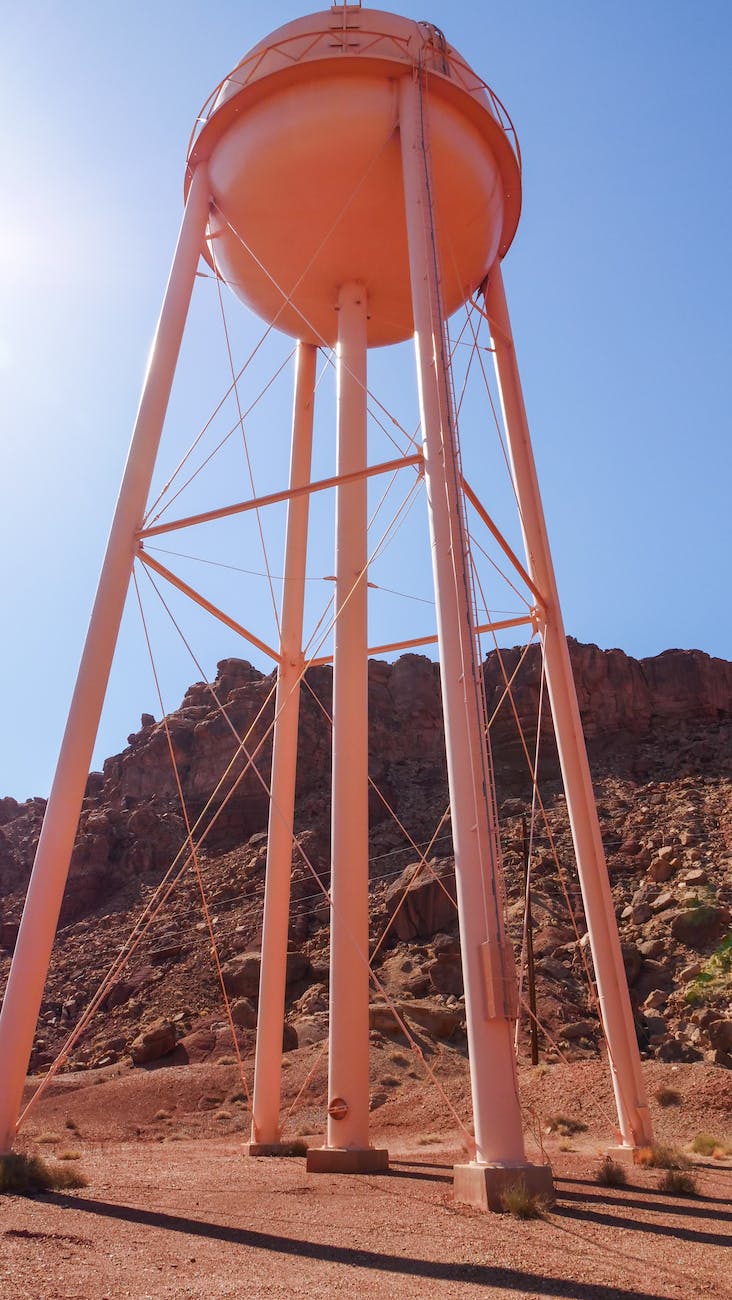
The project will include sandblasting the exterior and interior of the tower and applying new coatings inside and out. There also will be some landscaping work with new perimeter fencing.
The assessment also recommended foundation repairs, replacing the original valves, and installing new hatches, gaskets and a submersible mixer.
In addition to removing the tower’s outdated ladder system, workers will install new safety railing and fall protection equipment.
“We’re kind of excited for the face-lift that’s coming to the tower,” Patel said. “It does its job, but the paint job will make it more appealing for pedestrians downtown.”
By the way, this doesn’t help. Nobody’s having a better day down here because of that.
We have at least a few water towers in the area that include the logo or motto of a suburban community. Why not use them as advertising? This is a different approach than painting a smiley face to presumably attempt to improve people’s days or help them feel better about infrastructure.
Imagine the best weather for infrastructure. It is probably not the four seasons of weather in the Chicago region:
From the State Climatologist Office in Illinois:
Chicago lies midway between the Continental Divide and the Atlantic Ocean, and is 900 miles north of the Gulf of Mexico. Chicago’s climate is typically continental with cold winters, warm summers, and frequent short fluctuations in temperature, humidity, cloudiness, and wind direction. Many consider the more moderate temperatures of spring and fall to be the most pleasant. Lake Michigan provides a moderating influence on temperature while boosting the amount of snowfall received in the city.
Such fluctuations in the Chicago region lead to potholes, closures of airports and roads plus delays, flooding, and pressure on systems at both the hot and cold ends of the temperature spectrum. Coming out of a major snow storm and heading into several days of subzero temperatures, some of everyday activity is disrupted but mostly life goes on. Humans have developed systems and practices that make it possible to live in many different conditions.
What might be ideal? How about a place with more consistent temperatures, few storms, and no flooding? I am sure there are locations in the United States that meet this more than others. Everywhere else, people and systems adapt.
Modern infrastructure that makes everyday life possible is remarkable enough in addition to adaptability to different climates and making repairs when local conditions make it difficult.
Photo by Miguel u00c1. Padriu00f1u00e1n on Pexels.com
In 2018, UNESCO inscribed dry stone walling as an Intangible Cultural Heritage of Humanity, stating that “the technique exemplifies a harmonious relationship between human beings and nature.” When building a dry stone wall, Kaneko told me, you have to work with the contours of the land and irregularities of each stone. John New, the chair of the West of Scotland Dry Stone Walling Association, told me that “when you’re building a stone wall, you become part of the environment. Brown hares will just come up and stop and watch you.” Deer too. Almost as soon as it’s built, a stone wall is inhabited by insects—a key indicator of biodiversity—and small animals such as voles, chipmunks, and wrens. In China, researchers have documented the remarkable diversity of plants thriving on ancient stone walls—even in urban environments.
In rocky regions around the world, groups are working to preserve and promote the craft of dry stone walling, touting the benefits to biodiversity and low carbon footprint. These are inherently local efforts because building with stone makes the most sense when it can be sourced locally. (In the past, farmers used stone unearthed while clearing the very fields they needed to terrace or fence.) In Scotland, for example, trucking in material for a stock fence from far away could cost upwards of $5,000, New said. The most ambitious recent dry-stone-walling projects, such as the multimillion-dollar effort to restore the stone walls of Italy’s Cinque Terre, are in service of historical preservation. But Stone Walls for Life, the EU-funded project organizing the Cinque Terre restoration effort, argues that the walls strengthen resilience to climate change, too, by improving drainage and preventing landslides. They plan to replicate this kind of undertaking around the EU.
In Japan, Kaneko told me, most of the people who still know how to build simple utilitarian stone walls are in their 80s. In the past, if a stone wall along a rice paddy or road collapsed, the community would gather to repair it. This collective experience was key. When I met him again at a Kyoto café (in the concrete Kyoto International Conference Center, near a concrete-encased river), Kaneko told me about a 1919 Journal of Engineering article that emphasized the importance of human skill and discretion rather than objective numbers in stone-wall building. Although perfecting the craft of stone walling takes a lifetime, Kaneko said that an amateur, with no formal engineering experience, can learn the basics in about four days. Through workshops all over the country, he and Sanada teach people to place stones with the long side angled down into the slope, to make sure that each large stone touches at least two others, and to fill behind the large stones with small rocks or gravel as they build. There have been attempts to standardize and mechanize dry stone walling, using, for example, software and a robotic excavator. But Kaneko says that in many cases, the sites where he works are too narrow or steep for a machine to access. To him, stone walling’s reliance on man power instead of machine power, and passed-down knowledge instead of equations, is part of its value. “I like the very wild dry stone walls,” he told me.
Embracing those qualities, though, requires trust and experience. In July, Kaneko traveled to the town of Genkai, on Japan’s Southern island of Kyushu, to repair the walls at Hamanoura Tanada, a scenic and historic site where nearly 300 small terraced rice paddies chisel the dramatic slopes above an inlet of the Genkai Sea. A few years ago, the town’s planning and commerce division invited Kaneko to teach five local construction companies how to build dry stone walls so they could preserve the traditional scenery. But even with that training, none of them was willing to take on rebuilding stone walls. It’s seen as a labor-intensive and risky job, Kaneko said. Companies that use concrete can reliably calculate the strength of their walls, but it’s nearly impossible to estimate the engineered strength of any particular dry stone wall. Although villages and private landowners can choose stone over concrete, there have been no mainstream attempts to return to dry stone walling for major new public-works projects in Japan, Kaneko told me. In the United States, most landscaping walls shorter than three or four feet don’t need to be permitted, Alan Kren, a structural engineer at Rutherford + Chekene, told me. To build stone walls on any larger scale would likely require new standards for using these old techniques.
Lots of potential connections between this and the move to modernity more broadly:
-New crafts and methodologies that people know and use while older techniques fade away.
-Technological and scientific progress in new materials but costs with which we have not fully reckoned.
-Lost community moments replaced by private activity.
-Local efforts are difficult to sustain given broader global and social pressures.
The march of concrete will go on while some advocate for other options. And perhaps at some point concrete will be replaced by another material and the techniques of using concrete could be lost.
Crashes at one of the state’s most dangerous rail crossings, in Elmwood Park, have killed seven people and injured at least 27 over the last few decades. Village officials want to build an underpass to make the intersection safer, but the village can’t do it alone — the $121 million price tag is more than four times the western suburb’s annual budget, according to Village Manager Paul Volpe…
Elmwood Park has paid $230,000 since 2020 to the transportation lobbying firm Tai Ginsberg and Associates, according to federal lobbying records. So far, the village has received $3 million in federal funds, Volpe said…
Illinois cities, towns, villages and counties besides Chicago spent about $838,000 on federal lobbyists in 2020, $1 million in 2021 and $1.4 million in 2022, lobbying disclosure records kept by the U.S. Senate and analyzed by the Chicago Tribune/Pioneer Press show. This year, they have spent a total of $720,000 so far, per lobbying disclosures. The grand total is slightly inexact because lobbyists are not required to report receipts under $5,000.
One town that’s turned its attention to opportunities in Washington is north suburban Niles, where the village board recently renewed a $60,000 contract with lobbying firm Smith, Dawson and Andrews…
So far, Alpogianis said the village is more than satisfied with that change. He pointed to a recent $200,000 federal grant for the Niles Teen Center the village secured with the help of U.S. Sen. Dick Durbin’s office.
Suburbanites tend to like local government because they believe it is easier to convey their interests and they can see and experience local decisions. So getting more federal money that can be directly used to improve a local quality of life is a win, right?
I could imagine two primary objections:
Do lobbyists always pay for themselves? The story cited highlights several examples of successes. Does this work for every suburb?
Is federal money the money suburbs want? Local government beholden to federal dollars? Some might object, others may not care where helpful money comes from.
It would be interesting to hear from the lobbyist side about firms or individuals that do well for suburbs. What is their success rate?
When a large amount of rain is dumped on the Chicago region in a short amount of time, the infrastructure cannot keep up. The swamps underneath the third largest metropolitan region in the United States continue to influence everyday life:
The region’s struggle with chronic flooding begins with its location. Chicago and many of its suburbs were built on swamps, and storm runoff has become more difficult to manage as the region has been paved over.
These swamps had at least one advantage. The area between the Chicago River and the Des Plaines was swampy and this portage helped lead to Chicago’s growth as the Great Lakes and Mississippi could be connected.
But, think of all the effort required initially to drain the swamps or fill them in or build on and near them. Some early settlers built plank roads to try to stay above the mud. Then, there are consequences still today with major rains leading to flooded basements and sewage released into waterways. Planning for dealing with water requires resources and time, ranging from retention ponds to dealing with the effects of new nearby development to cleaning up after floods to building the massive Deep Tunnel project.
The article notes the decades-long efforts to address this. Communities within metropolitan regions might not like to pool resources but this seems like an issue that should bring together everyone to make serious headway on solutions in the next few decades.
The context for this quote is a dispute between local governments in the region about obtaining water. Hundreds of millions of dollars, perhaps billions, are on the line. People need water. For now, it is there and it probably will be there for a long time…but it is not guaranteed to be there.








 Legally Sociable