Castle houses and McMansions

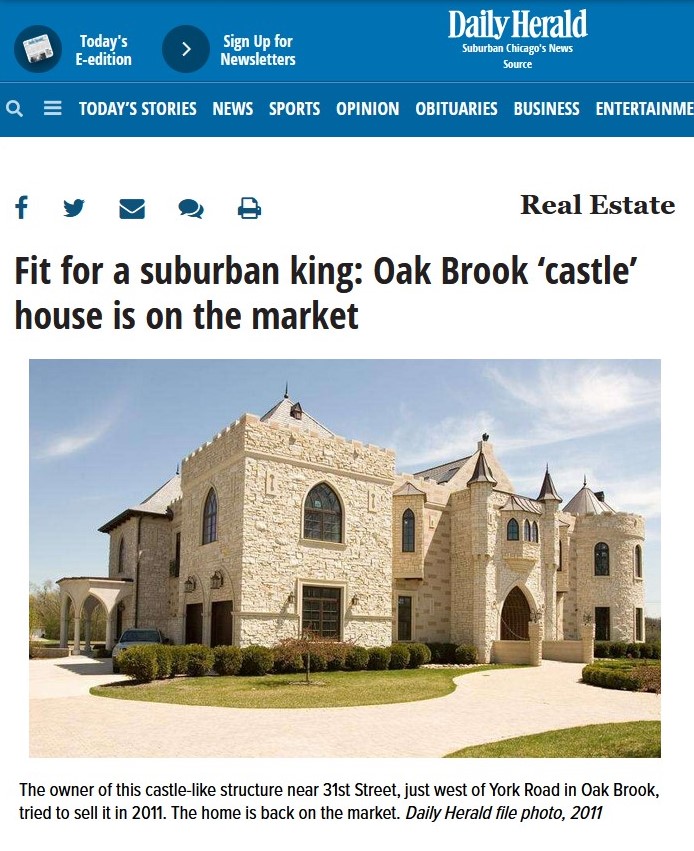
How might a large suburban house that looks like a castle fit the definition of a McMansion?

The home is large, roughly 12,000 square feet. It has lots of rooms and amenities:

The five-bedroom, seven-and-a-half-bath house, which is in the 3000 block of Lincoln Street, features a master-bedroom suite that takes up about 2,500 square feet. The listing says the house is 12,000 square feet.

It has a wine cellar, a movie-screening room, room for a pool table and a Ping-Pong table, a bar and an exercise area, all in the basement, an outdoor swimming pool, and a four-car garage.

This is the first trait of McMansions: they are large. I have suggested that being over 10,000 square feet should be considered mansions as they are beyond McMansions.

The other primary trait that might connect this home to McMansions is the architecture. It is a suburban home intended to look like a castle. Is it a pastiche or gimmick? How about the quality of the construction?

The walls average more than 20 inches thick, and there is 10-inch reinforced concrete between the floors.

Perhaps the builders were serious about making this a castle? This may not be the builder-designed cookie-cutter home that McMansions are often said to be; this could be a house more carefully designed to look outside and inside like a castle.

Thus, I am inclined to suggest this is not a McMansion castle. It is a mansion castle designed in a more coherent way.

Suburbs as diverse, welcoming to all (but not criminals), and open for business

The village president of Oak Brook touted the suburb’s approach to crime as part of its success. He ended the op-ed with this:

Photo by Ketut Subiyanto on Pexels.com

Oak Brook is a diverse community, welcoming to everyone except criminals. We’re open for business!

A little bit more on each of the three pieces of diversity, welcomes, and business activity.

Regarding diversity, the U.S. Census Bureau QuickFacts say the community of just over 8,000 residents is 61.8% white, 30.3% Asian, 4.5% Hispanic or Latino, and 0.6% Black or African American. The median household income is $146,409, the median housing value of owner-occupied units is over $801,000, and the poverty rate is 4.9%.

Many suburbs say they are welcoming and few, if any, would say they welcome criminals.

The community has plenty of business activity as it is home to Oakbrook Center and numerous offices along I-88.

Is this formula – diversity + welcoming + business – the secret to suburban community success? Or, is this a viewpoint from suburbs with certain features and character?

Advertising your business as five miles east of a wealthy suburb

Suburban businesses can use odd geographic markers to describe their own location. One building material company in the Chicago area regularly runs radio ads with this description of their location: five miles east of Oak Brook in Broadview. Why might they do it this way?

  1. Compared to Broadview, Oak Brook is a more known location.
  2. Oak Brook has a large shopping area with a mall and all sorts of restaurants and other businesses nearby. People already out shopping may be willing to drive a bit further.
  3. Oak Brook is a higher status community with more wealth. Also, Broadview is majority black and Oak Brook is majority white.
  4. They are trying to reach wealthier suburban customers. This is why they do not say they are roughly 14-15 miles from the center of the Loop.

All in all, the Broadview location is about 10 minutes east of Oak Brook. That is not a long drive for suburbanites who may be willing to drive all over the place for good deals. And the advertising strategy may have some effectiveness as the business keeps using it. Still, it strikes me as a bit odd to downplay their own location in favor of a suburb five miles away…


The irony of a Chicago area march to support police held in…Oak Brook

Hundreds of people gathered on Sunday to march in support of police near the Oak Brook Center mall:

King took to Facebook a few weeks back to recruit backing for a community march that would support police officers. She envisioned it as a kind of counterprotest — a response to the marches against police brutality that have taken place in the Chicago area and around the country in recent months…

The march stepped off from a parking lot at Oakbrook Center mall, moved south on Route 83, then headed east on 22nd Street, ending in a parking area on the other side of Oakbrook Center.

Marchers yelled “Go blue!” as they walked, and they held up signs that said “Blue lives matter” and “Blue protects, serves and defends us all.”…

Oak Brook police closed portions of Route 83 and 22nd Street to accommodate the march. Marchers expressed their thanks to the officers as they walked by.

Why is this setting particularly interesting? Here are a few reasons:

1. According to the Census, Oak Brook had 8,041 residents in 2013 and the median household income was $135,880.

2. Oak Brook Center is one of the largest shopping malls in the Chicago region and one of the more upscale.

3. The community has low crime rates.

4. According to Wikipedia, “it is home to the headquarters of several notable companies and organizations including McDonald’s, Ace Hardware, Blistex, Federal Signal, CenterPoint Properties, Sanford L.P., Tree house Foods, and Lions Clubs International.

5. The history of Oak Brook was influenced by one influential landowner: “It is sometimes referred to as Paul Butler’s realized dream. As the largest landholder, he had consulted with such experts as Robert Kingery of the Regional Planning Commis­sion, Carl Gardner Associates, and Garson Rohrback of General Planning & Research…A unique feature is the village-owned 270-acre Oak Brook Sports Core, purchased from Paul Butler in 1977 pursuant to a vote by the residents. The Sports Core now boasts an eighteen-hole golf course, bath and tennis club, polo fields, other recreational areas, all sup­ported by user-fees and available primarily to Oak Brook residents. The Sports Core was originally developed by Paul Butler, who was instrumental in bringing polo, the so-called sport of kings,” to the midwest. Mr. Butler, whose accidental death, the day after his 89th birthday in 1982, proved a great loss to the village, had always been an enthusiastic sup­porter of excellence in all fields of athletics. The Sports Core has over the years been the location of numerous fashionable benefit horse shows, international polo matches, golf tourna­ments and other events for which Oak Brook was noted long before it developed residen­tially and commercially.”

All together, Oak Brook is a wealthy suburban community with a significant retail and office base and a history connected to polo fields. If the recent protests regarding Ferguson and New York City are about police conduct and more broadly about race, Oak Brook, Illinois is (1) a community removed from these everyday concerns and (2) is exactly the sort of protected place that represents the white establishment. To hold a march in favor of police could be construed then as advocating for the status quo in Oak Brook and similarly safe and well-off places.

(An alternative explanation might be that Oak Brook is near multiple highways, making it easy for marchers to travel to the community.)