Crosses on churches vs. the popularity of cross necklaces

I found crosses on church buildings and online profiles are somewhat common but why bother with building architecture when cross necklaces are trending?
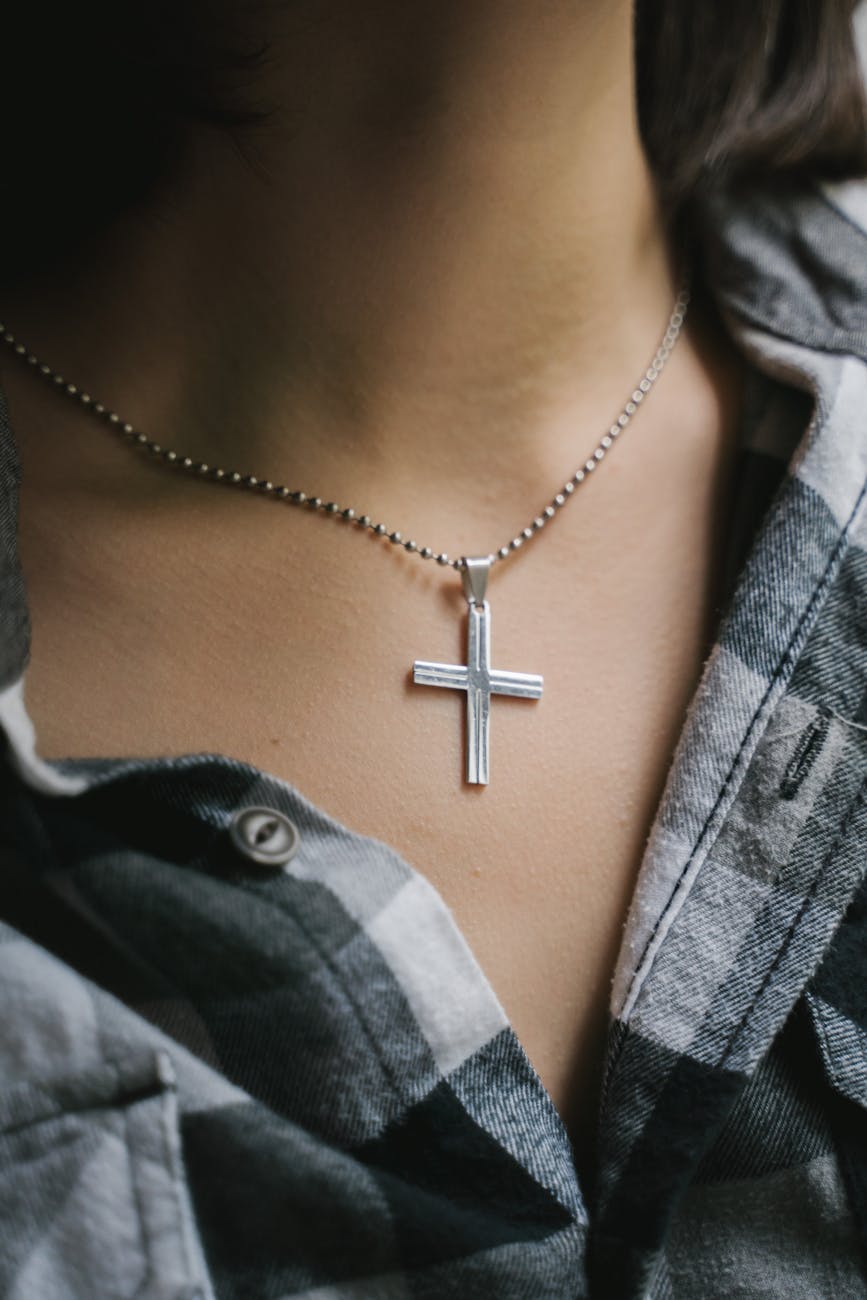
Photo by Tima Miroshnichenko on Pexels.com

As a millenniums-old symbol of Christian faith, the cross would seem somewhat immune to trendiness. But cross necklaces and pendants have been in vogue before and may be again as some feel more comfortable embracing their faith and seek community with others.

On red carpets, on social media, at protests by high-ranking Democrats and in the White House, necklaces with cross pendants are appearing with renewed prevalence. Chappell Roan wore an oversize one to the MTV Video Music Awards in September, and one dangled from Sabrina Carpenter’s neck in the music video for her single “Please Please Please.” The trendy online store Ssense sells them in nearly 50 variations, and mainstream jewelers like Kendra Scott and Zales carry numerous designs.

Lately, the cross necklaces flash across cable news screens several times a week, suspended between the collarbones of Karoline Leavitt, the White House press secretary, and Attorney General Pam Bondi…

Over centuries, the cross evolved as a signpost of the moral compass one shares with fellow Christians and a kind of talisman with deeply personal significance. “They have an official meaning but people bring their own meaning, which is where symbols really get their power,” said Mr. Covolo, 58, who in 2020 published a book about the link between Christianity and fashion.

The article suggests two primary reasons for more worn crosses: (1) strengthening/expressing one’s own faith and (2) identifying with religious communities. This speaks to two important elements of religious faith: knowing and living out one’s one faith and participating in community with others.

At the same time, this seems like it is part of the larger pattern of individualizing or privatizing faith in the United States. The individual makes choices regarding their faith and practice. They choose to display it or not. They pick a level of involvement that works for them and their stage in life. A necklace or pendant can be added and taken off. (This might be contrasted to religious tattoos, for example, that are more permanent.)

This all makes sense in a religious marketplace where the consumer is the key actor. Crosses on church buildings or online profiles could function in similar ways: religious communities have to brand themselves as a cross is a known marker of the Christian brand.

Would cross necklaces and pendants be something different in societies with other settings?

Materialism and religion in the clothes pastors wear

An Instagram account highlights the expensive wear of ministers:

On his feed, Kirby has showcased Seattle pastor Judah Smith’s $3,600 Gucci jacket, Dallas pastor T.D. Jakes’s $1,250 Louboutin fanny pack and Miami pastor Guillermo Maldonado’s $2,541 Ricci crocodile belt. And he considers Paula White, former president Donald Trump’s most trusted pastoral adviser who is often photographed in designer items, a PreachersNSneakers “content goldmine,” posting a photo of her wearing $785 Stella McCartney sneakers.

As the Instagram account grew, Kirby started asking more serious questions about wealth, class and consumerism, including whether it’s appropriate to generate massive revenue from selling the gospel of Jesus.

“I began asking, how much is too much?” Kirby said. “Is it okay to get rich off of preaching about Jesus? Is it okay to be making twice as much as the median income of your congregation?”

This is a long-standing issue within Christianity, let alone in American Christianity where money and status have existed alongside religious fervor and practices for a long time. In a society that emphasizes consumption, even conspicuous consumption, plus celebrity, is it a surprise that ministers would want to wear expensive items?

Counterfactuals to these observations might help. Two come to mind:

  1. Are there mainstream religious groups or leaders who actively shun or downplay status? I can think of famous pastors who are not as well dressed. But, are they necessarily poorly dressed? How much does presentation of self matter compared to other noteworthy factors like particular religious doctrines or practices? I assume there is some limit where a pastoral presentation has to fit some parameter or the lack of style or flashiness will be a negative. Is the nature of American religion with its religious economy of competition inextricably tied to status and presentation?
  2. Some evangelicals have raised questions about materialism and consumption for decades. Historian David Swartz’s book Moral Minority highlights how evangelicals in the early 1970s questioned the consumption patterns of Americans. If you want to go back further, Max Weber argued in The Protestant Ethic and the Spirit of Capitalism that a particular ascetic approach to spending wealth on oneself helped spur on capitalism. How far did this critique go? By the 1980s, evangelicals largely became associated with conservative economic policies and reside in suburbs where appearances and keeping up with the Joneses matter to some degree. At the same time, evangelicals often claim they do not want to be too flashy or that they are middle-class even if they have the resources to be above that.

Religious change in America between 2000 and 2010

Results from the 2010 U.S. Religion Census show religious changes in America between 2000 and 2010:

The 2010 U.S. Religion Census, released May 1 on the Association of Religion Data Archives, found that The Church of Jesus Christ of Latter-day Saints gained the most regular members in the last 10 years, growing by nearly 2 million to a total of 6.14 million adherents in 13,600 congregations…

  • Taken together, nondenominational and independent churches may now be considered the third largest religious group in the country, with 12.2 million adherents in 35,500 congregations. Only the Catholic Church and the Southern Baptist Convention are larger.
  • The U.S. was home to 2,106 mosques nationwide in 2010. The figure includes 166 mosques in Texas, 118 in Florida and 50 Muslim houses of worship in North Carolina…

Mainline Protestant churches lost an average of 12.8 percent of adherents in the first decade of the 21st century; 5 percent fewer active members were found in Catholic churches.

There is an explanation for this growing diversity toward the end of the article: the religious economy approach. This school of thought in the sociology of religion suggests that religious groups in the United States have to compete for adherents, sharpening the appeal and “marketing” of some of these groups. This takes place because of the separation of church of state which is a contrast to state churches in Europe that tend to stifle religious competition.

Some of these changes are also interesting at the local level. For example, Muslims are the fastest growing religious group in Illinois and there are now more Muslims in the Chicago area than Methodists. [The actual numbers for this second fact are not in this online story but were in the print version of the newspaper.]