This was the sight I saw a few days ago while driving away from my house: two Canadian geese sitting on my roof. It is not a surprise to see geese in the area. They fly overhead. They walk in the field in the park around the corner. They sit on the pond behind us and walk up into our yard. They occasionally try to cross local roads and tie up traffic.
But I have never seen geese on top of a house. Why would they want to go up there? There hopefully is a not good food up there. If they need a better view, they can fly. Is it safer from predators? Is it somewhere different?
I do not usually look up at my roofline while in front my house. Maybe I should. Perhaps there is more wildlife up there. How about the coyotes that have moved into suburban spaces? The hawk that sometimes sits in the big tree in our backyard? The many squirrels running? Or maybe the one-time appearance of the geese will keep others away.
Multiple intertwined social forces created the American suburbs as we know them today. One factor involves raising children in the suburbs. The suburbs are perceived by many to be the best places to raise children due to their houses, yards, quieter environments compared to the city, good schools, and other amenities. And since Americans often want or expect their children to do better than themselves, the suburbs are the place in which they believe this happens.
What happens if fewer children are born in the United States? This will not necessarily stop people from living in or wanting to live in the suburbs. But it could change their calculations about where to live or how to live in the suburbs. Some quick examples of how this might play out:
Suburbs are built on the idea of growth: new subdivisions, new activity. If growth slows, communities have a different identity and have to draw on different revenue sources. With less growth, communities shift to maintenance or building in different ways (see #2).
Suburbs have historically prioritized single-family homes as they provide space for nuclear families. But if fewer people need the space and yards of single-family homes (plus the issue of current prices), communities and developers will go for more townhouses and condos.
There is a reduced need for schools. Education is often viewed in the United States as the tool for social advancement. Many suburbs take pride in their schools. Growing suburbs equaled more schools. But fewer kids in the community means fewer enrolled students.
A suburban lifestyle built around kids’ activities and driving them around. The suburbs often require driving kids to school, sports, religious congregations, and more. The driving will not necessarily cease but the era of “Walmart moms” and “soccer moms” might diminish.
Many have complained that the streets of the suburbs are quieter than they used to be because kids are now inside or in organized activities. What if the suburban streets of the future (and schools and playgrounds and park districts and so on) are quiet because there are no kids living in suburbia?
The $1.1 million 3D-printers have churned out at least five new modern properties so far, with the first one taking only 24 days to complete.
Made by 4DIFY, the 1,000-square-foot house was the initial installment in the 3D-printed neighborhood…
Additionally, the process requires less labor and materials and also produces less waste, helping keep costs down.
The 3D printers mainly use concrete as filament for their builds…
“By automating the construction process with robotic precision and reducing material waste, we’re cutting build times by up to 75% and significantly lowering costs while increasing structural integrity, fire resistance, and seismic performance,” the spokesperson emphasized.
If construction techniques after World War II helped contribute to a suburban boom – mass production, large-scale subdivisions – could 3D printers help change the market? Two things stand out to me about the possibilities of 3D printed homes:
The speed at which homes can be built.
A lower price point compared to other construction techniques.
If both these things are true (and perhaps might even be improved at a larger scale), there could be opportunities. This neighborhood is also being constructed in California, a place where housing is especially needed.
The biggest change for a possible homeowner might be having concrete as a primary material for their home. Many American homes are made of wood frames clad with different materials. Concrete is essential to the modern world and why not have more homes made of the material? (I can also think of downsides; would people push against having concrete homes?)
“Zoning is one of the great protectors we have for investment,” he said. “Zoning is not (there) to exclude. Zoning is to protect.”
Suburbanites have invested money into their homes and zoning helps ensure property values increase/do not drop. Suburban residents like single-family homes, in part because of they view them as sources of wealth. They then can see many other land uses near these homes as threats to those values.
The second quote:
“Our local leaders are best positioned to craft solutions tailored to their residents’ needs,” he said.
Suburbanites also like local control. They can create zoning to prompt development that is consistent with what already exists in the community. They can spend local monies on what residents want. They have more control of local spending, rather than letting others further away spend their monies.
At the same time, do the efforts to protect and retain local control mean that suburban communities limit who might live in their community? Zoning for larger lots will tend to drive up housing values. Keeping zoning (and other matters) under local control means local officials can shape local options. If lots of suburban communities follow these logics, this can limit opportunities.
Luxury homes in the South Florida metro sold for a median of $4.04 million in October, up 187.3% from a decade ago—more than double the national rise of 82.5%, and the fastest growth of any major metro…
Over the past five years, luxury prices in the metro rose 105%, the second-fastest increase among major U.S. metros and only slightly behind Miami. West Palm Beach has also been the nation’s fastest-growing luxury market for most of the past year, posting the highest annual price growth in nine of the past 12 months…
Eight of the 10 major metros with the fastest growth in luxury home prices since 2015 are in the Sun Belt, reflecting a broader, decade-long shift in where high-end homebuyers are choosing to put down roots.
Following West Palm Beach in the top five are Nashville (+171%), Phoenix (+165.7%), Las Vegas (+161%) and Miami (+148%).
The report cites two factors driving this luxury housing growth: changes related to COVID-19 and remote work plus changes in taxes in coastal states.
I wonder if several other factors are at play:
More housing construction in Sun Belt locations than other places. For example, if there is more space available and/or fewer obstacles to building expensive housing in one place compared to another, it could help increase luxury housing.
Certain scenes or communities are cool. Could some of this be about wanting to be in up-and-coming places? Are there certain amenities or quality of life options available in these Sun Belt locations that are harder to obtain elsewhere?
Even with remote work, personal connections matter. Are certain companies and/or jobs located in the Sun Belt? Could this be about living near certain other wealthy people or particular social networks?
Incentives offered by certain locations. We know communities and states give tax breaks to corporations. Are these options available to organizations connected to wealthy residents who then also move? Or are there any incentives for residential construction?
While these luxury housing shifts are underway, it does not sound like any of the traditional centers of the most expensive housing are disappearing soon – they are just not growing as much.
On one side, living alone or with one other person can promote isolation or loneliness. On the other, excessive crowding (about 140 square feet per person, one study in Asia suggests) leads to stress, anxiety and depression. Happiness peaks somewhere in the middle, said Gerardo Leyva, an economist and researcher at Iberoamerican University in Mexico City.
Leyva analyzed data from tens of thousands of households in Mexico and Europe. He found that people living alone report the most satisfaction with their financial lives. But when it comes to overall happiness, the happiest households had about four to six people in them, regardless of home size.
This aligns with previous research: After crossing a minimum threshold of space for safety and comfort, every new bedroom or second floor yields less and less benefit. A brief spike in housing satisfaction from moving into “larger accommodations” produces no durable effects on overall life satisfaction. It may even erode it….
In his 2024 peer-reviewed study in the Journal of Public Economics, the assistant professor at Erasmus University Rotterdam in the Netherlands found that just the presence of bulky domiciles down the street virtually erased any satisfaction people gained from moving into their own bigger homes. “Larger homes do not increase well-being per se,” Bellet wrote me. “What matters most is how close [the size of one’s house] is to the largest houses in the neighborhood.”…
A 2012 study by UCLA researchers found up to 60 percent of homes sit largely unused. Position-tracking data reveal that families — even in large homes — cluster in a few small high-traffic rooms, usually the dining, kitchen and family rooms. That means a 1,200-square-foot home with a central hub may outperform (from a happiness perspective) a 3,000-square-foot home with a fragmented layout.
It sounds like happiness and home size is connected to multiple factors: having a bare minimum space per person, the number of people in the space, how the residence’s home size compares to nearby residences, and how the interior space is used.
Each of these factors suggest that the absolute size of homes matters less than relative size. If new homes are about 2,400 square feet on average, the experience of that 2,400 square feet is affected by the number of people living there or what other housing in the neighborhood. In one setting, it might be too small. in another, it is large.
This might all fit with something I wrote about years ago: Americans have large houses, in part, to store lots of stuff. Don’t want to throw things away? Like to collect things? Have a series of hobbies or interests? That bigger house could have space for it. The additional space is not for people or social connection but for stuff.
If happiness and house size is related to other factors, how does happiness about house size rank compared to other life factors that affect happiness? For example, what is the difference in effect size on happiness between having satisfying social connections compared to house size?
There are a number of established residential architectural styles in the United States. Victorian. Colonial. Ranch. Split-level. And the McMansion.
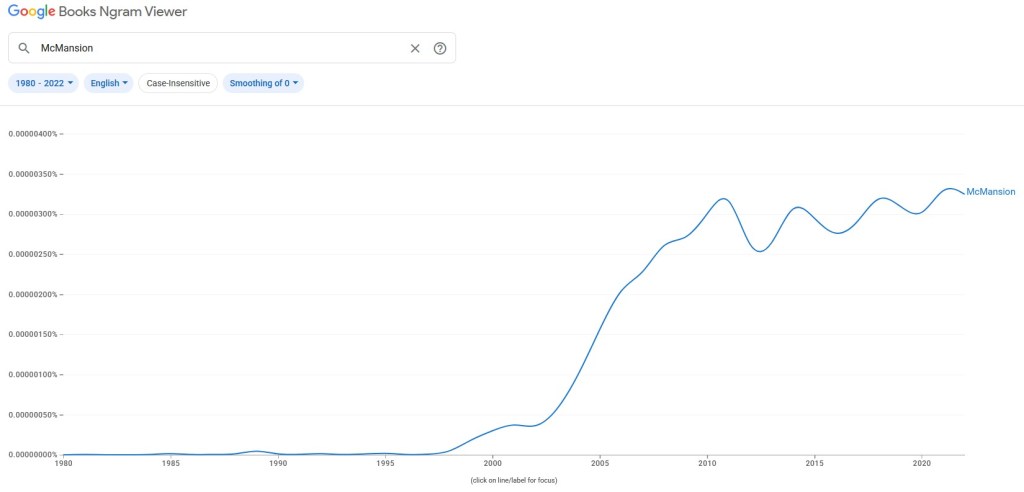
According to this Ngram viewer result, the term McMansion entered use in the late 1990s and then its use went up a lot between 2002 and 2011.
This roughly fits with what I found in my 2012 article on defining McMansions. The multi-faceted term described a newer wave of houses in a particular cultural moment.
What the Ngram above shows since 2011 matches what I have informally seen about McMansions since 2011: they are now just part of the landscape. They are not new. Americans build, sell, and buy them. They still are derided. There are dips up and down in the Ngram viewer but it has not changed much since 2011.
New residential styles will come in the future. Changes to society, the economy, housing, and preferences will lead to new designs that will then be assessed and critiqued. Perhaps they will bear some resemblance to McMansions, perhaps they go in completely different directions. The McMansion will live on among existing and new housing styles.
Another way to see if you’ve made it to the upper-middle class is to simply look at where you live. According to Rose, if “your home is in a ZIP code where folks want to live,” that’s a good sign that you’re there.
Keep in mind that it’s not all about appearances. People in the middle class might try to keep up with the Joneses — that is, they might compare themselves with their neighbors and try to match their level of wealth or status.
Those in the upper-middle class, however, do not. They don’t need to worry about whether their house is big enough or their car is luxurious enough. They can afford many of these high-end things without stretching their financial means.
Those in the upper middle class have the financial resources to live in places with higher housing prices. This means the houses may be bigger, the local amenities more plentiful, and the population more exclusive.
While the description above hints at this, why not just say that the upper middle class can afford a house that costs more? And how “expensive” is this neighborhood? In a typical metropolitan area, what percent of neighborhoods or communities are upper middle class, beyond the reach of the middle class or those around the median income and below the super wealthy enclaves?
How often then do those in the upper middle class use their community or neighborhood to signal their status? Just as a vehicle driven or a college attended or clothes worn or hobbies engaged in might signal class status, how much do they mention their community to highlight their status? If they say they live in “X,” is such a place widely known as being upper middle class?
Trahan told the Journal in 2023 that the house was “the worst investment ever,” but has since clarified those comments, telling People that she views the home as a piece of art.
“When I was buying it, I wasn’t thinking, ‘Oh, it was a great investment,'” Trahan told People in 2023. “When I buy art, it’s because I love the art. It’s not because, ‘Oh, I’m going to make money on this.’ If you’re going to make money in art, you have to sell it. I buy art, and then I don’t sell it.”
The first Brady Experience sweepstakes was such a success that Trahan is opening it up for another round. Trahan could not be reached for comment.
Can a home be art? Can a real suburban home that became part of a well-known TV show be art? This might require public and/or critical consensus.
The idea that a postwar suburban house could be a piece of art is not that farfetched. Imagine homeowners of such homes across the American landscape that lovingly take care of their homes, maintaining and improving them. Or preservationist efforts that protect particular homes for future generations. (Which postwar suburban homes might qualify for this is another discussion – which are more art and which are more pedestrian?)
Add to this the iconic nature of this home. For many, The Brady Bunch house represents suburban family life. The show only ran 5 seasons but the family and its home became a part of the postwar culture during its run, through syndication, and ongoing lore. I doubt many critics would say the show was art – it was a normal sitcom – but the iconic status of the show may elevate it in the eyes of viewers.
Perhaps the Brady home is pop art: a slice of a particular time that was revered by many.
Through the 1990s and early 2000s, there was so much single-family construction in Naperville that “I think there’s probably a little bit of a need to diversify housing product,” Whitaker said.
“I would say it’s not just townhomes, but I think you’ve also seen more senior housing, more apartments,” he said.
Whitaker also pointed to changing demographics in Naperville. It’s always been a great place to raise a family, but today, the population is aging, he said. “We’ve got a great supply of single-family homes in neighborhoods like Ashbury and Tall Grass in south Naperville, and frankly, it would be hard to … build new single-family homes at a price that is cost competitive to what exists in those communities,” Whitaker said. “And so I think the goal has been to diversify a little bit and find some different niches…
“The development will meet a significant community need by creating a housing opportunity that is suitable for many types of homebuyers,” the petition states, “including some of the fastest growing housing segments of our population, young professionals and empty nesters.”
As I noted yesterday, the primary way Naperville can grow in population in the future is to develop denser housing. Growth has been a key trait of the community for decades. But more and more townhouses is a change from single-family homes.
Additionally, these comments suggest townhouses in Naperville are aimed at particular residents. Specifically, townhouses could provide housing for seniors/empty nesters or young professionals. Might there be other homebuyers who could live in the townhouses?
Long-term, will more townhouses be palatable in the community if they are at particular price points and particular residents live there? There likely will be some pushback for townhouses regardless because of changes to character of the community and to the neighbors who own homes nearby.







 Legally Sociable