The new suburban crisis is…

According to Richard Florida, the era of cheap growth is over and suburbs will struggle to address important issues:

Suburban sprawl is extremely costly to the economy broadly. Infrastructure and vital services such as water and energy can be 2.5 times more expensive to deliver in the suburbs than in compact urban centers. In total, sprawl costs the U.S. economy roughly $600 billion a year in direct costs related to inefficient land usage and car dependency, and another $400 billion in indirect costs from traffic congestion, pollution, and the like, according to a 2015 study from the London School of Economics. The total bill: a whopping $1 trillion a year…

When all is said and done, the suburban crisis reflects the end of a long era of cheap growth. Building roads and infrastructure and constructing houses on virgin land was and is an incredibly inexpensive way to provide an American Dream to the masses, certainly when compared to what it costs to build new subway lines, tunnels, and high-rise buildings in mature cities. For much of the 1950s, 1960s, and 1970s, and on into the 1980s and 1990s, suburbanization was the near-perfect complement to America’s industrial economy. More than the great mobilization effort of World War II or any of the Keynesian stimulus policies that were applied during the 1930s, it was suburban development that propelled the golden era of economic growth in the 1950s and 1960s. As working- and middle-class families settled into suburban houses, their purchases of washers, dryers, television sets, living-room sofas, and automobiles stimulated the manufacturing sector that employed so many of them, creating more jobs and still more homebuyers. Sprawl was driver of the now-fading era of cheap economic growth.

But today, clustering, not dispersal, powers innovation and economic growth. Many people still like living in suburbs, of course, but suburban growth has fallen out of sync with the demands of the urbanized knowledge economy. Too much of our precious national productive capacity and wealth is being squandered on building and maintaining suburban homes with three-car garages, and on the infrastructure that supports them, rather than being invested in the knowledge, technology, and density that are required for sustainable growth. The suburbs aren’t going away, but they are no longer the apotheosis of the American Dream and the engine of economic growth.

Florida is right on a number of counts: (1) many suburbs are long past their period of growth and now having aging infrastructure as well as changing populations; (2) sprawl can be very inefficient for providing basic services (from water to roads to social services); and (3) we are in a different economic era.

At the same time, it is not necessarily clear where the suburbs will go after this. At least a few outcomes are possible:

  1. A decline in interest in suburbs (either a plateauing in population or even decreasing) due to inefficiencies, costs to the environment, and a resurgent interest in urban life (particularly among younger adults). Suburban critics have predicted movement in this direction for several decades.
  2. A retooling of suburbia. This could include: older suburbs adapting to the lack of greenfield growth opportunities; an increase in retrofitting older suburban developments and making them new and exciting; and denser suburban development (from row houses to New Urbanism).
  3. The status quo: enough Americans continue to express a desire for the suburban life despite what critics say. Technology may even help as driverless cars could make commutes more bearable.

There are indeed real issues facing suburbs, the suburban life was never as idyllic as it was portrayed, and suburban communities and outcomes today are varied. But, I believe it is hard to bet against an ongoing interest among Americans for the suburbs.
Quick Review: Driving After Class: Anxious Times in an American Suburb

I recently read anthropologist Rachel Heiman’s Driving After Class: Anxious Times in an American Suburb. Here are some thoughts about the study:

  1. I was drawn to this because even though a majority of Americans live in suburbs, there is a lack of in-depth studies of their experiences and social lives. I realize it is not a sexy topic – everyone thinks they know everything about suburbs – but there are plenty of interesting topics to pursue.
  2. The book is a little unusual in that it seems to be published a good amount of time after the research was done. Heiman undertook the research for her dissertation but the book was not published until 2015. This is not necessarily bad as time can give a researcher an opportunity to truly think about what they have found. At the same time, Heiman interprets some of her findings in light of the housing bubble and economic crisis of the late 2000s even though her research was from an earlier period.
  3. The best part of the analysis in my opinion was the chapter on a battle in the local school district. The New Jersey residents were part of a district that included a number of communities and when the district had to decide how to spread resources and which schools students should attend, the communities fought each other. In particular, the wealthier parts of the district generally did not want their children to have to attend the other schools which either had populations of lower-class or minority residents. Another chapter looked at how a community negotiated a request from a homeowner to place a gate across his driveway, a move interpreted by his neighbors and local leaders as an exclusionary effort. At other points, Heiman noted how residents reacted when she mentioned that she was living in a more affordable but less well regarded nearby suburb. More broadly, the analysis was better when it pointed out inter-suburban differences and how suburbanites negotiated their various statuses.
  4. The overall argument was that these suburbanites are trapped in a destabilizing neoliberal system. While this argument makes sense, I’m not sure it is too much different than critiques of suburbia dating back to the mid-1950s. Some of the same themes are present: conformity, squabbles over local class differences rather than looking at the larger social and economic system, anxiety, an emphasis on children, etc. While there are not enough studies of suburbs, we also need new approaches and arguments. And, there is still a basic question for studies of suburbs to consider: if life is so problematic in suburbs, why do many Americans still seek them out? If they are not dupes and have agency, what are viable alternatives to sprawling suburbs that offer what many Americans say they want?
  5. One topic I would have enjoyed reading more about: experiences inside housing. There is a chapter that takes an unconventional approach to this topic through examining the portions of homes with new carpet that is intended to impress visitors (and that children must not walk on with shoes).

In the end, I’m not sure this text would make my short list of excellent ethnographies of suburban life. At the same time, it has some strong moments and I could imagine using the chapter on school districts in courses.

A McMansion as shorthand for the white, suburban privilege of Brock Turner

One blogger connects the case of Brock Turner to the suburban house to which he returned:

I googled the address. I don’t know why I did that– morbid curiosity always gets the better of me. I clicked the satellite image and squinted at the blurry photo of a roof. It’s just an ordinary upper-class McMansion, one of many, on a spastic squiggle of a street in the middle of a wealthy suburban development. The kind of place where people can have every luxury they want, unless what they want isn’t kitsch. True luxury that isn’t kitsch is reserved for the richer still, the astonishingly wealthy whose sons would not go to trial at all for rape– not for the Suburban-McMansion Rich whose sons serve three months if the press is bad enough.

A suburban McMansion fits the story a number of people have told regarding Turner’s actions and subsequent treatment by the criminal justice system. McMansion owners are typically white suburban people with money – not really rich, as this post suggests, but rich enough to expect others to be impressed with their standing (and home). In this narrative, the McMansion signals their posture to the world: we aren’t bad people and should be treated with respect.

It is tempting to link a house to a narrative in this way. On the other hand, what if Turner had returned to a more modest 1950s suburban ranch? Would we then see a connection to white conformity? Or, how about a early 20th century suburban bungalow that hints at the fastidious nature of whites who want to preserve some golden era? Or, would a pricey downtown condo conjure up images of high-flying urban nightlife? Since Turner is an unlikable figure to many, I suspect detractors could find all sorts of evidence from the consumer goods in his life – clothes, appearance, vehicle, shopping patterns, and home – to illustrate their dislike. Some of these objects may indeed be connected to white, middle/upper-middle class suburbanites.

This is the not the first time McMansions have been linked to immorality and crime. See, for example, the suggestions in Gone Girl. And such narratives have a much longer history in novels, films, and TV shows that in the postwar era loved to peel back the facade of suburban life to find its truly seemly underbelly. Whether such links and depictions are connected to demonstrable patterns of morality and criminality is another story…


Cutting a suburban house in half for art

In 1974, artist Gordon Matta-Clark sought a suburban house to turn into art:

In the spring of 1974, Gordon Matta-Clark approached his dealers, Holly and Horace Solomon, and asked whether they knew of a house that he could cut in half. As it happened, they had recently purchased an empty, soon to be demolished house, 322 Humphrey Street in the suburb of Englewood, New Jersey – they were interested in the underlying lot rather than the building itself. As the house was going to be pulled down, the Solomons let Matta-Clark work on it for a few months prior to its destruction. [1] It was an ordinary balloon-framed, two-storey house, with a porch back and front and a base of cinder blocks. It was built during the 1930s when Englewood was expanding due to its proximity to New York City and its separation from the decay and lawlessness of the inner city. However, with the postwar economic downturn there had been a decrease in the number of households. [2] The house at 322 Humphrey Street would have been only one of a number of empty lots, and, like the apartment buildings that Matta-Clark had appropriated, was part of the larger system of profit and loss.

Having enlisted the knowledge and help of the German-born artist Manfred Hecht, Matta-Clark jacked up one end of the frame, including one of the porches, removed a layer of cinder blocks, and cut through the entire side of the building – inside and out – with a chainsaw. Gradually he lowered the back of the building onto the remaining blocks, leaving a gap in the cut of about two-thirds of a metre at the top that tapered to a slit at the base. [3] He called this work Splitting, and part of the filmed record features Matta-Clark stripped to the waist, at different times pulling hard on the jacks, up a ladder directing the saw and manipulating the cuts; he appears to be as engrossed in his work as Jackson Pollock in the films that show him dripping paint onto canvas, or indeed Trisha Brown in films of dance performances in which she scales buildings and creates improvised urban encounters. All show the artists’ physical and mental engagement with their work and are performances of a type. When writing about Splitting, Matta-Clark also gave the house its performative role, saying that having made the cut there was a real moment of suspense about how the house would react, but that it responded ‘like a perfect dance partner’. [4] Matta-Clark wrote that the production of the work was not illusionistic, but that it was ‘all about a direct physical activity, and not about making associations with anything outside it.’ [5]…

Matta-Clark felt, like the Situationists, that this dream had been used as a political tool by the ruling classes through the provision of convenience and dwellings, in order to contain and control the masses. [10] It was also integral to the return to family values in America after the war, which were promoted in television programmes, films and magazines. While the home was seen as private, the family was also encouraged to be part of a network of neighbourhood relationships, where conformity was important, but these relationships were ‘sold’ as intrinsic to the ‘good life’. [11] Matta-Clark questioned the interests involved in developing this dream and then providing for it:

The very nature of my work with buildings takes issues with the functionalist attitude to the extent that this kind of self-conscious vocational responsibility has failed to question or re-examine the quality of life being served. [12]

The Whitney Museum of American Art describes the meaning of the project: “This splitting implied both a rupturing of the fabric of domestic space and a liberation of the individual from suburban isolation.” This is one way to cut through the suburban facade…

The suburbs as a “Great Wrong Place”

In a review of mysteries written by women, one critic explains why suburbs are a common setting:

In the books I’ve been reading, the Great Wrong Place is sometimes suburbia, sometimes social media, sometimes high school, sometimes the marriage bed—everywhere something feels missing in contemporary life.

There is not much explanation here. However, this taps into a familiar suburban critique: the suburbs are a darker place than they appear. Even though they might be the image of the American Dream, many disturbing situations are underneath the surface. The key is the contrast between the displayed success of the single-family home and happy family and the tension that threatens to bubble to the surface.

What then exactly is missing from suburbs? Authentic displays of human difficulty and anguish (residents don’t talk about this stuff, perhaps because being vulnerable in the suburbs leads to social problems)? A lack of diversity in who lives there (the typical suburb is white and middle-class and shuts out other experiences)? Public spaces where residents can regularly mingle without having to have strong interpersonal relationships (everyone is cooped up inside their private spaces)? Whatever the reason, the suburbs provide rich spaces for today’s mystery (such as Gone Girl) and horror stories.

The common uniformity of prison and suburban design

In A Burglar’s Guide to the City, a reformed bank robber describes a realization he had while walking through the suburbs of southern California:

For Loya, linguist George Lakoff’s book Metaphors We Live By took an unexpected spatial resonance, revealing ways in which the built environment could be read or understood as a series of metaphors or signs. He said that after being released from prison, he spent a lot of time taking long walks around the suburban landscape of Southern California. He began noticing that every twenty-five feet, he would hit a driveway; he’d then walk eight feet across the driveway before hitting another stretch of grass; then another twenty-five feet to the next driveway, and so on, seemingly forever, “and the uniformity of that totally echoed the uniformity of the prison environment,” he said to me, “where I had my cell and my seven feet of wall and then a door. And I remember thinking, ‘Oh my God, man.'” He laughed at the utter despair of it all, having gone from one system of containment to another. How would you get away or escape from this?

This is a common image of suburbs: prisons of conformity and tedium, laid out every twenty-five feet by developers to maximize profits while misguided Americans snap up the properties thinking they have found the American Dream. Yet, sameness in lot size doesn’t necessarily mean sameness in lives. These regular spacing could be a very good sign of a tract neighborhood but even then, the homes – like those in Levittown over the decades – could be altered as various owners put their own mark on the dwellings. Or, the neighborhood could be quite diverse, particularly in older suburbs.

Additionally, prisons are built with very different purposes in mind compared to suburbs. Developers and local officials are not scheming to control people in these homes (except maybe through a capitalistic system that keeps them focused on their own properties and blinded from larger issues). In contrast, prisons are all about surveillance – just think of Bentham’s Panopticon.

Demolition for a teardown, clothes in the closet and all

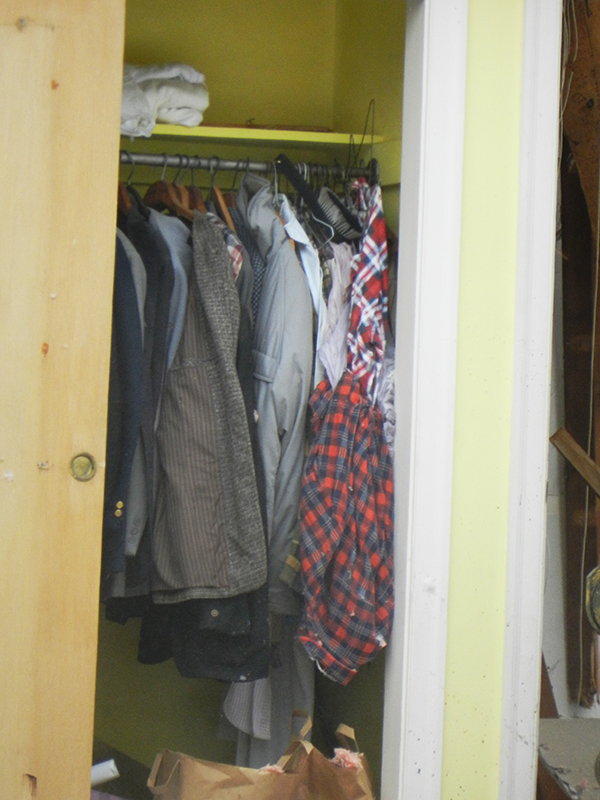
Many neighbors don’t like teardowns and one residents highlight that the new property owners didn’t even empty the old home:

This house is two houses away from us. The lady who lived in this house passed away a few months ago. A builder bought the house for $660,000 and a mortgage was taken out for $1,178,000 on it. So what this means is it’s probably going to be sold for a minimum of $1.5 million dollars…

The builder didn’t even empty the closet.

On one hand, if the whole house is going, why not simply trash everything inside rather than spend the time sorting it all out? On the other hand, displaying such a picture highlights several features:

  1. It increases the tragedy factor many claim are inherent in teardowns. These aren’t just houses; these places where people have lived for decades and threatening the character (and social life) of the neighborhood is not a trivial matter.
  2. Americans have so much stuff through our consumption patterns that it simply doesn’t make sense to try to salvage any of these items. It often may not be worth it to even donate the items as it is too easy to throw it out and/or obtain more.

Now that I think about, there are numerous photographers and artists in recent decades who highlight ruins in big cities – like Detroit or New York City. Where is the major project that documents the sadness of teardowns? It may not quite have the noir allure of the city but there is long history of suburban critiques to draw upon: the mass produced raised ranch of the post-war era is even more desolate in the snow and shadow of the wrecking ball.

Should we take joy in photos of a dying suburban shopping mall?

One photographer has been chronicling the last days of a mall in the Chicago suburbs:

It can be a tough thing to see a historic building being demolished, but what about when a suburban mall meets the wrecking ball? After a 63-year run, The Plaza shopping mall in suburban Evergreen Park has been demolished to make way for a newer, more modern outdoor mall. While there are many like it, The Plaza was notable for being one of the early indoor shopping malls in the Chicago area, and despite its staying power, the mall had become underutilized over the last several years. So called “dead malls” are nothing new, and if anything, they’re becoming more and more common. With the age of internet shopping and the massive reverse migration of residents leaving the suburbs for the city, many suburban malls have fallen into disrepair and have few, if any, major anchor stores left. One photographer, Martin Gonzalez, has been keeping up with the demolition of The Plaza and has been posting photos over the last several months. Here’s a quick look at some of his images of the fallen Plaza mall.

The pictures suggest ruin and decay, images Americans might more commonly associate with places like Detroit rather than the suburbs. But, the question that starts this article gets at this issue: should we take pleasure in seeing the suburban shopping mall – example of American consumerism, tacky architecture, and the social lives of teenagers with nowhere else to go – destroyed? That this mall failed could be used as evidence that critics of the suburbs were right: the whole system was not sustainable. Yet, there is fallout from this: how will the land get used? What happens to those jobs? Where is the local money that used to be spent here now going? Does the demise of the suburban shopping mall lead to more concentrated and authentic spaces (perhaps the New Urbanist dream) or increased fragmentation (big box stores and online shopping)?

See posts from the last year or so – here, here, and here – about the struggles of suburban shopping malls.

Transforming McMansions might offend architects?

The creators of The Offset House discuss possible reactions to their plans to renovate McMansions:

It’s easy to imagine NIMBY night-terrors if a neighbor suggested building this, but architects might not appreciate you treating McMansions so reverently, either. Who did you want to offend more?

Neustein: We wanted to offend Australian architects’ sensibilities. We don’t want to offend any actual [inhabitants]. We’re trying to appreciate what’s great about suburban life, because someone needs to if many people live there. A lot of architects are out of touch with ordinary aspirations for living and want to impose things from the top down.

Has this idea of outdoor verandas in housing appeared in Australian architectural history before?

Neustein: It’s important to recognize that we’re not necessarily talking about bringing this type of suburban environment forward; we might be talking about bringing it backward.

It is suggested in the first question that any neutral or positive use of a McMansion might be abhorrent to architects. Is this really the case? McMansions are not typically paragons of architectural design: they can have poor proportions, present a mish-mash of styles, and are often mass produced. Additionally, their setting in the suburbs may represent to many all that is wrong with modern society. Yet, if bad products can be made better, why wouldn’t architects support this? Perhaps this first question is intentionally overstated to present two opposites. At the same time, it is rare to find prominent designers or architects who are willing to work with “ordinary aspirations for living.”

Therapy for those making the city to suburb move

For families that are having a hard time leaving the city behind, the move to the suburbs can be easier if others help:

People move for many reasons. Brokers, however, see a familiar thread: Couples move to the suburbs after having kids. And, as people marry later and live in the city longer, moving becomes more than just packing. Mentally and emotionally, experts say, people wrestle with changing from city dweller to suburbanite.

“I see this all the time with my practice,” said David Klow, owner of Skylight Counseling Center, which has offices in Chicago and Skokie. “Where we live gives us a sense of identity.”

Swapping city life for the suburbs is different from moving to another town or neighborhood. Real estate agents say city-to-suburbs folks often need special hand-holding…

In September, Alison Bernstein launched Suburban Jungle in Chicago, which she started after moving from New York City to the surrounding area and feeling lost on which neighborhood would best fit her family. The company’s sole purpose is helping families transition from, for example, Lincoln Park to Lake Forest. Employees meet with shoppers, aiming to best match a town to their personality. They connect clients to suburb experts and locals at no cost, taking a commission from the sale.

“Our job is literally 98 percent therapy and not real estate,” Bernstein said. “It’s like, ‘Am I making the right move?’ It’s a lot of stress, and it’s a big change.”

Even as Americans move quite a bit (see evidence here and here), it can be a stressful process. However, two things strike me about this particular article:

  1. All the people cited here are on the higher end of the socioeconomic spectrum. The moves invoked include going from Lincoln Park to Hinsdale or Lake Forest. These are people who can afford to use a company like Suburban Jungle.
  2. Some of the fear of the suburban life might be driven by negative stereotypes of the suburbs. Some of these may have some truth – such as having fewer entertainment spots in the suburbs – but the typical suburban critiques (which have a long history dating back nearly a century) present a very one-sided view.

All together, being able to move to these kinds of suburban communities – wealthy, safe, good schools, clean, high property values – would be a dream for many people. On the other end of the socioeconomic spectrum, people often move to the suburbs seeking necessities such as work or cheaper housing but can end up in suburbs that have many problems that cities feature.