Not knowing about significant local events, bridge collapse edition

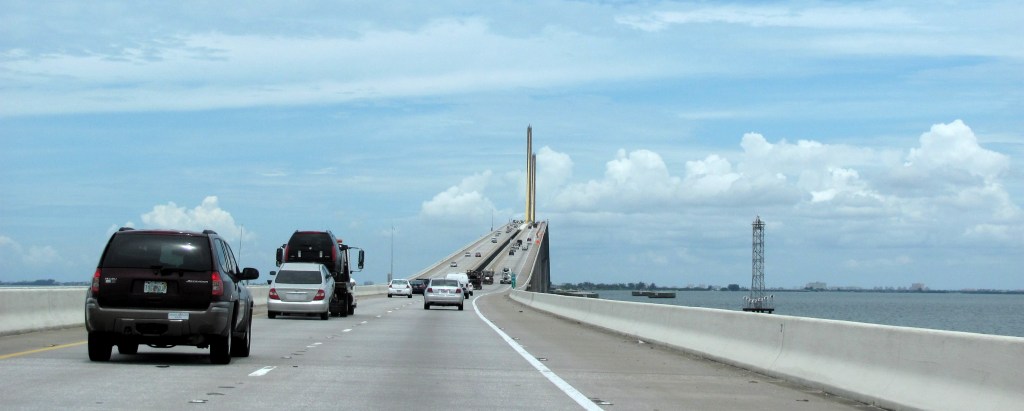
I have driven over the Sunshine Skyway Bridge a number of times when flying into Tampa and driving south. Here is an image of the roadway leading onto the bridge from 12 years ago:
Recently looking through used books at a local library, I learned that part of the prior span collapsed after being hit by a boat in 1980:
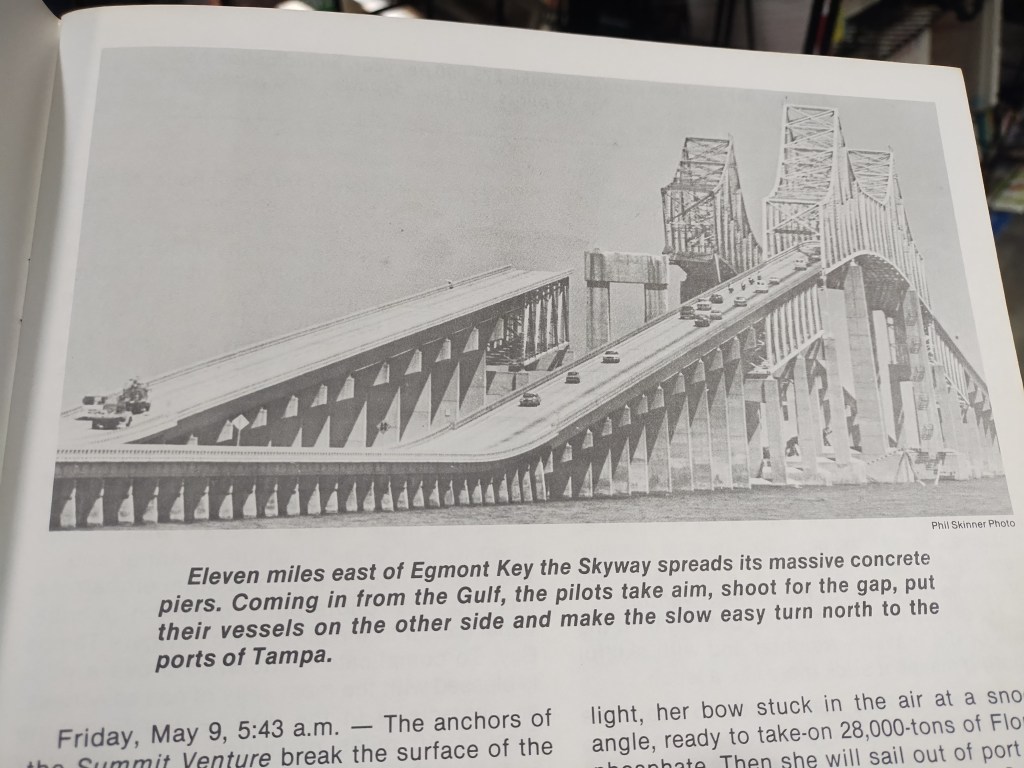
Wikipedia’s description of the disaster:

The second incident came on the morning of May 9, 1980, when the freighter MV Summit Venture collided with a support pier near the center of the bridge during a squall, resulting in the catastrophic failure of the southbound roadway and the deaths of 35 people when several vehicles, including a Greyhound bus, plunged into Tampa Bay.[13] Traffic was diverted onto the surviving two-lane span for several years until the replacement Skyway Bridge was completed, at which time the old bridge was partially demolished and converted into two[14] long fishing piers.

This is a significant local event that I had not heard of before. Such events are rare and likely stick in people’s memories for a long time. But as a visitor to the area, even one who has been there at least a few times, I did not know that this bridge had once collapsed.

What else am I missing when visit places near and far? In my research on suburbs, I have focused on key moments involving character, times when communities had public discussions about the choices they faced. Looking back, it was clear that these choices then shaped subsequent decisions and the character of the community.

Could local disasters have a similar effect on local character? Catastrophic events can rally a community, impacting people far beyond just those direct affected. Do people remember when they heard about the bridge collapsing? How many people wondered about their own drive over the bridge?

The most likely ways I could imagine finding about such events is either through reading about what happened or talking with someone who lived in the area. And some events might be more important than others; a major hurricane in an area is going to have a larger effect than a smaller matter.
What if all the homeowners in a town or sizable neighborhood wanted to sell at once?

The second part of this headline is thought provoking: “In a Florida Town Ravaged by Storms, Homeowners All Want to Sell.” More from the story:

Photo by Kindel Media on Pexels.com

Hoping it was a fluke, Driscoll tore out the affected drywall and started fresh. After all, the four-bedroom home built in 1960 had no flood history. 

But then it happened again, and again. Like many others in the community, he put his home up for sale in the spring of this year. After seeing little interest, he cut the asking price…

Ballooning home insurance costs and the perennial threat of violent storms are starting to undermine housing markets throughout much of the state. But in few places has the turnaround been more dramatic than in low-lying communities up and down the coast of Florida that frequently flood. 

The Tampa Bay housing market had been softening even before Helene struck. While prices have been flat, the area experienced a 58% increase in supply in August compared with a year ago, and a 10% decrease in demand, according to Parcl Labs, a real-estate data and analytics firm. 

About half the homes listed for sale in Tampa experienced price reductions as of Sept. 9, the third highest share of all U.S. major metropolitan areas.   

It sounds like there has been an increase in people wanting to sell in this area. It is not quite “all” have their homes on the market. Perhaps “all” might want to sell?

Either way, the idea of a large number of homeowners moving away at once is likely rare in recent years. There are ghost towns across the American landscape, whether in mining communities or suburbs. In these cases, everyone left and decades later there are some remnants or possibly nothing left if other land development has taken place.

If residents all left these Tampa neighborhoods, what would happen to the land? It could remain unpopulated if it was determined that these are areas that frequently experience flooding. The land could become wetlands or a buffer zone for nearby land. Or it could be turned over to other developed uses that might be less affected by flooding, whether that might be a park or industrial space.

Selling smaller yet posh apartments plus an urban lifestyle to younger renters in Tampa Bay

The Tampa Bay real estate market may have picked up again but it includes some new options: stylish, small, urban apartments for millennials.

So last month, the 28-year-old dietitian moved into a stylish flat in downtown’s newest apartment tower, Modera Prime 235. The trade-off? It cost $1,330, double her last rent, for a one-bedroom matchbox spanning 700 square feet.

“I knew I wasn’t going to be in a McMansion. . . . but it’s definitely enough space for me,” she said. “That price was a lot, like, ‘Oh my goodness, I’m going to have to watch my budget.’ But I’ve enjoyed every penny I’ve paid for it so far.”

Developers are racing to build more than 8,000 new apartments across Tampa Bay, sparking one of the biggest building surges since the housing bust. But to win big rents from millennials, the biggest generation in American history, they’re building in a way that looks nothing like the suburban booms of years past.

The emerging apartment complexes are more closely connected to city centers and packed with metropolitan perks, but they’re also surprisingly pricey and getting smaller. While the median new American home swelled last year to a record-breaking 2,384 square feet, Census data show, the nation’s median new rentals have narrowed to 1,043 square feet, the smallest since 2002.

“The younger generation, under 35, they don’t want to own homes. They don’t want a yard. … They watched what happened (during the recession), watched their parents lose their houses,” said John Stone, a managing director of multifamily housing for Colliers International, a real estate brokerage. “They have a different taste, a different value system. . . . These kids are more than happy to pay $1,200 in rent to walk out their door and immediately go to their favorite bar, their favorite restaurant.”

This has been a trend predicted for a while now by a number of people ranging from Richard Florida to James Howard Kunstler. Because of a variety of pressures from the increase in gas prices, the limited possibilities and decentralization of suburban sprawl, a changed job market, and new technologies, younger Americans may just want desire more exciting urban neighborhoods (though these don’t necessarily have to be in the city center or even in large cities) and smaller homes and private spaces. This is happening many metro areas throughout the United States but it is unclear how big the phenomenon might grow or how much other groups of Americans want to join millennials/the Creative Class.

Yet, as the article notes, this is all tending to lead to a segmented housing market with large suburban McMansions (or something like them), trendy yet small urban apartments for those who can afford them, and the lower end of the housing market that is still struggling.