
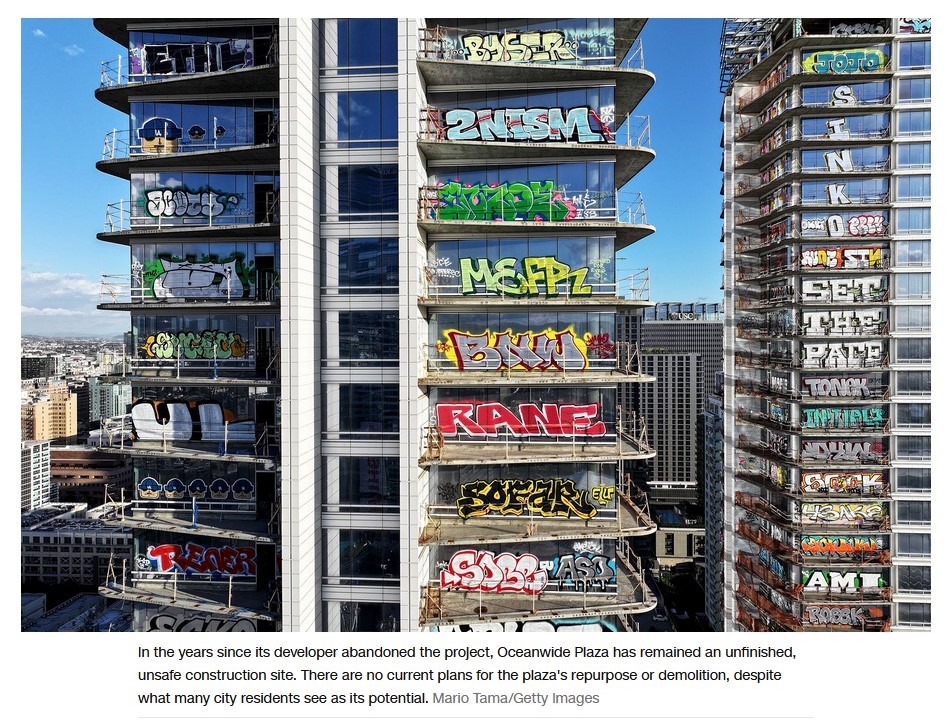
Climbing up abandoned, unfinishedfloors and tightrope walking across balcony ledges, backpacks clanging with cans of alkyd and acrylic, a collective of Los Angeles graffiti artists have transformed their craft beyond urban aesthetics to champion community issues.
Their choice of canvas: Oceanwide Plaza in Downtown LA. Occupying over a full square city block, the plaza was imagined as a vast mixed-use building project, offering city residents over 500 lavish condominiums, a five-star hotel, retail spaces, restaurants and a private 2-acre park.
However, construction on the $1 billion project, which began in 2015, was shelved after the Chinese-backed contractor Oceanwide Holdingsran out of funding in 2019 — and it has lain unfinished ever since…
Transformed in part into an art installation, Oceanwide became an opportunity for the graffiti artists to leave a message to the city below, and a call-out to policy makers who leave buildings to rot…
“People forget that people live here. People own businesses here and they don’t want to have to spend the time and money to clean it up,” said Blair Besten, executive director of the Historic Core of Downtown Los Angeles, an organization which works to improve the quality of life in downtown neighborhoods. The Historic Core prioritizes street sweeping, trash collection — and graffiti removal.
This article showcases the multiple sides of an ongoing public debate about graffiti: is it a response to difficult social and economic conditions? Is it art? Is it criminal behavior that should be punished?
At the same time, how is there such a large abandoned project in Los Angeles? What can a municipality do to finish the development or pursue another use?
Put these two ideas together: are there cities willing to have large-scale platforms for graffiti in or near their downtowns? If graffiti and its place in society is multi-faceted, how might Los Angeles or other large cities incorporate it or work with graffiti artists?
 Legally Sociable