More and more suburbs are embracing farmers markets in ways that go beyond the sale of produce. They have evolved into multi-purpose civic events — a proving ground for small businesses, a way for communities to advertise their services, a showcase for local musical talent, a source of food for area pantries and a draw for local eateries and shops.
Three thoughts in response:
How much of this is due to the relative lack of civic and public spaces in American suburbs? If people wanted to gather in suburbs, how attractive or available are non-private or non-commercial spaces? These farmers markets provide settings for people to shop, eat, and gather. Such spaces are lacking in the suburbs.
The weather has something to do with this. People want to be out in warmer weather. Fresh produce is available at this time of year. What would be the equivalent of this from November through March? Could there be a cold weather version of this in Chicago suburbs?
Economic development is a consideration here. People spend money at farmers markets. They also may spend more in the surrounding area, turning a farmers market visit into an additional trip to a store or restaurant. For suburbs with downtowns, a centrally located farmers market can add to what local officials often hope is a vibrant and walkable downtown.
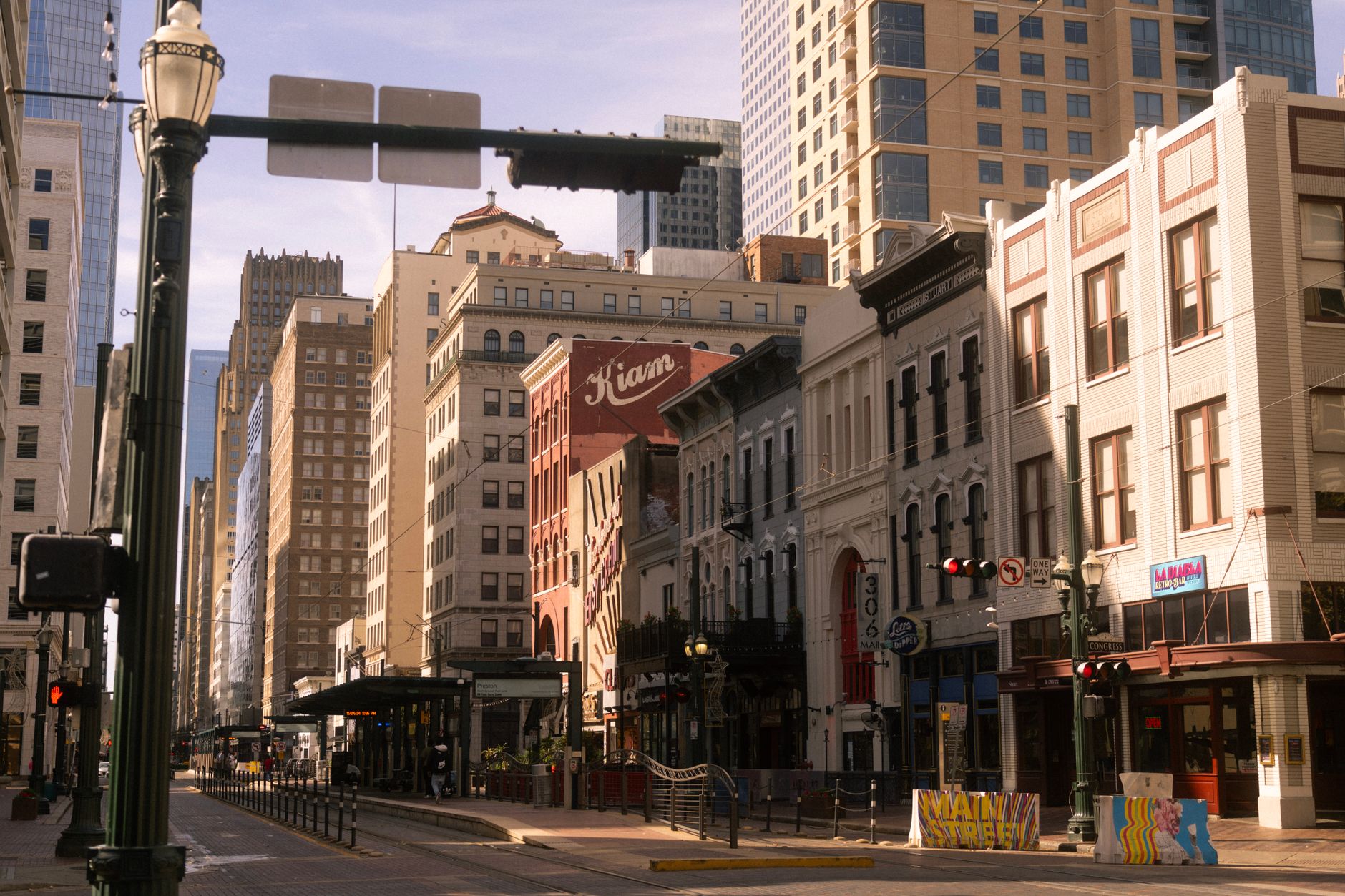
Downtowns are citywide reputation engines. They anchor the tax base, centralize economic growth, and can determine whether a city feels dynamic or stagnant. Our research suggests that improving downtown experience is one of the most effective levers for strengthening a city’s brand, building a thriving economy, and retaining residents. Great downtowns — whether called a Central Business District (CBD), city center, or financial district — make their cities more competitive for talent, businesses, and investments.
Revenues. Business activity. Vibrancy. Status. Defining a city.
What are downtowns in the United States today? Are they more vacant than in the past, perhaps stuck in urban doom loops? Are metropolitan regions now where more people live and conduct their daily business?
The report goes on to suggest that downtowns can thrive if they pursue a mixed-use approach:
Urban vibrancy is generated by dwell time, not solely by how many people visit downtown. Cities that understand this move from prioritizing throughput to experience, creating spaces vibrant enough to turn an errand into an afternoon stay. In this way, the CBD can evolve from a business district into a living room for the entire city. Mixed-use density, activated ground floors connected to the street, and safe, walkable pedestrian areas create the conditions for urban vibrancy. Downtown design choices are never purely local decisions; their benefits extend across the entire city. The most successful cities of the future will be those that invest in their CBDs to foster an environment that encourages residents and businesses to stay.
This would require some major changes in American cities. This is not the first expert suggesting that downtowns need to change. However, the old model has been around a long time. People and systems are used to it. What might be a reasonable timeline for a big city to significantly change their downtown from a business-first model? How does a city pursue this across the board as opposed to a development here or a development there?
Different cities pursuing different versions of this could be useful. There likely is no one size fits all solution. The biggest cities or the superstar cities might have very different options compared to other cities. Or the local context might matter quite a bit.
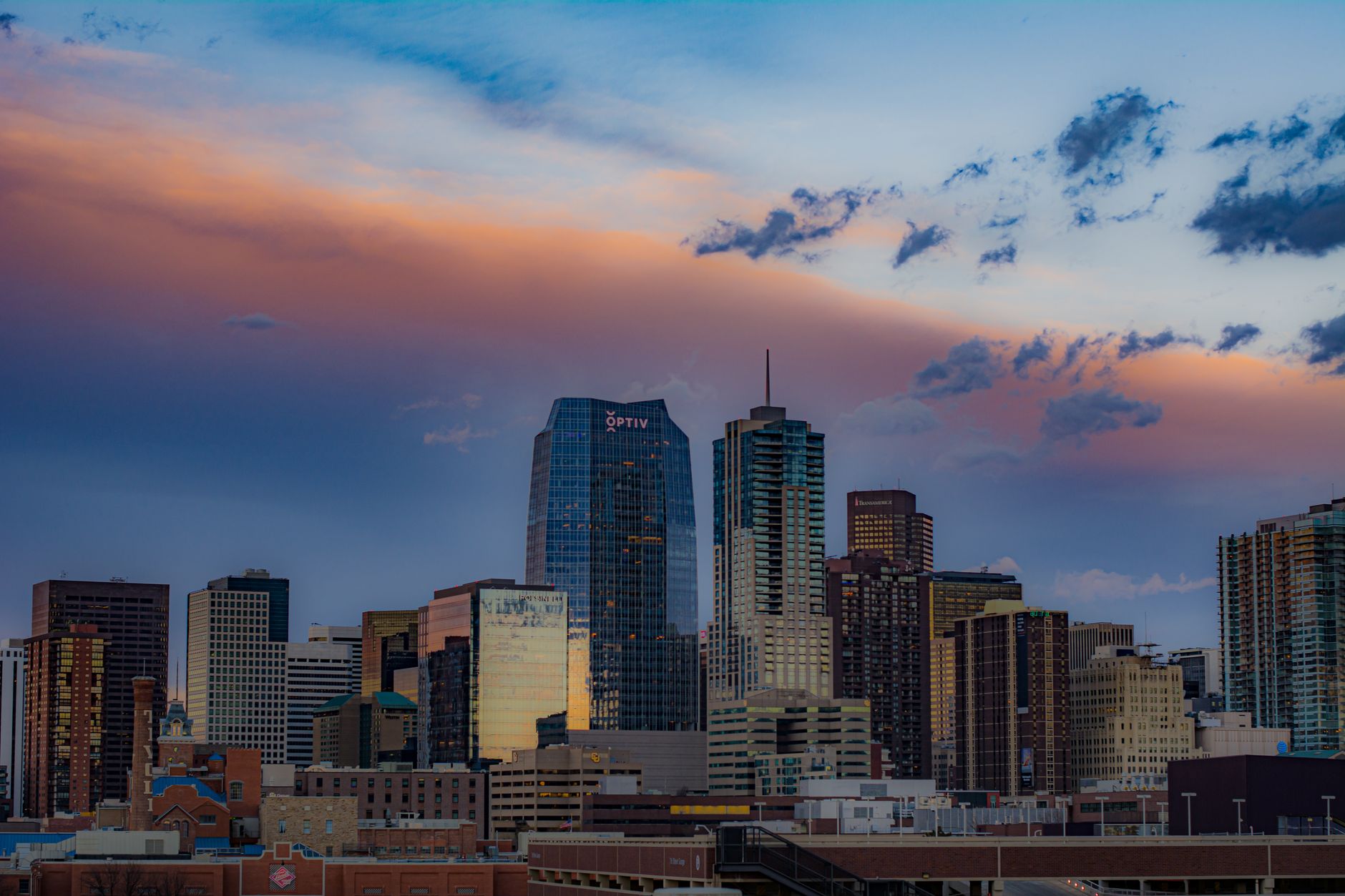
According to CBRE data cited by the Journal, nearly 40 percent of office space in Denver’s central business district now stands vacant, creating concerns that the city could become trapped in the same urban ‘death spiral’ facing other struggling downtowns…
Denver’s economy historically benefited from growth in technology, telecommunications, finance, energy and professional services. Those sectors, Odell said, have also proven among the most receptive to hybrid and remote work arrangements.
As workers stopped commuting into the city center five days a week, demand for traditional downtown office space evaporated…
The question now is whether Denver can transform itself quickly enough to avoid becoming a permanent symbol of urban decline.
Big city downtowns are important for a number of reasons with the foremost in the last century or so being the center of office-based activity. Could they still be influential with less office activity (such as the housing-based mixed-use activity suggested in this article)?
Maybe. Upon rereading Jane Jacobs’ The Death and Life of Great American Cities again this semester, I was reminded of her suggestion that cities are networks of neighborhoods. She speaks of Downtown and Midtown Manhattan but is more interested in somewhat dense neighborhoods connected to other similar places.
Or many places in the United States are already used to sprawling places where there are not centers but nodes of activity scattered across the landscape. Not one major center, many smaller centers that suburbanites travel to for work, entertainment, school, and more.
I cannot imagine downtowns as we know them from recent decades disappearing soon. The buildings still have some value to someone. But it is also hard to picture a different kind of center to regions with millions of residents.
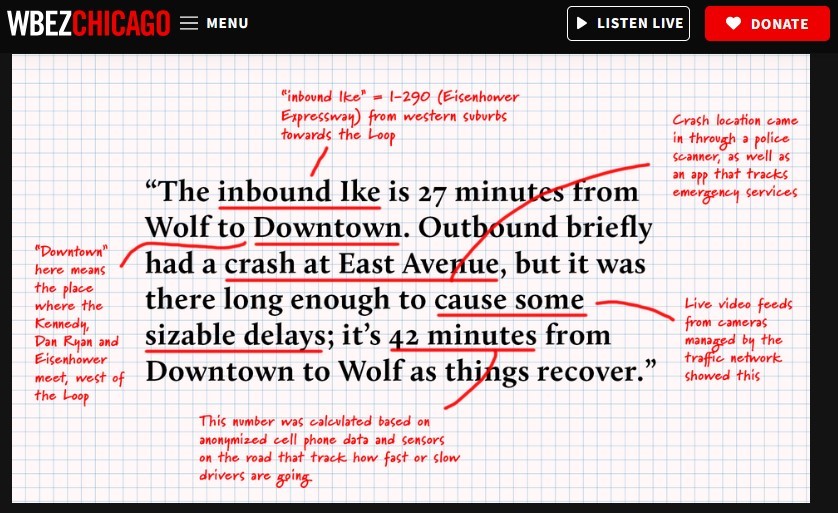
Listen to or watch or read Chicago traffic reports and “downtown” is likely to come up. Here is what that refers to:
In Chicago, the downtown is like it is in the many big cities: it is the central business district, marked by skyscrapers and business activity. Downtown and the Loop – marked by mass transit lines – are pretty synonymous. The Loop is one of the city’s 77 community areas that have been defined for decades.
But the downtown referenced above is outside the Loop. It is across the Chicago River. It is marked not by financial matters but by the convergence of highways. It arose on top of existing neighborhoods. This is technically the Jane Byrne Interchange, a busy location where people are driving in and out of the city. Depending on traffic, it can take a while to get from this location to downtown.
While they are not the same place, this sounds very American: the center of the city is actually where the most vehicles meet. As so much day-to-day life involves driving, perhaps this is downtown for many.
If you’re nodding, you’ve seen Very Merry Entertainment’s three holiday films shot on location in the Lake County village: “Christmas with Felicity,” “Reporting for Christmas” and “Christmas on the Ranch.” The latter debuted on Hulu in November.
“Once Upon a Christmas Wish,” a Long Grove production starring Mario Lopez, premieres Saturday on the Great American Family network. And two other Illinois-based movies, “Christmas at the Zoo” and “Christmas in Chicago,” will be released in the future.
In recent years, Illinois has emerged as the site of a holiday movie cottage industry. While old big-screen classics like “Home Alone” and “National Lampoon’s Christmas Vacation” are associated with the Chicago area, a crop of newer projects were also shot in the city and surrounding villages and suburbs. Of the Christmas movies released between 2018 and 2023, 12 were at least partially filmed in the Chicago area, including the 2021 Disney+ movie “Christmas Again,” according to the Illinois Film Office…
“The villages that surround Chicago are very bucolic, and have this period architecture and a setting that mimics the ideal that the storytelling for a Christmas film encompasses,” said Louis Ferrara, assistant deputy director at the Illinois Film Office. “If you go to Libertyville or Long Grove, you’ll see the Christmas decorations going up [in early November] and through the holidays. So, these villages exist in this manner every year. And I think producers and filmmakers are really now discovering that aspect of our region.”
In other words, the financial situation in the Chicago suburbs has to be good – aka tax breaks – and the communities fit the aesthetic for a Christmas film. If the goal is to have charming downtowns in small suburbs, the Chicago area has plenty of those. Take the Wikipedia description of Long Grove, mentioned above:
The village now has very strict building ordinances to preserve its “pristine rural charm”,[5] including prohibitions on sidewalks,[6] fences,[7] and residential street lights.[8] The Long Grove area is now known for its historic downtown, its exclusive million dollar homes and the annual events including the chocolate, strawberry and apple festivals that take place in May, June and September, respectively.[9] The Robert Parker Coffin Bridge, on the edge of the city’s downtown, is a historic 1906 bridge that is featured on the Long Grove’s logo and welcome signs.[10] Due to the 8-foot-6-inch (2.59 m) clearance height of its covering, it has been struck by vehicles dozens of times in recent years.[11]
Libertyville’s downtown area was largely destroyed by fire in 1895,[11] and the village board mandated brick to be used for reconstruction, resulting in a village center whose architecture is substantially unified by both period and building material.[11] The National Trust for Historic Preservation, which gave Libertyville a Great American Main Street Award, called the downtown “a place with its own sense of self, where people still stroll the streets on a Saturday night, and where the tailor, the hometown bakery, and the vacuum cleaner repair shop are shoulder to shoulder with gourmet coffee vendors and a microbrewery. If it’s Thursday between 7 a.m. and 1 p.m., it’s Farmer’s Market time (June–October) on Church Street across from Cook Park — a tradition for more than three decades.”[17]
I could imagine some additional Chicagoland suburbs would want to get in on selling themselves as having a charming, Christmas aesthetic that lasts all year long.
When suburbs build apartments or condos in their downtowns, who do they envision living there? A quote from suburban leader provides a hint as I have seen similar sentiments across suburban downtowns:
Suess said there’s a high demand for apartment space in the downtown areas and the suburbs in particular.
“The attraction of this I think is very much towards empty nesters,” Suess said. “I think it’s towards young professionals starting out and, again, folks who want to be in the downtown area.”
That is a very specific set of people. Presumably, these are people with the resources available to live in nicer apartments near a lot of suburban amenities.
At the same time, highlighting these groups also reinforces the importance of single-family homes in suburban communities. Empty nesters are ones who might have owned a home for years and raised kids there but now are looking for a change from maintaining a home. Young professionals are just starting out and perhaps they do not yet have the resources to be homeowners for the first time.
Often, suburbanites do not like apartments and/or the people who might live there. But the right apartments in a downtown setting can attract certain residents – the ones named above – and contribute to a denser, walkable, thriving downtown.
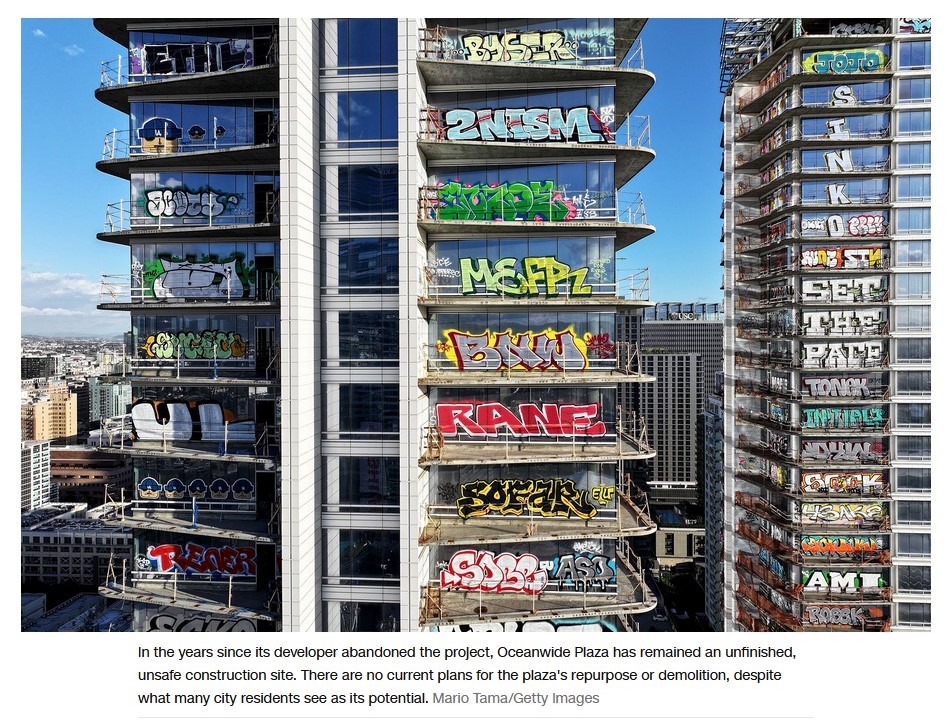
Climbing up abandoned, unfinishedfloors and tightrope walking across balcony ledges, backpacks clanging with cans of alkyd and acrylic, a collective of Los Angeles graffiti artists have transformed their craft beyond urban aesthetics to champion community issues.
Their choice of canvas: Oceanwide Plaza in Downtown LA. Occupying over a full square city block, the plaza was imagined as a vast mixed-use building project, offering city residents over 500 lavish condominiums, a five-star hotel, retail spaces, restaurants and a private 2-acre park.
However, construction on the $1 billion project, which began in 2015, was shelved after the Chinese-backed contractor Oceanwide Holdingsran out of funding in 2019 — and it has lain unfinished ever since…
Transformed in part into an art installation, Oceanwide became an opportunity for the graffiti artists to leave a message to the city below, and a call-out to policy makers who leave buildings to rot…
“People forget that people live here. People own businesses here and they don’t want to have to spend the time and money to clean it up,” said Blair Besten, executive director of the Historic Core of Downtown Los Angeles, an organization which works to improve the quality of life in downtown neighborhoods. The Historic Core prioritizes street sweeping, trash collection — and graffiti removal.
This article showcases the multiple sides of an ongoing public debate about graffiti: is it a response to difficult social and economic conditions? Is it art? Is it criminal behavior that should be punished?
At the same time, how is there such a large abandoned project in Los Angeles? What can a municipality do to finish the development or pursue another use?
Put these two ideas together: are there cities willing to have large-scale platforms for graffiti in or near their downtowns? If graffiti and its place in society is multi-faceted, how might Los Angeles or other large cities incorporate it or work with graffiti artists?
Imagine a stereotypical suburban downtown in the United States. It has two story brick buildings with storefronts on the first floor. There are some offices and places to eat. A few people walk around while cars drive past parked vehicles. There may be train tracks and a station marking the ability to commute to the big city. Not far from such a streetscape are often church buildings of various denominations and traditions.
Not all suburbs have downtowns. Many of the postwar suburbs are agglomerations of subdivisions, commercial areas, and industrial parks. But, religious buildings are there too. Go to a major intersection involving a highway; is there a megachurch nearby? Are there congregations meeting in former big box stores and in strip malls? There may not be an obvious walkable center to these suburbs but there are still plenty of congregations.
Religious buildings dot the suburban landscape. They may not be the most desirable land use with congregations not paying property taxes for their property and the opportunity costs of how valuable land might instead by used. Neighbors and local leaders may object to constructing a new religious building or a religious group altering an existing building. However, numerous residents attend these congregations. A number of these congregations and buildings are fixtures and centers in their communities. These congregations host services and can provide services to and space for the community.
These buildings range in size and architecture. Some of this depends on religious traditions. Some traditions have a particular approach to a building. Other traditions have more flexibility. People of faith in the suburbs may meet in a traditional-looking church – even as a member of a faith that is not Christian – or in a school, a movie theater, a mall, an office building, or a home. These approaches might be guided by financial resources or by concerns that certain styles may inhibit people from joining their community.
Thus, the American suburbs can include large Hindu temples, mosques and Islamic community centers, megachurches, and traditional religious buildings large and small. They can meet in old and new structures. They can move between locations as their congregations grows or shrinks, acquires resources or has difficulty finding resources.
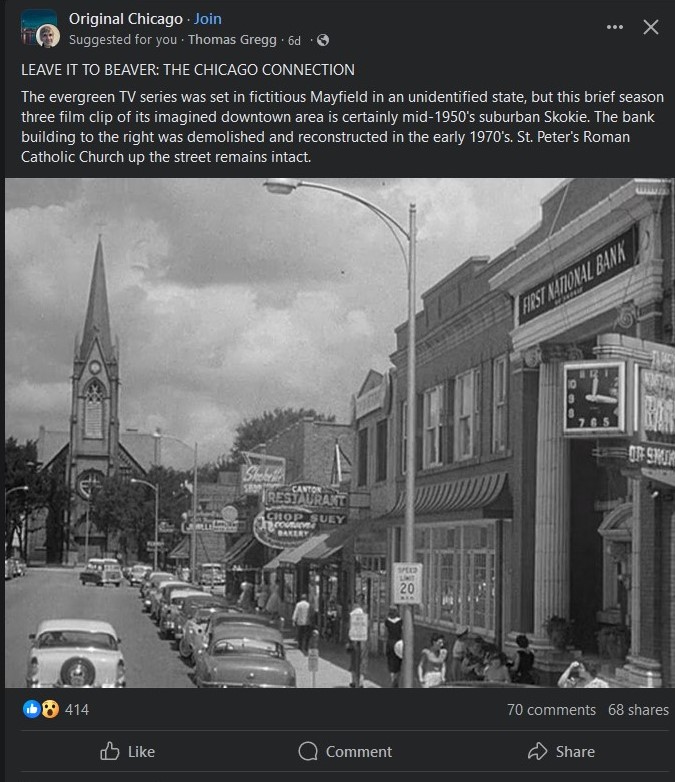
Television shows may use a variety of settings to film scenes. Given my research on suburbs depicted on television, this example struck me as it combines a famous suburban show and a Chicago suburb:
A variety of websites back up this claim (IMDB, blog). The first home in the show, what I describe as having “two stories, a one-car garage, three bedrooms, and at least two bathrooms (Bennett 1996),” was on a Universal Studios backlot. The show is often held up as an exemplar of suburban-set TV shows in the postwar era yet I noted that it “ran six seasons but never cracked the top 30” most popular TV shows.
As a fictitious show set in an unnamed community, it is interesting to consider why Skokie might have been chosen. Was there existing footage that could be used? Did someone connected to the show or studio have a personal connection to Skokie? Did Skokie represent the experiences of American suburbs at this time? Would someone watching the show then or now see this scene and connect to particular places?
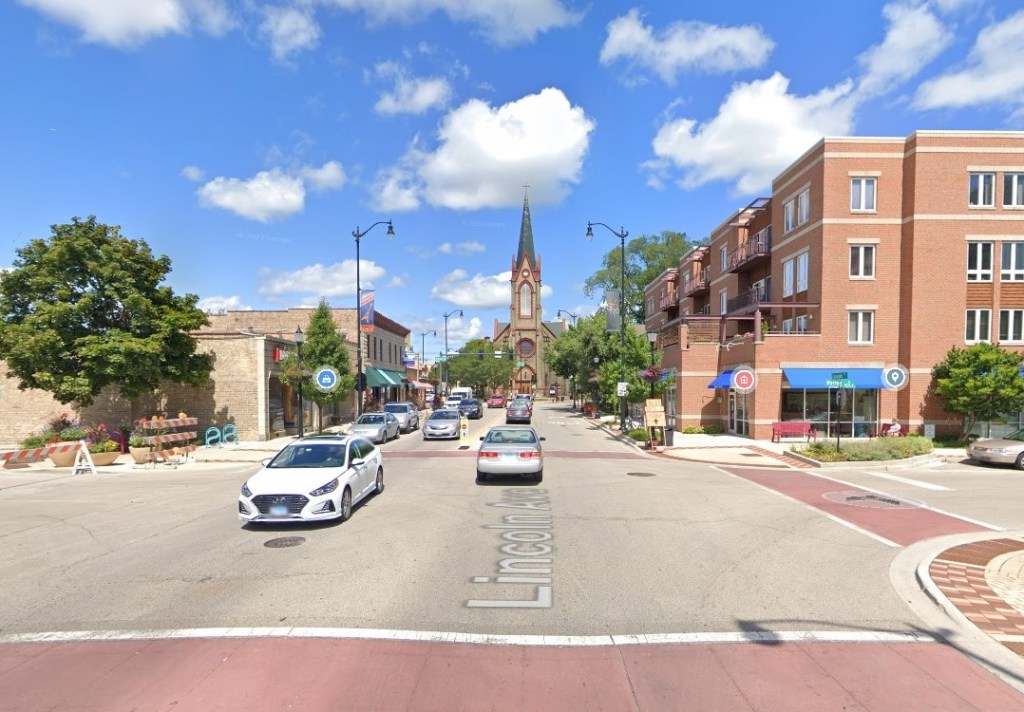
Here is a similar view from Google Street View in August 2019:
The sort of construction on the right – what looks like mixed-use four-story buildings – is common in suburban downtowns where they hope that increased numbers of downtown residents will patronize local businesses and restaurants in addition to those who want to visit such locations. These streetscapes have often replaced one- to two-story structures such as those in the top image.
Hundreds of apartments, a 600-vehicle parking garage and new retail and entertainment space are among an array of possibilities for the redevelopment of a key area of downtown Mundelein known as the “Bank Triangle.”
Suburban downtowns served different purposes in the past. They were economic and social centers in the midst of less developed suburban territories. Businesses located there sold more everyday goods including food and clothing. Banks and churches were there.
Now, suburban downtowns want mixed-use properties that match up downtown residents with restaurants, particular kinds of retailers, and entertainment and cultural options. These land uses bring in residents and money. They are perceived to be vibrant land uses. The other land uses have moved elsewhere or have downsized; banks have consolidated and have fewer branches, retailers are in strip malls and shopping malls, and more people moved to sprawling subdivisions further removed from downtowns.
This shift highlights a new version of suburban downtowns. They are now places to live and go to, not necessarily centers of community life. They have particular land uses and not others. And these will likely to continue to change in the future.





 Legally Sociable