I have tried numerous weather apps and websites over the years searching for an interface that provides all the information I want in a helpful format.
Many platforms seem to want to emphasize the current temperature and conditions and make it harder to see other details. And they want you to view ads.
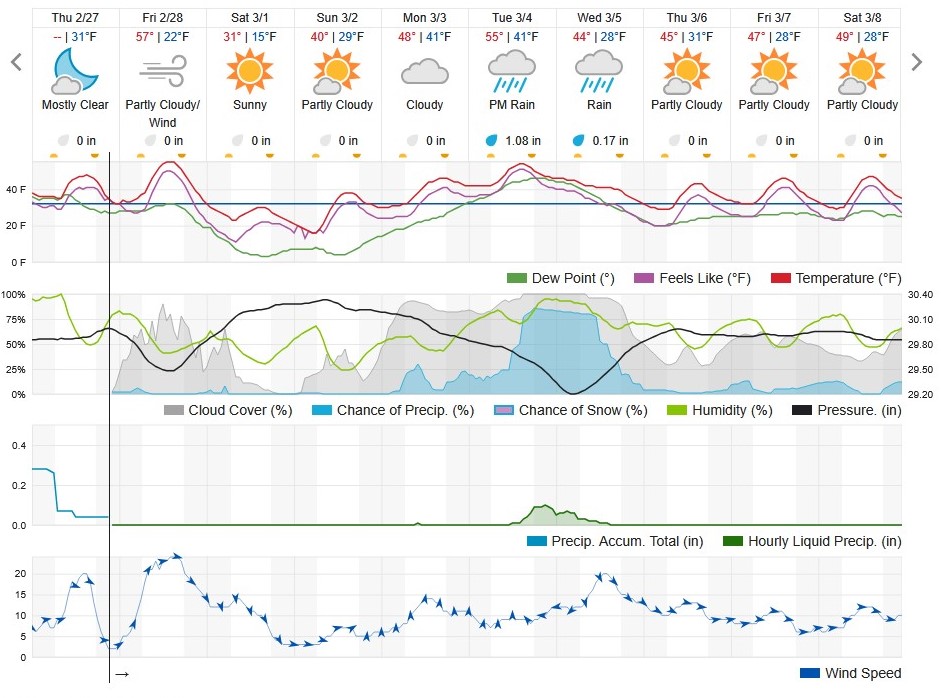
I eventually found Weather Underground’s ten day forecast. It works best on a bigger screen through their website. Here is what it looked like last night:
This does tell me current conditions – I can see them on the left. And there is a temperature high/low and a graphic at the top. But it also does several other things:
-provides info on upcoming days
-graph lines for temperature, wind chill, dew point, cloud cover, precipitation and wind
-the user can move along those graph lines to see the exact prediction conditions at that time so it can operate like an hourly forecast
Perhaps this is too much information for many. But I don’t need to scroll down and down or click to another screen. I can have a current condition graphic and can see current conditions plus can see trends for the future. This is the weather site I am sticking with (though would be open to trying other options).
After adjusting for inflation, Chicago’s median household income grew by just 9% from 2000 to 2023. Meanwhile, the city’s median cost for rent and utilities grew by 28%, roughly three times faster, according to a WBEZ analysis of census data.
This particularly affects lower-income residents:
Like Robinson, about 129,000 renter households in Chicago — roughly one-fifth of the citywide total — make between $2,000 and $4,000 a month, according to a WBEZ analysis. About 30% of those households are spending a majority of their income on rent and utilities…
Twenty-five years ago, a majority of the apartments in a dozen neighborhoods would have been affordable for someone making about half the city’s median income, like Robinson. They would have included North Lawndale, South Lawndale, the Lower West Side, the Near South Side, Douglas, Grand Boulevard, Washington Park and Woodlawn. Now, a majority of the rents in those eight neighborhoods are completely out of her reach. For example, after adjusting for inflation, the median rent in the Near South Side community has nearly quadrupled since 2000.
And the causes?
New apartment construction fell off dramatically in the late 2000s, in the early years of the subprime mortgage lending crisis and the Great Recession. “A number of single-family home builders [and] a number of multifamily developers left the sector all together,” Hermann said. “Less housing was built for more than a decade than we’ve seen pretty much ever.”…
The city is also losing housing — in particular, older two- to four-unit apartments that have historically offered more affordable rents for families.
Can leaders – political, business, real estate, etc. – address this issue? Building more units overall could help. Offering more incentives for affordable housing could help. Promoting and incentivizing development throughout the city – and not just areas where developers see the potential for a lot of profit – could help. Can housing be a leading issue to tackle?
Big cities face numerous issues but housing is a foundational concern. Residents need quality housing at prices they can afford. Not having such housing can affect all areas of life, including people’s hope for what their future can be. It can lead to people leaving (hinted at by the end of the article) and limit who can move in. And if the affordable housing shortage continues, the number of units needed only increases.
Vito Perillo, the mayor of Tinton Falls, Monmouth County, died over the weekend at the age of 100. According to Governor Phil Murphy, Perillo was the country’s oldest mayor.
We sometimes see stories of young mayors, perhaps a college student or young adult who is elected. They are at the start of adult life and may be perceived as not having the life experience that could help in leading a community.
On the other hand, being elected mayor at 93 could mean the community benefits from the wisdom of many years lived. That person could have decades of relationships and experiences in the community. They could have a sense of what the community was and how it understands itself.
In some suburbs, the mayoral role is less involved than the city manager role. Mayors are elected by residents while managers are professionals who take care of day-to-day operations. Mayors may be the ones who show up at community events, vote in local council meetings, and cheerlead for local happenings.
At what age would suburban residents say someone is generally too old to be mayor? At least in this suburb outside New York City, residents elected Perillo twice to lead the community.
Pound for pound, Tiny Houses pack a punch that would put any McMansion on the canvas.
There are several possible interpretations of this statement (and the subsequent featuring of three tiny houses in three different US locations). It could refer to the value of tiny houses (“pound for pound”). Even with a small footprint, tiny houses can offer a lot. Second, it could be that tiny houses are superior to McMansions. Hence, they could “put any McMansion on the canvas.”
Has this happened, have tiny houses knocked out McMansions? I have argued before the tiny house movement has not taken off. And McMansions are out there, even if the term is highly negative and few seem to want to defend it. If it a battle of sentiments, I would guess more people have positive associations with tiny houses compared to McMansions. If it is a matter of numbers, I would guess there are more McMansions than tiny houses.
All of this could change in the future. Perhaps both will become part of housing eras gone by and trends will move on to other kinds of residences. Perhaps one will take a decisive advantage in the public view and/or in prevalence. In the meantime, few people are likely choosing directly between the two.
To put it most simply, the evangelical ethos is activistic, populist, pragmatic, and utilitarian. It allows little space for broader or deeper intellectual effort because it is dominated by the urgencies of the moment. (12)
Does this cultural approach to life among American evangelicals match the cultural life in American suburbs?
One important element I would add to Noll’s description above is “individualistic.” Suburbanites and evangelicals both privilege their standing before considering the collective fate of their neighborhoods, communities, and country. They envision social change starting with the efforts of themselves and a few others around them. They spend much of their energy focused locally. They think less about larger social structures.
Evangelist Billy Graham adopted this approach when considering the world’s ills. In his messages across decades, he often started with the issues facing the world. Crime, communism, war, unrest. And the answer Graham provided to all this was not to listen to experts and scholars talk about social factors that provoke bad activity but rather to address the issue of sin in every person and for people to turn to Jesus. By transforming individual hearts, Christians could then positively influence society and address the social ills Graham started with. I discuss this in more detail in Chapter 8 of the book.
Thus, evangelicals found suburban settings to be welcoming or comfortable as their approach to the world complemented and was influenced by suburban settings.
The Greater Orlando Aviation Authority on Wednesday took steps toward that future by seeking partners to develop and operate a flying car landing pad — called a vertiport — at the airport. The invitation is expected to publish in March with a 2028 target for a finished product.
The airport expects to put the vertiport on land in the East Airfield region on the northeast side or land on the south side near the train station, according to a news release…
Orlando Mayor Buddy Dyer, a member of the aviation authority, said the city is a global leader in Advanced Air Mobility (AAM) — the technology behind flying cars — and having the hub at the airport makes sense…
He said vertiports may help manage the city’s growth, but that’s much farther off. He envisions starting with a four- to six-passenger vehicle operating out of the airport and eventually corridors for flying cars will follow. The small aircraft are expected to use electric power, and take off and land vertically.
Three thoughts on these plans:
It sounds like Orlando wants to pursue this to contribute to its economic growth. It could become a leader in flying cars. How big of an industry could this be? Americans like cars, Americans dislike traffic…could this be a big growth industry in the coming decades?
The connections between this and the numerous theme parks in the area are intriguing. Would visitors be willing to try these because this is an exciting place to visit? Could the flying cars be linked to Disney or Universal or other partners?
Flying car corridors will be interesting to see. How will they work and where will they be? How visible will they be from the ground? Will they also have gridlock?
Flying cars could be cool but if they lead to similar problems plaguing cars at the moment – traffic, expensive to buy a vehicle and maintain it, etc. – it may not get off the ground.
The 28-21 vote against lowering the speed limit followed a spirited and emotional debate that pitted traffic safety advocates, many of them on the North Side, against African-American alderpersons concerned about uneven enforcement and a surge in pretextual traffic stops targeting Black drivers.
West Side Ald. Jason Ervin (28th), Mayor Brandon Johnson’s handpicked Budget Committee chair, led the charge against the lower speed limit.
Ervin said he “understands the logic that, if you go slow,” there will be fewer traffic fatalities and serious injuries. But when Johnson’s 2025 budget is balanced, in part, by installing more speed cameras, he is concerned about an avalanche of speeding tickets that struggling Chicagoans cannot afford to pay…
Wednesday’s vote was a bitter and emotional disappointment to Ald. Daniel La Spata (1st), an avid cyclist who represents Bucktown, Wicker Park, West Town and Logan Square, where several fatal accidents have occurred…
La Spata has estimated the lower speed limit could save the lives of more than 300 Chicagoans over the next decade.
The summary of the discussion hints at the meaning of speed limits. Are they about safety and discouraging higher speeds? A good number of American roads are built to be wide and straight such that the design itself can help drivers feel comfortable in going faster. And since many drivers go above whatever speed limit is posted, is a lower limit necessary to reign in the higher speeds?
Or are they about police enforcement? Are they about collecting revenue? Whether administered via law enforcement personnel or a speed camera, there is a legal process at work. In a society where driving is often required, the enforcement element matters.
Trying to think outside the box a bit, couldn’t the Council meet in the middle and settle for a 28 mph speed limit? Do all speed limits need to be in 5 or 10 mph increments?
This likely will be an ongoing discussion given the amount of driving in Chicago, interest in biking and pedestrian options in the city, and concerns about police activity.
I began to see the birds walking on the streets of Wheaton in small groups. I had never seen wild turkeys in a residential area before. I quizzed people about the birds and nobody in the area was surprised by their presence.
I asked people from out of the area about the birds and they thought I was insane. I carried photos I had taken in my neighborhood to prove my sanity. People could not believe the Wheaton turkeys truly existed.
The sight of wild creatures in the suburbs may astound but I would guess many suburbanites would be hard pressed to show where animals live in the suburbs. They might be able to find the rabbits that live under their deck but where did that fox come from? Or where do those Canadian geese go at night? Does that circling hawk live nearby? And so on. The suburbs may offer their residents proximity to nature but that nature can be elusive.
Infrastructure might not be a popular topic but when something that works every day suddenly does not work, numerous lives can be disrupted. See this example from suburban Skokie:
Skokie residents are trying to recover from the huge water main break Feb. 14 that sent icy floodwater into nearby basements, blocked streets, prompted a boil water order for the population of 65,000 lasting nearly three days, shut down Westfield Old Orchard Shopping Center, forced Skokie Hospital to transfer trauma surgery patients and surgeons, closed most businesses, shut schools and barred restaurants’ doors on Valentine’s Day…
Though flooding problems were contained in a residential area of northeastern Skokie, locally known as Skevanston, and the northwestern portion of Evanston, a lack of clean water impacted businesses, homes, and institutions throughout Skokie. Village officials said they are preparing, at their Feb. 18 Village Board meeting, to declare a state of emergency, a necessary step before applying for federal and state disaster funds…
According to a news release from the village, the water main break was caused by a failed fitting cap installed in 1963. The part has an expected lifespan of between 80 and 100 years.
Neighbors in the vicinity of Prairie and Emerson told Pioneer Press that the village conducted emergency repairs in the same area the night before the main burst, which made some skeptical of the cause of the break.
Water is basic for everyday life. And not just any water; clean water that flows continuously. Suburbanites might not think much of these water flow on a daily basis but this broken water main disrupted residential, business, medical, and school activity. Streets and buildings were flooded. Regular suburban life was put on hold.
Skokie could be one of many suburbs across the United States that face similar issues. Skokie boomed in population after World War Two, going from just over 7,000 residents in 1940 to over 59,000 in 1960. All of this growth required infrastructure. The particular water main in question had a cap from 1963. Even with an expected life of 80 to 100 years, that cap is over 60 years old. At some point, those pipes will need to be replaced. What will that cost and how easily will it be accomplished? Regular maintenance can help address these issues but bigger replacement projects are sometimes necessary.
If all goes well, suburbs like Skokie will not experience events like these that lead to declaring a state of emergency and the infrastructure that supports suburban life will be regularly maintained so that suburban life can go on.
The book Forgotten Chicagoincludes the claim that at Chicago’s railroad peak, 1,000 trains daily moved in or out of the city. One chapter of the book details the numerous train stations that are no longer standing that serviced these trains.











 Legally Sociable