Architecture to improve your health and increase your happiness

Check out this guide from the American Institute of Architects on how certain designs can improve your health. A few examples:

Serenity Now: The spaces architects create can have a soothing and calming effect that reduces stress through mitigation of excessive noise, allowing visual connections beyond the building or within it, and providing access to natural daylight. Research indicates that short-term exposure to noise may negatively affect mental  well-being; prolonged exposures may exacerbate other issues, including aggression…
Stairs Can Save Lives: Well-integrated and -designed staircases can increase physical activity and cardiovascular health. A Harvard study found that men who climbed at least 20 floors per week had a 20 percent lower risk of stroke or death from all causes. New York City’s Active Design Guidelines recommends stair-design strategies that may increase physical activity.
Toxic Gas: Off-gassing from high VOC (volatile organic compound) materials can trigger respiratory health problems such as asthma or allergies in both users of buildings and the people who build them. A child that sleeps in a bedroom with fumes from water-based paints and solvents is two to four times likely to develop allergies or asthma…
Eyes on the Street: Street-level doors and windows encourage walkability and foster a strong sense of community, which aids people’s sense of environmental safety and broader community health. In a Bronx, N.Y., neighborhood where crime is prevalent, the Betances Community Center, designed by Stephen Yablon, AIA, illuminates a central staircase and gymnasium in natural light, wrapping its ground-level façade in windows as well. These transparencies give the building a welcoming presence and offer views to a public park across the street.

A lot to have to consider when designing and constructing a building. It is interesting that a number of these suggestions cross multiple areas of need. For example, stairs are necessary for safety if elevators stop operating. Toxic gas from VOC materials is a green issue. Eyes on the street is a classic phrase from Jane Jacobs to describe the kind of vibrant street life that helps social control without the need for formal policing. But, to also pitch these as health issues is likely a nice marketing tool. Not only can architects design a well-functioning building, they can improve people’s health outcomes.

In pointing to this story, Curbed provides a quote that architects can even do more: they “are often the architects of our happiness and unhappiness as well.” What can’t architects do?
Height battle between Willis Tower and One World Trade Center reveals each city’s insecurities

One World Trade Center may have been officially declared the tallest building in the United States but one writer argues the debate is really about Chicago’s and New York City’s insecurities:

What this whole thing really measures isn’t the size of a pair of buildings—it’s the size of each city’s insecurity. New York has its hollow confidence, and Chicago has its inferiority complex. Each is painful, but both can be soothed by the balm of the biggest building. Helpful reminder: The reason that Western Hemisphere asterisk has to be applied to the Willis / World Trade debate is because, among the tallest buildings worldwide, these two barely make the top 10.

The tallest building thing is just a stand-in for the real question: Which is the better city? You’ll need a different kind of Council on Urban Habitat to really get to the bottom of that.

Which is the better city? New York City is consistently ranked as the #1 global city. New York has more glamor, more of the global financial industry, more people than other cities in the United States, and one of the most impressive concentrations of people, buildings, and wealth in Manhattan. Chicago has its place as the quintessential American city (from its explosive growth in the late 1800s, its place as a transportation hub, the birthplace of numerous financial industry and commodity trade inventions, and its contrasts of wealth and poverty) and architecture.

But, all places have imperfections. See an earlier post about Chicago’s insecurities. And, it also depends on which other cities are in the comparisons: New York City is commonly compared to the world’s greatest cities including London, Paris, Berlin, Tokyo, and Hong Kong. Chicago, on the other hand, contends with two larger U.S. cities (including Los Angeles, a city that doesn’t seem to get caught up in these debates) and perhaps the next tier of global cities.

How exactly a building settles these concerns is beyond me. As the article notes, there are other buildings around the world – in some that rank lower on the scale of global cities, places like Dubai, Mecca, and Shenzhen – that are as tall or taller.

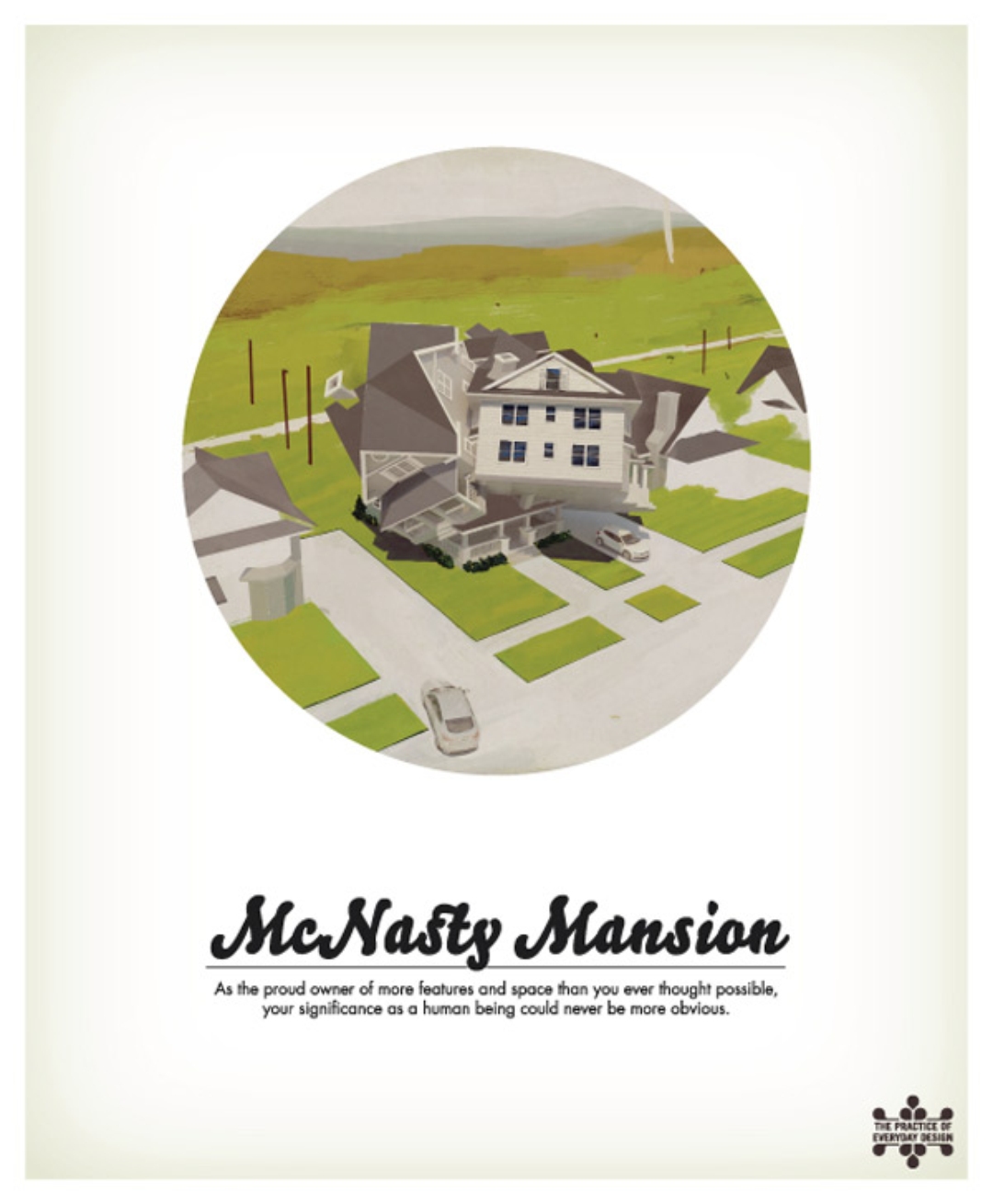
The crazy house you get when put together the McMansions of Google 3D warehouse

One group combined the various McMansion designs they found on Google 3D warehouse – and the result is not pretty:

Two-year-old Canadian design office The Practice of Everyday Design searched Google 3D Warehouse (an open-source library of model files) for the most popular suburban home typologies. After culling the top examples, they fused them all together and 3D-printed the mess. They call it “Nasty McMansion,” and you can buy one! We suggest hanging it on a string and dangling it from the ceiling in your office, as a warning.

Think of it as a kind of Ringstrasse for suburban mansions. Write TOPED:

“The McNasty Mansion offers a new and more exciting typology of homes, formed off the same principals of the McMansion: more rooms than one can fill, enough mixed styles to ensure complete architectural confusion, and enough faux finishes and cheap materials to keep cost down but dimensions huge.

I’m not sure how exactly they put this image together but it looks like it was done in such a way to maximize the bizarreness. For example, that front door on the left that tilts down toward the ground would be quite difficult for the average McMansion owner to access. Wouldn’t you get a similar result even if you combined more pleasing designs? And how exactly does their 3D design incorporate “faux finishes and cheap materials” versus the real things? But, if the goal was to create a “McNasty” design that creates a startling visual, the goal was met.

Just curious: what is the general level of architectural design on Google 3D warehouse?

The balloon-frame building invented in Chicago in 1833

The building technique that helped give rise to mass-produced suburbia was invented in Chicago in 1833:

But traditional building methods required hand-hewn beams, hand-wrought mortise and tenon joints, lapped half dovetails, and something more crucial — labor-intensive construction at a time when labor was spread too thin.

Then in Chicago, Augustine Taylor got credit for creating balloon-frame construction, a hammer-and-nails forerunner to the light-frame construction that still dominates U.S. housing…

Experienced builders supposedly derided Taylor’s St. Mary’s Church in Fort Dearborn as “balloon-framed” because it looked like a stiff breeze would blow it away. But many accounts suggest the name came from a similar French Missouri type of construction called maison en boulin

Chicago architect John M. Van Osdel attributed the invention to Chicago carpenter George W. Snow in 1832. The Chicago History Museum and other scholars point out that Virginia carpenters in the 17th century — facing similar pressures to build fast — employed similar techniques. But it wasn’t mass-produced like Chicago was prepared to do. Between 1866 and 1875, the Lyman Bridges Company of Chicago sold pre-fab balloon-frame structures to western settlers, one of several purveyors of so-called “sectionalized housing.”

This technique was perfectly suited for mass produced suburban housing in the post-World War II era as it could involve standardized parts, be constructed quickly, and be done cheaply. Builders like the Levitts could quickly construct the frame of a home (after a foundation was laid) and then have a series of other workers come through to complete the home. The majority of American homes rely on wood studs nailed together – not complicated but relatively sturdy.

It is interesting to see that this is the #5 innovation from Chicago’s history. Considering the work that went into some of the others (like #8 Reversing the Chicago River), the balloon-frame structure had an outsized impact on American life.

Sociologist recommends designing libraries and community centers so people can use them in disasters

Sociologist Eric Klinenberg says more libraries, community centers, and other public spaces should be rethought and redesigned so that they could help people in times of crisis:

“Think about this: you’re in the midst of an extraordinary crisis, it’s so profound that the systems in your city have shut down. You don’t have power, you might not have water, you don’t have communications. Is that the moment you want to go into some strange, random public institution you’ve never spent time in before — one that’s likely to be overwhelmed by people with real needs and problems, and that might not be capable of giving you what you need. Or is that the moment you want to go a place that you feel comfortable in and familiar with, a place where you know the faces and are likely to see your a lot of your neighbors. It’s kind of a no-brainer.”

“Every neighborhood in this country should have a designated emergency safe space, and it will work well if its also a place that people use in their lives everyday, or every week. And if we can do that right, we can do something amazing. Not just protecting ourselves from the next crisis, but improving the quality of our lives and our communities all the time.”

And then speaking about a new design competition, Rebuild by Design:

Yeah. This is such an exciting competition. We had 148 design teams from around the world apply to come up with innovative solutions to deal with the threats of climate change, and there are 10 teams that are finalists that are doing their projects now.

I took them to the Red Hook Initiative because it’s an example of a community institution adapting its mission and changing the way its space worked during the crisis to become a relief operation. And they wound up serving thousands and thousands of people in that neighborhood because the staff knew the place well. Residents of the community felt very comfortable and at home there and because the design of the building allowed them to change the space according to the acute needs of that situation.

Klinenberg goes on to say that building resilient communities is important. Designing public buildings and spaces so that they can meet multiple needs could help a neighborhood or community get back on its feet quicker after a disaster. It would then be worth hearing more about what these redesigns could look like. How much different would a “resilient library” look?

It strikes me that pursuing this could be quite difficult in the suburbs. Because of the density of the city, it could be easier to find public spaces suitable to this task every so often. But, when people are more spread out and some suburban communities offer little in the way of public spaces, this would be harder.

Bankrate.com asks “What is a McMansion?”

Bankrate.com defines financial terms and recently look at the term McMansion:

The Bankrate.com financial term of the day is: “McMansion”

“McMansion” is a disparaging term used to describe homes that are oversized and opulent, but also without a whole lot of uniqueness. McMansions are loosely defined as houses between 5,000 and 10,000 square feet with soaring, grandiose entryways and multicar garages, often shoehorned onto relatively small lots.

McMansions are giant homes that have sprouted up in the suburbs the way fast-food restaurants have — hence the name.

Three features of this definition stand out: (1) marking the term as a disparaging one – it is rarely used positively and can be used effectively when criticizing others; (2) it highlights their mass-produced nature (not very unique, sprouted up); and (3) sets some square footage limits so that McMansions are larger than most American homes but don’t run into mansion territory. Several other parts of the definition, including common design features and small lots, may be common but are not part of all McMansions. However, the video is disappointing. I was hoping for some classic images of McMansions…

I also wonder if this is Bankrate’s definition of a McMansion as Americans see them or as a financial publisher? Here is a little bit about Bankrate.com:

We at Bankrate, Inc. have over three decades’ experience in financial publishing. Bankrate was born in 1976 as “Bank Rate Monitor,” a print publisher for the banking industry…

Today, Bankrate, Inc. is the Web’s leading aggregator of financial rate information, offering an unparalleled depth and breadth of rate data and financial content. Bankrate continually surveys approximately 4,800 financial institutions in all 50 states in order to provide clear, objective, and unbiased rates to consumers. Our flagship Web site, Bankrate.com, provides free rate information to consumers on more than 300 financial products, including mortgages, credit cards, new and used automobile loans, money market accounts, certificates of deposit, checking and ATM fees, home equity loans and online banking fees.

In addition to rate data, we publish original and objective personal finance stories to help consumers make informed financial decisions.

What exactly does Bankrate think about McMansions?


Focus groups examine home designs in a warehouse

Pulte recently put together some new home designs in a Chicago area warehouses to see how consumers would respond:

Basically, it was the latest incarnation of the company’s ongoing experiment: walking focus groups of consumers through full-size prototypes of floor plans of homes that Pulte intends to build, and asking for reactions before the first shovelful of earth has been dug. The consumers’ input enables the builder to tout the homes as “Life Tested.”

So on this September day, in an 88,000-square-foot warehouse in suburban Franklin Park, nine Chicago-area homeowners were life-testing “houses” framed in lumber and covered with sheets of Tyvek house wrap to simulate walls.

Pulte brought in a team of carpenters to do the framing for 11 houses and the fixtures within, such as kitchen islands and bathroom sinks, which were covered in corrugated paper and marked — in case you weren’t sure what you were looking at — “island,” “sink,” etc…

Total silence ensued — they weren’t supposed to speak to one another, so as not to influence opinions — as they wandered from room to room. Then they moved “upstairs” (that is, next door) to do the same thing.

This sounds like a helpful approach to getting feedback about particular interior features, even if the features aren’t fully constructed. However, I wonder how valuable this feedback is without situating a home within a particular neighborhood. I assume Pulte would say the neighborhood is another important factor and that they build attractive neighborhoods that only enhance the individual homes.

It is also interesting to see that Pulte’s designs are then said to be “life tested.” Pulte has built enough homes over the decades to legitimately claim this for established featuresbut can they really say this for new designs?

Transforming a Bell Labs complex into a mixed-use development

The famous Bell Labs complex in Holmdel, New Jersey is due for a makeover into a mixed-used development:

Developer Somerset Development has tapped Alexander Gorlin Architects to convert the 1.9 million-square-foot facility into a contained island of retail, dining, residential, hotel, performance, and office space—providing new amenities, from a town library to an outdoor sports complex, for the sprawling suburban community. Two New Jersey–based firms, NK Architects and Joshua Zinder Architecture + Design, will also collaborate on the design of the interior tenant space.

“It is almost like the Romans have left the arena. How do you re-inhabit the coliseum? How do you inject new life in a space that is waiting for something to happen?” said Gorlin. “It symbolized America at its post-war peek in 1962.”

The colossal, quarter-mile-long atrium will be the cornerstone of the renovation. Gorlin imagines that this vast, open space will serve a similar function to that of the Armory, and host a variety of events such as large and small-scale performances, a farmer’s market, and pop-up shops…

So far the development has one tenant, Community Healthcare Associates, which plans to take over 400,000 square feet of the building. The developer envisions the complex will house a variety of tenants that meet the needs of the rather affluent surrounding community. “Everything has to mesh and come together: the clientele, the target market. There is room for many different levels,” said Zucker.

A fascinating building where much technological progress took place will be converted into another sort of lifestyle center for wealthy suburban residents. On one hand, it is a good idea to use the building for something the community can utilize now rather than let it fall into disrepair. On the other hand, the building could be treated like any other big box facility. There is potential here to market the new offices and uses as part of technological history – but this may not fit the theme of farmers markets, pop-up shops, and boutiques.

As the article notes, this building may just symbolize America at its post-war peak: big business, modern architecture, technology, all in a bucolic suburban (median household income over $140k) office campus setting. Perhaps after its redesign it will symbolize America of the 2010s: consumption, entrepreneurship, mixed-income developments, still in a bucolic suburban setting.

Plans for the first skyscraper that can disappear

Construction is expected to begin soon on a South Korean skyscraper that could hide itself:

[T]he world’s first disappearing skyscraper has just been approved for construction for the Incheon International Airport area outside Seoul, South Korea. No date is given as the projected completion yet, but according to Architizer, Tower Infinity, designed by GDS Architects, will rise 450 meters (1476.38 feet) in the air and feature “a cutting-edge LED façade system that allows visual information behind the skyscraper to be captured and simultaneously projected from the tower’s surface.” The building, in turn, will “blend into the background like an enormous, crystalline chameleon.”

Tower Infinity, which will be filled not with residences but with “entertainment and leisure purposes,” will have the third highest observation deck in the world, and its the exterior can also be used as a giant screen to project photos or movies. Despite its massive, thunderous stature—the architects believe that the primary function of the skyscraper, which they’ve nicknamed the “Anti-Landmark,” is to “celebrate the global community rather than focus on itself.” They write: “Instead of symbolizing prominence as another of the world’s tallest and best towers, our solution aims to provide the World’s first invisible tower, showcasing innovative Korean technology while encouraging a more Global narrative in the process.”

Whether Tower Infinity is “a magical piece of technological ingenuity, or a cynical new branch of architectural exhibitionism,” as Architizer puts it, one thing’s for sure: the $28B “Dream Hub,” a minicity of architectural experimentation composed of buildings by Daniel Libekind, Foster + Partners, Skidmore, Owings & Merrill, among others, as well as a rather controversial number by MVRDV, probably won’t happen in Seoul.

It will be interesting to see how this type of facade will be deployed. Imagine a regular show where the building lights up and then suddenly disappears. In a less urban area or if the backdrop is conducive, the building could disappear to be replaced by a scene of nature. Or, the LCD facade might be used as a giant advertising screen. Perhaps new regulations and codes have to be developed by urban municipalities to limit what the building might do.

But, I can’t help thinking the building has a future in action movies, perhaps the James Bond or Mission: Impossible series, as the centerpiece in some bizarre plot.

American colleges have Gothic architecture because they wanted to be linked to English universities, make clear their intellectual heritage

American colleges adopted Gothic architecture to make statements about their connections to the past as well as to other well-known schools:

American universities had always treasured the influence of Oxford and Cambridge. The colleges that would become the Ivy League were meant to model the Oxbridgian ideal of constructing a college around a quadrangle. In practice, though, American colleges of the 18th century were quite different. They were more devoted to scholarship than their British brethren. They were disconnected from a university. And they were poorer: Often, they didn’t have enough money to complete a ring of buildings around their quad…

“What Gothic meant changed depending on the time,” Johanna Seasonwein, a fellow at Princeton University Art Museum, told me. When Victorians emulated Gothic, they did it sloppily, mixing styles and idioms. “Something Islamic, something Byzantine,” might get thrown in there, says Seasonwein. This was the Victorian Gothic of the 1860s and ‘70s: a mishmash.

Collegiate Gothic, which followed Victorian Gothic, was much more precise. It emulated Oxford and Cambridge more directly.

There’s even a patient zero, of sorts, of Collegiate Gothic. In 1894, Bryn Mawr commissioned a new building, Pembroke. Its interpretation of Gothic so inspired other schools that they commissioned similar plans from the architects which designed the hall. (That firm, Stewardson & Cope, wound up constructing a near-copy of Pembroke on Princeton’s campus, where it’s called Blair Hall.)…

Collegiate Gothic was not a naive emulation, though. The Gothic revival “was just as much saying who was accepted in this atmosphere [of the college] as who was not,” says Seasonwein. Universities were expanding, and welcoming new students, but they were still mostly populated by WASPy men. Before the 1890s, many college presidents would have resisted a filigreed medieval style for fear it would look too “papist.”

Woodrow Wilson, when president of Princeton, has a now-famous quote about the revival: “By the very simple device of building our new buildings in the Tudor Gothic style we seem to have added a thousand years to the history of Princeton,” he said. Normally, the quote is truncated there, but in fact it continues: “…by merely putting those lines in our buildings which point every man’s imagination to the historical traditions of learning in the English-speaking race.” (Emphasis mine.)

All together, this is a good reminder that an architectural style we associate with a particular set of activities didn’t necessarily have to be. Social forces pushed colleges to adopt a particular architecture and they assumed this design communicated key messages.

The examples of collegiate Gothic cited in this article tend to be from elite Northeast and Midwest institutions. So does this architecture today still function in a similar manner, clearly demarcating these campuses as a cut above the rest? Other kinds of colleges, perhaps marked by region or the year they were founded or the students they serve, might have intentionally adopted other architectural styles to communicate other messages. Let’s say we wanted to look at the architecture of community colleges. I suspect more of them are post-World War II institutions that more modernist and functional architecture. What exactly does this communicate? Some counterfactuals might be interesting to look at as well: the community college with more traditional architecture or the elite school, like a Caltech, that has a different architectural style.