Barbie could only live in the Los Angeles region

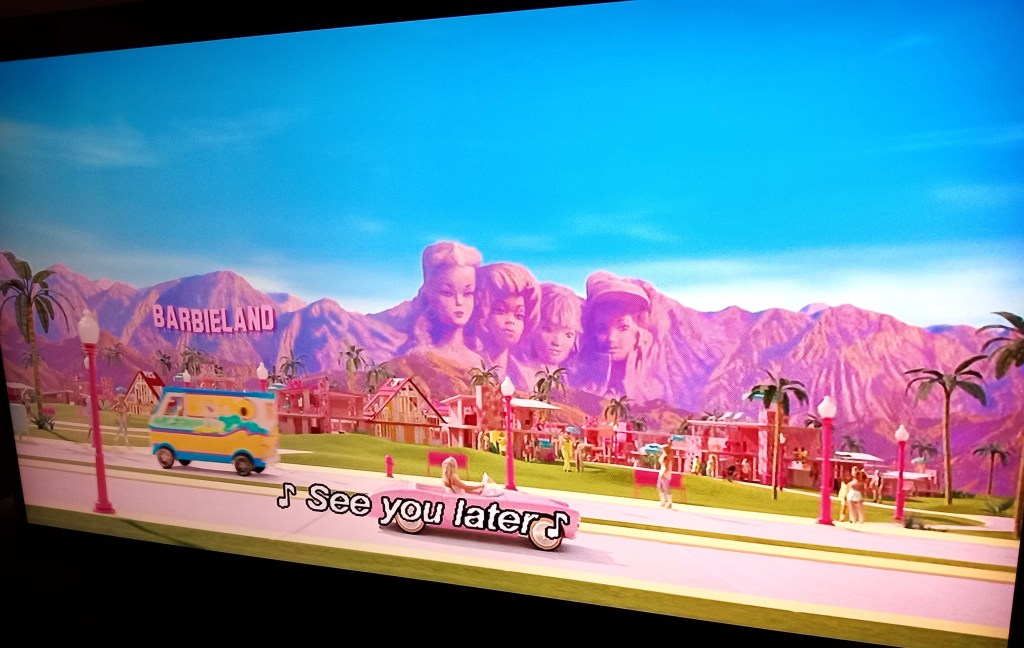
Barbie is one of the most famous toys and she resides near Los Angeles. Could she live anywhere else? I pondered this when seeing Barbie:

This scene, along with others in the movie, firmly place Barbie in and around Los Angeles. There are palm trees. Beach scenes along the ocean and boardwalk. The mountains looming in the background. A replacement for the “Hollywood” sign. Her dreamhouse is in Malibu.

Could Barbie live in other locations? How about Manhattan Barbie? Atlanta Barbie? Omaha Barbie? These are harder to imagine. Barbie has a lifestyle tied to a postwar vision of the American Dream exemplified by life in Los Angeles. She was not alone; TV shows endlessly showed life in southern California, Disneyland first opened there, and sprawling suburbia became a model.

A new city and/or region could become the marker of a new era and new toys. Perhaps Houston? A different city that will grow rapidly and look different or exhibit different patterns of life and development?

Are the suburbs connected to the popularity of 1950s housewife fashion?

If the style of the 1950s is back, what does this mean about how people see the suburbs?

Photo by Wendy Wei on Pexels.com

A new generation of women is discovering the midcentury look, albeit for wildly varying reasons. Perhaps most divisively, there’s the “trad wife” movement, an online community of traditional women whose retro fashion reflects their religious, conservative and even sometimes far-right values. Then there are women who profess “vintage style, not vintage values,” combining hourglass silhouettes with a progressive worldview. And then there are those women and designers who just happen to appreciate the bygone charm of a swirly skirt…

The contemporary interpretations of 1950s fashion run the gamut from a sprinkle of yesteryear—winged eyeliner, a Grace Kelly headscarf, cat-eye sunglasses—to full-on June Cleaver dress-up. Fans of the look share makeup tutorials and life philosophies on TikTok. On

Pinterest, the somewhat disturbing tag “Stepford wife” includes images of Nicole Kidman in the spooky 2004 remake alongside black-and-white photos of women vacuuming. On Etsy, a gateway to the style, vintage hounds source period pieces, as well as replicas from purveyors like “Hearts and Found” and “Son de Flor.”

The 1950s housewife look isn’t limited to online rabbit roles and vintage shops. It’s also bleeding into high-end runway fashion. Prada has long made ladylike pieces like full skirts, capri pants and fitted sweaters cornerstones of its line, and Dior’s fall 2023 collection played up the house’s heritage of hourglass shapes.

Missing from this discussion is any explicit mention of the suburbs. The suburban lifestyle of the 1950s was a particular one. Even as it suggested middle-class success, it was not home to all nor offered equality. The country was relatively prosperous. The examples of fashion images from the era hint at the suburbs, whether it is Leave it to Beaver or I Love Lucy (two shows part of a study I published on TV shows set in the suburbs) or The Stepford Wives or Barbie (who has a dreamhouse).

Is this fashion trend connected to a feeling of nostalgia about or wrestling with the suburbs? The suburbs are not typically thought of as incubators of high fashion or culture yet, given their important part in American history and as the most common place where Americans live, there may be some connections here. I remember a political poll in 2016 getting at this longing among supports of Donald Trump. There are plenty of American narratives about a golden era of suburbia and also numerous critiques of those narratives.

The suburbs have an ongoing legacy that plays out in all sorts of contemporary issues and conversations. That it should be part of fashion should not be a surprise, even if it may not appear obvious to start.

Barbie’s Dreamhouse and the dream of homeownership

Barbie has a big house, reinforcing ideals in the United States about homeownership:

Photo by Karolina Grabowska on Pexels.com

From the beginning, much of Barbie’s existence — her unrealistic physical proportions, the lack of racially diverse dolls, the toy’s reinforcing of gender roles — has been debated in jest and in seriousness. But her home, which has not been as publicly parsed or praised like the doll, has been a mirror for the various social, political and economic changes the rest of the country was experiencing. It has followed housing patterns and trends, from chic, compact urban living to suburban sprawl to pure excess. At times, it has been out of step, ignoring the country’s ills (Barbie’s never been broke; she has never lost her house to foreclosure)…

Financial institutions frequently turned down mortgage applications for women without male co-signers when Mattel debuted the Dreamhouse in 1962, three years after Barbie shook up the toy world, arriving in a one-piece bathing suit and kitten heels…

Society has held up “this promise of homeownership as part and parcel of the American dream,” for centuries, said Ms. Castro. More than 60 years of Barbie’s Dreamhouses have further instilled that in us from a young age.

To own a home at all, especially one with a three-story slide, can feel unattainable for most. From July 2021 to June 2022, home buyers were richer, whiter and older than they had been in decades. The share that were first-time homeowners was the lowest its been since at least 1981. And, the median home price exceeded $400,000 for the first time.

It’s called a Dreamhouse for a reason. We can all dream, can’t we?

Is the Barbie Dreamhouse simply a plot to teach children that they should aspire for a large home with all the latest furnishings and in a bright style?

The American Dream of homeownership is persistent and takes many forms. It includes statements by presidents. It includes decades of policies. It is reinforced in television shows and on television networks. It then would not be a surprise that children’s toys would reflect a similar theme.

How many toys do this? How often does “playing house” explicitly or implicitly support homeownership? Even if children cannot voice what they are doing, living in a society that pushes the American Dream of a suburban single-family home is bound to be picked up early in life.

All of this thinking of the Dreamhouse reminds of Lynn Spigel’s 2001 book Welcome to the Dreamhouse: Popular Media and Postwar Suburbs. I recommend it.

Barbie’s DreamHouses and American houses

A new book shows how the Barbie DreamHouse changed over time:

The monograph, which the publishers say is “the first architectural survey of the world’s best-selling dollhouse”, features glossy images of the houses captured by fashion photographer Evelyn Pustka, alongside detailed architectural drawings…

The homes themselves range from contemporary influencer houses all the way back to the mid-century bungalow of the 60s.

In this way, the book establishes the Dreamhouse as an early example of homes turning from private domains into a means of expressing and performing our personality for others – alongside the Eames house, the Playboy apartments and Jackie Kennedy’s televised tour of the White House in 1962…

“So there’s this bifurcation where the Dreamhouse is more in conversation with McMansions, which might reference postmodern architecture but lose the kind of ironic quoting involved in using Doric columns.”

The emphasis here seems to be on how the Barbie homes reflected architectural styles. However, how much did these toys shape architectural styles? As people played with these houses, how did it change their perceptions of houses? This might be difficult to ascertain but presentations of homes and what is normal or aspirational can help shape what people expect.

A question: have any constructed houses been inspired by the Barbie DreamHouses? This could be another signal of how Barbie has affected homes.

Winner selected for new, greener Barbie house

One columnist takes issue with the winning design selected for the new Barbie house that was intended to be a greener home:

What Li and Paklar imagined was a series of glass cubes stacked on top of each other with enough space underneath the beach mansion for a car or motorbike to park. Very chic, very elevated, very Le Corbusier. The interiors (pink, of course) look airy, clutter-free and, with 4,881 square feet of living space, lonely for a single person. There are bamboo floors and a roof garden with natural irrigation. But even those tiny eco-design gestures cannot offset the fact that Barbie gets to hog a massive house on three acres of pristine West Coast beach. Sorry, girlfriend!

America has been damned by the tyranny of the excessively large house. Check the explosion of square footage over the last half century of the private home, from the modest two-storey of Leave it to Beaver to the sprawling residential heaps featured on The O.C. Barbie once cavorted through her own shopping-mall playset. It was just something she had to have, like a purse.

The problem with the McMansion scenario? It’s unaffordable and unsustainable. But, like Barbie’s impossibly small waist, it’s a dream that everybody is conditioned to want…

Li and Paklar might have been tempted to design a compact, art-filled studio in the heart of Manhattan for Barbie. They might have edited her massive wardrobe down to a few edgy, well-designed outfits and given her a pair of workboots to wear on construction sites. If they had, my bet is they wouldn’t have won the design competition. In America, what suits Harvard-educated architects doesn’t really count. You have to think big, hungry thoughts to get ahead. Just like Barbie.

It sounds like this columnist thinks that McMansions can’t really be green.The fact that the home is large and has a large lot is simply too much to overcome.

Did anyone really think that Mattel would select something small, non-luxurious, or small? Perhaps the selection of this design suggests Americans want green and luxury to come together and don’t want to sacrifice much in order to be green. Therefore, acquiring smaller homes is driven more by economic trouble (people can’t access the actually homes they would want) or individualistic choices (wanting to declutter, simplify, improve, etc.) rather than the idea of sacrifice or helping the world.

The actual home design is more modern than I would have expected. How about a discussion about Barbie’s aesthetic tastes in homes?

Barbie needs a “green dream home”

The socialization process that children go through includes messages and ideas that they get from the toys that they play with. So if we want future adults to live in greener homes, then perhaps it will be Barbie who leads the way:

With an exciting new career in architecture, Barbie naturally needs stylish new digs which is why Mattel has teamed up with the American Institute of Architects (AIA) to launch the Architect Barbie Dream House Design Competition…

And here are Barbie’s guidelines, in her own words:

My Dream House should reflect the best sustainable design principles and also be a stylish space that I can live in comfortably. A sleek, smart home office is important for any doll…

I love to entertain so I need living and dining areas that are open and connected allowing for mingling and easy entertaining from one room to the other…

And the list of guidelines goes on.

This is an interesting list: it starts with “sustainable design principles” but then the rest of the list expands on the concept of “stylish space.” So Barbie might want a greener home but this home is still going to have to be pretty large to accommodate all of her stuff. The home may be designed a little better but it still sounds like it will be an ode to consumption since she is a “fashionista,” has at least three cars, and needs a big yard. Can Barbie live in a greener McMansion (not that architects could call it that)?

It would be interesting to see what type of architects would openly submit designs for this.

On “shooting creatives” and “winning eventually”

Copyright law is everywhere these days, even in the popular (i.e., non-specialized) press.  And it’s in the pop press where things get interesting:  all of the legal niceties that IP legal specialists drone at each other quickly get reduced to bracing, real-world takeaways.

Take this recent piece by Roger Moore, a movie critic for the Orlando Sentinel, who makes some unintentionally wonderful arguments for copyright reform:

Orlando attorney John Rizvi of Gold & Rizvi, P.A., specializes in [intellectual property] law, and he spends part of his time shooting down what creative people think they know about copyright and that nebulous concept known as “fair use.”

Stop right there.  Did he say “shooting down” and “what creative people think” in the same sentence?  This already sounds like promoting science and the useful arts to me.

Sigh.  What else?

Moore also quotes from Marshall Leaffer, a “Distinguished Scholar in Intellectual Property Law at Indiana University and the author of ‘Understanding Copyright Law'”:

Leaffer cited as an example [of fair use in action] a conceptual artist who made and sold photographs of Barbie dolls posed in provocative ways. He was just doing a parody, right? He figured he’d be safe.

“Mattel sued him,” Leaffer said, referring to the doll’s maker. “He won. Eventually. But it cost him a lot of money.”

Let me reemphasize what Leaffer skips right past.  The artist won. Using Barbie was a fair use.  But the artist only won “eventually”.  And “it cost him a lot of money”.

What can we take away from Moore’s article?  I humbly submit we should reform the monstrocity that is U.S. copyright law.  Why?

  1. We need to stop shooting down creative people.
  2. We need to make sure that artists acting well within their rights simply win, not “eventually” and after years of financially ruinous litigation.