Current owner of “The Brady Bunch” house says it is a “piece of art”

The owner of The Brady Bunch house, bought for $3.2 million in 2023, says it is art:
Photo by Puu0219cau0219 Adryan on Pexels.com

Trahan told the Journal in 2023 that the house was “the worst investment ever,” but has since clarified those comments, telling People that she views the home as a piece of art.

“When I was buying it, I wasn’t thinking, ‘Oh, it was a great investment,'” Trahan told People in 2023. “When I buy art, it’s because I love the art. It’s not because, ‘Oh, I’m going to make money on this.’ If you’re going to make money in art, you have to sell it. I buy art, and then I don’t sell it.”

The first Brady Experience sweepstakes was such a success that Trahan is opening it up for another round. Trahan could not be reached for comment.

Can a home be art? Can a real suburban home that became part of a well-known TV show be art? This might require public and/or critical consensus.

The idea that a postwar suburban house could be a piece of art is not that farfetched. Imagine homeowners of such homes across the American landscape that lovingly take care of their homes, maintaining and improving them. Or preservationist efforts that protect particular homes for future generations. (Which postwar suburban homes might qualify for this is another discussion – which are more art and which are more pedestrian?)

Add to this the iconic nature of this home. For many, The Brady Bunch house represents suburban family life. The show only ran 5 seasons but the family and its home became a part of the postwar culture during its run, through syndication, and ongoing lore. I doubt many critics would say the show was art – it was a normal sitcom – but the iconic status of the show may elevate it in the eyes of viewers.

Perhaps the Brady home is pop art: a slice of a particular time that was revered by many.
The Brady Bunch house as “the second most photographed home in America”

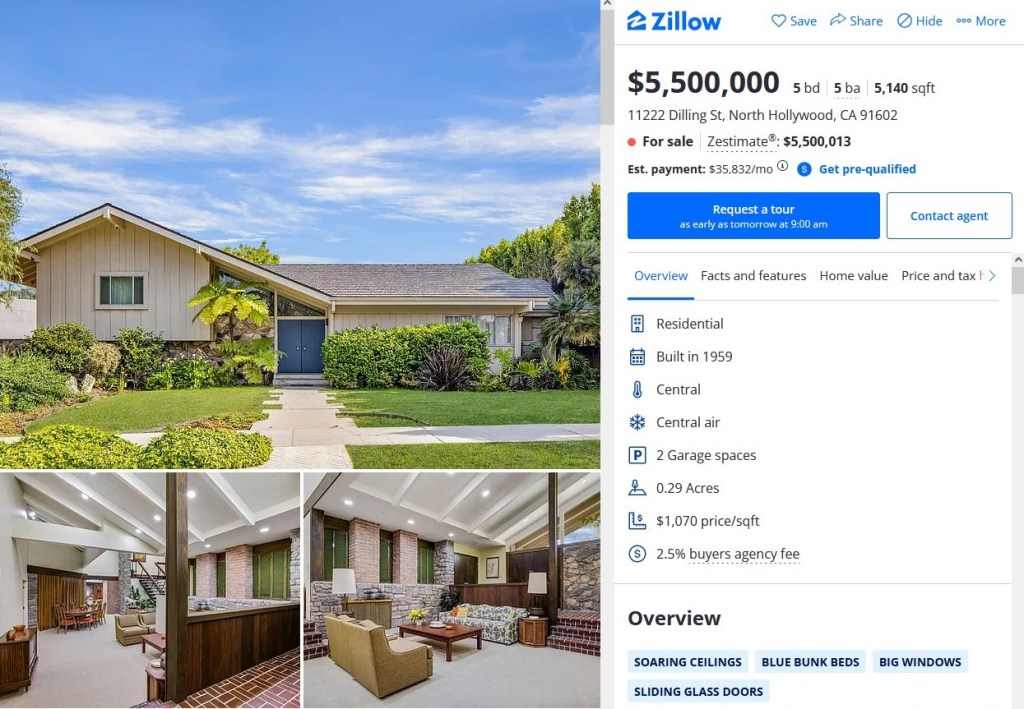
The house featured on the Brady Bunch is up for sale again. Apparently, many people have photographed the home:

The Brady Bunch only lasted five seasons, but its cultural footprint has endured. The ABC comedy — which followed a blended family of eight, their live-in maid and, at certain points, a dog — ran from 1969 through 1974 before inspiring TV movies, a satirical feature remake (and sequel) and countless pilgrimages to 11222 Dilling Street. It has been called the second most-photographed home in America, trailing only the White House, though there is little evidence to back up such claims. 

I am sure someone could try to quantify this. Scan through all of the pictures on the Internet including photo upload sites? Perhaps measure the number of visitors each year to different houses and estimate how many pictures they might take?

A better question to ask might be this particular house is so popular for pictures. It is tied to a popular TV show, it is accessible to the public who can see the home from the street, it is located within the second largest metropolitan area in the United States, and there are a lot of tourists in the area. Still, it is a home built in 1959 that looks rather unremarkable from the outside. This might be a story about (1) the power of TV in American culture and (2) the importance of TV in this particular era of suburbia and Baby Boomers.

I wonder if any other TV shows would be in a top 10 of photographed homes in the United States.

(See earlier posts about the Brady Bunch house: a 2018 post about HGTV owning the home and a 2012 post about comparing the exterior and interior of the homes.)

Considering what we know about the broad sweep of suburban TV shows

An Atlas Obscura piece on Levittown begins with a summary of suburbs on television:

gray scale photo analogue of television

Photo by Andre Moura on Pexels.com

From the air, the homes fan out like intricate beadwork. For decades, America’s suburbs have been a popular setting for television shows, from Leave It To Beaver* to Desperate Housewives, chronicling entertaining trivialities against the backdrop of meticulously shorn lawns, the drifting smoke of barbecues, the infrastructure of cars and roads: a pleasantly domestic—but fraught—version of the American dream.

There is no doubt about the claim in the second sentence: “America’s suburbs have been a popular setting for television shows.” Today, television viewers can still find new suburban sitcoms that play with the 1950s formula (actually begun in radio) of a happy nuclear family with plenty of resources working through entertaining yet relatively low-level issues. And as noted at the end (and developed by numerous scholars – I would recommend starting with the work of Lynn Spigel), the television image of suburbs was too pleasant and reinforced a well-off white image of the suburbs.

At the same time, I have published two articles on television in the suburbs and they contribute to a more complicated story of suburbs on television. In my article “From I Love Lucy in Connecticut to Desperate Housewives’ Wisteria Lane: Suburban TV Shows, 1950-2007,” I find that suburban-set shows never dominated the most popular American TV shows. Although such shows might be familiar, common, and live on in memories connected to a different era, they are not the only places Americans see on television. Take as one example the Brady Bunch: it may have been watched for millions in syndication, it may have particularly influenced younger viewers, and it had an iconic house but it never was a Top 30 television show. The suburban TV show is well-known but how influential they are is debatable.

Similarly, more recent suburban TV shows have truly tweaked the format. Lynn Spigel points out that twists to the typical format started early on while more recent shows feature suburban lifestyles from a different point of view (thinking of Black-ish, Fresh Off the Boat, and American Housewife off the top of my head). I wrote “A McMansion for the Suburban Mob Family: The Unfulfilling Single-Family Home of The Sopranos” and considered this critically-acclaimed and popular show set in suburban New Jersey. It has a similar set-up to 1950s suburban shows – the successful white nuclear family living in a big suburban house – but ultimately suggests all of this is an illusion as Tony Soprano’s mob dealings undergird and undercut the family’s attempts to live a normal suburban life. The Sopranos is not the only show to do this; others feature other family structures, deviant behavior, and alternative routes into and out of the suburban dream.

At this point, have television shows covered all of the stories of American suburbs? No. Is there still a typical format? Yes. Have creators played around with the typical format to present other stories? Yes.. Do Americans want to watch suburban TV shows? Yes and no.

HGTV cashes in on the popularity of the suburban Brady Bunch home

The iconic home of the Brady family on The Brady Bunch may have a number of confusing features but it is still popular: HGTV is working on a show about the renovation of the home.

The Studio City, Calif., residence was pictured in each episode before the camera took viewers inside the family’s abode. Those scenes, which featured, for example, the kitchen where housekeeper Alice (the late Ann B. Davis) dished out jokes or the girls’ bedroom, where Marcia Brady brushed her hair, were shot on a soundstage.

The house changed hands over the summer, when the network snapped up the property for an unknown price. (Former ‘N Sync member and Brady Bunch die-hard fan Lance Bass narrowly missed out on the place in a bidding war.)

HGTV revealed in August that it had placed the winning bid and would restore the home “to its 1970s glory” as part of a new show.

On Thursday, the network announced that A Very Brady Renovation is set to premiere in September 2019. Home renovation pros from HGTV will “reimagine the popular show’s interior set design, working to ensure that the final renovation results stay true to the spirit of the Brady Bunch family home that everyone loves and remembers,” according to a press release. In other words, the iconic staircase and the retro hues used in the home will remain.

Perhaps this is what nostalgia about postwar suburban life looks like: it is filtered through television. Instead of having a show about updating postwar suburban homes (imagine an HGTV show solely devoted to the iconic Levittown and other mass produced suburbs), a network banks on a fictional suburban home. If this Brady Bunch renovation show works, I imagine more shows featuring famous TV homes could occur.

This whole concept makes some sense. Television emerged at the same time as the suburbs. Certain shows, including the Brady Bunch, became associated with suburban America. Some have argued the depictions of suburbs on television helped encourage suburban development – I’m not sure there is much evidence for that. Still, the suburban TV show following the exploits of a nuclear family and kids developed in this time and is still a genre today.

But, I could also imagine some alternative ways that a home like that of the Brady Bunch could enter the realm of nostalgia:

  1. Becoming a museum. Imagine either someone purchasing the property and turning it into a museum or a local government acquiring the property. Put a little money into the home to set up some displays, charge a manageable entrance fee, and the facility is up and running.
  2. Since the first option might cause some zoning issues, move the whole home to a place – museum, theme park, TV studio – better suited to host visitors to the home. What if there was a theme park built around TV buildings or even just around depicted suburban homes?