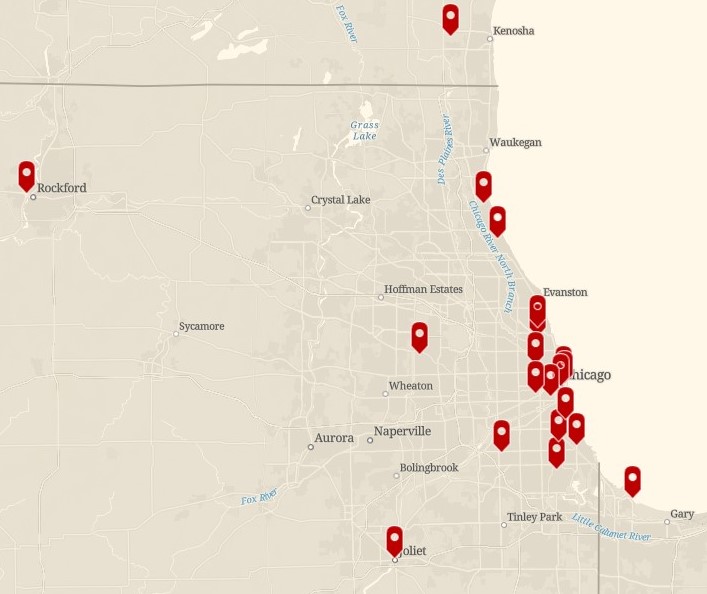
I do not know enough literature to know how well this map might reflect the totality of fiction written about and/or set in Chicago. However, the map above has relatively little from the suburbs. Here are the suburban works listed (a few others have markers in the suburbs but the descriptions say they are set in Chicago):
-Joliet – A Martyr for Suzy Kosasovich (2008)
-Salt County, Illinois – Water Marked (2000) [this is the one with a marker in northeast DuPage County on the map above]
-Prairie Park, Illinois – Neon Green (2016) [this is the one with a marker in northwest Indiana]
More broadly, is there any consensus on the best suburban novel of the last few decades? Academic treatments of the literature set in suburbs often cite novels like The Crack in the PictureWindow or Revolutionary Road from the early years of postwar suburbia.
The context for this quote is a dispute between local governments in the region about obtaining water. Hundreds of millions of dollars, perhaps billions, are on the line. People need water. For now, it is there and it probably will be there for a long time…but it is not guaranteed to be there.
The Metropolitan Water Reclamation District of Chicago holds tours for the public. I recently participated in a live zoom version. You can watch a version here.
The tour was very informative about water and processes. We learned about watersheds and the small hill that separates water going into the Great Lakes versus the Mississippi. We learned about how water is cleaned in water treatment plants. We learned about the reversal of the Chicago River. We learned about the Deep Tunnel system. All of this was accompanied by helpful visuals (maps, drone footage) and engaging hosts who answered questions as they arose.
And it was also a public relations exercise. We heard about the ways that the MWRD has improved. We heard about the benefits of all their efforts. They had booklets for people to access, including materials for kids and information in multiple languages. The presentation was smooth.
What the tour could not as easily touch on: is this the best way to deal with water and land in a metropolitan region? Are there harmful byproducts of these systems (how about forever chemicals in sludge sold to local farmers)? Does the Deep Tunnel system solve all the problems it was supposed to?
Infrastructure like this is essential to modern life. People expect clean water to be available. When it is not, it is very surprising. They may complain about water rates and tax bills, but the whole system as experienced in the United States is relatively cheap for consumers.
Thus, positive public relations involving infrastructure can help the public know about these systems that they contribute to and depend on. People do not like a highway construction project that is over budget and over time? They can be informed about how these processes work and about the benefits that will come eventually. The public does not like a rate hike? They can learn about all the amazing systems that make it possible to live modern life.
All of this does not mean that the public relations version should necessarily win the day. I am generally in favor of all of us knowing more about the infrastructure we rely on. Yet, there are also questions or concerns that public relations can not easily bat away. If we can have more informed conversation about infrastructure, perhaps we could avoid protracted debates or simplistic approaches.
Let’s say winters in the future in the Chicago region turn out to be not as cold, do not involve as much snow, and/or include more warm days. In just the last month, we have experienced wind chills of roughly -30 degrees below zero and 50 degree days. The Chicago region has had moments of winter but not a full month of winter. Would Chicago residents like a long-term shift away from winter?
On one hand, many Chicago area residents complain about the winter. They make clear their opinions about the cold, snow, potholes, salt, longer traffic times, winter gear, heating bills, and more. At least a few vacation in warmer climates during the winter and some move to warmer climates.
On the other hand, it is hard to imagine the Chicagoland experience as it is known now without winter. What about the social capital created by griping together? The possibility of a white Christmas? The pride about shoveling and still doing life when talking to people in parts of the country where a light amount of snow shuts everything down? Invigorating winter outdoor activities? Supposed “Bears weather”? Jokes about the two seasons of winter and construction? And so on.
Perhaps new weather patterns would lead to a reconfigured understanding of what winter is. People can adapt to change over time. They can find different ways to bond and different experiences or group identities that bring them together. The long-told tales of the Blizzard of 1967 or Snowmageddon 2011 will fade further into the archives. Chicago could still have a winter that is different than the South or West even if it s different than what it is in the past.
A dynamic, cooperative region that thinks and behaves collectively has a better chance at prosperity than one that functions as an amalgam of fiefdoms.
We know that’s hard for politicians to grasp. They want to be able to tout in news releases that they’ve persuaded a mega-firm to relocate its headquarters to their turf, and it doesn’t matter that those jobs and tax revenue have been lured away from a nearby community.
But it does matter, because it’s not a win for the region. Municipalities that compete among themselves may win some skirmishes, but they’ll win the war if they band together and compete as a region — against other regions in the country and globally…
What’s missing is the will to capitalize on those assets collectively, rather than selfishly.
Perhaps this latest attempt at regional cooperation will gain the traction that previous tries could not. For the sake of Chicagoland’s short-term and long-term outlook, we hope so.
I wonder if this renewed interest has anything to do with concerns about population in the region and companies headed elsewhere. It is one thing to compete when the region compares favorably to many other places in the country. In this situation, there might be plenty of companies, residents, and growth to go around. But, in a region that is struggling or the perception is that it is struggling, can the different communities afford to compete with each other?
While the editorial mentions the need for politicians to change their approach, the public might need some time or convincing to get there as well. One way to define a community is in opposition to or as different from another community. How many suburbanites define their neighborhoods and communities in comparison Chicago and the troubles it faces? Might this also happen for some who live in Chicago and view the suburbs as problematic? (This does not even get to how Chicago area residents might view further-flung locations such as Indiana, Wisconsin, or downstate Illinois.) A robust regional partnership could help residents see the advantages to cooperating and recognizing the advantages numerous communities bring.
At one time, this system may have made sense. The Chicago region, as in multiple regions in the Northeast and Midwest, was organized with a dense commercial district at the core. Today, this makes less sense in many US metropolitan regions where the many trips and commutes are suburb to suburb. Throughout a region, suburbs are job centers, entertainment centers, and residential communities.
Reconfiguring infrastructure like highways, railroads, and mass transit to fit these new realities – perhaps now exacerbated by more employees working from home – is a long process with multiple avenues to pursue.
The partnership agreement features a code of professional conduct that prevents members from soliciting businesses from other participants’ jurisdictions, or disparaging those communities when a business considers relocation. The agreement also calls for the participants to share information and produce 150 “pro-Chicagoland” decisions.
Michael Fassnacht, president and CEO of World Business Chicago, said that after 23 years, the city’s public‑private economic development agency is becoming a regional operation. The region’s gross domestic product is not only the third-largest in the nation, but the size of some nations’, including Sweden and Poland, he added…
By getting investors to view the region as a whole, it has a better chance of landing valuable projects for the good of all, Conroy said…
Having traveled the world in search of foreign investment, Reynolds said potential partners speak of Chicagoland, not just Chicago. And so he was happy Wednesday to have heard local leaders use that term more in one morning than they had in decades.
It will be interesting to see what the first successful efforts of this partnership yields. Or, conversely, the first conflict where actors and municipalities in the region do not agree.
A Daily Herald analysis of 95 suburban sales tax receipts during the state’s 2021 and 2022 fiscal years shows the towns combined to average a 28.6% increase in sales tax revenues, resulting in nearly $230 million more…
First, federal and state laws that took effect in January 2021 required companies to assess sales taxes for online purchases at the rate of the buyer’s hometown…
Then, COVID-19 stimulus funds paid directly to Americans reinvigorated purchases on physical products…
And the final catalyst for sales tax revenue growth statewide has been the historic increase in the inflation rate.
The article goes on to discuss two issues I was wondering about: how will these communities spend this money and will this revenue increase last?
My guess is that there will not be too many major changes even with these increases. Because it is not clear whether the money will continue to come in at similar rates (though the online source sounds durable), the money could be limited to particular items or shorter projects.
At the same time, an increase in monies could help address important needs and build a good foundation for the next few years. Could some communities complete a project that they had been waiting on? Or, could they start something rolling for the longer-term that needed resources to get rolling?
These increases could also lead to some interesting conversations about what to prioritize and spend on. (Additionally, communities without bumps might have interesting discussions.)
The Chicago Metropolitan Agency for Planning (CMAP), which tracks these patterns, has found that drivers are taking trips on different days, at different times, and sticking closer to home than they used to. An analysis done for WGN-TV shows fewer trips being made at the familiar times and locations of rush hours. “Instead, they are more spread-out, making travel and congestion unpredictable,” WGN reported.
Another big factor in this traffic roulette is the continued rise of e-commerce. Amazon, FedEx and UPS trucks are everywhere, it seems, stopping-and-going, and sometimes blocking streets as drivers deliver online orders. CMAP reports that single-unit truck traffic (including those delivery vans) has shot up 20% since early 2020.
The third variable is public transit. Ridership on CTA, Metra and Pace continues to lag pre-pandemic levels, thanks in no small part to the perception that they are either unsafe, inconvenient or both, meaning more commuters are driving. As a result, motoring to and from downtown can be as rough as ever, especially on Tuesdays, Wednesdays and Thursdays, when employers are more likely to require the physical presence of their office workers.
While these patterns will continue to evolve in the years ahead, working and shopping from home are here to stay, and public transit has a long journey to win back its customers. Planners need to adjust accordingly, and that probably means re-engineering traffic systems.
Summary: Tuesday through Thursday are now the worst “regular” rush hour days, trucks and traffic can be anywhere, and fewer people are using mass transit.
Does the Chicago area have an advantage because of its grid network? If drivers encounter a problem, it is not hard to find an alternative route. Compared to cities with longer histories and fewer major roads in the Northeast, Chicagoans have a plethora of options. On the other hand, the Chicago area is limited in terms of highways and sprawling roads compared to some places in the South and West.
Even with a grid and flat surface, one of the biggest problems seems to be that traffic – driving and rail – tends to end up in particular chokepoints that are more unpredictable in their use. Drivers still go through the Jane Byrne Interchange. Freight traffic needs to get through railyards and across at-grade crossings. Could this traffic be effectively lessened or rerouted in ways that help people and goods flow more quickly?
If there was an issue that the over 9 million people in the Chicago region could address together, this might be it. Yes, few people want to pay for solutions they do not directly benefit from. However, solutions to these issues across the region would benefit everyone.
Once a novel concept, more and more suburbs are permitting residents to raise backyard chickens. Among the latest is Rolling Meadows, which enacted regulations in 2019 allowing them, after rejecting the idea in 2014 and 2018. Others include Bartlett, Deerfield, Des Plaines, Evanston, Glencoe, Grayslake, Highland Park, Schaumburg and Wheeling,
Suburban proponents of backyard hens laud their benefits, such as a source of healthy eggs and an affordable food option.
Opponents, however, worry about the possible impact on neighbors, from the noise and odors to concerns about attracting coyotes.
Are chickens enhancing the suburban experience or detracting from it? More Chicago area communities are coming down on the positive. How long until the majority of suburbs allow chickens or are there significant barriers facing suburban chicken expansion?








 Legally Sociable