I do not know how many people are on this mailing list or how many people would change their water use patterns based on an email. However, I can see the point: if capacity is reduced and the Metropolitan Water Reclamation District of Greater Chicago knows about it, why not ask?
As the region continues to grow and experience more development, these water issues will likely grow. Pursuing different solutions could help as could changing usage patterns.
Photo by Miguel u00c1. Padriu00f1u00e1n on Pexels.com
Illinois’ attractiveness for data centers stems from economic incentives, an already improved power infrastructure and its being a net exporter of electricity, he said.
Furthermore, the use of clean-energy sources, including nuclear power plants and solar, is a draw for public companies with an environmental awareness that lead the data center industry, Sitar added.
This reminds me of the book Urban Fortuneswhere sociologists John Logan and Harvey Molotch discuss some of the actors involved in and benefiting from growth machines. They include utilities. Growth means more potential customers. In this particular case, data centers need a lot of electricity. ComEd, the primary electricity provider in the Chicago area, can make that happen:
A number of factors contribute to the suitability of a property like the former Sears campus in Hoffman Estates for the development of data centers, but access to an extraordinary amount of electricity is one that’s a make-or-break element.
And while the developer and municipality must rely on ComEd for that side of the project, the electric company’s expertise doesn’t make such a task easy or routine.
The article suggests a new data center will require its own substation.
Of course, one could ask about the impact of using all of that electricity. At the same time, the utility likely has a big customer who will be there for a while.
The 9 a.m.-5 p.m., five-days-a-week-in-an-office commuter is an endangered species on the brink of extinction. And that reality poses an existential crisis for transit agencies, especially commuter rails like Metra.
Now the agency’s post-pandemic recovery plans are coming into focus, and commuters could soon feel changes, from some increased fares to new ridership packages that will make a popular 10-ride card obsolete.
But perhaps the most interesting shift is Metra’s attempt to market itself as more than a vehicle to get white-collar workers downtown…
The plan is also focused on promoting non-downtown trips, which Metra sees as a growth opportunity. To encourage a trip to the zoo, for example, one-way tickets that don’t include a downtown starting point or destination would cost $3.75 regardless of distance…
Even if Metra wanted to add more frequent trains — which Gillis said it does — that change can’t happen overnight. Mixing up schedules would likely require infrastructure updates and new agreements with the freight railroads that share the tracks Metra trains travel on. All that would come at a cost, which may be out of reach for an agency barrelling toward a budgetary crisis.
One issue that is very difficult to address: is the railroad infrastructure in the Chicago region just not in the right places? The hub-and-spoke model worked for decades but more commuting is suburb to suburb. The region needs rail lines and other mass transit options that link suburbs and suburban job centers. Even just adding one or two dependable connector options between the Metra lines could be a big help. (See the proposed STAR Line.)
Another route to pursue: continue to encourage communities to build more transit-oriented development that can help create a larger residential base who can easily hop on and off railroad lines. I was recently on a suburban railroad line and saw a family with small kids hop on for three stops and get off. If more people can easily walk to a station, travel quickly and reliability, and find something interesting within a short walk a few stops away, they will do so. What might be good for local development can also be good for Metra.
While higher-end properties are outperforming less expensive options among the suburbs’ 99 million square feet of office space, they still saw a decline in the year’s second quarter, ending a yearlong run of gains, according to data collected by the Chicago-based firm.
Thanks to a recent local news segment that asked people in Naperville about Chicago politics, the two communities are being compared. Why?
Let’s be real, though: The mayor was also taking a dig at Naperville. It’s become a Chicago tradition. Whenever a Chicagoan complains about the proverbial suburbanite who claims to be from Chicago, it’s always someone “from Naperville.”…
I really wasn’t finding anything in Naperville that I couldn’t get in Chicago. That explains why I only visited every 10 years. I could live a complete life without ever going to Naperville, especially since it’s such a long haul on the train. But I’m sure that’s also true of Lemont or Schaumburg or Libertyville. Of all suburbs, why do Chicagoans single out Naperville for scorn? At the Naper Settlement, I met a woman who offered an answer. Jeanne Schultz Angel grew up in Naperville, went to Waubonsie Valley High School, then moved to Norwood Park, from which she commutes back to her hometown to work as associate vice president of the history museum. That evening, she was helping set up for a Weezer tribute concert.
“Speaking both languages, I think there’s this perception and then there’s the reality,” Angel said. “People in Chicago might think they know the brand, which is idyllic suburban. We always make the top lists of where to live. Chicagoans tend to get beaten up about living in Chicago. There’s a lot of learning curve that can increase understanding. People who think Naperville is this very idyllic, very American place, it does surprise. We have a Patel Brothers. Naperville has a constant transient population, but I think a lot of people who grew up in Naperville had their careers here and bought homes here. I love the city. I love Naperville, too. It’s a different kind of life.”
Chicagoans need to respect Naperville’s differences and stop cracking jokes at its expense. Stop thinking about Naperville altogether. It’s so far away. Why let it bother you? I just spent a day in Naperville and I probably won’t think about it for another decade, when I find a reason to visit again.
On one hand, these explanations make some sense. Naperville is a successful suburb. It is the second largest suburb – after Aurora – in a sprawling region of over six million suburbanites. Chicago is a big city whose big city problems can often be in the news or political conversations. Residents of the two communities might have different ideas about the kinds of lives they want to live. Thus, the two places serve as shorthand for a long-standing American competition between cities and places outside of them.
On the other hand, there are plenty of stories and reports that take a similar tack to this piece. The journalist or researcher from the city comes out to the suburbs to examine the life they find unusual. What do those suburbanites actually do day-to-day? How do they survive in such a place devoid of culture and sophistication?
The two municipalities might do better to cooperate more as leaders within a metropolitan region that could better coordinate its efforts to help all in the region thrive.
The office vacancy rate in the suburbs has ticked up again and is now at a record high. Real estate services firm Jones Lang LaSalle says the suburban office vacancy rose to 28.9% in the second quarter, up from 28.5% in the first quarter. A year ago it was 27.1% and at the beginning of 2020 it was 22.1%. The data is further evidence that companies are still shrinking office footprints as remote work continues. JLL says the suburbs have lost more than 3 million square feet of office space since 2020, nearly the same amount that was lost during the Great Recession that started in 2008.
If these office spaces are lost permanently, here are several things suburban communities would lose:
Property tax revenue. These payments contribute to municipal budgets and might help reduce property tax burdens for residents.
Prestige. Having office space and big corporations is a source of civic pride. Not all suburbs have this. These are visible symbols of economic success.
Jobs within the suburb. Even if a majority of employees come from outside of the particular suburb in which the offices are located, communities and leaders can tout the number of jobs located in the suburb.
On the flip side, if a number of these jobs permanently move to people’s residences, particularly single-family homes, this might help redefine what the suburban single-family home includes. The suburban home might no longer be a strong, private refuge from the outside world, but instead be a combination workplace and home.
When a large amount of rain is dumped on the Chicago region in a short amount of time, the infrastructure cannot keep up. The swamps underneath the third largest metropolitan region in the United States continue to influence everyday life:
The region’s struggle with chronic flooding begins with its location. Chicago and many of its suburbs were built on swamps, and storm runoff has become more difficult to manage as the region has been paved over.
These swamps had at least one advantage. The area between the Chicago River and the Des Plaines was swampy and this portage helped lead to Chicago’s growth as the Great Lakes and Mississippi could be connected.
But, think of all the effort required initially to drain the swamps or fill them in or build on and near them. Some early settlers built plank roads to try to stay above the mud. Then, there are consequences still today with major rains leading to flooded basements and sewage released into waterways. Planning for dealing with water requires resources and time, ranging from retention ponds to dealing with the effects of new nearby development to cleaning up after floods to building the massive Deep Tunnel project.
The article notes the decades-long efforts to address this. Communities within metropolitan regions might not like to pool resources but this seems like an issue that should bring together everyone to make serious headway on solutions in the next few decades.
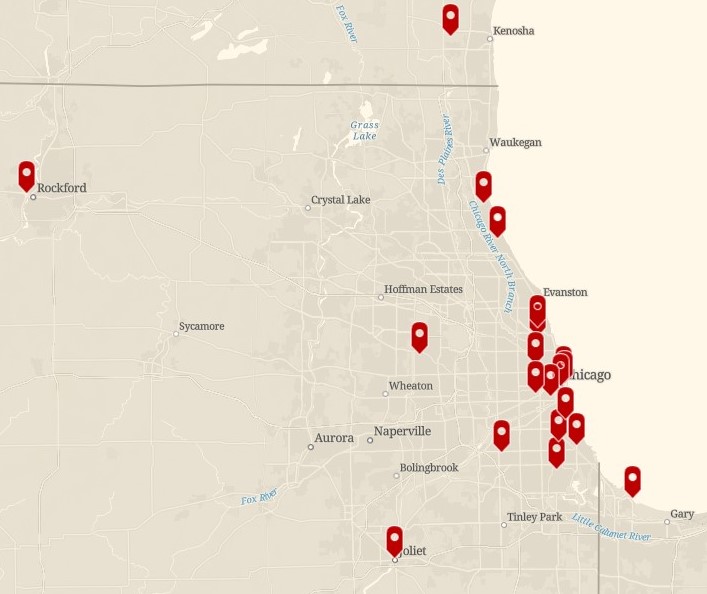
I do not know enough literature to know how well this map might reflect the totality of fiction written about and/or set in Chicago. However, the map above has relatively little from the suburbs. Here are the suburban works listed (a few others have markers in the suburbs but the descriptions say they are set in Chicago):
-Joliet – A Martyr for Suzy Kosasovich (2008)
-Salt County, Illinois – Water Marked (2000) [this is the one with a marker in northeast DuPage County on the map above]
-Prairie Park, Illinois – Neon Green (2016) [this is the one with a marker in northwest Indiana]
More broadly, is there any consensus on the best suburban novel of the last few decades? Academic treatments of the literature set in suburbs often cite novels like The Crack in the PictureWindow or Revolutionary Road from the early years of postwar suburbia.
The context for this quote is a dispute between local governments in the region about obtaining water. Hundreds of millions of dollars, perhaps billions, are on the line. People need water. For now, it is there and it probably will be there for a long time…but it is not guaranteed to be there.
The Metropolitan Water Reclamation District of Chicago holds tours for the public. I recently participated in a live zoom version. You can watch a version here.
The tour was very informative about water and processes. We learned about watersheds and the small hill that separates water going into the Great Lakes versus the Mississippi. We learned about how water is cleaned in water treatment plants. We learned about the reversal of the Chicago River. We learned about the Deep Tunnel system. All of this was accompanied by helpful visuals (maps, drone footage) and engaging hosts who answered questions as they arose.
And it was also a public relations exercise. We heard about the ways that the MWRD has improved. We heard about the benefits of all their efforts. They had booklets for people to access, including materials for kids and information in multiple languages. The presentation was smooth.
What the tour could not as easily touch on: is this the best way to deal with water and land in a metropolitan region? Are there harmful byproducts of these systems (how about forever chemicals in sludge sold to local farmers)? Does the Deep Tunnel system solve all the problems it was supposed to?
Infrastructure like this is essential to modern life. People expect clean water to be available. When it is not, it is very surprising. They may complain about water rates and tax bills, but the whole system as experienced in the United States is relatively cheap for consumers.
Thus, positive public relations involving infrastructure can help the public know about these systems that they contribute to and depend on. People do not like a highway construction project that is over budget and over time? They can be informed about how these processes work and about the benefits that will come eventually. The public does not like a rate hike? They can learn about all the amazing systems that make it possible to live modern life.
All of this does not mean that the public relations version should necessarily win the day. I am generally in favor of all of us knowing more about the infrastructure we rely on. Yet, there are also questions or concerns that public relations can not easily bat away. If we can have more informed conversation about infrastructure, perhaps we could avoid protracted debates or simplistic approaches.