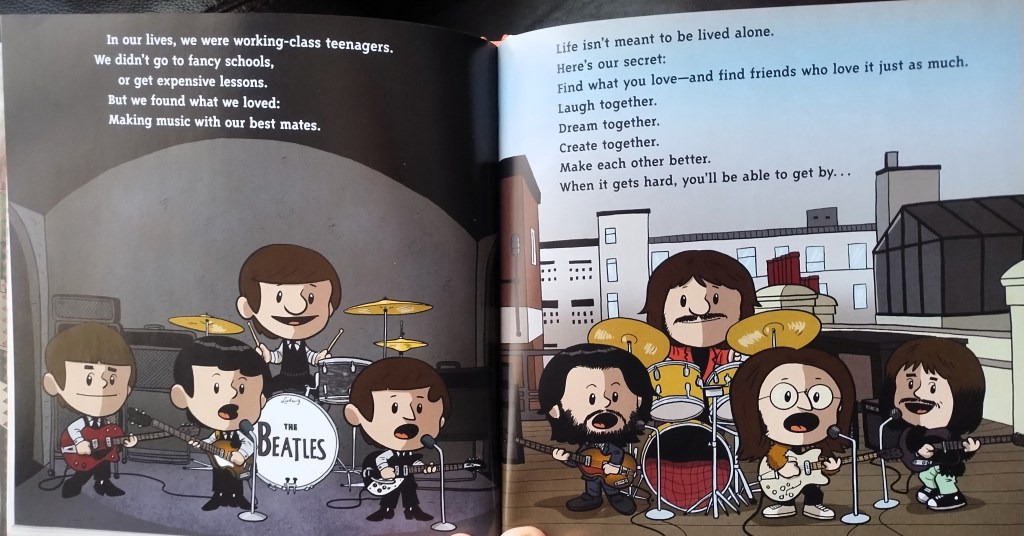
Whatever the answer is, how does one explain this in children’s books? I read a recent example in We are The Beatles, an entry in the “Ordinary People Change the World” series.
As someone who has read plenty of books about The Beatles, I appreciate seeing opportunities for kids to learn about the group. With an overview of the group’s members and their career (plus some lively illustrations), this might give kids a sense of what the group was and what they accomplished. Just complete the line implied at the end of the second page depicted above: “with a little help from my friends.” (I’ve also read Who Were The Beatles?in the “Who Was” series.)
But it may be just as hard to explain to kids as it is to explain to adults. I also recently read The Genius Mythwhich has an extended discussion of The Beatles. If “genius” is not about a lone innovator, does this musical group help us see the relational and social alchemy that leads to genius?
As The Beatles and their music continue to age (Paul and Ringo can’t live forever, can they?), it will be interesting to see if the narratives about their success change. What might kids and adults think in 2060, one hundred years after the group worked hard to establish themselves?
It’s a small village, just over an hour from the heart of Chicago by car, but it has consistently reported some of the lowest crime rates in the region, with a violent crime rating of zero. This small-town security is one of the driving forces behind Campton Hills’ rising popularity with families in recent years. People moving out of Chicago or nearby suburbs are looking for peace of mind in their neighborhood, and this village delivers exactly that…
A place with such a high safety ranking is the perfect spot for families to put down roots. In this regard, Campton Hills is truly designed for families to thrive. Schools in the area have earned a strong reputation for academic achievement, supportive teachers, and a wide range of extracurricular opportunities. The village is also home to some of the highest-rated public schools in the state.
In the village, there is an impressive range of amenities to keep families busy. Community parks provide space for picnics, soccer games, and weekend strolls, while nearby forest preserves give children the chance to explore nature close to home. (Nature lovers should visit this peaceful suburb near Chicago next.) Access to healthcare and family-oriented services is reliable, with clinics and hospitals within easy driving distance. Campton Hills also hosts seasonal events that bring neighbors together, including the Boo After Dark Halloween event.
It always feels like a win when you find somewhere close to the city that still feels like it’s tucked away in the middle of nowhere. And Campton Hills’ rural character is something that truly makes it stand out. Unlike some suburbs that feel like extensions of the city, this village keeps the perfect balance of open countryside and convenient access to Chicago.
The story starts with safety. People are looking for a safe place with little to no crime. Their kids will be safe. It is away from the city and others places with crime.
But then the story goes on to include other factors that attract families to this specific suburb. The schools have a good reputation. There are parks and forest preserves. Medical care is nearby. The community comes together for events. It is close to Chicago but feels rural.
Is this how people chose a community to live in? Do they prioritize safety and then if other things look good, they go with that? Do they research all the statistics about various communities, look at rankings provided by numerous sources, and develop their own composite score of which community comes out on top?
I am reminded of research from sociologists Annette Lareau and Elliot Weininger where they find networks, affected by social class and race, mattered for how people chose communities. What networks lead to Campton Hills and other suburbs like it? How do relationships and social ties provide people with information about communities? Do articles like these make their way through some networks?
(Interestingly, Campton Hills is a new suburb: it was incorporated in 2007. And it is relatively small: just over 10,000 residents in the 2020 Census.)
Taylor Swift’s The Life of a Showgirl album is off to a sparkling start in the United States. On its first day of release, Oct. 3, the set sold 2.7 million copies in traditional album sales (physical and digital purchases) across all versions of the album, according to initial reports to data tracking firm Luminate. That marks Swift’s biggest week ever, and the second-largest sales week for any album in the modern era — since Luminate began electronically tracking data in 1991. The only larger sales week in that span of time was registered by the opening frame of Adele’s 25, which sold 3.378 million copies in its first week in 2015…
The sales of The Life of a Showgirl will increase in the coming days, with the current tracking week ending on Thursday, Oct. 9. The album’s final first-week sales number is expected to be announced on Sunday, Oct. 12, along with its assumed large debut on the multi-metric Billboard 200 albums chart (dated Oct. 18). If The Life of a Showgirl debuts atop the Billboard 200, it will mark Swift’s 15th No. 1 album, lifting her past Drake and JAY-Z for the most No. 1 albums among soloists, and becoming the sole act with the second-most No. 1s ever. She is currently tied with Drake and JAY-Z with 14 No. 1s each, and only The Beatles, with 19 No. 1s, have more, dating to when the chart began publishing on a regular, weekly basis in 1956.
So maybe it is not just the album we should be thinking about here; Taylor Swift is a rare artist who consistently sells albums. She has lots of fans and they consistently push her album to #1.
Thinking as a sociologist, here are questions I have moving forward:
At what point does this sales record decline or the support not become as fervent from fans?
What is it exactly about Swift’s music and persona that cuts through this fragmented media landscape? I recently saw some figures about what is popular these days to watch on cable TV; it is basically live sports and cable news as other programming does not draw large audiences. How is she so successful in this particular music and cultural landscape?
Are labels and artists trying to replicate what Swift does – doing what she does for even one or two albums might make for a very successful artist – or do they acknowledge she is a singular artist?
What will we remember about Swift with these massive sales and #1 record after #1 record? What narratives will emerge and how might these differ across different storytellers?
I have also heard this critique applied to retail spaces, Disney World, and resorts. They project one image but they are not what they seem. They are real places – you can walk around, you can buy things, etc. – but not real at the same time. They lack authenticity. (This might imply there are places that are authentic, not imitations. They are what they are. This is another matter.)
Are there suburbs that are real places, where the facade is not a facade, that feel like what they actually are? Or suburbs that are honest about the challenges they face alongside the possibilities they might offer? How accurate is the narrative that the American suburbs are inauthentic or is this more prevalent in cultural works?
Lots of things happen in big cities. Some stories are stranger or more influential than others. But how might one story get commemorated for years? Which cultural narratives last? One non-profit leader described this particular story:
“The incident is woven into the city’s pop culture fabric, and the anniversary seemed like an opportunity to emphasize that the world has to protect our natural resources, but it didn’t work out,” Frisbie said of the effort.
The article on the 20th anniversary provides some hints on how this story caught on and continues to be told. To go beyond a story that the people involved tell over and over, some help is needed:
-Famous people involved. The music group was well-known with multiple #1 platinum albums under their belt. This was not a random tour bus.
-Criminal charges and a court case. This involves different public bodies and can keep a story in the news.
-The media. A strange but true story – bathroom matters! a famous band! charges! – is a good one to get attention. And can we expect stories on the 25th anniversary, the 30th, and so on?
I am sure it would be hard to measure but it would be interesting to look at how this story stacks up against other stories in the city of Chicago. Which ones stand the test of time? Does this one make it into “official” lore (books, museums, memorials, etc.)? What is the half-life of pop culture stories in Chicago?
If Chinatown’s ending forces the audience to sit in a feeling of hopelessness, it should also disturb anyone invested in Los Angeles’s future. The history of water in 20th-century California was defined by mammoth feats of engineering and an enduring belief that someone like Mulholland would eventually come along and enable the impossible. Each new dam or aqueduct only guaranteed the arrival of the next one—the population growth allowed by Mulholland’s aqueduct, for example, later resulted in L.A. tapping other water sources, such as the Colorado River. California has had a few good years of rain recently, but the long-term sustainability of the state’s water supply depends on collective conservation efforts: drastically reducing the amount of water used by Big Agriculture, moderating suburban tasks such as watering lawns, regulating the state’s groundwater.
“There is no more water to capture with big projects. There just isn’t. The future is really about much smarter water management,” Stephanie Pincetl, a UCLA professor who specializes in urban policy and the environment, told me. Conservation measures, she argues, are the way forward even if politicians wish they could stump for some grand technological innovation the way their 20th-century predecessors did: “The approach to the 21st century has to be a lot more subtle, a lot more place-based, and a lot more guided by the realization that water is a scarce resource, and so we need to treat it like a scarce resource.”
Finding water in Los Angeles, the Southwest, the West, and the United States more broadly may become more paramount in the coming decades. Which cities and regions would do well in competing for water? Would a lack of water in some places lead to growing populations in places with plenty of water?
While we are at it, why not tell more exciting stories in these categories:
Origin stories of modern places. Take any of the big cities in the United States and put its origin story in a movie or a miniseries. How about the rise of Phoenix?
It would be interesting to popularize more stories about water and other necessary resources in daily life. How about a thrilling tale about concrete? It is hard to imagine modern life without out. Or air conditioning. Can’t have a lot of the global development of the last century without it. Or salt. Where do we get all this salt in our daily lives from?
If Chinatown can entertain and inform about place, why not engage in more storytelling that explains where places have come from and where they might be going?
The best suburban stories, on the page or on-screen, are deceptively complex, affixing irony or self-knowledge to what may initially appear to be mere scathing social criticism. Take Revolutionary Road, the searing 1961 Richard Yates novel adapted to the big screen by Sam Mendes in 2008. This is the tragedy of Frank and April Wheeler (played in the film by Leonardo DiCaprio and Kate Winslet), average New Yorkers in the ’50s who move to a tree-lined Connecticut suburb to start a family and watch their dreams die. Frank commutes to the city for a sales job he loathes. April whiles away her days with the kids, forgoing whatever ambitions she might otherwise have had.
Here’s the catch: As April and Frank plan a move to Paris—where Frank will do an unspecified creative something—then retreat back into a domestic existence both tortured and predictable, it becomes clear that they would live quotidian lives no matter where they laid their heads. Paris. Connecticut. New York. The suburbs just happen to be the perfect venue for their smallness, the place where their silent scream can disappear between the hedges. In this sense, Yates’s suburban critique carries a strong whiff of irony. After all, it’s hard to blame the perfect lawns and fake smiles when you carry your misery the way a turtle carries its shell.
The only truly honest person in these suburbs is John, the adult son of the community’s busybody real estate agent. John is a mathematician who has undergone extensive shock treatment for his mental illness, a spirit stifled by his family’s shame and hyperconformity. (Michael Shannon plays him in the film and walks away with the whole thing.) John might actually be happier in Waldie’s Lakewood, where strange behavior, including obsessive hoarding, arguably becomes part of the town’s beautiful fabric, the answer to any easy assumptions of conformity…
The naked reality Waldie depicts subverts any impulse to indulge dystopian visions or Twilight Zone–like allegories. (The suburbs, incidentally, provided a feast for The Twilight Zone. Take 1960’s “The Monsters Are Due on Maple Street,” in which a bland collection of suburban neighbors, walled off from the rest of the world, become a self-immolating mob when they suspect an alien invasion.) Waldie doesn’t need such devices to conjure his uncanny suburbia. He accentuates minute details of housing and neighborhood construction—drywall, crape myrtle, layers of stucco—with philosophical musings and remembrances that sometimes cross over into the macabre. “In the suburbs,” he writes, “a manageable life depends on a compact among neighbors. The unspoken agreement is an honest hypocrisy.”
Is the suggestion here that the problems people face in the suburbs are the same sorts of problems they would face in other settings? Or that people in the suburbs are idiosyncratic just as they are elsewhere?
I wonder if the difference is that the American Dream placed a large burden on suburbs: life had to be good, not just normal. The sparkle of the new home and suburban lifestyle were not just to be settled into and lived in; it had to be the apex of American, and perhaps global, life.
On the whole, the standard of living in American suburbs is pretty high compared to historic and global settings. But, could any place easily be the promised land? It is probably not a coincidence that this book is titled Holy Land.
The six part documentary Can’t Get You Out of My Head: An Emotional History of the Modern Worldcaptures well the foreboding and confusion of our current moment at the beginning of the third decade of the twenty-first century. Here are a few thoughts on what I found to be a thought-provoking and interesting watch:
The general premise is that the freedom, prosperity, and joy that was supposed to come with the ascension of liberal democracy and individualism at the end of the twentieth century did not come. Indeed, it may have led to new and more troubling questions. The sweep of history is limited to roughly the last 100 years but there is a lot to consider over the six episodes. Even if you do not agree with the argument, there are a number of threads and points of information that may be new and/or have not always been put together in such ways.
The construction of the documentary adds to the foreboding as its intersperses multiple threads across different countries, montages of images set to generally upbeat pop music, and a dark instrumental soundtrack.
That this work is not from an American point of view and includes important actors from around the globe is very important. There were things I had not known before. I know the American perspective on the world is very biased and yet my daily reading is almost exclusively in this realm. At the same time, the documentary is still from an Anglo perspective and it would be worthwhile to hear form voices elsewhere on what is chooses to say and show and what it does not address.
Just as an example of one of the important questions raised: what happens if a democratic people elect or support an undemocratic leader? More specifically, what do the cultural and political elites do in such a moment? In the current populist period, this is a real conundrum.
One thing I appreciate is the interest in thinking across contexts and time. I would argue we need more work that tries to pull together multiple strands from around the globe across big chunks of time. Put this documentary series next to Graeber and Wengrow’s The Dawn of Everythingand there may be some patterns worth considering.
While I finished watching this several months ago, the title is correct: I cannot get some of the ideas and images out of my head.
Northwestern University economics professor Ian Savage examined American crash data over a decade, concluding that 7.3 people died in a car or truck for every billion passenger miles, 30 times the risk on urban rail and 66 times the risk aboard a bus. (If you’re wondering, motorcycles are by far the riskiest vehicles of all, while airplane travel is the safest.)
Even with these numbers, there are multiple reasons why many continue to prefer to drive:
Studies show that people typically feel safer in vehicles they control compared to those they cannot (i.e., a car compared to a bus or train). Worse, the rare transit crash is often a top media story, while daily car collisions barely register. “It’s baked into how we talk about crashes,” says Millar, of Washington State. “We had an Amtrak train crash here, three people died, and it was international news. That same week 10 people died on highways in this state—and it was the same the week before that, and the week before that.”
According to psychology’s “availability heuristic,” the intense attention paid to exceedingly rare plane or train crashes can lead us to unconsciously exaggerate their frequency, while the media’s shrug at car crashes causes us to discount the dangers of driving. One extreme example: A study found that the shift away from flying toward driving in the aftermath of 9/11 led to over 2,000 additional traffic deaths in the United States.
Lots of interesting factors to consider here. Do the perceived advantages of driving block out any consideration of the risk? Even if people had these numbers at their fingertips, would they consider risks or numbers?
I have argued before that the preference for driving is strong. If people in the United States have the resources and opportunity, they will pick driving over mass transit. Of course, the system is set up to make this choice for driving easier with an emphasis on roads and linking important cultural values and driving (such as individualism, taking road trips, suburban life, etc.).
This may be a prime case where making an argument from the numbers simply will not get far given the cultural narratives and social systems already in place. Perhaps the numbers could be paired with a compelling story or narrative? Even then, it could take a long time to convince Americans that because driving is more dangerous than other options they need to switch to other modes of transportation.
For the residents, it’s one of the most successful experiments ever undertaken in creating a community from scratch…
But critics say there’s something not quite right about The Villages, a sprawling suburb an hour’s drive north of Orlando in Florida…
She likened The Villages to Jim Carrey film The Truman Show about a flawless but ultimately fake town.
The filmmaker has now produced a documentary about the world of The Villages called The Bubble which has its Australian premiere at this month’s Sydney Antenna documentary film festival…
Days for its residents are crammed with exhausting rounds of golf, cardio drumming, belly dancing and cheerleading lessons, even synchronised golf cart displays. And day drinking – lots and lots of day drinking…
The company that runs The Villages were none too keen on Ms Blankenbyl and her film crew’s presence.
On one hand, this is a familiar suburban story told for decades: the suburbs present themselves as the place for happy and successful family life. They aim to be green, quiet, and friendly. But, are they really? When a crime is committed, this might be a crack in the facade. Or, family life is not what it seems. Or, the community is built on the basis of exclusion and who is not welcome and/or present. There are plenty of real-life examples of this plus numerous films, novels, and stories that explore these themes.
On the other hand, The Villages appears to have some unique features that might set it apart from typical suburban experiences. It is a 55+ community which changes the entire social structure. The American suburbs broadly are built around protecting children and providing them room to thrive and succeed. It is in Florida so there is warmth and sun in levels that many suburbs cannot match. It is relatively new with a limited history and set of traditions and practices plus a particular architectural and natural approach that still looks new.
Is it a bubble? Many middle to upper-class suburbs might be accused of this. Is it different than many suburbs? Just by its population composition, yes. I look forward to seeing this documentary and thinking about it more.







 Legally Sociable