Review of the updated “A Field Guide to American Houses”

The 1984 version is a classic and there is now an updated version of A Field Guide to American Houses:

Architecture buffs, decorators, historians and anyone who studies the built environment will have Virginia Savage McAlester’s encyclopedic update of her 1984 book “A Field Guide to American Houses,” (Alfred A Knopf, 2013) on their wish lists.

For example: For those who think “prairie palace” and “McMansion” are merely envious epithets for “house bigger than mine,” the author explores the 1980s birth of the Millenium Mansion style and explores the reasons for the wide criticisms (“These complicated roofs can be thought of as crowns, or, more satirically, as the Future Roofers of America Relief Act.”)

For fans of modern ranches, Savage McAlester breaks them down into submovements with different roots. For lovers of historic homes, this is a rich trove of not just details, but reasons for them.

And for those seeking a homeplace that makes sense, the new chapter on neighborhoods is nothing less than essential.

It is hard to find another source that combines the technical features of different styles of American housing architecture as well as good summaries of each architectural movement.It can be hard to keep track of all the different exterior parts that are associated with different architectural styles – keeping your Italianate from your Georgian to your Colonial straight – and this book has helpful diagrams and descriptions.

I’m looking forward to seeing the section on McMansions. If I remember correctly, the 1984 version had a section on more postmodern or eclectic housing styles and McMansions would have likely fallen into that category. But, a reference book like this has the ability to shape understandings of McMansions for years to come.
Once residents become more “architecturally aware,” they won’t choose McMansions

An Australian architect says more residents in Perth would avoid McMansions once they become “architecturally aware”:

Designer homes are popping up across Perth as the city becomes more ‘architecturally’ conscious.

Aspects such as strong horizontal lines, cut outs and bold rectangular features are increasingly popular in new residential homes.

As Perth’s architectural style grows up, McMansions will be out and clean, simple modernist designs will be in, according to David Karotkin, the WA President of the Australian Institute of Architects…

“In more recent years there has been an increased awareness of architecture in Perth,” Mr Karotkin said…

“There’s awareness about the importance of the designs and the buildings we live in, work in and play in – it’s all architecture.”

There are several ways such statements might be interpreted:

1. Perth residents are finally becoming knowledgeable about architecture and are rejecting architecturally-deficient McMansions. There is an element of snobbery here: McMansions are for the less knowledgeable while the more educated pick homes designed by architects.

2. Perth is developing its own architectural style. Building styles might be drawn from other cities or countries but a new Perth School might be emerging. Having common design, particularly if it is recognized by outsiders, can become a mark of pride.

3. Architects are looking to increase the number of homes they design. In the United States, most homes are designed by builders and architects have just a small slice of the market. Educating people about the benefits of designed homes means more money.

I wonder what this architect would think if there are still some people who choose McMansions even with higher levels of education.

Architectural sociology approach to why Las Vegas residents don’t know their neighbors

Sociologists looking at why Las Vegas residents don’t know their neighbors explain that the design of their newer subdivisions are partly to blame:

“So that means squeezing a lot of houses into small lots, and it also means an architectural design in many cases that doesn’t facilitate the flow of people,” UNLV sociology professor Robert Futrell said.In 2010, UNLV professors conducted a survey of neighborhoods and people living throughout the Valley. They found that communities built after the construction boom of the 1990s include narrow streets, concrete walls, short driveways and few front porches. All of these things impede social interaction.

“While many developers have tried to create these master-planned communities to be high-functioning, high-interacting neighborhoods, many of them are not working that way,” Batson said.

Professors point to neighborhoods with short driveways as an example. People drive up to their homes, open the garage and drive in without talking to anyone.

The article goes on to say that residents in these communities truly do want to interact with their neighbors. But, design holds them back.

Is it completely the fault of design? The beginning of the article also notes that Las Vegas has many transient residents. If it is truly the design, we should be able to look at neighborhoods with different designs and measure higher levels of social interaction. Is this what we actually find? New Urbanists argue it is all about designing neighborhoods in a traditional way but they don’t as often bring up the data that would show the neighborhoods do what they say they should do. Other might counter that even with some better home design, people are still distracted from social interaction because of cars, air conditioning, television, the Internet, and more.

Another thought: would the residents of these new neighborhoods be willing to trade the size of their homes or the interior features of their homes for some more neighborly features?

When Mediterranean McMansions threaten the local architecture

An article about local Tampa architecture notes McMansions might define the city’s structures:

When one thinks of Florida architecture, if one thinks of Florida architecture, Disney World might come to mind. Or the ubiquitous Mediterranean McMansion in a gated golf-course community. Or the art deco hotels of Miami Beach.

Tampa architecture? Not so much. But there is more to the Cigar City than the iconic University of Tampa, the Museum of Science and Industry and some glass bank towers.

Tampa architecture, says John Howey, FAIA, himself one of the city’s architectural grand guard, is like Cuban bread, the kind served at the city’s landmark Columbia restaurant…

To summarize his city’s architecture, Howey returned to the Spanish/Cuban food analogy.

“It is so like paella,” said Howey. “When you put it all together, it is very tasty. Taken separately, you would think they would clash.”

My take on reading this article is that Tampa doesn’t have much of a unifying architecture style outside of some modernist structures. Perhaps this is because it is a relatively recent big city; it’s biggest growth period was from 1950 to 1960 when the population increased from 124,861 to 274,970.

Two thoughts:

1. What would it take to give a city like Tampa its own style? Could it be done through constructing key buildings, like civic institutions, in a particular style? Would it require a number of architects banding together? Styles don’t just come out of nowhere.

2. New Urbanists often argue that their developments should be based on local styles. Would they adopt a more generic Southern style in Tampa or perhaps a beach house type of design?

“Gated communities for the rich and poor”

A sociologist who has studied gated communities in Puerto Rico discusses gated communities across the socioeconomic spectrum:

The concentration of class and racial privilege in suburbs, fortressed enclaves, securitized buildings, and private islands takes place alongside the spatial concentration of poverty in ghettos, favelas, and barrios. Residential gates for the rich have also led to the rise of gates for the poor—in favelas in Brazil, South African townships, peripheral urban migrant settlements in China, and even in some public housing developments in the United States. The built environment sorts and segregates people, physically and symbolically distinguishing communities from one another. Whether one is locked inside or kept outside is determined by one’s race, class, and gender. In both kinds of gated communities, controlled access points restrict movement in and out. However, living in gated communities of the rich and poor are vastly different experiences.

The privileged gates of Extensión Alhambra offer a retreat into a secure, idyllic community; newly privatized street and sidewalks are restricted to sanctioned, paying community members, who can decide who is allowed inside. In the impoverished community of Dr. Pila, in contrast, government and private overseers control the movement of residents. So while the gates of Extensión Alhambra permit their affluent residents to exert greater political and social influence over their home turf, in Dr. Pila they have the opposite effect, diminishing residents’ power. In privileged communities, gates lock undesirables out; in poor communities, they lock them in. In both cases, gates are erected to serve the interest of the upper classes, who are primarily white. In other words, gates reproduce inequality, and cement or—to use Michel DeCerteau’s term—“politically freeze” social distinctions of race and class.

The same types of structures, different purposes and consequences. This reminds me of the debate regarding the design of public housing projects in the United States: if high-rises hadn’t been the primary choice and public housing agencies instead went with low-rise buildings or New Urbanist type structures, perhaps major problem would not have developed. But, in the case of public housing and gated communities, they can exacerbate existing issues but it is more difficult to claim they cause the issues in the first place.

Designing parking garages for life after cars

Parking garages can be designed in such a way so that they can be converted into other spaces if need be:

There’s a growing belief among architects and designers that all urban parking garages should be built with these “good bones,” which will allow them to be re-purposed in the future. For a variety of reasons, from higher gas prices to greater densification to better transit options, city residents will continue to drive fewer cars. As a result, we’ll eventually require fewer parking lots. The ability to adapt a structure rather than tear it down will save developers time, money, and material waste.

“As the auto culture wanes we’re going to have a lot of demolition to do, which is unfortunate,” says Tom Fisher, dean of the College of Design at the University of Minnesota. “If we’re going to build these [garages] let’s design them in a way that they can have alternative uses in the future. With just a few tweaks that’s really possible.”

Fisher says designing parking structures with an eye toward their afterlife is not only logical but rather simple. His three key elements to an adaptable garage design are flat floors, comfortable floor-to-ceiling heights, and enough loading capacity (in other words, strength) to support another structural use. Those types of changes may cost a tiny bit more up front but will provide enormous savings down the line…

New York isn’t the only place where this re-use is happening. During a recent talk, Fisher pointed out a few other examples from the Twin Cities and elsewhere around the country. In St. Paul, a developer is converting a century-old building from a garage into an apartment complex; in Miami Beach, a parking ramp is being used for retail and housing purposes.

While cars are not going away anytime soon, occasionally converting parking garages can happen. Yet, it would be interesting to see the money that converting requires versus tearing down the garage and building a new structure. I also imagine there are limits to what parking garages can be converted to.

I wonder if the fact that a building was formerly a parking garage is also part of the marketing. That might be a very different ring than saying it was a former factory or theater or church.

Scaffolding makes buildings possible

Constructing large buildings and repairing them requires a somewhat simple yet crucial element: scaffolds.

Scaffolds, fundamentally and philosophically, allow for newness—but they are, in every other way, very, very old. The caves of Lascaux, home to paleolithic paintings thought to be the first evidence of humanity’s expansion into artistry, feature sockets in their walls—borings that suggest Earth’s earliest expressionists relied on scaffolding to do their work. There’s evidence of scaffolding—wood, secured with knotted ropes—in ancient Greece. And in ancient Egypt.

In more contemporary times, scaffolds have become ubiquitous. In cities, scaffolds are part of the everyday sightscape, so saturated that they become almost invisible. We duck under them on sidewalks. We hang signs on them, taking advantage of their impermanent platform. We sense their message: that building is happening, that things are changing, that progress is marching on. And we sense that, in their way, they are generous. They are with us, in large part, to help something else come into being.

They may be considered ugly by some but they are indispensable. With them, you can reach great heights without machines. Imagine cherry pickers tall enough to reach the top of the Washington Monument or using helicopters for such work.

While they are necessary parts of our infrastructure, I don’t know that I would go so far as to celebrate their presence on the Washington Monument or other great landmarks. Two quick examples where I have seen scaffolding in action:

1. When I was in grad school at the University of Notre Dame, the school undertook a regilding of the golden dome on the Main Building. This isn’t just a gold color; the school uses gold leaf on the exterior. However, this led to an outcry from seniors that they wouldn’t be able to take graduation pictures in front of the dome because of the scaffolding. If I remember correctly, the school removed the scaffolding for graduation weekend and then started up work again.

2. On a couple of Hollywood studio tours, we saw the interiors of the some of the backlot sets. It might look like a New York City street but once you walked inside, you saw that it was a facade with a bunch of scaffolding inside on the backside of the exterior walls.

In both cases, the scaffolding was a necessary part of the process but it is not the main point. The job of scaffolding is to get out of the way to leave a more impressive structure behind. Perhaps scaffolding at the Washington Monument provides a change of pace but it is meant to be temporary. Like a lot of good infrastructure, you shouldn’t have to consider its necessity if it doing its job.

Architecture to improve your health and increase your happiness

Check out this guide from the American Institute of Architects on how certain designs can improve your health. A few examples:

Serenity Now: The spaces architects create can have a soothing and calming effect that reduces stress through mitigation of excessive noise, allowing visual connections beyond the building or within it, and providing access to natural daylight. Research indicates that short-term exposure to noise may negatively affect mental  well-being; prolonged exposures may exacerbate other issues, including aggression…
Stairs Can Save Lives: Well-integrated and -designed staircases can increase physical activity and cardiovascular health. A Harvard study found that men who climbed at least 20 floors per week had a 20 percent lower risk of stroke or death from all causes. New York City’s Active Design Guidelines recommends stair-design strategies that may increase physical activity.
Toxic Gas: Off-gassing from high VOC (volatile organic compound) materials can trigger respiratory health problems such as asthma or allergies in both users of buildings and the people who build them. A child that sleeps in a bedroom with fumes from water-based paints and solvents is two to four times likely to develop allergies or asthma…
Eyes on the Street: Street-level doors and windows encourage walkability and foster a strong sense of community, which aids people’s sense of environmental safety and broader community health. In a Bronx, N.Y., neighborhood where crime is prevalent, the Betances Community Center, designed by Stephen Yablon, AIA, illuminates a central staircase and gymnasium in natural light, wrapping its ground-level façade in windows as well. These transparencies give the building a welcoming presence and offer views to a public park across the street.

A lot to have to consider when designing and constructing a building. It is interesting that a number of these suggestions cross multiple areas of need. For example, stairs are necessary for safety if elevators stop operating. Toxic gas from VOC materials is a green issue. Eyes on the street is a classic phrase from Jane Jacobs to describe the kind of vibrant street life that helps social control without the need for formal policing. But, to also pitch these as health issues is likely a nice marketing tool. Not only can architects design a well-functioning building, they can improve people’s health outcomes.

In pointing to this story, Curbed provides a quote that architects can even do more: they “are often the architects of our happiness and unhappiness as well.” What can’t architects do?

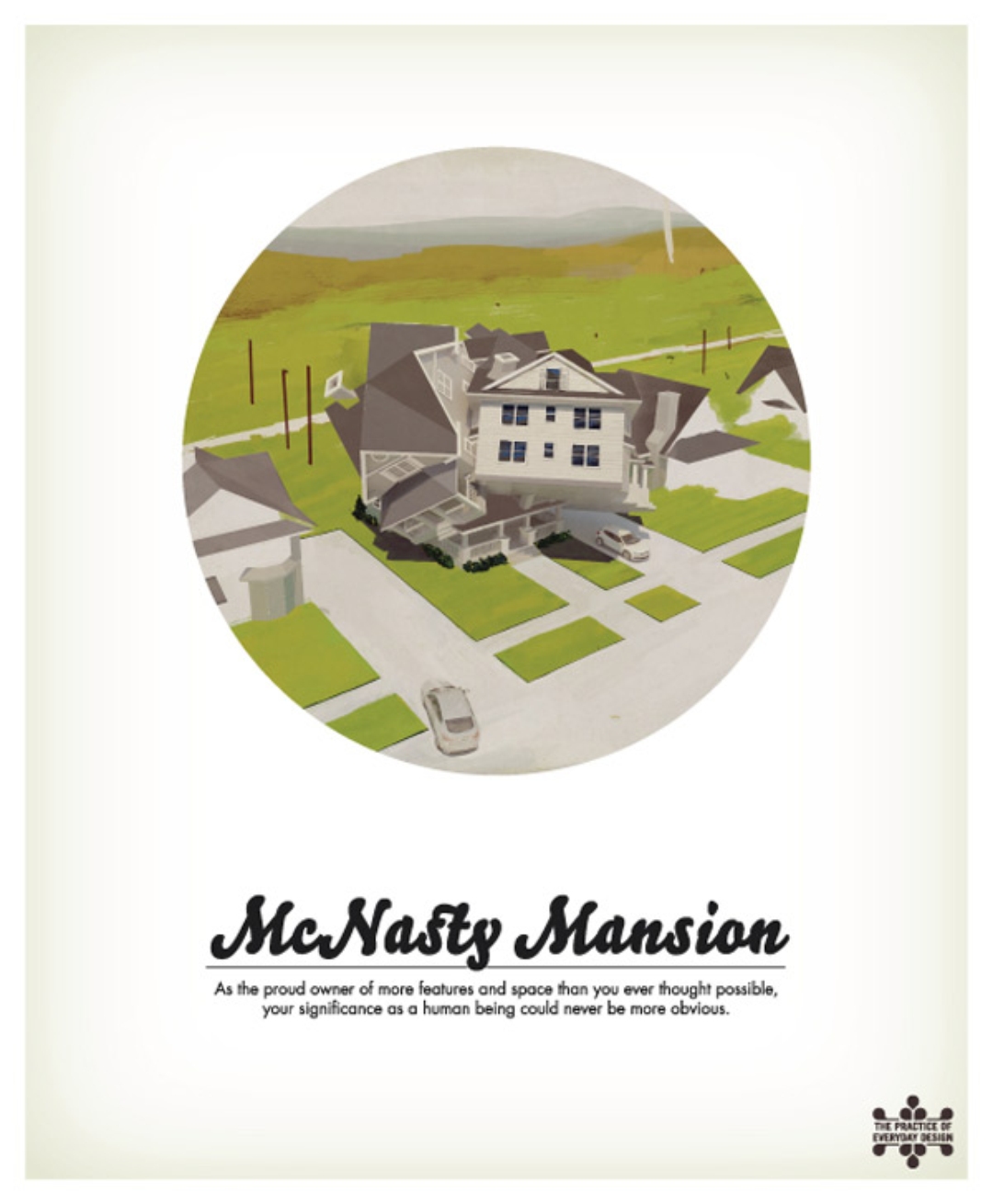
The crazy house you get when put together the McMansions of Google 3D warehouse

One group combined the various McMansion designs they found on Google 3D warehouse – and the result is not pretty:

Two-year-old Canadian design office The Practice of Everyday Design searched Google 3D Warehouse (an open-source library of model files) for the most popular suburban home typologies. After culling the top examples, they fused them all together and 3D-printed the mess. They call it “Nasty McMansion,” and you can buy one! We suggest hanging it on a string and dangling it from the ceiling in your office, as a warning.

Think of it as a kind of Ringstrasse for suburban mansions. Write TOPED:

“The McNasty Mansion offers a new and more exciting typology of homes, formed off the same principals of the McMansion: more rooms than one can fill, enough mixed styles to ensure complete architectural confusion, and enough faux finishes and cheap materials to keep cost down but dimensions huge.

I’m not sure how exactly they put this image together but it looks like it was done in such a way to maximize the bizarreness. For example, that front door on the left that tilts down toward the ground would be quite difficult for the average McMansion owner to access. Wouldn’t you get a similar result even if you combined more pleasing designs? And how exactly does their 3D design incorporate “faux finishes and cheap materials” versus the real things? But, if the goal was to create a “McNasty” design that creates a startling visual, the goal was met.

Just curious: what is the general level of architectural design on Google 3D warehouse?

The balloon-frame building invented in Chicago in 1833

The building technique that helped give rise to mass-produced suburbia was invented in Chicago in 1833:

But traditional building methods required hand-hewn beams, hand-wrought mortise and tenon joints, lapped half dovetails, and something more crucial — labor-intensive construction at a time when labor was spread too thin.

Then in Chicago, Augustine Taylor got credit for creating balloon-frame construction, a hammer-and-nails forerunner to the light-frame construction that still dominates U.S. housing…

Experienced builders supposedly derided Taylor’s St. Mary’s Church in Fort Dearborn as “balloon-framed” because it looked like a stiff breeze would blow it away. But many accounts suggest the name came from a similar French Missouri type of construction called maison en boulin

Chicago architect John M. Van Osdel attributed the invention to Chicago carpenter George W. Snow in 1832. The Chicago History Museum and other scholars point out that Virginia carpenters in the 17th century — facing similar pressures to build fast — employed similar techniques. But it wasn’t mass-produced like Chicago was prepared to do. Between 1866 and 1875, the Lyman Bridges Company of Chicago sold pre-fab balloon-frame structures to western settlers, one of several purveyors of so-called “sectionalized housing.”

This technique was perfectly suited for mass produced suburban housing in the post-World War II era as it could involve standardized parts, be constructed quickly, and be done cheaply. Builders like the Levitts could quickly construct the frame of a home (after a foundation was laid) and then have a series of other workers come through to complete the home. The majority of American homes rely on wood studs nailed together – not complicated but relatively sturdy.

It is interesting to see that this is the #5 innovation from Chicago’s history. Considering the work that went into some of the others (like #8 Reversing the Chicago River), the balloon-frame structure had an outsized impact on American life.