Rapid population growth in Florida and Texas now slowing?

What happens if communities in Texas and Florida are now not growing as fast as in recent years?

Photo by brian neeley on Pexels.com

Fewer Americans are moving to boomtowns in Florida and Texas – once red-hot destinations that saw surging populations and soaring home prices.

Tampa, FL, had a net inflow of just 10,000 residents last year, according to fresh data from Redfin. That is less than a third of the 35,000 in 2023…

Meanwhile, Dallas – one of several Texas cities that boomed during the Covid-19 pandemic – saw a net inflow of around 13,000 residents in 2024, also down from 35,000 the year prior. 

Americans had previously been drawn to Sun Belt cities due to their warm weather, low tax rates and affordable housing compared to coastal cities.

But that appeal is fading fast. The cost of living has jumped, thanks to rising mortgage rates, skyrocketing home prices, and higher fees for insurance and HOAs – particularly after a string of natural disasters.  

Several long-term consequences come to mind in addition to the effects on the local real estate markets:

  1. Growth is good in the United States for a place’s status. To not grow – or even to level off – is considered bad. These places will be viewed as less desirable overall if they are not rapidly growing.
  2. How does this change local planning and revenue projections? Imagine you see growth going at a particular pace for a certain time. If that growth does not occur, there could be major changes in budgets and land use. (Whether these possibilities should have been factored in is another matter; who would have factored in a global pandemic?)
  3. What other places will take over as being the fast-growing places? Will places in Arizona or Idaho (or the West more broadly) look more attractive? Or perhaps just population growth as a whole slows in ways that few American places are growing quickly?

Amid rising housing values, Americans “revolting” against property taxes

Florida and at least a few other states are considering limiting or eliminating property taxes:

Photo by Nachelle Nocom on Pexels.com

Florida’s leaders are considering a far-reaching remedy to cut the soaring costs of owning a home: ditching property taxes

“People are getting crushed not just by home insurance but by property taxes,” said GOP state Sen. Jonathan Martin, who is sponsoring a bill that would require a study on the elimination of property taxes be completed by October. “That American dream in Florida is taking five figures a year in local taxes.”

Revolts against property taxes have erupted elsewhere in recent months as homeowners’ tax bills have risen alongside home values. Property values in the U.S. increased 27%, adjusted for inflation, between January 2020 and July 2024, according to the Tax Foundation, a think tank.

“You’re seeing a groundswell of opposition to property taxes generally”—one reminiscent of a wave of protest in the 1970s and 1980s that triggered ballot measures including Proposition 13 in California that capped property taxes, said Jared Walczak, vice president of state projects at the Tax Foundation.

A number of states including Wyoming, Kansas and Montana are weighing significant property-tax limitations, he said. In November, voters in North Dakota rejected a ballot measure that would have eliminated property taxes.

This is the double-edged sword of property taxes in the United States: homeowners like their property values going up but they do not like it when their property taxes adjust to that increased value. In the short-term people do not want to pay more in taxes even as in the long-term they will benefit from selling at a higher price.

So what other taxes might people be willing to pay if property taxes are reduced or done away with? There would be other ways to generate revenue that would not be tied to property values. More taxes on driving? Higher sales taxes? Increased tax rates on business activity?

It would also be interesting to see how local governments would adjust to the change in funding. Would other tax formulas equal the same amounts that come now through property taxes? Who would make up the shortfalls in funding?

What happens when a place is no longer growing quickly, Florida edition

Populations and demand in housing markets can ebb and flow. What happens when a state known for growth for a while starts to lose its luster?

Photo by Del Adams on Pexels.com

Florida was one of the epicenters of the pandemic’s great migration, but while crowds of people are trying to settle into places like Orlando, Tampa, and Jacksonville, many Floridians want to dump their homes and get out.

The exodus is mainly being driven by higher housing costs, a higher cost of living, and souring attitudes toward the influx of people who moved to Florida in recent years. Those factors combined are making daily life in the state way more difficult, current and former Florida residents said.

While 730,000 people moved to Florida during 2021 and 2022, nearly half a million people left, according to US Census data.

The state, meanwhile, just lost its status as the most moved-to region this year, according to an analysis conducted by the Florida-based moving service PODS. South Florida, in particular, ranked among the regions people were most keen to move out of, the report said.

Waning enthusiasm for the state is evident in housing activity, which has fallen from its pandemic highs. The number of homes for sale in Florida has soared 42% compared to levels last year, according to Redfin.

In the United States, growth is good. A growing population is connected to an increasing status that hopefully just brings in more people and business.

But population booms do not last forever. A good number of American communities have had periods of rapid population growth, including many big cities and numerous suburbs, and then other periods of slow growth or even population loss.

From the evidence above, it sounds like Florida’s growth has slowed. It is another matter if the state starts losing residents. If that happens, dire descriptions can emerge such as it being a “failed” state.

If growth slows in Florida, what other states might take up the mantle of those with rapid growth? Can they have a sustained run of growth that brings prestige?

Wrestling with the legacy of the cross at the De Soto National Memorial

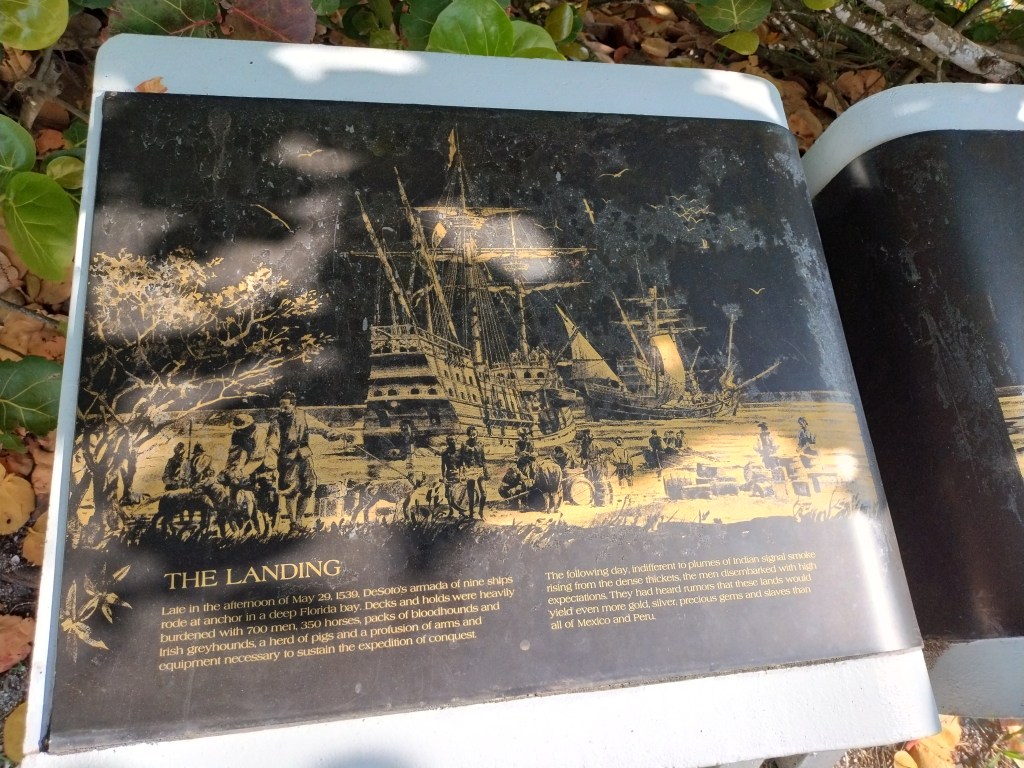
I recently visited the De Soto National Memorial near Bradenton, Florida. The entrance to the site describes the beginning of the landing of De Soto’s group:

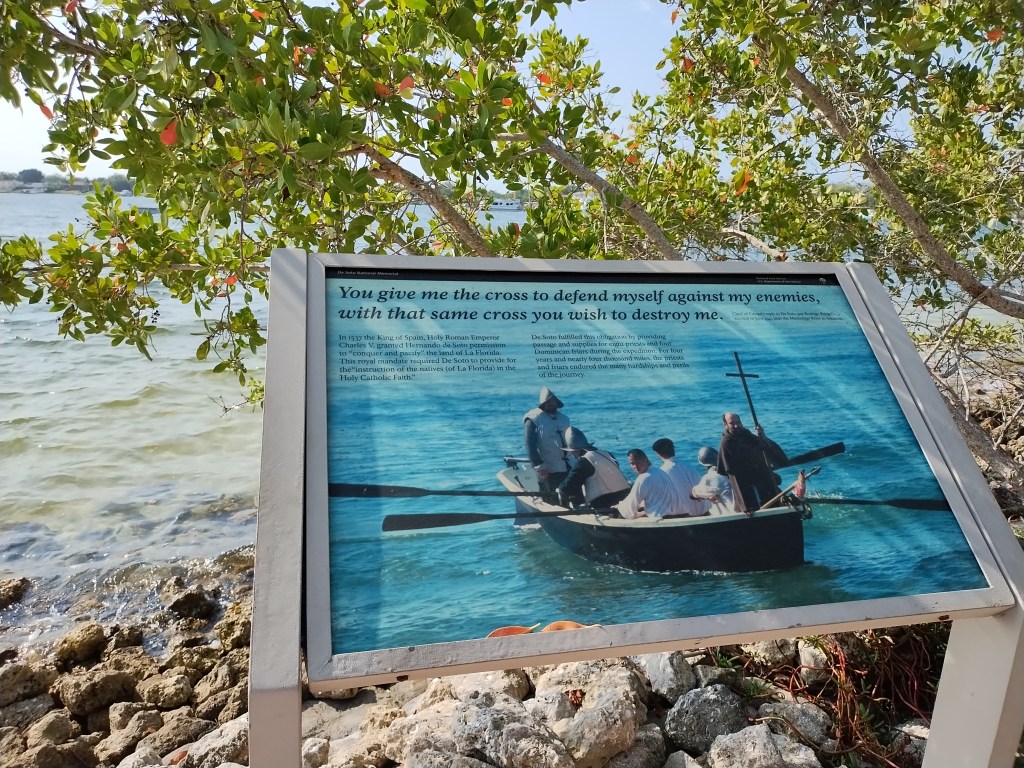
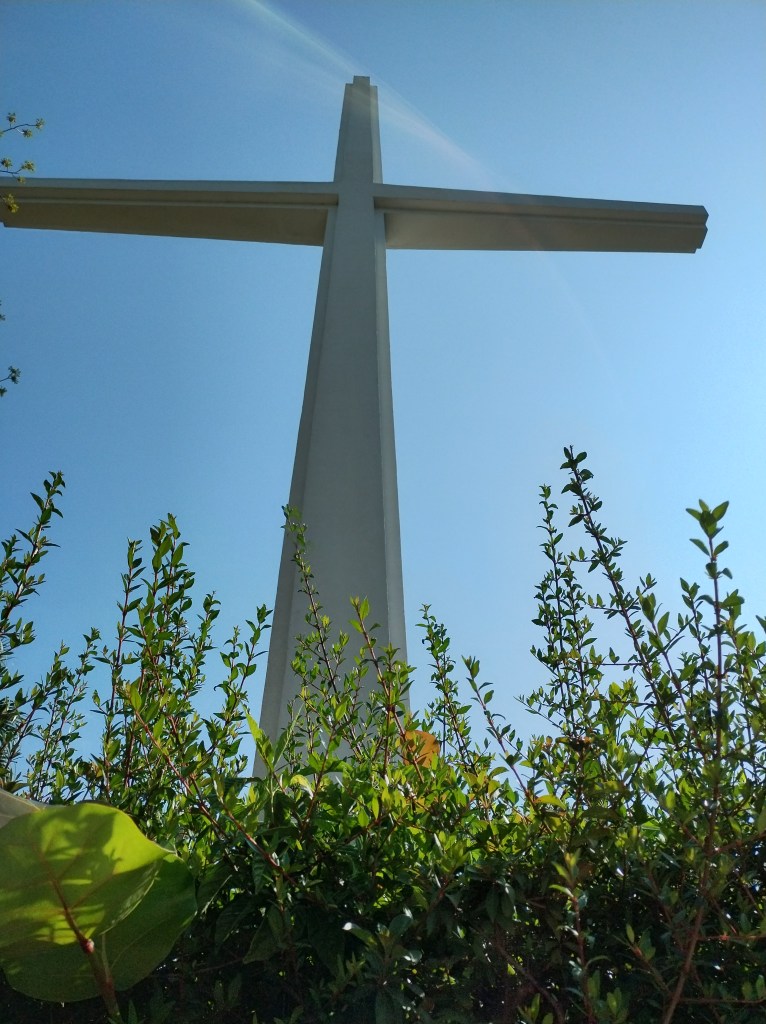
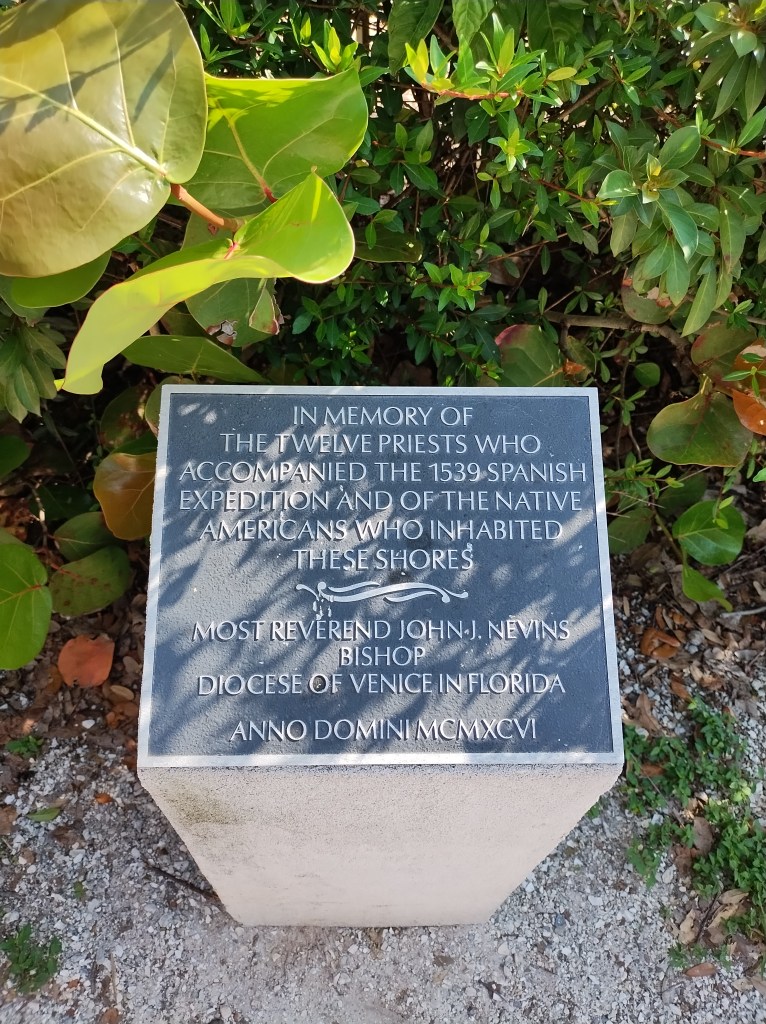
A short trail that winds in a loop from the entrance back to the parking lot provides more details of the encounters. This includes some reflection on the role of the cross:

A complicated legacy that visitors are left to consider.

An American downtown with multiple traffic circles

On a recent visit to Sarasota, Florida, I discovered multiple traffic circles on a major roadway (US-41):

I was not there at the busiest time of the day but it seemed that all the traffic was flowing fine through the roundabout. The biggest issue I could imagine for drivers is getting into the correct lane for where the driver wants to exit the traffic circle. For example, in the image above, to go straight, the driver could be in either lane but to go left or right, one has to pick the correct lane and then exit appropriately.

These were not the only traffic circles spotted in western Florida. I saw several under construction, both on existing roadways and along new roadways. The more constructed, the more familiar drivers will be with them.

One big advantage of these is that traffic can often keep moving rather than the stopping required by stop signs or traffic lights. If the driver has yielded, there is no need to stop if the coast is clear.

I do not know which American communities have more traffic circles than others but this could be an interesting way for places to distinguish themselves from others.

Can McMansions make a whole town the ugliest in its state?

One look at the ugliest communities in each state picks Panama City Beach, Florida because of its McMansions:

Photo by Nur Andi Ravsanjani Gusma on Pexels.com

Panama City Beach, Florida is a resort town full of lots of fun and scenic views. In a very confusing naming twist, there’s also Panama City, Florida which is just right down the road from the resort town. Unfortunately, people don’t think it’s nearly as beautiful or fun as PCB. 

The main complaint of residents, who are in agreement that Panama City isn’t the prettiest place to live, is all of the McMansions that seem to pop up all over the place. They’ve hit a critical mass of boring, tasteless homes and now it’s starting to drag the city down! 

A resort town where the McMansions are the aesthetic problem in the community? This is a community with big hotels, a Ripley’s Believe It or Not, a waterpark, and many of the typical establishments found along roads in the United States.

I wonder if the issue with McMansions is more about (1) changes to existing neighborhoods and/or (2) the McMansions are more visible to residents while the resort areas appeal more to tourists.

Thinking more broadly, in a beach town, how easy is it to fight against McMansions? Being on the water leads to higher real estate prices and more demand.

If Colorado wants to become home to Disney and be the anti-Florida, would all the evangelical organizations in Colorado Springs want out?

As Florida moved to revoke the local governance power granted by the state to Disney, Colorado Governor Jared Polis extended a welcome to Disney:

Photo by Erick Todd on Pexels.com

Colorado Governor Jared Polis has invited Disney to relocate to Colorado after Florida Governor Ron DeSantis’ “socialist attacks” on the company.

“Florida’s authoritarian socialist attacks on the private sector are driving businesses away,” Polis tweeted on Tuesday. “In CO, we don’t meddle in affairs of companies like @Disney or @Twitter.”

Polis then made his pitch for a new theme park in Colorado. “Hey Disney we’re ready for Mountain Disneyland,” he continued—a statement DeSantis’s office told Newsweek was “an odd invitation.”…

Polis also invited Twitter to launch headquarters in Colorado, regardless of “whoever your owners are.”

States fight over companies and jobs regularly, even as this round includes a particular culture war dynamic.

I am interested in the possible fallout for the cluster of evangelical organizations in Colorado Springs. While Colorado as a state made have made several decisions in the last decade or so toward blue status, it has longer featured two centers of power: a more progressive Denver and Boulder and a more conservative Colorado Springs. Even though the latter center has fewer residents than the cities to its north, it is home to many evangelical organizations. The profile of the city was particularly boosted by the move of Focus on the Family from the suburbs of Los Angeles to Colorado Springs in the early 1990s and the rise of local megachurch pastor Ted Haggard to president of the National Association of Evangelicals in the 2000s.

Would a continued shift left in Colorado lead evangelical organizations to want to go somewhere else? Some of the factors that made Colorado Springs attractive in the first place might still be there but the political climate and state policies less friendly. And where would they go? There might be safer clusters. For example, one study examines three other evangelical parachurch clusters in addition to Colorado Springs – Tulsa, Nashville, Washington, D.C. Would Tulsa and Nashville be safer and/or attractive choices compared to a changing Colorado?

Some city or community might also take advantage of this. Instead of waging a Twitter and media campaign impugning the choices of another state, why not quietly offer tax breaks, a promise of limited red tap and regulations, and a welcome plus reassurance that the evangelicals of Colorado Springs would be welcome in a political environment more to their liking.

The complications of switching over from Disney self-governance in Florida to local government

With the Florida legislature voting to strip Disney of its self-governance status regarding the Disney World land, what might this mean for local governments?

Photo by Benjamin Suter on Pexels.com

The counties, on June 1, 2023, would assume all of Reedy Creek’s assets and liabilities and become responsible for providing all of the services currently handled by the district, CNBC reported.

Currently, Disney finances the services supplied by Reedy Creek, which would normally be funded by local municipalities. The company, instead, charges itself property taxes to finance its service and pays the Orange County Sheriff’s Office for law enforcement.

Once Reedy Creek is dismantled, local taxpayers and municipalities would likely be responsible for those services.

’Removing district could transfer $2billion debt from Disney to taxpayers and could potential have an enormous impact on Orange and Osceola residents!’ State Sen. Linda Stewart, who voted against the bill, tweeted Wednesday.

However, Rep. Fine told Insider he believed taxes could go down because the measure was ‘eliminating a layer of government’.

Walt Disney World already pays property taxes to Orange and Osceola counties, so that would not change, however the counties would get to collect the tax revenue Disney currently pays to itself.

The transfer of revenues, services, and infrastructure from a private entity to a set of local governments might take some time to sort out. Who will be responsible for what? How do the revenues compare to the costs required? How does this require local governments to adjust?

Let’s say this process is a complicated one. Does this affect the experience of visitors to Disney properties or to local residents?

While this is a national culture wars story at the moment, it would be interesting to hear from local officials on what they think of this or how they anticipate this working out. Very few local officials would want to lose a major company from their land. Would they vote against their own local economic and political interests in the service of sending a message to Disney?

The legislative act that helped Disney build Disney World in Florida

Corporations, sports teams, and developers ask for or make use of tax breaks or monies or land opportunities provided by governments. Walt Disney benefited from a 1967 act by the Florida legislature:

Photo by Craig Adderley on Pexels.com

The Reedy Creek Development Act can be traced back to 1967.

It was a pivotal negotiating factor in convincing Disney to locate his company in Florida and allows the company to do just about whatever it wants on its land.

“The ability, the power to build a nuclear power plant, an airport manufacturer, distill and distribute alcoholic beverages and lots of other things,” said Dr. Richard Foglesong, author of “Married to the Mouse” in an interview with WFTV in 2021.

Many would love to have this kind of freedom to do what they want with a large property. In contrast to what was possible through this act, many property owners would have to apply to local governments for uses of the property beyond what is allowed through the local zoning.

If leaders in Florida follow through with revoking this act and Disney wants to go elsewhere, does this shape up to be a second Amazon HQ #2 situation? Or, does Disney have a lot fewer possible locations to go to given its need for a lot of land and good weather?

Familiar story: suburb that looks like paradise but is not, The Villages edition

The Florida community The Villages has roughly 80,000 residents living northeast of Orlando. Is it paradise or a sinister place?

Photo by Sebastian Voortman on Pexels.com

For the residents, it’s one of the most successful experiments ever undertaken in creating a community from scratch…

But critics say there’s something not quite right about The Villages, a sprawling suburb an hour’s drive north of Orlando in Florida…

She likened The Villages to Jim Carrey film The Truman Show about a flawless but ultimately fake town.

The filmmaker has now produced a documentary about the world of The Villages called The Bubble which has its Australian premiere at this month’s Sydney Antenna documentary film festival

Days for its residents are crammed with exhausting rounds of golf, cardio drumming, belly dancing and cheerleading lessons, even synchronised golf cart displays. And day drinking – lots and lots of day drinking…

The company that runs The Villages were none too keen on Ms Blankenbyl and her film crew’s presence.

On one hand, this is a familiar suburban story told for decades: the suburbs present themselves as the place for happy and successful family life. They aim to be green, quiet, and friendly. But, are they really? When a crime is committed, this might be a crack in the facade. Or, family life is not what it seems. Or, the community is built on the basis of exclusion and who is not welcome and/or present. There are plenty of real-life examples of this plus numerous films, novels, and stories that explore these themes.

On the other hand, The Villages appears to have some unique features that might set it apart from typical suburban experiences. It is a 55+ community which changes the entire social structure. The American suburbs broadly are built around protecting children and providing them room to thrive and succeed. It is in Florida so there is warmth and sun in levels that many suburbs cannot match. It is relatively new with a limited history and set of traditions and practices plus a particular architectural and natural approach that still looks new.

Is it a bubble? Many middle to upper-class suburbs might be accused of this. Is it different than many suburbs? Just by its population composition, yes. I look forward to seeing this documentary and thinking about it more.