American Dream past and future about status? Stability?

What is the American Dream actually about? An editorial in the Chicago Tribune considers how younger Americans see the American Dream:

Photo by Get Lost Mike on Pexels.com

Lower marriage rates and lower homeownership among younger adults seems to indicate the increasing elusiveness of what we have long considered the American Dream of owning your own place and building a family.

So what’s going on? Is this a generational shift in values — or the predictable result of a system that’s become too expensive and too precarious for anyone to gain a foothold?…

So is the American Dream disintegrating? Or is it changing shape?

We think the answer is a bit of both. Affordability plays no small role in explaining why fewer young people buy a home or choose to go into debt for a degree…

If Gen Z does bring marriage back into fashion, it won’t be a return to tradition so much as a reinvention of it — one that values stability, yes, but also flexibility and purpose. That’s the American Dream now.

The suggestion above is that the American Dream involved (1) homeownership and (2) having a family. Have these two things and you have made it. The contrast is provided at the end. Younger Americans perceive more instability in the economy and in relationships. The old path of securing a home and family is not as easy. They want something different: “flexibility and purpose” rather than “stability.”

How much of a change is this? The key might be getting at the motivations behind achieving these goals. What was having a home and family about? Reaching a certain middle-class status? Keeping up with the Joneses? The shift toward “flexibility and purpose” is about what exactly: self-sufficiency? Status? A better sense of self?

In other words, I wonder if this is more about changing methods to achieve the American Dream rather than a shift in goals. As noted in the editorial, many younger Americans still want to own a home. Many will pursue relationships. But the means to getting here may have changed. There is a narrative now that this former path was easy: the decades after World War Two provided easy opportunities for many Americans to buy a home and start a family. Perhaps this was a unique time in history with relative prosperity and the conclusion of a major war where the United States emerged as a winner.

Imagine several decades from now when the postwar era is one hundred years ago. Americans may still want the same things – purpose, a sense of achievement, a certain status – but what form that takes may have changed. What marks a middle-class life may look different. Feeling accomplished or stable may take a different form.

Are millennials going to the suburbs like boomers did?

The American suburbs reach across generations:

Photo by RDNE Stock project on Pexels.com

But the reality of many millennials is starting to more closely mirror their parents’. They’re catching up on earnings and wealth, and while they’re still behind on homeownership, they’re not screwed. It may have taken them awhile to settle down, but they’re getting around to it and heading to the suburbs. In short, millennials are looking increasingly boomer-esque, and in some areas, they’re doing better than their parents.

The primary argument here involves wealth and homeownership. Are millennials at similar levels? Can they find the same kind of American Dream consisting of making it to the suburbs and owning their own house?

But it strikes me that there is a larger argument to make: these are longstanding cultural patterns, not just questions about economic resources. A later passage in the article hints at this:

In other words, it may not be that all the millennials headed to the suburbs want to be there, but in some cases, they feel like they have no choice but to exit urban centers and swallow a longer commute in the process.

“The plurality are moving to the suburbs, but that’s where the housing stock is,” Lautz said. Some of it has to do with having school-age kids, for example, but a lot has to do with affordability and availability.

Do economic conditions alone drive these choices – people need housing they can afford – or is it about influential ideologies that provide Americans particular messages about the suburbs? Americans prioritize certain things in suburbia. They like cheap and big houses. They like living near certain neighbors. They like particular amenities in their communities, including those they think help their children succeed.

If millennials do indeed end up in the suburbs at similar rates to previous generations of Americans, they may do so because this is what Americans have been doing for decades. There are economic imperatives for doing this – owning a suburban home is a primary vehicle for acquiring wealth – but also established patterns where they like driving, they are used to the ins-and-outs of sprawl, and they enjoy their private dwellings.

What older adults owe younger adults regarding housing: nothing, something, or everything?

Older adult Americans are holding on to their big houses longer. Should they do this? Here are three options in the American context for how older adults could approach housing in terms of what they might owe younger adults regarding housing.

Photo by Luis Yanez on Pexels.com
  1. They owe younger adults nothing. Older adults worked hard to acquire and maintain their properties. They are holding on to them as valuable assets that can continue to appreciate in value. If they can stay in the homes (considering finances and health), why shouldn’t they stay in the homes they selected as long as they can?
  2. They owe younger adults something. Older adults can balance what they would like as they age – staying in their homes, cashing out the value of those properties – with also helping younger adults who desire housing. This might look different for a variety of households and locations.
  3. They owe younger adults everything. Older adults should actively work to pass along their homes and properties (and their associated wealth and opportunities) to younger people. They should make way for future generations who could benefit from the housing they benefited them. They are passing along a housing legacy that can enrich their children and grandchildren. They have an obligation to insure housing is readily available for those who come after them.

This is a rough approximation of options available within the United States. Numerous articles in recent years highlight this dynamic of generational shifts in housing options and preferences. The housing situation in the United States is unique – emphasizing single-family homes, limited supply, high mortgage interest rates, a big Baby Boomer generation, decades-long housing value increases, and more – and Americans tend to think that housing is a market, not a human right.

Fast forward ten or twenty years down the road: I would guess Americans will follow some middle option above. Some older adults will want to or have to pass along housing, others will hold onto it as long as possible. What might be most interesting is if some of those big houses stop rising in value so much or even lose value – how much might this change the dynamics in housing turnover?

How much do Americans deserve to own a home?

Building on yesterday’s post regarding the growing homeownership rate of millennials, I wonder: how much do Americans today feel they deserve to be able to own a home? It is one thing to make a choice to buy a property, it is another to feel that the economic and social conditions render this difficult or impossible. Here are several factors complicating this issue:

Photo by Pixabay on Pexels.com

-For at least one hundred years, American leaders and residents and cultural narratives have held up homeownership as an important marker of success.

American policies have also helped make homeownership possible. It is not just that people wanted to own homes; the American system helped make this possible.

Homes are a primary driver of wealth. If Americans feel they cannot purchase a home, they are missing out on this wealth-building instrument.

Homeownership is often viewed more favorably than renting. To own suggests stability and involvement in the community. To rent suggests transience and lack of financial resources.

-There is an expectation that younger or upcoming generations will able to achieve more than previous generations. This is part of the American Dream and tied to homeownership: shouldn’t younger Americans have bigger and better housing options?

The American social contract includes a house. Many Americans expect they should be able to purchase a home. I would guess that Americans and the American structures will continue to pursue and promote homeownership, even when it might be difficult. A big change might require a significant event or a steady long-term process moving toward different housing preferences and possibilities.

Catching up: over 50% of millennials own a house

The first part of the title of the post works two ways: I somehow missed this news earlier this year and the absolute number of the homeownership rate for millennials may matter less than how it compares to previous generations.

Photo by MART PRODUCTION on Pexels.com

The nation’s largest generation made the jump to a homeowner majority last year, reaching more than 18 million, according to a recent report from Rent Café. 

Rent Café’s report found that 51.5 percent of millennials now own a home. This population, which consists of those born between 1981 and 1996, added seven million homeowners in the previous five years alone…

Millennials became a homeowner majority generation when the average member was 34 years old while Gen X reached the milestone by 32 and baby boomers by 33…

Sky high mortgage rates also pushed many buyers out of the market and back toward renting. Rent Café’s report showed millennials are still the dominant renter generation in 2022

It takes time in life to develop the resources and connections to achieve homeownership. Since owning a home is an American ideal, it can serve as a marker of how successful Americans are.

Thus, the data cites above provides some hints regarding millennials. They were slightly older than the two previous generations for the average age for becoming a homeowner. Millennials have more renters than previous generations.

Trends could change in the future. Economic conditions could again become more favorable. New forms of housing options may develop. New policies could help promote homeownership.

However, this narrative is going pretty strong for the moment: millennials have had a harder time pursuing this basic marker of American success. And because the American dream is supposed to be attainable, this will have implications for discussions, policies, and communities.

Average sales price of houses up over 500% since 1983

An article on generational wealth transfers in the United States highlighted this significant rise in the average selling price of homes from 1983 to today:

From reading the chart, the rise in average prices is over 500% from roughly $90,000 in late 1983 to over $500,000 in early 2023. This, presumably, can be seen in communities across the country.

This is quite the rise. In this time, leaders promoted the ideology of homeownership. Americans came to see housing as more of a financial investment. It was the time of McMansions. Sprawl continued and zoning protected single-family homes.

Now there is a lot of money tied up in homes and real estate plus homes have become an even more important marker of wealth. As the article asked, will the transfer of wealth in these homes simply reproduce existing disparities in housing? Or, might there be ways that the increased value of housing help promote access and opportunities for others?

Use better social science categories than “generations”

Millennials, Boomers, the Silent Generation, Gen Y, etc. are all categories that people generally think describe real phenomena. But, are they useful categories for describing patterns within American society?

Photo by Sarah Chai on Pexels.com

This supposition requires leaps of faith. For one thing, there is no empirical basis for claiming that differences within a generation are smaller than differences between generations. (Do you have less in common with your parents than with people you have never met who happen to have been born a few years before or after you?) The theory also seems to require that a person born in 1965, the first year of Generation X, must have different values, tastes, and life experiences from a person born in 1964, the last year of the baby-boom generation (1946-64). And that someone born in the last birth year of Gen X, 1980, has more in common with someone born in 1965 or 1970 than with someone born in 1981 or 1990.

Everyone realizes that precision dating of this kind is silly, but although we know that chronological boundaries can blur a bit, we still imagine generational differences to be bright-line distinctions. People talk as though there were a unique DNA for Gen X—what in the nineteenth century was called a generational “entelechy”—even though the difference between a baby boomer and a Gen X-er is about as meaningful as the difference between a Leo and a Virgo…

In any case, “explaining” people by asking them what they think and then repeating their answers is not sociology. Contemporary college students did not invent new ways of thinking about identity and community. Those were already rooted in the institutional culture of higher education. From Day One, college students are instructed about the importance of diversity, inclusion, honesty, collaboration—all the virtuous things that the authors of “Gen Z, Explained” attribute to the new generation. Students can say (and some do say) to their teachers and their institutions, “You’re not living up to those values.” But the values are shared values…

In other words, if you are basing your characterization of a generation on what people say when they are young, you are doing astrology. You are ascribing to birth dates what is really the result of changing conditions.

As this piece notes, popular discourse often treats generations as monolithic blocks. Everyone in a particular generation has similar experiences, outlooks, values. Is this actually true? Or, are other social forces at work including changing conditions, lifecourse changes, social markers like race, class, and gender, and more?

I remember seeing earlier this year an open letter from social scientists to Pew Research asking them to discontinue using generation categories. This is one way that change could occur: researchers working in this area can replace less helpful categories with more helpful ones. This could be scientific progress: as our understanding of social phenomena develops, we can better conceptualize and operationalize these. With sustained effort and keeping up with changes in society, we could see a shift in how we talk about differences between people born at different times.

Yet, this also takes a lot of work. The generations labels are popular. They are a convenient shorthand. People in the United States are used to understanding themselves and others with these categories. Sociological categories are not always easy to bring to the public nor do they always find acceptance.

At the least, perhaps we can hope for fewer articles and opinions that broadly smear whole generations. Making hasty or less than accurate generalizations is not helpful.

Religious parents, congregations, and passing on faith

Sociologists Christian Smith and Amy Adamczyk have a new book where they look at parents and passing down religion to children. In an interview, here is how Smith describes some of the findings:

Photo by Luis Quintero on Pexels.com

The other big surprise was parents’ views of their religious congregations. The common story is that laypeople just want to dump their kids off at church and have religion taken care of by youth ministers. But we found parents just want church to be friendly and a good environment, but they think it’s their job to take care of religious things. That seemed to be kind of a mismatch in how clergy and youth ministers think about parental involvement and the way parents described that involvement…

In the book, you say that a central part of your argument is that what religion is has fundamentally changed from a “communal solidarity project” to a “personal identity accessory.” Can you elaborate briefly on what that means?

This is my historical interpretation of our findings, trying to make the best theoretical sense I can of what’s going on. The idea of a communal solidarity project is that in a former time in American history, religion would have been much more of a collective, community-based experience. It would have been something people shared in common and that had much more of a social dynamic to it. The parents wouldn’t have had so much burden to promote religion because it would’ve just been living in the community. Over time, that world has dissolved…

And you raised the question of mismatch earlier, but I would say this is the real mismatch. Not so much strategy differences between parents and youth ministers, but what church is for. I think some of the main actors that are gathered in congregations have very different ideas of what they’re even doing there. What’s fascinating, sociologically, is how they can continue that mismatch for years and not really figure out the differences between each other—like not really have it dawn on them, “Oh, we have totally different realities going on here.”

These are big picture issues regarding religion in the United States: what is the role or place for parents even alongside the common idea that children should be able to make their own choices? What are religious congregations about: places of religious community and solidarity or places for individual consumers to take what they can get? How do parents and churches interact when their goals might be similar but their means and/or expectations differ?

One notable feature in the books Smith and his colleagues have written about the faith of teenagers and emerging adults is how these patterns among younger adults help shed light on broader patterns in American society. What teenagers take in and how they act does not come out of nowhere. They may be exacerbating existing trends or remixing elements of culture, but they are building on what is already happening with adults, institutions, families, and others.

Time travel to the words that arrived with McMansion in 1990

According to Merriam-Webster, the word McMansion first appeared in 1990. What words came with it? From the Time Traveler in 1990:

This is an interesting list of terms that have now existed for thirty years. Like the McMansion, these refer to newer phenomena that either did not exist prior to 1990 or did not have a reason to be named.

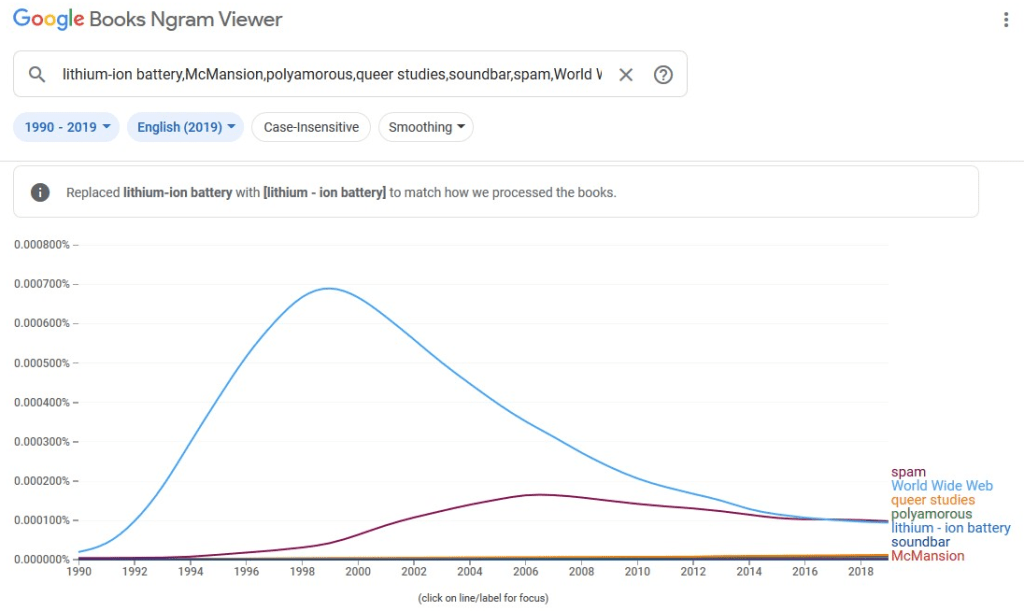
But, just because terms were introduced does not necessarily mean that they were used at the same rate over time. Using Google NGram Viewer, here are some of the terms in comparison:

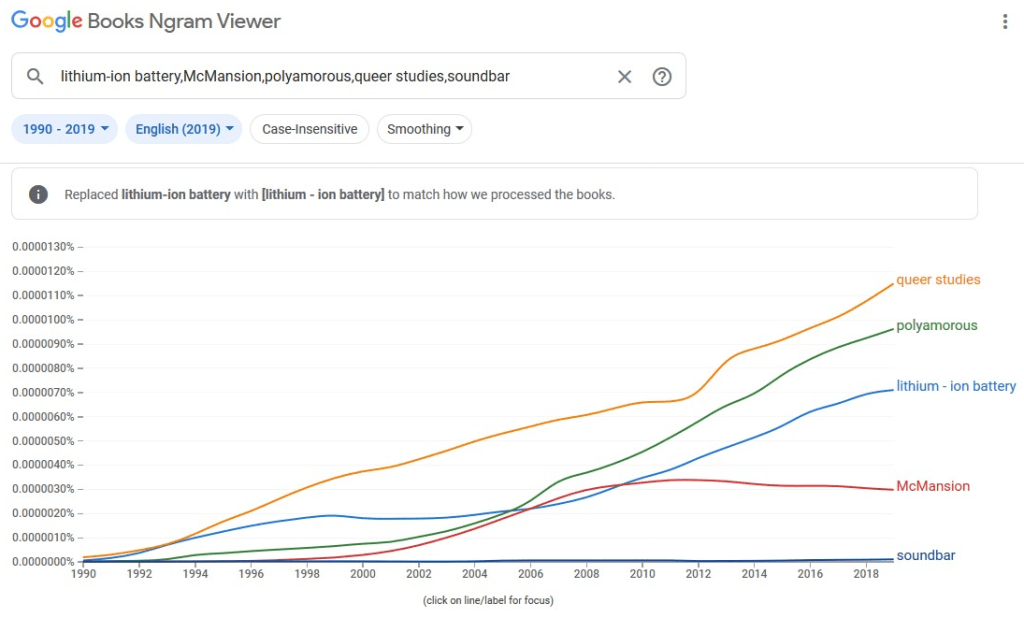
Take out the tech terms – World Wide Web and spam – and now some of the patterns regarding other social phenomena are more clear:

Since this covers books, there might be a lag compared to other sources. For example, my own analysis of the use of the term McMansion in the New York Times and Dallas Morning News found the term had higher rates of usage from roughly 2005 to 2008 (and then plateaus, just as it does with book usages several years later). But, it also takes some time for terms to be used widely. Indeed, three of the five terms above steadily rise in usage.

Given the time travel back to 1990, it might be hard for any new words to compete with computer or Internet related terms. The introduction and spread of the Internet shaped many aspects of society. At the same time, new understandings of sexuality and relationships are pretty influential as well. Perhaps thirty years is not enough to judge the impact of these words just yet.

What could lead to Americans considering what they want the suburbs to be

Yesterday, I wrote about competing visions of American suburbs. Under what circumstances might a national conversation, debate, and/or reckoning take place regarding what suburbs should be in the future? Here are a few possibilities:

photo of houses under starry skies

Photo by Dominika Roseclay on Pexels.com

  1. An election. As noted yesterday, elections can help to bring issues to the forefront. The suburbs are not a key issue in the 2020 presidential election but this does not mean they could not be down the road.
  2. Building concern about housing. The need for cheaper housing in certain metropolitan areas has led to local and state-level debate but this has rarely reached national levels. I am pessimistic about national level discussions about and solutions for housing – but it could happen.
  3. Some sort of crisis or unusual occurrence in suburbia that pushes people to rethink what suburbs are about. Perhaps it is ongoing police violence – like in Ferguson, Missouri – or an usual place like Columbia, Maryland that people want to emulate.
  4. Declining interest in living in suburbs among future generations. Whether millennials and their successors want to or can live in suburbs is up for debate.
  5. A redefinition of the American Dream away from single-family homes, driving, and private spaces to other factors ranging from different kinds of spaces (perhaps more cosmopolitan canopies?) to an inability or declining interest in homeownership compared to securing health care and basic income or a rise in AI, robots, and technology that renders spaces less important than ever.
  6. Black swan events or large changes beyond the control of the average suburbanite. Imagine no more gasoline or a disease that strikes suburbanites at higher rates or a collapse of the global economy rendering the suburban lifestyle difficult. (Because these are black swan events, they are hard or impossible to predict.)

For roughly seventy years, the United States has promoted suburbs on a massive scale (with evidence that a suburban vision has existed for roughly 170 years). With a majority of Americans living in suburbs, it would take work or certain events for a robust conversation to be had and then a wind-down of the suburbs and shift toward other spaces would likely take decades. At the same time, future researchers and pundits might look back to important conversations, events, decisions, or changes that started the United States down a path away from suburbs. Those precipitating factors could occur today, in the near future, somewhere down the road, or never. While the suburbs in the United States have tremendous inertia pushing them into the future, they do not necessarily have to continue.