An April study by the Chamber of Commerce, a real estate research company, named D.C. the loneliest city in America, based on Census Bureau data showing that 48.6 percent of households in the city consist of just one person, the highest share of any city with a population of at least 150,000. Nationwide, the study said, solo living has increased as people wait longer for marriage and children, and the covid pandemic accelerated the trend.
Three thoughts (and questions) in response:
It is interesting that the original study framed this as about “loneliness.” Does this match with the experiences of the residents who may choose to live in a single-person household?
If the problem is indeed loneliness, then the solution presented here involves co-housing opportunities. Who are these housing opportunities available to and who are they not available to? Who will end up living in these spaces?
Is there a tipping point where the percent of single-person household has particular effects on local community life? Washington is at the top of the list but it is very close to the number 2 city (Birmingham).
The research found two thirds of homeowners across the nation live in a house with an average size of 214 sqm, followed by New Zealand and the United States with a typical home 200 sqm in size…
Australia has an average household size of just 2.5 people, with nearly half of the population living in 2-3 person households, the figures found…
Nearly a quarter of Australian households consist of only one person, although that’s not as bad as Denmark, where almost 40 per cent of citizens live by themselves…
The data was collected from reports provided by World Population Review, Statista, Eurostat and official census data.
Are there causal effects between these two statistics? Do people today generally want more individual living space? Does having a larger house lead to having a smaller household? Or are these two social features produced by separate factors?
One other interesting feature of this article: large houses are called McMansions. The opening line of the story:
It’s official: Australia is the king of the McMansion.
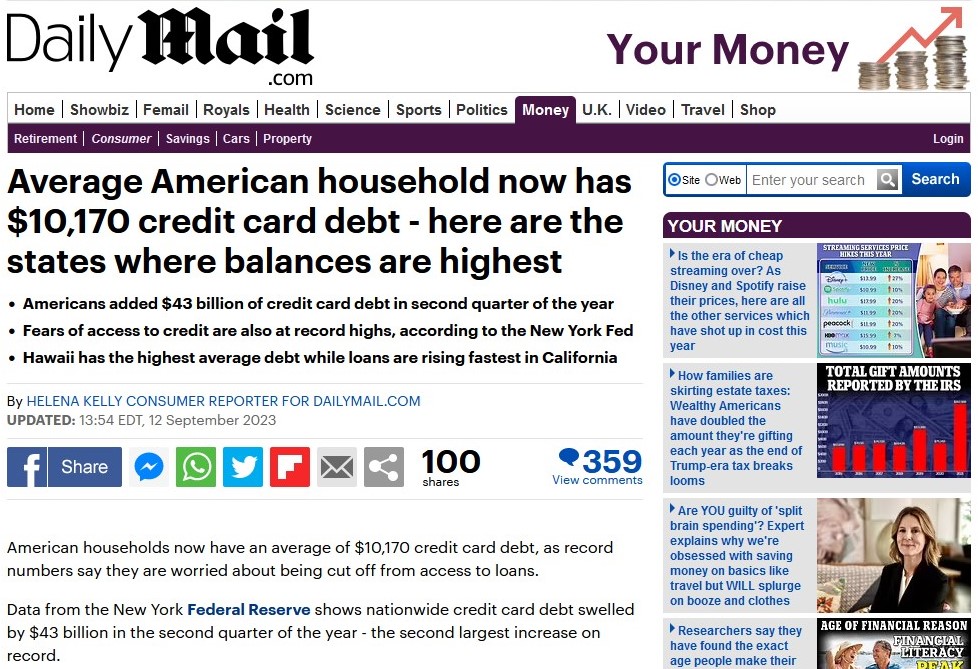
Is the average the best measure? With credit card debt possibly ranging from $0 to who knows how much, is the average a good measure of what is typical?
A recent GOBankingRates survey found that 30% of Americans have between $1,001 and $5,000 in credit card debt, 15% have $5,001 or more in credit card debt and about 6% have more than $10,000 in credit card debt.
Unfortunately, most people with an active credit card account don’t always pay their bills in full. A November 2022 LendingTree survey found that just 35% of cardholders say they always pay their credit card balance in full every month, while 65% say they carry a balance at least some of the time. Nearly half (46%) of those cardholders who have card debt say it would take them at least a year to pay it off.
And tables on this site based on 2019 Federal Reserve survey data suggest the median credit card debt is quite a bit lower than the average.
I am guessing the median credit card debt is a better measure of the typical debt as it better accounts for all the households without any credit card debt. There is a place for the average or the total amount of credit card debt, particularly if one wants to emphasize the growing amount of debt.
The theory that the aging population would require fewer homes isn’t quite accurate. It turns out older consumers tend to prefer smaller dwellings but not fewer homes. The Barclays housing team makes the argument that currently more boomers are partly responsible for creating more households, putting pressure on housing demand…
“Hence, as an increasing share of the population shifts into older age groups, more and more households tend to be formed. That is, as a given household head ages, the size of the household (in terms of people) tends to become smaller and smaller, with children moving out and couples separating because of divorce or death,” the economist added…
“Retired people always are much more likely to be the head of a household than those in pre-retirement age. This is because a given person in this age group is much more likely to be a single head of a household, especially as they, inevitably, lose a life partner,” Millar told Yahoo Finance in an email. “The difference now is that this generation is a much larger group than the one that preceded it, which means that they demand much more housing.”
That leaves less existing inventory for the younger ones, especially millennials as they reach an age where they would form a new household and buy a house.
Do Americans have to take up more houses just because there are more people? This gets at American ideas about single-family homes and households. Is it most desirable to spread out and have numerous private dwellings? Is this also a reflection of sprawling development in the post-World War II era?
If future generations are smaller in size, they could theoretically occupy fewer houses just by having fewer people. But, they could also decide to live in different ways. Fewer detached housing units? Denser settings, even in the suburbs?
This story is not over as population changes and desires for housing are dynamic.
Chicago is seeing more rental housing developments geared toward families like the Matariyehs, as buildings with higher concentrations of two-bedroom or larger apartments are coming on the market or under construction. On top of the shortage of housing broadly, there is also a shortage of family-sized rental housing — typically defined as units with two or more bedrooms — in Chicago and nationally. Rental housing for families that is affordable is in especially limited supply, as two- to four-flats have continued to be gobbled up or priced up by gentrification in Chicago.
A 2020 report from the Chicago Department of Housing finds that for the past decade, market-rate construction has leaned heavily toward studio and one-bedroom units, which, in turn, has shaped affordable housing production. For affordable housing developed through the city’s Affordable Requirements Ordinance — the policy which requires many developers to make a chunk of their units affordable housing — more than 75% of units under construction or completed as of 2020 were studios and one-bedrooms, with less than 5% being three-bedroom units or larger, according to the city report.
Whether in city neighborhoods or suburban communities, larger units mean more children might be present. Children need to go to school. Children can create noise. Children might be drawn to different local amenities than others.
Some of this is a cost question. Housing proposals in suburbs can often into details about how many children might be attending local schools. How will these costs be covered?
When thinking about more expensive developments in cities and suburbs, many places look at two groups of residents they want to target: young professionals and downsizing seniors. The first group is college-educated and is looking for a package of culture and entertainment. The second group is looking to move to a smaller space and enjoy life in ways they might not have been able to with work and/or family obligations.
There will always be at least a few places and developments that appeal to families. Suburbs, for example, can be known for being family-friendly. There is money to be made here.
But, shifts in households and lifestyles may mean an increasing number of places with relatively few or no children – and this is reinforced by the built environment.
Living alone is much more common in large cities. Singles now make up more than 40 percent of households in Atlanta, Seattle, San Francisco, Minneapolis and Denver, according to a paper by the British historian Keith Snell. Half of all Manhattan dwellings are one-person residences. Snell identified a Midtown Census tract where 94 percent of households comprised a single person.
There are likely a lot of factors influencing these numbers in cities. This includes available jobs and economic conditions, family formation processes, cultural and entertainment opportunities, and housing options.
There are also old American narratives about where families live. How about the story about young people in the big city forming families or households, having kids, and then leaving for the suburbs? Do cities provide more opportunities for people in single-person households?
It would be interesting to see the variation in single-person households within and across American cities. Certain cities are listed above at over 40% and certain Manhattan neighborhoods are cited. Does this also mean the numbers are quite different in other New York City neighborhoods or in other American big cities?
The difficulties of living alone tend to lie more on a societal level, outside the realm of personal decision making. For one thing, having a partner makes big and small expenditures much more affordable, whether it’s a down payment on a house, rent, day care, utility bills, or other overhead costs of daily life. One recent study estimated that, for a couple, living separately is about 28 percent more expensive than living together.
These efficiencies are an inherent feature of sharing costs with other people, but the barriers to living alone, for those who want to, would be much lower if housing (and health care, and education) weren’t so expensive. Moreover, the types of housing that are most commonly available for one person typically privilege privacy over togetherness, but the two don’t need to be mutually exclusive. DePaulo has studied communities where single residents have their own spaces, but also plentiful shared areas with “the possibility of running into other people.” If you need to, say, move heavy furniture or get a ride somewhere in an emergency, your neighbors are easy to reach. More such options would make solo life easier.
With the rise in housing prices, the barrier to entering the housing market keeps increasing. A single-person household has fewer potential resources to draw upon.
Additionally, a good portion of housing is geared toward families or larger households. While some locations have plenty of smaller units – think studios to two bedroom units – other locations have larger residences. For example, suburbs are often full of single-family homes with 3+ bedrooms and more square feet.
Finally, housing in the United States is often tied to ideas of familial bliss. Those same private suburban homes are meant to enhance family life. Residences provide private spaces for nuclear families. They may have outdoor space for kids to play in and adults to use. Homes are a symbol of success and can provide a good long-term return on investment. Can a single person still enjoy and benefit from a house? Yes, but this may not be the typical image of life in a single-family home.
The number of U.S. homes with a married couple and kids fell to a record low, according to new government data, as the pandemic further delayed weddings and more adults don’t plan to have kids at all.The share of the U.S.’s 130 million households headed by married parents with children under age 18 fell to 17.8% in 2021 from 18.6% last year, according to the Census Bureau. That’s down from more than 40% in 1970.
By absolute numbers, there are just 23.1 million homes with nuclear families, the fewest since 1959, the data show.
Today, suburbia is much more complex. It still includes nuclear families and families wanting their children to succeed. But, it also includes single households, multi-generational households, older adult households where their children have grown and/or are still living occasionally, households where the partners are not married, and young professionals.
All of this means that the typical image of nuclear families in the suburbs may not be as prevalent or powerful as it once was. It still is important, particularly in more residential communities. But, as more different kinds of households also reside in suburbs, what communities values and how decisions are made may change. Are the suburbs of today just for families with children or do they have a responsibility to a broader audience? The future American vision of the suburbs may still include families and children but the depiction may also include other households that also contribute to the good of suburban community.
The company’s resilience suggests the S.R.O. housing model never really disappeared. It was reinvented for the suburbs, where, since the mid-2000s, more poor people have been living than in cities, according to research by Elizabeth Kneebone and Alan Berube, the authors of the 2013 book “Confronting Suburban Poverty in America.” And it morphed in accord with broader economic trends — captured, above all, by two statistics: One in five adults who “wanted more work” were doing without full-time work in late 2019, according to the Federal Reserve; and 53 million people have low-wage jobs, research from the Brookings Institution shows. An expanding industry built on informal and impermanent housing is a reflection of the precariousness that increasingly defines daily life for millions of Americans.
And one company sees it as a business opportunity:
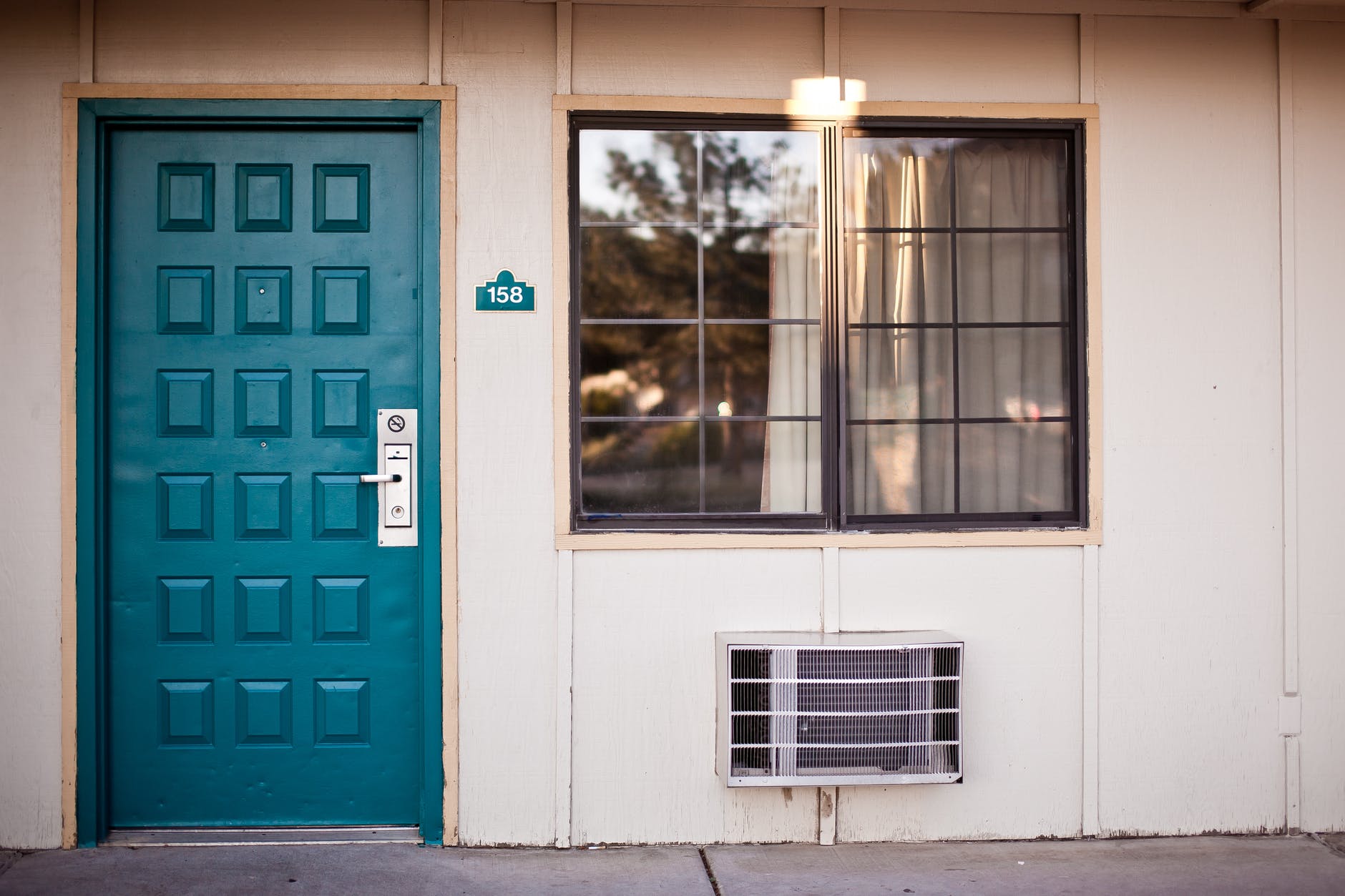
The Siegels see no end to demand and seized on the pandemic as an opportunity to expand beyond Nevada. Last July, the Siegel Group announced the purchase of two Budgetel hotels, 15 miles from downtown Birmingham, Ala.; in November, the company said it was buying a HomeTowne Studios with 130 units in Baton Rouge. The most recent purchase, announced in early May, is an Amerihome Inn & Suites in Houston, five miles north of the beltway in the city’s outer suburbs. That brought the chain to 60 sites nationwide, which now also include Toledo; Memphis; Jackson, Miss.; and Shreveport, La. As Stephen Siegel put it to me, “Our business model is great in a good and a bad economy.”
As the article notes, there are much bigger problems here masked by the opportunity or reliance on extended stay hotels: there are limited housing options for people with limited income, evictions on their record, and poor credit. Government assistance can be lacking or very slow. Landlords have their own worries. Suburban safety nets are thin or do not reach very far. Non-profits and religious groups are not as involved in housing. As sociologist Matthew Desmond showed in Evicted, the housing issue is a big one.
What suburban community would want to address this? Many suburbs want to be a higher-status community and this generally means avoiding having cheaper housing. Depending on the suburb, cheaper housing might be everything from smaller single-family homes to apartments to trailer homes. Hotels might be more acceptable because they could be used by a wide variety of people, including business visitors and potential tourists. If there are problems at such hotels, this could lead to issues.
Assuming buyers saved 10 percent of their income every year, it would take a single buyer 11 years to sock away enough for a 20 percent down payment on a typical U.S. home, versus less than five for couples. To crunch the numbers, Zillow used income data from the Census Bureau’s 2016 American Community Survey and Zillow’s own 2016 home value data; the 20 percent down payment was calculated based on the most expensive home a household could afford.
The analysis reveals that a single homebuyer in Chicago has to save 10 years for a down payment compared with four years for a couple…
Those numbers alone shape a dismal view of homeownership, but couple them with this statistic, and for women, it gets bleaker: Single men are able to afford a larger share of U.S. homes than single women — 52 percent vs. 39 percent…
Despite inventory challenges, it’s important to note that single buyers aren’t necessarily looking at the same homes that couples might be eyeing. Couples may want the yard and be willing to look for residences in the suburbs, while singles may not be willing to lose the amenities that city living offers. And Dantzler, the broker, adds that there are still starter homes out there for single buyers. Just keep in mind that “starter home means different things for different people,” she said. Also, singles exploring homeownership may want to look into low-down-payment home loans, such as the Federal Housing Administration loan that allows for a 3.5 percent down payment.
The single-person household may be popular because one gains autonomy but this may come with a cost: a financial cost. A couple can pool resources and accumulate wealth more quickly. Could the recent drop in homeownership in the United States be tied in part to more people choosing the single life and not having as many resources for a home?
Of course, perhaps the dream is really to be a single-person household with a high income or lots of wealth so one does not need roommates…







 Legally Sociable