Adding hundreds of luxury apartments to a shopping mall – and not affordable housing

Why add affordable housing to the suburban shopping mall when a developer and community can add hundreds of luxury apartments to the mall? Such a plan is under discussion in Skokie, Illinois:

Photo by Terje Sollie on Pexels.com

The Skokie Village Board gave tentative  approval at its Oct. 8 meeting for developers to build hundreds of luxury apartments across three buildings at the upscale Westfield Old Orchard Shopping Center.

The first phase of construction would create 425 apartments between two mixed-use buildings, one five stories tall and one seven stories tall. The second construction phase would be for an additional seven-story building that could be used for more apartments or a hotel, said Stephen Fluhr, Unibail-Rodamco-Westfield’s senior vice president of development…

The additions to the mall were met with criticism by an affordable housing group, which blasted the Village Board for approving plans they saw as having too few affordable apartments.

The first phase would put two buildings in the area of the former Bloomingdale’s retail space in the northwest part of the mall, south of Old Orchard Road and east of Lavergne Avenue.  The developers’ intention is to create a new neighborhood complete with parks, restaurants and spaces for concerts and farmers markets, according to Fluhr. The development is a partnership with the mall’s owner URW and Focus, a development group that is also in the process of building apartments near malls in Vernon Hills and Aurora.

Many malls would like to add housing to their property (examples from the Chicago suburbs to southern California): it makes use of vacant shopping space and provides local residents who might visit stores, restaurants, and entertainment options at the mall.

I would also guess many mall and community would like to add luxury apartments. These apartments will attract certain kinds of residents, those with resources to spend more in the community and contribute to a certain status. Luxury apartments at malls would go along with the idea that only the wealthiest malls will survive.

But, as communities consider affordable housing, why not include affordable housing as part of redeveloped housing at the mall? Many suburbs have limited greenfield development options so redevelopment provides an opportunity for affordable housing. Or affordable housing could provide housing for people working at the mall or working near the mall as shopping malls tend to be close to all sorts of businesses and jobs.

The bigger issue at hand is likely this: how many suburbs are truly willing to add affordable housing? And if they say they want to add such housing or have local regulations that require it, where will they allow it be located?
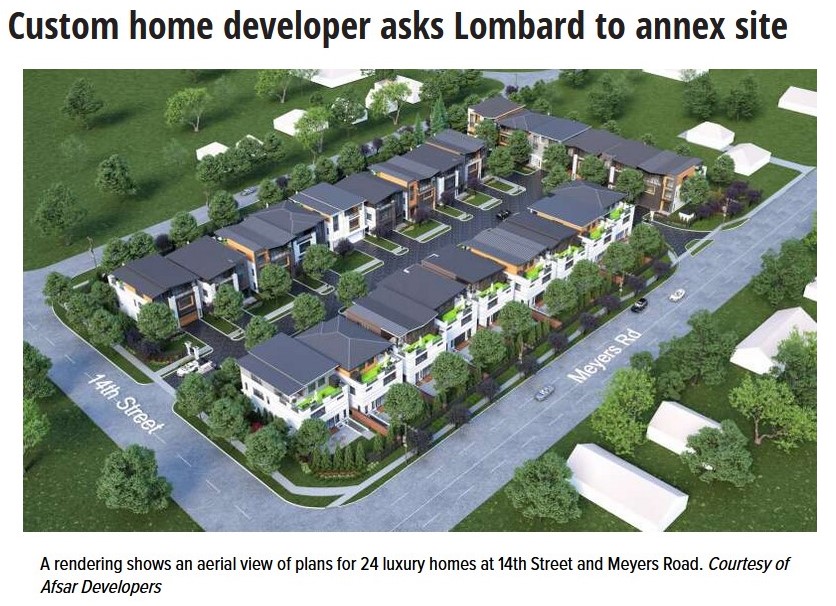
Can you have “high-end, custom homes” that are within a few feet of the neighbors?

A new proposed subdivision in one Chicago suburb will have “custom, high-end homes.” But the image provided suggests these homes will be right next to their neighbors. Do these things go together?

https://www.dailyherald.com/20240903/news/custom-home-developer-asks-lombard-to-annex-site/

A description of “high-end” and “custom” plus looking at the rendering suggests these will be pricey homes. To have this square footage with a garage in a new single-family home build in an older suburb will cost buyers a good amount.

But the homes are so close to each other! Americans like single-family homes in the suburbs but they also like a little space. They like a lawn and an approximation of nature. They like some privacy and an ability to do what they want with their property.

The demand will be there for these homes, yards or not. Housing supply is limited. Some buyers want to pay for less yard space. The new spacious interior with features will outweigh other downsides. If plenty of Americans prefer private interior spaces, these homes will offer that. Like many in the suburbs, people can drive into their garage, close the door, and do their thing inside with little interaction with neighbors or the community.

I also imagine there are a good number of people in the United States who would look at the drawing above and not have any interest due to the lack of space around each house. These are denser suburban homes that do not appeal to everyone.

McMansions are not necessarily in gated communities

One writer suggests both McMansions and gated communities are alive and well in the United States:

In the late 1990s and early 2000s, the real estate market saw an explosion of “McMansions” and sprawling estates across the nation. The economic downturn toward the end of the decade brought the country back to earth and shifted the trend in new housing from giant luxury homes back to moderately sized residences.

While many have claimed that the McMansion boom is over, others beg to differ…

While the tiny house trend has been intriguing to observe, it’s not terribly indicative of where the country is headed in general. For every house that’s being built on wheels, at least one other is moving into a luxurious gated community.

To be honest, experts who voiced a death sentence on McMansions, estates, and gated communities probably spoke too soon.

This piece seems to suggest that homes in luxurious gated communities are necessarily McMansions. However, I’ve never seen evidence that would suggest this is the case. There is little doubt that these two trends were occurring around the same time with gated communities picking up steam in the 1970s and 1980s and the term McMansions arriving by the late 1990s even if the homes started growing in number in the 1980s. But, not all gated communities necessarily include large houses. From what I can recall from the 1997 book Fortress America: Gated Communities in the United States, gated communities can often include middle-class or more average homes as can even be in urban neighborhoods with smaller homes. Gates may project the image of exclusivity but this can be relative or as Blakely and Snyder point out in the book, the gates are often just ornamental rather than serving as real barriers.

At the same time, it would be interesting to look at some data on this. Yet, it is relatively hard from survey data to define a McMansion beyond basic features like square footage and number of rooms.

To the Miami Herald: a 23,576 square foot home is not a McMansion

The Miami Herald features a 23,576 square foot home for auction. However, they err by calling it a McMansion:

If you need a house that stretches across east and west wings, a massive McMansion — said to be the largest home for sale in Broward — will be auctioned off on Dec. 8.

The 23,576-square-foot, custom-built home on 10 acres features seven bedrooms, eight full baths and two half baths. It boasts inlaid Italian marble and cathedral-style ceilings, and comes with a guest house, four-car garage, and statues and objects of art from all over the world.

“The finish work on the inside is the most amazing, with 30-foot high ceilings, chandeliers. It’s just magnificent,” said Jim Gall, president of Auction Company of America, hired to auction off the home, which was listed a year ago for $10 million…

Gall said he plans to start the bidding on the house at $5 million.

Homeowner Ray Moses said he and his wife, Pam, spent five years building the mansion after buying the property, which was formerly used as a horse boarding facility. Broward County property records show they paid $2,225,000 for the acreage in 2003.

Here are four reasons it is not a McMansion (with the most important reason at the top):

1. This home is far beyond the size of a McMansion. This kind of square footage is way beyond a McMansion.

2. Because of its size, luxury, and land, it is also out of the price range of a typical, particularly in Florida. The price might make sense if it was a big house in New York City.

3. This is not a big house on a postage-stamp lot; there are ten acres of land.

4. The home is custom-built, not part of a suburban neighborhood where the houses all look at the same.

By size alone, this home is not a McMansion but the other factors matter as well.

Interestingly, the report on the auction starts with the term McMansion and later uses mansion. Does this suggest the terms are interchangeable? Again, I would argue they are distinct categories.