Can McMansions ever add to the charm of a neighborhood or community?

I’ve seen many stories over the years of how teardown McMansions ruin the charm of older neighborhoods. Here is a recent case from the north shore of Long Island:

Call it a neighborhood dispute over home sizes. A small village on Long Island is seeing more and more small homes torn down to make way for so-called ‘mcmansions.’

Some neighbors have been pushing back, saying the huge homes are taking away from the charm of their community.

Are there any conditions under which a new McMansion might be considered charming? While I can’t recall seeing such a positive description used, here are a few scenarios in which it might work:

  1. The replaced home was small, decrepit, and in severe disrepair. McMansions may not be the preferred replacement option but some homes can be terrible shape and such eyesores are appreciated by few neighbors.
  2. The owners of the new home go significantly out of their way to placate neighbors. Regular deliveries of baked goods? Lots of volunteering for local duties? Handwritten notes asking for forgiveness? Hosting regular parties for neighbors in their spacious new home?
  3. The McMansion meets certain conditions: it is not so large compared to nearby homes, it does not seem to be bursting out of its lot, and the architecture is tasteful and consistent with nearby homes. Even with these, I suspect some neighbors will never be able to get past the idea of a McMansion.

Critics of McMansions tend to pick out clear-cut cases but not all larger teardowns are so easily categorized.

Photo illustrates two of the concerns about teardown McMansions

A news story about possible changes to Burbank’s guidelines for single-family homes includes a great depiction of a teardown McMansion:

burbankteardownmcmansion2013


The image illustrates two common issues neighbors have with such new homes. First, the new home is significantly larger. Not just a little larger; a lot larger. Next to a postwar ranch home now sits a two story property that extends almost to the side property lines and partly due to its higher base now looms over the older, smaller home. Second, we don’t even have to go so far as to claim the architecture of the new home is garish; rather, it is significantly different from the next door ranch home. The small ranch home common to many suburban communities may not be much to look at (though they do have their own enthusiasts) but at least such homes are on blocks of other such homes. Once teardowns begin, the architectural continuity is lost and a hodge podge of homes emerges. A new owner of a teardown could attempt to do a lot to smooth over hard feelings among neighbors but the task is probably more difficult when such a disparity in size and architecture exists.

At the same time, pictures of teardowns can be taken in such a way that either highlight or downplay the differences between adjacent homes. However, I don’t think the picture above can be explained away by angles or camera lenses.


Once a home is labeled a McMansion, can it be redeemed?

McMansionHell recently examined a home in Flower Mound, Texas. A real estate insider asks what the listing agent is now supposed to do:

I post this not to be mean, because obviously this home has people who love it and it is someone’s home, no matter how much of a “mound” it is. There are some very pretty parts. I post it because I truly want your opinion: what would you do with a listing like this to make it more appealing?

A good question for either a real estate agent or a homeowner. With McMansion almost never serving as a positive term, I assume having a home labeled a McMansion is not going to (1) help with the selling price or (2) entice buyers. Even when such homes were really popular, I don’t think too many people would label the homes McMansions to help their cause.

Crazy idea: could you shame people and damage their lives by outing McMansion owners and agents who sell such homes? If you don’t like suburbs – and there are plenty of people who can’t stand them, including a number in academia – this could be an individual level strategy to discourage people from living there. Or perhaps some wealthy McMansion critic could buy up such homes and redevelop the property (presumably with structures they liked better or they could provide a memorial garden).

Haunted McMansions vs. creepy unfinished construction sites

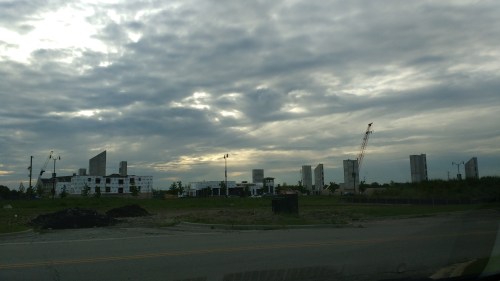
I posted Wednesday about a claim that McMansions appear haunted because of their poor architecture but I think unfinished construction present their own horrors. See this suburban example:

img_20160520_183358037

This is an early evening image of a new residential construction project not too far from our house. All that is standing at this point are elevator shafts. Imagine being trapped in such a project late at night with shadows and wind. There are piles of debris and materials all around. The only escape may be to climb up…shafts that go nowhere. It could be an outdoors, David Bowie from Labyrinth sort of scene. All within sight of a wealthy suburban community with nice homes and lively commercial areas. Yet, it is difficult to imagine how someone might end up in such a situation where they are wandering around such a site.

In contrast, McMansions and other homes may be easier to consider haunted because we associate warm, fuzzy feelings with single-family homes and creepy or evil beings and happenings seem to be such opposites. From the beginnings of the American suburban single-family home, this space was to be a domestic refuge from the outside world or any other intrusions.

But, an empty construction site or unfinished project presents different problems. Is there anyone around? Was the project abandoned for a good reason or some unknown or unspoken reason? Are these ruins or a work in progress? In the end, does the unknown – the construction site – or the familiar – the single-family home, however weirdly designed or old it is – present a more problematic situation?

Seeing McMansions as perfect haunted houses

Pile on the McMansion hell: one writer argues McMansions capture all the essential features of haunted houses.

The term McMansion is itself still relatively recent, coined only in 1992 according to the Oxford English Dictionary. But the landscape of America has long been populated by these off-kilter, jumbled houses, homes whose shape defied all balance and order. At least since the 19th century, we’ve had to deal with ostentatious monstrosities, built without symmetry or class, gargantuan hallmarks of the nouveau riche. We didn’t call them McMansions back then; we called them haunted.

The archetypal American haunted house has always been one whose construction was aesthetically unbalanced. Take one of the most famous American haunted houses, Nathaniel Hawthorne’s house of the seven gables. Defined by its “seven acutely peaked gables, facing towards various points of the compass, and a huge, clustered chimney in the midst,” the house is the ill-gotten gains of Colonel Pyncheon, who accuses his neighbor Matthew Maule of witchcraft in order to acquire his land. There is no order or symmetry to the house; indeed, it’s not even clear where the front of the house is, since it lacks any kind of façade or welcoming front door. The titular, odd-numbered gables poke out in different directions, overwhelming the house with secondary masses and voids. A McMansion 150 years before the term was invented, Hawthorne’s creation set the template for a house that exemplifies wealth without class, ostentation without order…

What is this connection between odd constructions and ghosts? Perhaps it’s because these strange buildings defy common sense and time-honed principles, creating in us a sense of unease that’s hard to name. The principles of architecture—the ones so readily abused by McMansions—didn’t appear overnight; they emerged from centuries of use and tradition. They reflect how we move through houses and how we are most comfortable in them. They maximize the kinds of spaces where we feel most at home, organized around layouts that facilitate ease of use and movement…

In the absence of a good vocabulary to describe that sense of unease, we often fall back on the language of hauntings. A house that’s settled uneasily in its foundation, so that doors swing closed by themselves, and whose layout may trigger a feeling that something isn’t it right—how easy it is to call it haunted, to blame that sense of unquiet on a ghost. The lexicon of the paranormal, after all, is far more ubiquitous and widespread than that of architectural principles, and the language of ghosts is often far easier to call upon than that of primary and secondary masses.

McMansions do regularly feature in horror films. But, this argument is a stretch and I suspect this is another McMansion pile on: “I already don’t like the homes so why not link them to something many people don’t like?” By this argument, any building that is not balanced or orderly is haunted. There are plenty of structures that would fit this description, including many older homes and much of postmodern architecture. On the other hand, do prototypical haunted houses share common traits? Probably, particularly as they are depicted in mass media (whether books, films, or television). In other words, haunted houses may be largely cultural constructions and if enough people paint McMansions as haunted, perhaps it will become real.

Additionally, this argument suggests the supernatural potential of haunted houses is nothing more than bad architecture. How many people would accept this argument, whether they are ghost hunters or people who believe in spiritual beings?

New Australian homes shrinking in size

Not too long ago, new Australian homes rivaled those of the United States. Times have changed:

The country’s homes — some of the biggest in the world — reached peak size in 2009 at an ­average of 222sq m for newly built houses and apartments combined, according to research under­taken exclusively for The Weekend ­Australian.

But the global financial crisis ­put paid to that. The average new home now stands at 192sq m, making it smaller than in 2001, senior KPMG analyst Simon Kuestenmacher found in an analysis of 15 years of data from the Australian Bureau of Statistics.

“Market pressures, a shift in values to ‘less is more’ and spending on experiences rather than material goods, especially among Gen Y, has put Australia on a trajectory towards smaller homes,” Kuestenmacher noted…

firefox_screenshot_2016-09-25t22-25-53-040z

Such trends regarding home sizes can fluctuate as economic conditions, local regulations, and cultural norms change. Now that the new home size has shrunk in Australia, will this continue for a long time? Hard to tell.

I also like the extra analysis that breaks down home size by location: there is not necessarily a singular trend in a country. While much analysis of home size in the United States relies on the single figure produced by the Census each year, I imagine there are some disparate trends across cities and regions in the U.S.

What exactly does “Death Knell Tolling for McMansions” mean?

Numerous outlets are sounding a similar theme: Death Knell Tolling for McMansions. Most of this seems to be based on one recent study that said the cost premium McMansions used to command has declined. Does this mean McMansions are in decline? Not necessarily. There are many ways this could turn out including:

  1. McMansions are still built and bought and sold. Even if they don’t command as much money as before, they still might be profitable.
  2. Over the coming years, fewer McMansions are built and the ones that are constructed are primarily in thriving communities (lots of money as well as population growth).
  3. Regardless of whether #1 or #2 happen, there are plenty of existing McMansions. They could go (1) like many other older American homes – altered, remodeled, passed from groups to groups; or (2) they are so undesirable or shoddy that they are replaced by other housing options. The second option is hard to imagine; plenty of postwar houses are still in existence and it would be costly to destroy a lot of housing units.

Even if fewer McMansions are constructed in the future, they aren’t simply going away. Some McMansions will be around for 50+ years.

A McMansion as shorthand for the white, suburban privilege of Brock Turner

One blogger connects the case of Brock Turner to the suburban house to which he returned:

I googled the address. I don’t know why I did that– morbid curiosity always gets the better of me. I clicked the satellite image and squinted at the blurry photo of a roof. It’s just an ordinary upper-class McMansion, one of many, on a spastic squiggle of a street in the middle of a wealthy suburban development. The kind of place where people can have every luxury they want, unless what they want isn’t kitsch. True luxury that isn’t kitsch is reserved for the richer still, the astonishingly wealthy whose sons would not go to trial at all for rape– not for the Suburban-McMansion Rich whose sons serve three months if the press is bad enough.

A suburban McMansion fits the story a number of people have told regarding Turner’s actions and subsequent treatment by the criminal justice system. McMansion owners are typically white suburban people with money – not really rich, as this post suggests, but rich enough to expect others to be impressed with their standing (and home). In this narrative, the McMansion signals their posture to the world: we aren’t bad people and should be treated with respect.

It is tempting to link a house to a narrative in this way. On the other hand, what if Turner had returned to a more modest 1950s suburban ranch? Would we then see a connection to white conformity? Or, how about a early 20th century suburban bungalow that hints at the fastidious nature of whites who want to preserve some golden era? Or, would a pricey downtown condo conjure up images of high-flying urban nightlife? Since Turner is an unlikable figure to many, I suspect detractors could find all sorts of evidence from the consumer goods in his life – clothes, appearance, vehicle, shopping patterns, and home – to illustrate their dislike. Some of these objects may indeed be connected to white, middle/upper-middle class suburbanites.

This is the not the first time McMansions have been linked to immorality and crime. See, for example, the suggestions in Gone Girl. And such narratives have a much longer history in novels, films, and TV shows that in the postwar era loved to peel back the facade of suburban life to find its truly seemly underbelly. Whether such links and depictions are connected to demonstrable patterns of morality and criminality is another story…


When realtors dislike McMansions

Realtors sell homes. So how do they feel about McMansions? A piece at Realtor.com offers some hints:

We’ve struggled to cover McMansions. For starters, they’re not pleasing to the eye. And, more importantly, we can’t put our finger on exactly what it is about these sad but pricey structures that inspires such a visceral negative reaction…

Q: We’ve grappled with this one for a long time here at realtor.com®. McMansions are like the classic definition of obscenity—”I know when I see it”—but we’ve never come up with a concrete definition for them…

All of the mail from realtors I’ve gotten has been really positive as well. I think that realtors are generally tired of McMansions, especially since they’re so difficult to sell. They find a lot of catharsis in reading McMansionHell.

Does this mean that realtors wouldn’t help sell or buy a McMansion because of their refined architectural sensibilities or because McMansions use of a lot of resources? While McMansions could generate profits for builders, they could also be good for realtors who could make larger commissions.

Based on this, I would enjoy seeing some realtors discuss their approach to McMansions. If I had to guess, I would imagine fewer realtors would be openly critical of such homes because it might limit their business. Perhaps some want to sell such homes while others avoid them like the plague. If they have strong feelings either way, would they openly share these opinions with buyers and/or guide them in certain directions? How many realtors live in homes that could be considered McMansions?

How McMansions affect the children who grew up in them

The founder of the Tumblr McMansion Hell was asked about the effect of McMansions on younger generations:

Returning back to our earlier conversation about why your Tumblr seems to especially be popular among young people, it would seem that not only are young people rejecting their parents’ values but they’re also coming of age during a time that has other trends affecting the decline of McMansions. For instance people are choosing to remain in cities rather than move to suburbs, they’re prioritizing the quality of possessions versus the quantity, there’s a focus on minimalism and everyone’s obsessed with Marie Kondo and de-cluttering. What do you think about all of this?

I think that what it really boils down to is the previous generation — the McMansion buyers — [placed an emphasis] on owning and having assets and this [younger] generation is now more interested in having experiences. Having the experience of community by living in the city, having the experience of having a house that’s well-crafted. This is also the first generation that really grew up with the concept of global warming and we have more of an urgency because our lives are going to be impacted by it. For a lot of young people that grew up in the suburbs, once you reached adolescence, there was a quality of life that was really impacted by the isolation of the suburbs and I think that has played a huge role as to why the younger generation is rejecting this notion of ‘the big house’ and this notion of always being in the car.

There are a number of broad assumptions made here on both sides – interviewer and interviewee – and how they may be affected by McMansions. It is still not entirely clear that younger Americans don’t want to own homes in the suburbs or that consumerism has abated. Younger Americans do seem to have less interest in driving – as evidenced by delayed drivers licenses – though McMansions aren’t only located in exurbs. Some of this will take time to sort out as there have also been large scale economic events that have had some effect.

Among those who discuss McMansions, you would be hard pressed to find many who would argue McMansions are good for children. The opinion above is that children who grew up in such homes will react in certain ways to their negative effects. Yet, how many people reject the general values and norms of their parents? Americans often celebrate this ideal – teenagers should have room to explore, adults should be able to make their own choices and be their own person – but there is often more continuity in society than we suspect. Social change can indeed take place across generations but not all of life necessarily changes.

I can see it now: let’s replace the term Millennials with the McMansion generation. While most people didn’t grow up in such homes, it would fit certain narratives…