The flow of young adults to cities has slowed, leading to the idea of “peak millennial”

Have we reached “peak millennial” for America’s cities?

Dowell Myers, a professor of demography and urban planning at the University of Southern California, recently published a paper that noted American cities reached “peak millennial” in 2015. Over the next few years, he predicts, the growth in demand for urban living is likely to stall…

The debate is full of contours and caveats, but it really boils down to this: Are large numbers of millennials really so enamored with city living that they will age and raise families inside the urban core, or will many of them, like earlier generations, eventually head to the suburbs in search of bigger homes and better school districts?

Their choices — and it will be at least a few years before a definitive direction is clear — will have an impact on city budgets and gentrification fights. It could change the streetscape itself as businesses shift. It will affect billions of dollars’ worth of new apartments built on the premise that the flood of young people into cities would continue unabated.

It could also have a big impact on the American landscape more generally. For the past half-century, the trend toward suburbanization has continued with no real opposition. Even in the 1990s and 2000s, when urban areas were starting to turn around, subdivisions continued to expand. Have millennials ended that trend?…

Stay tuned. A few quick thoughts:

  1. One underlying issue here is the idea that cities need to keep growing in population in order to be vibrant or relevant. Can all American cities grow at significant rates? Should they?
  2. As noted in this article, the pull of suburbs is still strong. Any reversal from suburbs to cities is likely to happen over decades, not within a short span or a single generation.
  3. If cities are affected by a small generation after millennials as well as a declining rate of millennials staying in cities, who will they try to attract next? The article also notes that immigration levels have stabilized. Will there be a new plan from mayors and other urban leaders to bring in more residents?

Exodus of black residents from Chicago’s South Side

A long-time resident of Chicago’s South Side discusses the movement of black residents to other locations:

For South Side residents, the writing has been on the wall. Starting as a slow trickle into the suburbs as industrial jobs began drying up in the 1970s, black flight increased in the 2000s, with blacks seeking the suburbs like never before — as well as places like Georgia, Florida or Texas, according to U.S. Census data.

The population shift has folks like myself, left behind on the South Side, feeling like life after the rapture, with relatives, good friends and classmates vanishing and their communities shattering. A recent study found that nearly half of the city’s African-American men between 20 and 24 were unemployed or not attending college…

Every senseless death, every random shooting and every bullet-riddled weekend means another family, another frightened parent must make the decision to stay or go.

Those of us left behind must deal with the aftershocks: lessening political clout, limited public services and the creep of poverty and crime into neighborhoods like South Shore and Auburn-Gresham.

Even as some trumpet the demographic inversion of metropolitan areas other research suggests poor neighborhoods, particularly in Rust Belt cities, can often slowly lose residents. On one side, there is a lot of attention paid to whiter and wealthier residents moving into urban cores and hip neighborhoods while on the other side, little attention is granted to disadvantaged neighborhoods. In some of these neighborhoods, it is remarkable just how much open space there can be as buildings decay and few people clamor to move in (think of Detroit and its urban prairies as an example).

As recession fades, Americans again move South and West

New Census data shows the move of Americans to the Sun Belt is picking up steam:

Census population estimates show that the 16 states and the District of Columbia that comprise the South saw an increase of almost 1.4 million people between 2014 and 2015. The 13 states in the West grew by about 866,000 people.

The gains represent the largest annual growth in population of the decade for both regions and signal that the multi-decade migration to the Sun Belt has resumed after being interrupted by the Great Recession of 2007-09 and the economic sluggishness and anxiety that followed.

In comparison, population growth in the Northeast and the Midwest — including what’s known as the Snow Belt — remained sluggish, growing by about 258,000 residents combined…

A search for jobs and more affordable housing were behind two-thirds of the long-distance moves made between 2014 and 2015, according to a separate census report. Family reasons, such as getting married or rejoining relatives, accounted for another quarter of households moving.

People would generally say that mobility like this is good: Americans feel more confident in moving (they can sell their house, find a new job) and chase new opportunities (we’re told a good market requires workers who are willing to go where the jobs are located). At the same time, the states that are losing population could suffer some negative consequences ranging from a loss of status (both perceived and real – the article mentions the shift in House seats) to declining tax bases.

Even as this shift to the Sun Belt continues, it would be interesting to take a long-term perspective: how has this changed the United States as a whole? While Los Angeles has certainly risen to the top (and eclipsed Chicago as the Second City), the South is still often treated as distinct rather than the new normal.

Record numbers of displaced people and refugees

One writer suggests the current refugee and displaced persons crisis is truly epic:

There are more displaced people and refugees now than at any other time in recorded history — 60 million in all — and they are on the march in numbers not seen since World War II. They are coming not just from Syria, but from an array of countries and regions, including Afghanistan, Iraq, Gaza, even Haiti, as well as any of a dozen or so nations in sub-Saharan and North Africa. They are unofficial ambassadors of failed states, unending wars, intractable conflicts.

And the numbers may continue to be significant for a while:

While the flow of migrants to Europe this year already represents the biggest influx from outside the Continent in modern history, many experts warn that the mass movement may continue and even increase — possibly for years to come. “We are talking about millions of potential refugees trying to reach Europe, not thousands,” Donald Tusk, the president of the European Council, said in a recent Twitter posting…

“I don’t think this wave can stop,” said Sonja Licht of the International Center for Democratic Transition. “It can maybe from time to time be somewhat less intensive, we simply have to prepare. The global north must be prepared that the global south is on the move, the entire global south. This is not just a problem for Europe but for the whole world.”

Those policy makers who seem pretty unprepared for this – even though there have been hints of migration for a while now – better get moving on a response, both for the refugees and their electorates.

Sociologist proposed moving Hong Kong’s population to Northern Ireland

Recently declassified documents show conversations about one sociologist’s plans to move residents out of Hong Kong:

Newly-declassified documents released at the National Archives in Kew, west London reveal how senior civil servants reacted enthusiastically to proposals in 1983 from a University of Reading academic that a chunk of Ulster – between Coleraine and Londonderry – be turned into a new home for Hong Kong’s 5.5m citizens.

The proponents of the plan, which one Northern Ireland office official declared should be “taken seriously”, suggested the mass transportation of Cantonese speakers would have the dual advantage of boosting the Ulster economy while solving Britain’s dilemma over what to do with the millions of Hong Kong residents concerned they would have no future under Chinese rule…

When details of the scheme, floated by sociology professor Christie Davies, appeared in a Belfast newspaper in October 1983, they caught the eye of George Fergusson, an official in the Northern Ireland office…

The academic, who has subsequently specialised in studying the nature of comedy, said: “I am glad my sensible idea was taken seriously. It was humorous but deliberately ambiguous. My test of a good humorous satire is if a significant minority take it seriously.”

Perhaps this is more revealing of those who were excited about this plan – we can simply move millions of people to solve two political issues at once! – than of the one who made the proposal. Deliberately relocating millions of people halfway around the world sounds like it could lead to all sorts of unintended consequences. How in the world would something like this even be carried off?

Another issue is whether a city could be swiftly moved and replicated elsewhere. Diasporas are not unheard of but the settlements in the new locations can’t completely mirror the original location or scene. Modern Hong Kong was formed out of a unique social and political context as was Northern Ireland. Building a Northern Ireland version of Hong Kong (or a Canadian Atlantic version or a West African version) could turn out to be very interesting…

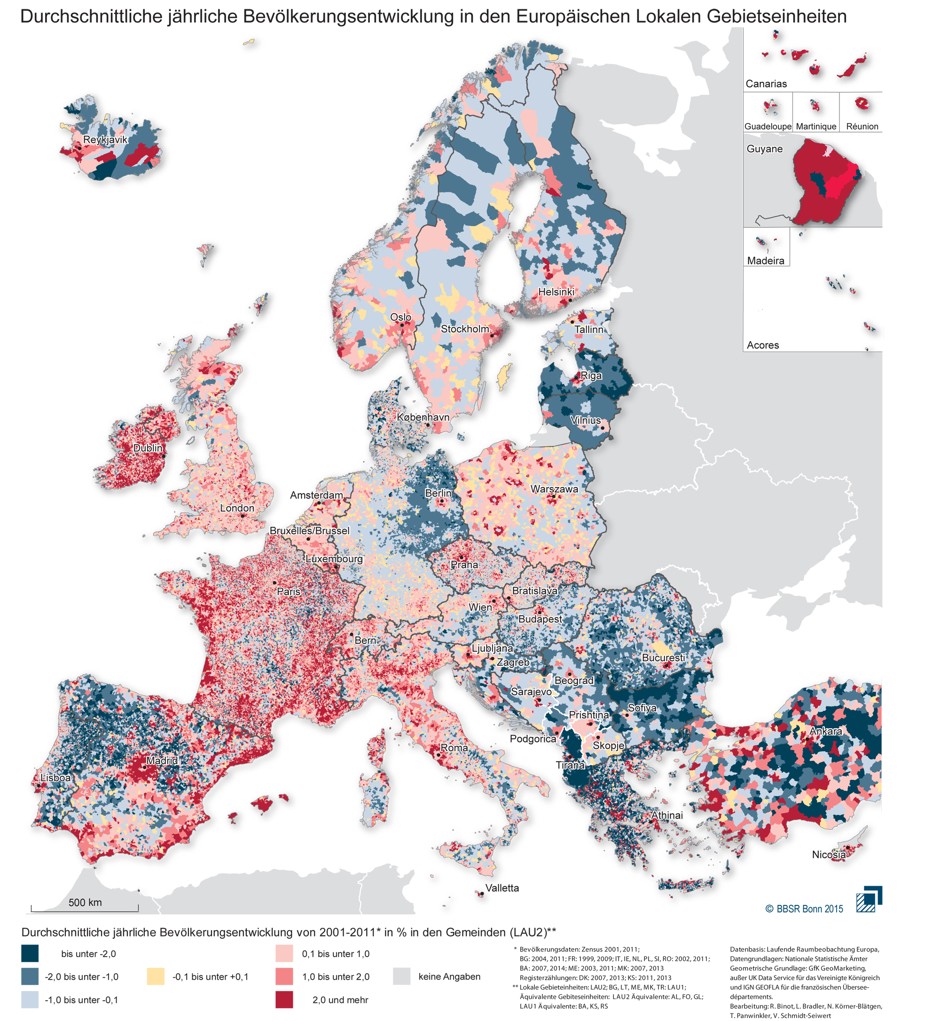
Detailed map of population changes in Europe, 2001-2011

A new map shows the population trends at work in Europe between 2001 and 2011:

Look at the Eastern section of the map and you’ll see that many cities, including Prague, Bucharest, and the Polish cities of Pozna? and Wroc?aw, are ringed with a deep red circle that shows a particularly high rise in average annual population of 2 percent or more. As this paper from Krakow’s Jagiellonian University’s Institute of Geography notes, Eastern cities began to spread out in the new millennium because it was their first chance to do so in decades…

We already know from other available data that Europe is experiencing a migration to the northwest, but the BBSR map adds complexity to this picture and reveals some interesting micro-trends. The dark blue coloring of the map’s Eastern section shows that the lean years for Eastern states are by no means over. Residents have continued to leave Albania, Bulgaria and Latvia in particular in search of jobs, while even relatively wealthy eastern Germany has been hollowed out almost everywhere except the Berlin region.

Population growth in the Northwest, meanwhile, is far from even. While large sections of Northern Scandinavia’s inland are losing people, there’s still modest growth on the Arctic coasts. And while the Scottish Highlands contain some the least peopled lands in all of Europe, Scotland’s Northeast shows remarkable population gains, a likely result of the North Sea oil industry concentrated in Aberdeen…

Spain’s trends look a little different from those of Europe as a whole. It’s actually in the country’s Northwest where the population has dropped most sharply, notably in the provinces of Galicia and León, which have long been known to produce many of Spain’s migrants.

But other previously impoverished regions, such as Southwestern Murcia, have grown, a trend continuing along the Mediterranean coast where population levels have risen sharply.

All of this may help explain reactions to migrants – population pressure is high in some places, particularly wealthier regions, while population loss is occurring in more economically depressed areas. It is also a helpful reminder of how relatively free people are to move between places. I don’t know how exactly this lines up with historic migration rates – particularly before the rise of nation-states which presumably allowed more of an ability to control population flows – but the industrialized world (and much of the rest of the world as well) is quite a mobile one.

Even if Northeastern states have lost 40% of their House seats, has the region lost that much influence?

Large-scale population shifts can have all sorts of effects including the loss of seats in Congress:

The Census Bureau reports that population growth has shifted to the South and the result is that the 11 states that make up the Northeast are being bled dry of representation in Washington…

Deep in a recent report, for example, the American Legislative Exchange Council tabulated how the drop in population relative to the rest of the nation cut the region’s power in Washington. While the states from Pennsylvania to Maine had 141 House members in 1950, they are down to 85 today, a drop of some 40 percent.

California and Texas combined have more House representatives..

“This result is one of the most dramatic demographic shifts in American history. This migration is shifting the power center of America right before our very eyes. The movement isn’t random or even about weather or resources. Economic freedom is the magnet and states ignore this force at their own peril,” said the report.

The last quote is particularly interesting as the population center of the United States has indeed kept moving further and further west (and a little south). Yet, even with the loss of seats from Northeastern states, New York City is still the #1 global city. Additionally, this region is close to the city of Washington D.C. which seems to be doing just fine in terms of wealthy counties and communities and a growing presence among large cities. Does having less seats in Congress necessarily mean the Northeast has lost 40% of its influence in American life? How many lobbyists are located in the Northeast compared to other places? Where are the institutions of higher learning from which many politicians and other elites come from? Where are the large media organizations?

It would also be interesting to see where these Northeast house seats have been lost. Is it primarily from large cities or more from mid-sized cities and more rural areas that have had steady population losses? Is this more of a Rust Belt phenomenon that affects cities like Buffalo, Rochester, and Worcester more than Boston, New York, and Philadelphia?

People leaving blue states tilting national elections?

An analysis of the “blue-state diaspora” suggests this has helped Democrats in presidential elections:

Over the last few decades, residents of many traditionally liberal states have moved to states that were once more conservative. And this pattern has played an important role in helping the Democratic Party win the last two presidential elections and four of the last six. The growth of the Latino population and the social liberalism of the millennial generation may receive more attention, but the growing diaspora of blue-state America matters as well.

The blue diaspora has helped offset the fact that many of the nation’s fastest-growing states are traditionally Republican. You can think of it as a kind of race: Population growth in these Republican states is reducing the share of the Electoral College held by traditionally Democratic states. But Democratic migration has been fast enough, so far, to allow the party to overcome the fact that the Northeast and industrial Midwest contain a smaller portion of the country’s population than they once did…

The spread of people born in New York State offers a particularly telling example: Of the 20 million Americans alive today who were born in New York, nearly one in six now live in the South. That would have been almost unthinkable 50 years ago, when the share was one in 25…

The first thing we noticed was a major blue-to-red shift: Since 2000, the blue-born population in red states has grown by almost a quarter, to 11.5 million, or 12 percent of the states’ total population.

The paradox here is that this trend could be positive or negative depending on the level of analysis. Typically, population loss is seen as a negative thing. If there are large numbers of people leaving New York City, we might ask whether something is wrong in NYC. Actually, New York City may not be a good example because it always tends to draw people but think instead of liberal Midwestern cities, places like Chicago or Detroit or Cleveland, that have lost population and this has been tied to problems within those cities. Yet, the spreading out of liberals could work well on a national scale if those places losing liberals aren’t filled up with conservatives and the liberals who move weaken the conservative advantages elsewhere.

It is hard to imagine that any of this could be planned but I could imagine some interesting future scenarios where political parties encourage enough people to move, perhaps temporarily, so they can vote in a different place to help swing an election.

The migration patterns of the world’s millionaires

Here are the top destinations for the world’s millionaires:

According to a report from New World Wealth, the U.K. was the top destination in the world for migrating millionaires over the past decade. Between 2003 and 2013, the U.K. had a net inflow of 114,100 millionaires (people with $1 million or more excluding their primary residence)…

Singapore, with its tax-friendly policies and security, ranked second in attracting the world’s wandering wealthy. It gained 45,000 millionaires between 2003 and 2013. The U.S. ranked third, gaining 42,400 millionaires.

So where were all these millionaires moving from? Mostly China. According to the report, China had a net outflow of 76,200 millionaires during the 10-year period. India was the next largest loser, with a net outflow of 43,400, followed by France, Italy and Russia…

The study said that overall, London has the most millionaires of any city, with 339,300. New York ranks second with 300,100, followed by Tokyo (226,500) and Singapore (225,000).

Follow the money. Even as these millionaires then move to certain cities, there are certainly patterns within these cities as to where they move and with whom they associate. All of these top urban destinations for millionaires have strong finance sectors as well as some of the world’s most expensive housing even as some of them also have relatively poor areas, sizable immigrant populations, and numerous social problems within a short distance from the residences of some of the wealthiest people in the world.

Visualizing the migration flows in and out of DuPage County

The US Census recently released data on county-by-county migration flows. The tables that can be downloaded are huge but here is a look at the flows in and out of DuPage County:

DuPageCountyMigrationFlows

Looks like a lot of movement to (and some from) warmer locales – southern California, Arizona, Florida – and lots of movement in the Midwest in an area roughly bounded by St. Louis, Detroit, and Minneapolis. You can also look at the migrations by education or income level.

Very cool all around. There is a lot of data to crunch here and these visualizations help make sense of a lot of data. At the same time, these aren’t necessarily huge movements of people. Take Harris County, home to Houston (4th largest city in the United States): over this five year span, there was a +88 flow from Harris to DuPage County.