Why doesn’t everyone leave Chicago or Illinois?

With the recent news of Chicago’s continuing population decline as well as population loss in some suburbs, some critics have suggested this all makes sense with the problems facing Chicago and the state of Illinois. The argument goes like this: when social, economic, and political conditions are bad, people vote with their feet and leave. Look at all the people moving to Texas and the Sun Belt!

However, there are multiple reasons people stay in Chicago and Illinois. Among them:

  1. It is costly financially to move. It takes time and money to move to a new location. Having a good job on the other hand is needed.
  2. It is costly socially to move. Finding new friends and social connections can be difficult, particularly in today’s society where Americans tend to stick to themselves.
  3. They have a good job in Illinois or Chicago. There are still plenty of good jobs here; Chicago is the #7 global city after all and there are lots of headquarters, major offices, and research facilities alongside large service and retail sectors.
  4. They have families or ties to the area. The Chicago region is the third biggest in the country – over 9 million residents – and there are lots of residents with long histories and/or many connections.
  5. Both places have a lot of amenities. One of the busiest airports in the world? Impressive skyline? Access to Lake Michigan? Good farmland? Located in the center geographically and socially in the United States? Land of Lincoln?

All that said, for the vast majority of Chicago and Illinois resident, there are not enough negatives outweighing the positives of staying. (This is not the same as saying current residents are happy or wouldn’t prefer to live somewhere else.) Compared to other American locations which are growing more quickly, it doesn’t look good but Chicago and Illinois also aren’t emptying out like American major cities did in the postwar era or some rural areas.
More on the reduced geographic mobility of Americans

A new book from economist Tyler Cowen discusses how the geographic mobility of Americans has declined:

Nowadays, moving from one state to another has dropped 51 percent from its average in the postwar years, and that number has been decreasing for more than 30 years. Black Americans, once especially adventurous, are now especially immobile. A survey of blacks born between 1952 and 1982 found that 69 percent had remained in the same county and 82 percent stayed in the same state where they were born…

One reason people don’t move where the jobs are is because of real-estate prices — which in turn are kept at high levels by regulatory restrictions and NIMBY-ism. In New York City in the 1950s a typical apartment rented for $60 a month, or $530 today if you adjust for inflation. Two researchers found that if you reduced regulations for building new homes in places like New York and San Francisco to the median level, the resulting expanded workforce would increase US GDP by $1.7 trillion. That won’t happen, though: More homes would diminish the property values of existing homeowners.

That locked-in syndrome is a factor in economic stagnation, too: A recent Wells Fargo survey found that white-collar office productivity growth was zero. As the economy was supposedly recovering from the financial crisis, from 2009 to 2014, American median wages fell 4 percent. Men’s median incomes today are actually below 1969 levels. Had we retained our pre-1973 rates of productivity growth, the typical household would earn about $30,000 a year more than it does.

Despite all the hype attached to a few tech companies, far fewer companies are being formed than in the 1980s, and fewer Americans are working for startups. Such new companies are linked with rapid job creation. We’re coming close, Cowen says, to realizing the 1950s cliche (not really true then) of everyone clinging to a job at a handful of huge, soul-crushing companies.

As I’ve seen a number of stories about declining mobility (see earlier posts here, here, and here), I wonder if the period between the early 1900s and 1960s was simply unusual. The American economy was doing well (except for the Great Depression and the World Wars) and other factors including legal segregation in the South drove mobility. What if more limited mobility is “normal” outside of unusual time periods? Should we expect that Americans should be willing to pick up and move just because there may be a job or an opportunity elsewhere? I would guess humans default toward less geographic mobility because moves limit the ability to develop communities. In fact, it has only been in recent centuries that more of the population has even had the opportunity to travel or move large distances from where they were born. Perhaps the real question here is to find out more of what would lead people (whether in the United States or elsewhere) to move significant distances.

Why Americans do or do not move

An article about the most and least mobile cities in the United States includes some discussion of what pushes people to move or to stay put:

“There are two main determining factors whether people move or not,” says Nathalie Williams, a sociology professor from the University of Washington. The good: “The better people feel their lives are going, the less likely they are to move elsewhere.”  The bad: Lousy economies can force people to head for greener pastures.

But of course, economic insecurity can also keep people in the same place.

After the housing bust in 2007, migration slowed down, because uncertainties about the job market had made people nervous about changing jobs and deciding to move on. They were less likely to upgrade to a bigger and nicer home. Plenty even found their homes deep underwater, and were unable to sell.

Now that the recession is over, mobility is finally picking up again, says Kenneth Johnson, a demographer at the University of New Hampshire. And jobs lure people, especially younger ones who haven’t put down deep roots, to new centers of employment.

The short explanation is that economic factors are influential. But, there may be three caveats to this: (1) movement can occur because of either a good or bad economy, (2) it may depend on people’s stage of life, and (3) perhaps there is more to this than economics. Regarding the first point, the article juxtaposes Detroit and Honolulu, the two cities that are least mobile. These are two very different places: one is doing well, the other is not. Later, it is noted that several of the most mobile places are college towns with populations that are more transient (this involves students but also others whose jobs in academia and related industries can lead them from college town to college town). Finally, the description of life in Honolulu cites some economic factors (low property taxes) but also includes a unique cultural setting that some enjoy.

In the end, I’m not sure this article does much to help explain why people move. They move less when economic times are good and bad. Certain places are more mobile because of institutions that encourage transience (colleges) while other places have quality of life traits that discourage moving. Does this mean the most mobile places are somewhere in the middle of these rankings? Or, is it all relative to what people in the region have experienced in recent years?

American geographic mobility still limited

Richard Florida highlights how the percent of Americans moving each year has slowed, particularly compared to the postwar era:

Just slightly more than one in ten Americans (11.2 percent) moved between 2015 and 2016, almost half the 20.2 percent rate back in 1948, when the Census began tracking American mobility. Mobility was once the cornerstone of the American Dream, but today Americans move less often than Canadians, and only a bit more than Finns or Danes.

Both longer and shorter moves have declined over this period. Just 6.9 percent of Americans made shorter moves within the same county, down from 13.6 percent in 1948. The mobility rate for these types of moves plummeted between 1998 and 2008 (with the economic crisis) as the chart below shows, and has declined more slowly ever since.

(David Ihrke/U.S. Census)

Longer moves between counties declined from 6.4 percent in 1948 to just 3.9 percent today over the same period.

(David Ihrke/U.S. Census)

Florida goes on to provide several possible reasons for this more limited mobility. But, two quick issues come to mind:

  1. The historical comparison is both useful and might be a red herring. On one hand, we can consider trends over six decades and this provides helpful context. Too many current news stories talk about trends based on one year changes in data. On the other hand, the immediate decades after World War Two may have been extremely different with general prosperity in America and growing suburbanization. Should we expect the same levels of mobility today or was the postwar era unique?
  2. Is there an ideal level of mobility? I know Florida is in favor of mobility because it means workers can flock to places with jobs and cities that have certain features will attract motivated and talented residents. Clearly, no mobility would create issues as there could be significant mismatches between jobs and employees. But, instead of making comparisons to a few other countries, what would be a healthy level of mobility in the United States?

All that said, a less mobile United States is a different United States.

Peak urban millennial reached?

A new study suggests millennials are now less interested in settling in big cities:

Millennials have been singled out as the stuff cities are made of, but Dowell Myers, a professor at the University of Southern California’s Price School of Public Policy, says the real estate industry should be bracing for a shift back to suburbs…

In a study published in late April in the journal Housing Policy Debate, Myers examined Realtor surveys and various sources of federal data…

Myers, however, found that circumstance was the likely driver of urban living: Three cycles — one demographic, one economic and one housing-based — converged in the 2000s to drive millennials into downtowns.

All three have reversed their effects, he said.

If this holds up, two possible consequences:

  1. Cities have worked hard in recent decades to appeal to young, educated adults – the Creative Class, in particular. If this group doesn’t move to cities in as large of number, who will cities try to attract? They may still go for wealthier empty nesters and retirees who can purchase housing and contribute to the tax base. But, they don’t quite have the same benefits as vibrant, motivated young people.
  2. If they aren’t going to the big cities, suburbs and suburban developers will increasingly look for ways to attract this demographic. Denser, more vibrant suburban areas could be appealing as they offer “city-lite” living. This could lead to more smaller yet having-all-the-features suburban housing.

Explaining Americans’ decline in geographic mobility

Derek Thompson highlights a decline in movement and summarizes what might be behind it:

Between the 1970s and 2010, the rate of Americans moving between states fell by more than half—from 3.5 percent per year to 1.4 percent. “It’s a puzzle and it’s the one I wish politicians and policy makers were more concerned about,” Betsey Stevenson, a former member of Obama’s Council of Economic Advisers, told The New York Times this week. Fewer Americans moving toward the best jobs and starting fewer companies could lead a less productive economy. On Thursday, the Financial Times reported that productivity “is set to fall in the U.S. for the first time in more than three decades.”…

Every dimension of declining American dynamism is connected. The slowdown in most areas’ business development comes from a shifting tide in American migration. For 100 years, population flowed from poor areas to rich areas. Now the trend has reversed. Land-use policies prevent more middle-class families from living in productive areas, because housing becomes too expensive. Meanwhile, the rich can afford to cluster in a handful of metros where entrepreneurship is a norm, while business dynamism falls in the rest of the country. There used to be too much land to settle. Now there’s not enough land to share.

Two quick related thoughts:

  1. You regularly see people make the argument that people should just pick up and move to where there are more opportunities, meaning jobs and a cheaper cost of living (generally referring to housing and maybe taxes). There is even a single case in Evicted where a person moves from a poor Milwaukee neighborhood to a southern city and seems to be doing well. However, moving is not necessarily easy (see #2).
  2. Why are economists the only ones summarized here? Are sociologists not paying much attention to this? On one hand, I can see how economics would drive decisions about moving. Yet, it is not the only factor. People have social connections wherever they live and it can be difficult to form new social networks. While Americans always have prized mobility, don’t they also celebrate finding your roots and being a presence in your community? (Granted, Americans may be doing neither: moving less and being less engaged in civic life.) This reminds me of some public housing residents who didn’t want to leave pretty bad conditions in high-rise buildings. Or, what about explanations like those in The Big Sort or The Rise of the Creative Class where people choose to live near people like themselves.

Majority of older Americans want to “age in place,” not move to the city

An article profiling some suburbanites who moved to the city as older adults admits that this isn’t the path desired by most Americans:

But you didn’t move back into the city, did you? Instead, you’re doing what the vast majority of American adults prefer to do: “aging in place.” According to a recent survey of adults 45-plus by AARP, 80 percent of respondents agreed that “what I’d really like to do is remain in my local community.”

But for those willing to make the exodus, the move into Chicago proper can be extremely rewarding…

Still, the Zimmermans’ move into town runs counter to overall trends. The 2015 data from the National Association of Realtors show that among “repeat buyers” (most likely to be boomers and Gen Xers), only 12 percent are buying in urban areas. An equal number are going to rural areas, 20 percent are going to small towns, but most — 53 percent — are buying in the suburbs.

And here’s a bit of a shocker: Although studies show that a third of retirees don’t expect to move at all, those who do move are not necessarily even downsizing. According to a recent survey by Age Wave, a firm that specializes in research on the aging population, only about half of retirees 50-plus who move after retiring choose a home that’s smaller; 19 percent move to a place of equivalent size, and 30 percent actually upsize.

There are always a good number of stories about urban revivals and people flocking to American big cities for the amenities and short commutes. However, the stories tend to obscure that the majority of Americans do not choose this path. When asked, many Americans say they want to live in small towns than anywhere else.

Particularly for older adults, the move to the city is probably only possible for those with significant means. Additionally, where many of those people want to move – is in nicer neighborhoods with cultural events, access to jobs, and newer construction – as opposed to living in many of neighborhoods of the city.

At the same time, aging in place in the suburbs presents unique challenges with its emphasis on single-family homes and driving. Homes can be difficult to maintain for decades and driving may not be possible at a certain point. Then, the spaciousness of the sprawling suburbs can be a significant hindrance to providing social services.

As recession fades, Americans again move South and West

New Census data shows the move of Americans to the Sun Belt is picking up steam:

Census population estimates show that the 16 states and the District of Columbia that comprise the South saw an increase of almost 1.4 million people between 2014 and 2015. The 13 states in the West grew by about 866,000 people.

The gains represent the largest annual growth in population of the decade for both regions and signal that the multi-decade migration to the Sun Belt has resumed after being interrupted by the Great Recession of 2007-09 and the economic sluggishness and anxiety that followed.

In comparison, population growth in the Northeast and the Midwest — including what’s known as the Snow Belt — remained sluggish, growing by about 258,000 residents combined…

A search for jobs and more affordable housing were behind two-thirds of the long-distance moves made between 2014 and 2015, according to a separate census report. Family reasons, such as getting married or rejoining relatives, accounted for another quarter of households moving.

People would generally say that mobility like this is good: Americans feel more confident in moving (they can sell their house, find a new job) and chase new opportunities (we’re told a good market requires workers who are willing to go where the jobs are located). At the same time, the states that are losing population could suffer some negative consequences ranging from a loss of status (both perceived and real – the article mentions the shift in House seats) to declining tax bases.

Even as this shift to the Sun Belt continues, it would be interesting to take a long-term perspective: how has this changed the United States as a whole? While Los Angeles has certainly risen to the top (and eclipsed Chicago as the Second City), the South is still often treated as distinct rather than the new normal.

How residents of Great Britain choose where to live

A new study looks at why people live where they do in Great Britain:

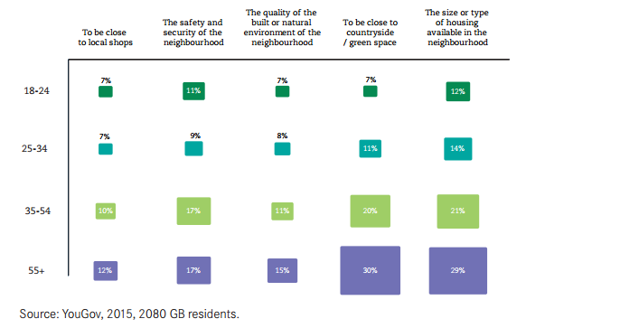
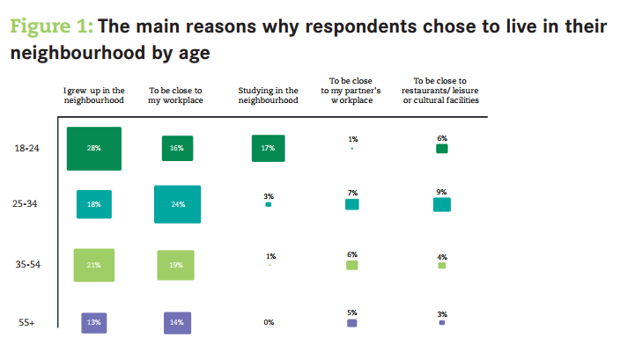
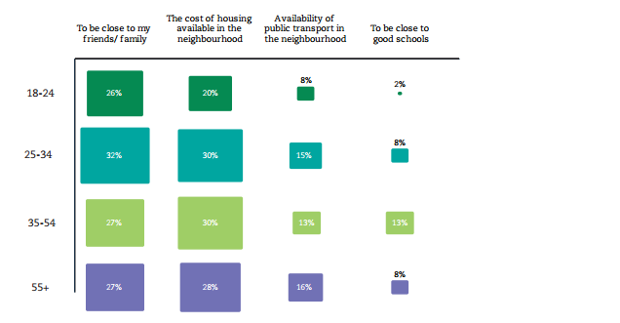
Not surprisingly, the key things that matter to people about the neighborhoods they live in include a mix of housing costs, being close to family, and proximity to where they work. More than a quarter (28 percent) of respondents cited housing costs and proximity to friends as key factors in the neighborhoods where they live, followed by the size and type of available housing (22 percent), and proximity to their workplace or their partner’s workplace (21 percent)…

The full report offers this conclusion:

Where people choose to live is largely determined by their stage of life. Young people aged between 25 and 34 prioritise proximity to the workplace, cost of housing, and access to leisure and cultural facilities when choosing where to live. Those aged between 35 and 55 tend to value access to good schools, and the  size and type of their houses. And those aged over 55 prioritise access to countryside and green space.
These preferences help to explain the differing demographics seen across cities and their surrounding areas – different parts of cities are more able to offer amenities that are prioritised by people at different stages of their lives.

Overall, it sounds like two factors matter most even with the age differences: a favorable location in regards to social necessities (jobs and relationships) and good but affordable housing. Of course, obtaining these two goals may be quite difficult for many given that: families and friends don’t necessarily prioritize living near each other as opposed to living close to work or going where the jobs are, employers tend to be concentrated in certain locations, affordable and desirable housing can be very difficult to find in many popular areas, and consumers can’t exactly find housing that is everything that they want.

If age or life stage matters so much, should planners and others really go after lifestyle sorts of communities appealing to just one group or provide options for multiple groups within individual communities?

Wealthier kids go to nearby schools; poorer kids travel further

Living in a poorer neighborhood means the resident children travel further to go to school:

Julia Burdick-Will found it was actually children in affluent neighborhoods who stayed close to home for school. In lower-income neighborhoods, kids in search of better options dispersed to dozens of other schools, often commuting alone for miles.

In Chicago neighborhoods with a median household income of more than $75,000, most students attended one of two or three schools. But when the neighborhood median income dropped to less than $25,000, students dispersed to an average of 13 different schools…

In affluent neighborhoods almost no one traveled 4 miles to school; the average commute was about 1.7 miles. But in disadvantaged neighborhoods, the average commute for children was 2.7 miles, with 25 percent of the kids traveling more than 4 miles. Ten percent of the low-income kids traveled more than 6 miles…
In low-income neighborhoods the problem isn’t just access, Burdick-Will said, but the potential social costs of traveling far across the city every day, possibly alone—costs that don’t apply to similarly achieving students in higher income neighborhoods.

An interesting paradox. Typically, wealth means mobility: they can seek out opportunities far and near, move to new locations when need by, afford the transportation costs. We imagine poorer residents stuck in neighborhoods with little opportunity to leave – and evidence from Robert Sampson in Great American City suggests even when afforded the opportunity to leave, many poor residents turn to similar poor locations.

Yet, public schools are one of the more local institutions in the United States. People move to neighborhoods and communities for the quality of their schools. The majority of property taxes go to local schools. Local school board officials are often elected and want to shape their local institutions. Community events are often held in these schools. They are a source of pride if the schools do well, a source of concern if they are not doing well.

Given that, it makes sense that Burdick-Will would suggest it is a burden for kids to go further for school. And that burden is on top of the other obstacles children in poorer neighborhoods face.