Trying to portray early 1920s New York City accurately

A discussion of The Great Gatsby includes portions about trying to accurately show life in New York City:

Photo by Ramil Ugot on Pexels.com

Between Manhattan and West Egg, where Jay Gatsby and Nick Carraway live, spreads the “valley of ashes,” “a fantastic farm where ashes grow like wheat into ridges and hills and grotesque gardens; where ashes take the forms of houses and chimneys and rising smoke and, finally, with a transcendent effort, of men who move dimly and already crumbling through the powdery air”. Fitzgerald’s valley of ashes tips its hat to TS Eliot’s The Waste Land, but it was also a feature of New York at the time. The Ash Dumps were mountainous piles of ash up to 90ft high, a malodorous stretch of swampland in which coal ash, cinders, garbage, and human waste had been dumped. Lone figures wandered the desolate heaps searching for treasure or anything they could sell – a perfect image of a nation squandering its promise in search of a buck.

Most of the novel’s memorable details function in the same way, as realistic features of New York in 1922, and as symbols that fuse social satire with the novel’s metaphysical meanings. Gatsby is peppered with familiar symbols: the valley of ashes, the green light, the eyes of Dr Eckleburg that are mistaken for the eyes of God. It’s a novel that understands how signs can expand our capacity for thought. Gatsby’s green light has become one of the most famous images in literature, standing for Gatsby’s envy of the Buchanans’ world and his desire to attain it. It suggests his and his nation’s aspirationalism, their faith in renewal, in the fresh hope of starting over – and their drive for the colour of American money…

Hollywood routinely helps itself to any details from the 1920s that let it gesture toward the jazz age. Baz Luhrmann’s 2013 film adaptation of Gatsby features Prada dresses in silhouettes that were not worn until around 1928. This may sound like pedantic quibbling – what’s six years in Hollywood time? But, socially and culturally, the 1920s ended in a very different place from where they began: the styles of 1922 were far closer to those of 1919 than to those of 1929.

Luhrmann’s Broadway is thronged with yellow taxis – but New York taxis were not uniformly yellow in the early 1920s. There were also red taxis, blue taxis, checkered taxis, and by the summer of 1923, lavender taxis, like the one Myrtle Wilson selects after letting four others pass by. Lavender taxis were known for being expensive and could seem pretentious, an impression heightened by their violent colour scheme: “cerise and lavender taxis with red and green checkers”. A night out in Prohibition New York, it was said, “begins in a bierstube [beer hall] and ends in a purple taxi”. Myrtle Wilson, with her violent affectations and social climbing, would naturally choose a lavender taxi.

These deadening clichés distort our view of Gatsby in important ways. They keep us from registering how rich and strange and alien its world is: the New York of Gatsby lures us in because it is a surreal and surprising city, without a trite yellow cab in sight – but a lavender one is waiting for those who care to notice. All these carefully chosen details also suggest a world beyond the merely mimetic – what John Updike once called the ability of language to be “worked into a supernatural, supermimetic bliss”. The reason everyone who reads Gatsby wants to join the fun has far less to do with our ideas of what a jazz-age party looked like than with the vital strangeness of Fitzgerald’s writing. The lavender taxi is hyper-realistic, but it is also surrealistic, capturing the phantasmagorical qualities of Gatsby’s New York.

Trying to remember the past of familiar places can be difficult. Images and narratives about New York City are so widespread and pervasive that they can be hard to counter. Was Times Square always that way? What about Harlem or Brooklyn?

Cultural works that try to do this can add to the difficulty. Did they portray things correctly? What sources are they drawing on? How many people engaged with that cultural work (whether it was accurate or not)?

Are there sites devoted to pointing people to correct depictions of places in the past and telling them which ones to avoid? For example, this article points out that Fitzgerald captures some unique features of early 1920s New York while the 2013 film does not. If I wanted to know more about New York as it was, should I watch the Godfather or find other sources?

Is there a great novel of the Chicago suburbs?

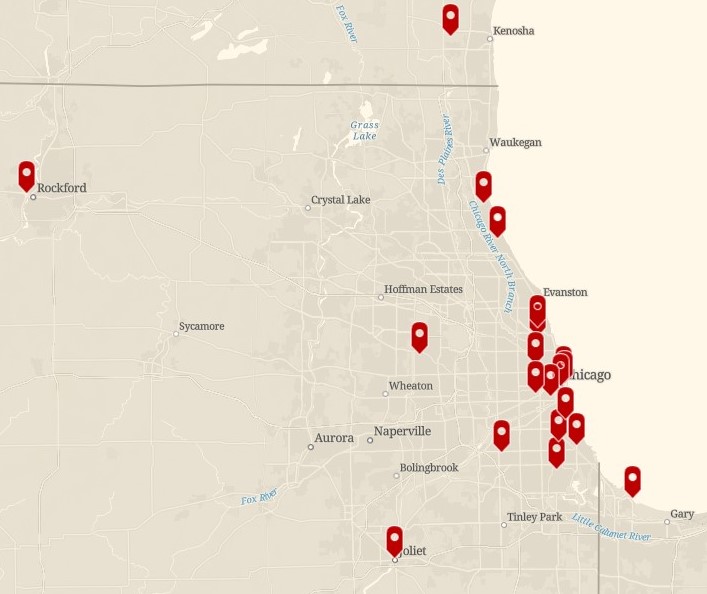
A professor of creative writing set out to map 1,001 novels set in the United States. In her project, here is what the Chicago region looks like:

I do not know enough literature to know how well this map might reflect the totality of fiction written about and/or set in Chicago. However, the map above has relatively little from the suburbs. Here are the suburban works listed (a few others have markers in the suburbs but the descriptions say they are set in Chicago):

-Joliet – A Martyr for Suzy Kosasovich (2008)

-Salt County, Illinois – Water Marked (2000) [this is the one with a marker in northeast DuPage County on the map above]

-Prairie Park, Illinois – Neon Green (2016) [this is the one with a marker in northwest Indiana]

-Lake Forest – Ordinary People (1976)

No interest in the latest from Jonathan Franzen?

More broadly, is there any consensus on the best suburban novel of the last few decades? Academic treatments of the literature set in suburbs often cite novels like The Crack in the Picture Window or Revolutionary Road from the early years of postwar suburbia.

One approach to the broken dreams of the American suburbs: realistic expectations

After reading Jonathan Franzen’s latest novel Crossroads, I have a not-original answer to the problem of the brokenness lurking behind the promise of the American Dream in the American suburbs: realistic expectations about what life in the suburbs is like.

Photo by Lara Jameson on Pexels.com

Much is expected of the American suburbs and Americans love them for multiple reasons. They are the land of opportunity. Home to the middle-class and the hard-working. A symbol of success. A setting meant to guarantee success to future generations. The land of private single-family homes where owners can control their own destiny.

What if the suburbs could never deliver on all of these promises? What if it was only available to some? What if the humans who tried to pursue these goals still faced difficulties and heartbreak? What if the suburbs covered up a whole host of issues in American society?

Numerous novels, films, songs, and creative works have addressed these questions over the last century. They have clearly showed the cracks in the suburban facade, the tragedies masked by the suburban sprawl.

But, these works often struggle to propose a solution. Get rid of the suburbs? Do not move to them in the first place? Stop promoting them?

If anything, these works serve as a cautionary tale: the suburbs may not be as impressive as they are made out to be. They are home to the problems all humans face as well as have their own particular issues due to their histories and current realities.

At the same time, through policy and ideology, millions of Americans have moved to the suburbs. Balancing the dire stories told of life falling apart in the suburbs alongside the narratives of success and comfort in the suburbs, is there a more realistic narrative available about what suburban life is?

Suburban fiction and the unhappy white suburban families of Jonathan Franzen

There exists a common fictional narrative involving the American suburbs: the white nuclear family that looks successful from the outside – home, children who achieve, high-status communities, good jobs, well-educated, etc. – is internally falling apart. The suburban veneer is thin; when it is scratched away or falls off, the white suburban family is hurting. Such a story has been told in various forms for decades.

Photo by Kindel Media on Pexels.com

I have recently read several of the big novels of Jonathan Franzen. In both The Corrections and Freedom, the various members of white suburban families are not doing well and neither is the family as a whole. He switches perspectives from different family members (and some connected characters) who are experiencing both their own personal struggles and ones connected to their upbringing and those ongoing ties. The suburban homes are not happy ones; they are settings for unresolved conflicts, anger, and a sense that life should have turned out better.

Is this the same kind of suburban fiction that has been tread many times before? The settings have changed a bit – the suburbs of the 2000s are not exactly the same as the new mass produced suburbs of the 1950s, there is new technology available, etc. – and Franzen has a particular style. However, the stories felt similar to others in key ways.

(Disclaimer: I have not read all of Franzen’s work or his most recent novel set in the Chicago suburbs.)

Can a “great novel” be set in the Chicago suburbs?

A new book from author Jonathan Franzen chronicles of lives of a family in the Chicago suburbs:

Q: Your novels are often set in the Midwest, but why set a trilogy in suburban Chicago?

A: I wanted it near a major metropolitan area in the Midwest. I wanted it big because my recollection of the early 1970s is strongest ‘73 onward. I was in suburban St. Louis and the stuff that was happening in suburban St. Louis was probably happening a year or two earlier in Chicago. For that reason, the book begins in late 1971. I could be more assured of getting the cultural references and spirit right. But also, gosh, the Midwest just recurs in my work, right? I was born in suburban Chicago, I knew Chicago starting from the mid-70s on. Both of my brothers moved to Chicago, and with a novel, it’s nice to feel like you know the streets in a place. It’s that extra research you don’t have to do.

This leads to two related questions:

  1. Can a great cultural work be set in the American suburbs of the postwar era? Can the space that is often criticized for sprawl, conformity, exclusion, and dullness serve as a compelling setting?
  2. Are the suburbs of a city like Chicago, set in the Midwest, a kind of shorthand for central or normal America?

Of course, the simpler answer may be what is above: Franzen is familiar with the Chicago suburbs and its ways of life. But, the questions above still stand: are there great cultural works set in the suburbs? In a country where a majority of the residents live in the suburbs, I would suggest those experiences have not necessarily translated into critically acclaimed or very popular cultural works.

See this earlier post on different kinds of cultural works involving the suburbs.

“Who sings the song of suburbia?” Part Five on poetry and patterns

Starting with Jo Gill’s questions in the Introduction of the book The Poetics of the American Suburbs, summarizing some of the academic work on novels and suburbs and screens – television and movies – and suburbs, and then considering what a more robust study of music and suburbs might consider, it is time to conclude this series of posts on cultural works and the suburbs.

Photo by Eric Smart on Pexels.com

To go back to the beginning, how does Gill conclude her study of poetry and the suburbs? Here is the final paragraph:

Postwar suburbia has been understood and depicted as a place where little of significance can be said, where there is a profound absence of meaning, where communication is stylized, superficial, muted almost into silence. Yet as the poems discussed in this study indicate, suburbia is replete with meaning. Its poetry is bold, innovative, and engaging – both formally and thematically – in its evocation of this space and time. Indeed, the suburbs we know are known to us, in part, because of the ways in which poetry has constituted and mediated them. In turn, this poetry shows the signs of its own discursive, spatial, and historical contexts. As Doreen Massey has argued, “Social space is not an empty arena within which we conduct our lives; rather it is something we construct and which others construct about us” (49). For Roger Silverstone, suburbia is a “geographical, an architectural and a social space,” but it should also be understood as “an idea and ideology, as form and content of texts and images and as product of a multitude of social and cultural practices” (ix). Poetry, as this book has demonstrated, plays a vital – if until now overlooked – role in these processes. It offers a startling lens through which to view suburban landscape and architecture and to understand the nuances of the suburban everyday, and it demands of us that we read it with acuity and sensitivity. In its diversity and frequent ambiguity, poetry breaks the stranglehold of polarized thinking or, what Robert Beuka calls, “our continued cultural reliance on a restrictive binary system in defining the suburban milieu” (10). The Poetics of the American Suburbs has argued that the poetry of this time and place is critical, interrogative, evocative, expansive, and suggestive in turn. Most importantly, it is a poetry that is often skilful, occasionally luminous, always intriguing. The song it sings is sometimes familiar, sometimes subtle, sometimes discordant. As I hope this book has demosntrated, it deserves a hearing, and rewards attentive listening. (Gills 2013: 181)

This is a good description of what Gills does throughout the book, analyzing both popular and more literary poetry, showing how the constraints and possibilities of poetry help lead to insights about the suburbs, and how poetry reacted to and was shaped by suburbia. I recommend the book for those interested in studying the interaction of cultural works and the suburbs.

As I reviewed this academic work, it led to a few more thoughts on patterns within the work:

  1. One idea that emerges from a number of these texts: understanding the suburbs requires analyzing what they mean and how narratives about them develop. Cultural narratives are influential and these cultural works contribute to an ongoing conversation about what the suburbs are and how they are to be regarded. For sociologists, both the facts about the suburbs – how did they arise, how are they changing, what social forces affect life there – and the interpretation of the suburbs – what are the processes of meaning-making around them – matter.
  2. The academic literature addresses both works that praise or celebrate suburbia and works that critique suburbia. There are many works in this latter category, particularly in more recent years.
  3. This is truly an interdisciplinary endeavor with scholars across a number of disciplines – Communications, English, Geography, Sociology, History, and more – contributing. These different perspectives help illuminate varied aspects of the cultural works and what they mean.
  4. Related to #2, much of the work I have seen in this employs close readings or case studies of particular works or collections of works. There is less work that takes a quantitative approach to such cultural works.

In sum, I am grateful for all of this good academic work. It has helped me think more comprehensively about the suburbs and be more aware of how cultural works contribute to and/or challenge my and our perceptions of the suburbs. I am sure the academic conversation – and the public conversation about suburbs as well – will continue as suburbs change, new cultural works are produced, and the larger social context evolves.

“Who sings the song of suburbia?” Part Two on novels

Jo Giles’ book The Poetics of the American Suburbs is the first academic study I have seen of poetry about or influenced by the suburbs. And the questions posed at the beginning of the book are worth considering – see Part One.

Photo by Suzy Hazelwood on Pexels.com

At the same time, the study of other cultural products or works about the suburbs is alive and well. Today, I will profile several academic studies involving novels and the suburbs. Poetry and novels might be very different forms of writing yet there is some overlap in themes. Additionally, writing and reading a novel might be more similar to poetry than other forms of cultural products – like television and film – which I will address tomorrow. (On Thursday, I will address a fourth category of works – music – that some commonalities with poetry.)

Two scholarly books, in particular, are great introductions to examining novels about the suburbs. In the 2001 book White Diaspora: The Suburb and the Twentieth Century American Novel, Catherine Jurca looks at how such works discuss the homelessness of suburbanites even as they have succeeded by acquiring the suburban single-family house and the representation of suburbanites as a whole – “empty white people” – as a sociological fact. In the Introduction, Jurca puts these two narrative strands together:

this study examines the tendency in twentieth-century literary treatments of the American suburb to convert the rights and privileges of living there into spiritual, cultural, and political problems of displacement, in which being white and middle class is imagined to have as much or more to do with subjugation as with social dominance.

Robert Beuka’s 2004 book SuburbiaNation: Reading Suburban Landscape in Twentieth Century American Film and Fiction emphasizes the important role of place and how fictional works addressed both fixed ideas about suburbs and variation within suburbia. From the end of the introduction of the book:

For the authors and filmmakers I discuss, the suburbs present a reflection of both the values and the anxieties of dominant U.S. culture. Their various gazes into the heterotropic “mirror” of suburbia reveal a landscape both energized and compromised by manifold cultural aspirations and fears.

These two books cover a lot of literary ground: there are a number of novels that explicitly address suburban life. Additionally, their analytical lenses help shed light on important themes and patterns. There are lived suburban experiences and then there are narratives about suburban life. Both are important and influence each other – both facts and interpretation matter for a full understanding of suburban life.

More broadly, novels are important. Long, important books are signs of culture and sophistication. I am thinking of sociologist Wendy Griswold’s work on the development of a reading culture that requires a number of elements to come into place for producers to create novels and a reading public to consume them. Perhaps it is not surprising that a number of novels and the suburbs converged given the significant social change of suburbanization as well as the development of the American literary scene. For novels and fictional works to coalesce around certain themes involving suburbia matters.

Tomorrow, several of the important scholarly works I have drawn on that analyze television and film representations of the suburbs.

Novel suggests McMansions gentrify small suburbs

A new novel suggests McMansions can upset small suburbs:

Novels about small houses in small towns can feel cramped. But in Julie Langsdorf’s White Elephant, the locals fight to keep things that way in their property battle with a builder who puts up McMansions. Set in the suburban Maryland town of Willard Park, the story depicts a married couple’s struggle with their defunct sex life, middle school kids and their awkward, back-stabbing drama, a pot-head attorney whose marriage is in trouble, and numerous sketches of other denizens. White Elephant has a long, slow start, but once it gets going, it bolts straight to the end...

White Elephant is a gentrification story which focuses on suburbs and small towns. This tale will feel familiar to anyone who has lived in an inner suburb and woken up one morning to the shock of McMansions going up nearby. Suddenly all the talk is of assessments, property values, equity, and second mortgages. The new houses tower over neighbors. Or, if a block of expensive townhouses has been installed, suddenly the local school is too small. It’s not as pernicious as urban gentrification, booting out locals to make way for wealthy hipsters and their $10 latte watering holes, but it’s a menacing cousin. Costly houses and townhouses open the door for luxury apartments, and once those appear, all the old affordable ones raise their rents. A person working full-time on minimum wage can hardly afford a one-bedroom apartment in any American city, and this is the next step, as the blight of gentrification seeps out into formerly cheap suburbs.

I believe that McMansions can upset residents’ conceptions of their neighborhood or community. There are plenty of cases in the last 10-20 years that suggest some believe McMansions, whether in new subdivisions or as teardowns, ruin locations they like.

On the other hand, the description above of how all this works seems a bit odd to me. A few questions:

  1. How many inner suburbs become home to many teardown McMansions? Inner suburbs can be wealthy, working-class to poor, or somewhere in-between.
  2. My guess is that McMansions and more expensive housing do not just pop up in a community: there are precipitating qualities of the community that lead developers and local officials to think that the more expensive housing would take off. In other words, wealthier communities beget more housing for wealthier residents.
  3. Cheap suburbs, if just going by cost of housing, can be located throughout a metropolitan region. If gentrification is simply more expensive redevelopment, it could happen in many places throughout a region.
  4. Why is this gentrifiation not as pernicious if new development makes it harder for locals to stay? It may be happening in a suburban area but not all suburbs are that well-off.
  5. Is there a small-town suburban life worth defending? Decades of suburban critiques suggested suburbanites and their communities have all sorts of deficiencies. Are suburbs now to be saved from McMansions?

The McMansion is a monster to invoke in today’s fictional tales as its size and lack of good taste relegate it to at least shady, if not menacing, status.

McMansion literary tales: a proposed teardown leads to local dysfunction

The McMansion continues to feature in literary works. A new book from a Washington D.C. area author uses a proposed teardown McMansion to highlight suburban issues:

Coincidence or not, Langsdorf’s success comes after leaving her longtime suburban existence. Following her 2012 divorce, Langsdorf moved to Adams Morgan in the District and devoted herself to writing while teaching yoga on the side. And yet, the book takes her back to that former life: “White Elephant” seems to channel all of the frustrations she felt juggling her identities as a mother and creator in a stifling suburb. The novel follows the residents of the fictional enclave of Willard Park — inspired, in part, by Langsdorf’s hometown of Kensington, Md. — where an interloper’s plans to build a McMansion amid the cozy bungalows leads to angry town halls, scandalous romantic dalliances and shady high jinks.

Like Langsdorf, two of the main characters in her ensemble are mothers grappling with their identities beyond being wives and mothers. Allison Miller, who has lived (mostly) happily in Willard Park for more than a decade, wonders what to do with her photography — more than a hobby, less than a career. Her new next-door neighbor, Kaye Cox, can’t figure out who to be, caught between her role as a fixture in her husband’s behemoth of a house and her own interest in interior decoration. These women and their author are well-acquainted with the eternal dilemma for parents, the pull between caregiving duties and other interests, professional and personal…

Almost every neighborhood in the D.C. region has experienced a version of the changes in “White Elephant.” Even Adams Morgan: The Line hotel, for example, occupies a building that was once a church. Langsdorf laughs about some of the struggles she’s seen in her own building, hastening to add that her fellow co-op residents are all great neighbors.

The residents of Willard Park come to realize that houses matter less than their inhabitants — and that the suburbs aren’t for everyone. Langsdorf understands this, too; in her current existence she feels more herself. “My life is much more vibrant,” she says. “I love being able to walk everywhere, and I do have more time to write.”

That a proposed McMansion could lead to “dalliances” and “high jinks” is intriguing to consider…the angry public meetings are much easier to verify.

While it would not have been possible to discuss McMansions before the 1980s since the term did not exist, it sounds like this new work draws on several common suburban critiques featured in novels, films, television shows, and other cultural products. Suburban residents, particularly women and mothers, feel trapped by suburban expectations and a landscape that does not easily lead to human connection or diverse experiences. They then look for ways to break free of the suburban mold and explore different outlets.

These works tend to emphasize those that feel “the suburbs aren’t for everyone.” At the same time, many Americans live in the suburbs by choice and I assume a good number of suburbanites feel their existence is at least okay. Is it because cultural works need crises to overcome (the hero on their journey must overcome something) or are the suburbs are a unique target because they are so common in the United States (over 50% of residents live there) and so reviled?

Quick Review: my favorite novel to reread, The Winter of our Discontent

I have over the years read many “classic” works of literature. There is one to which I keep returning: The Winter of Our Discontent by John Steinbeck. While it is not as widely read or discussed as his works like The Grapes of Wrath, East of Eden, and Of Mice and Men (and I enjoy all three of these), it is the first one I think of when I look at my bookshelf of classics with the aim of rereading something. Here are the reasons why:

  1. Many key features of American life today are captured in this book. Steinbeck suggests as much with a single sentence on a page before the story begins: “Readers seeking to identify the fictional people and places here described would do better to inspect their own communities and search their own hearts, for this book is about a large part of American today.” The narrative involves these plot points: the downfall of a once high-status family, looking for the next way to become wealthy and keep up with the Joneses, the main character tries to get ahead as a hardworking grocery store manager (suffering the indignity of a lower status job to help his family) while also pondering whether there are ways to shortcut the system (should he be skimming off the top? Should he turn in his boss?), and teenagers who want fame and fortune without a lot of hard work. In some ways, the story seems a bit unusual today: a white family with a long history in a community tries to regain their status. At the same time, the concerns motivating the family are very similar to those seeking fame today on social media or the many who are trying to weigh hard work versus getting ahead faster.
  2. Particularly compared to some of his other classic works, there is a good amount of humor in the main character Ethan Allen Hawley.  It may be bleak or black humor but Hawley has a way of using humor to help him navigate tough situations.
  3. The story involves connections to my sociological research. One of the key plot points is that local officials are looking to become wealthy from the development of land. In an older community, selling and developing land amidst suburbanization offers a new way to generate wealth as well as transform the character of the small town. This story is the one of numerous small communities outside major American cities from roughly the late 1800s through today. Similarly, local growth machines of politicians and business leaders can profit tremendously from these changes.
  4. I have no problem reading longer novels: I have read such texts like Les Miserables and War and Peace and enjoyed them. But, it does help that this Steinbeck text is a bit shorter. On the whole, Steinbeck was pretty good at working in shorter and longer mediums ranging.

Ultimately, in my mind the themes of The Winter of our Discontent still ring true for American society today. Delivered in a relatively concise format with some humor and tragedy, this is a worthwhile read over and over.