Record office vacancy rate in Chicago’s Loop

Over a quarter of the office space in Chicago’s Loop is empty:
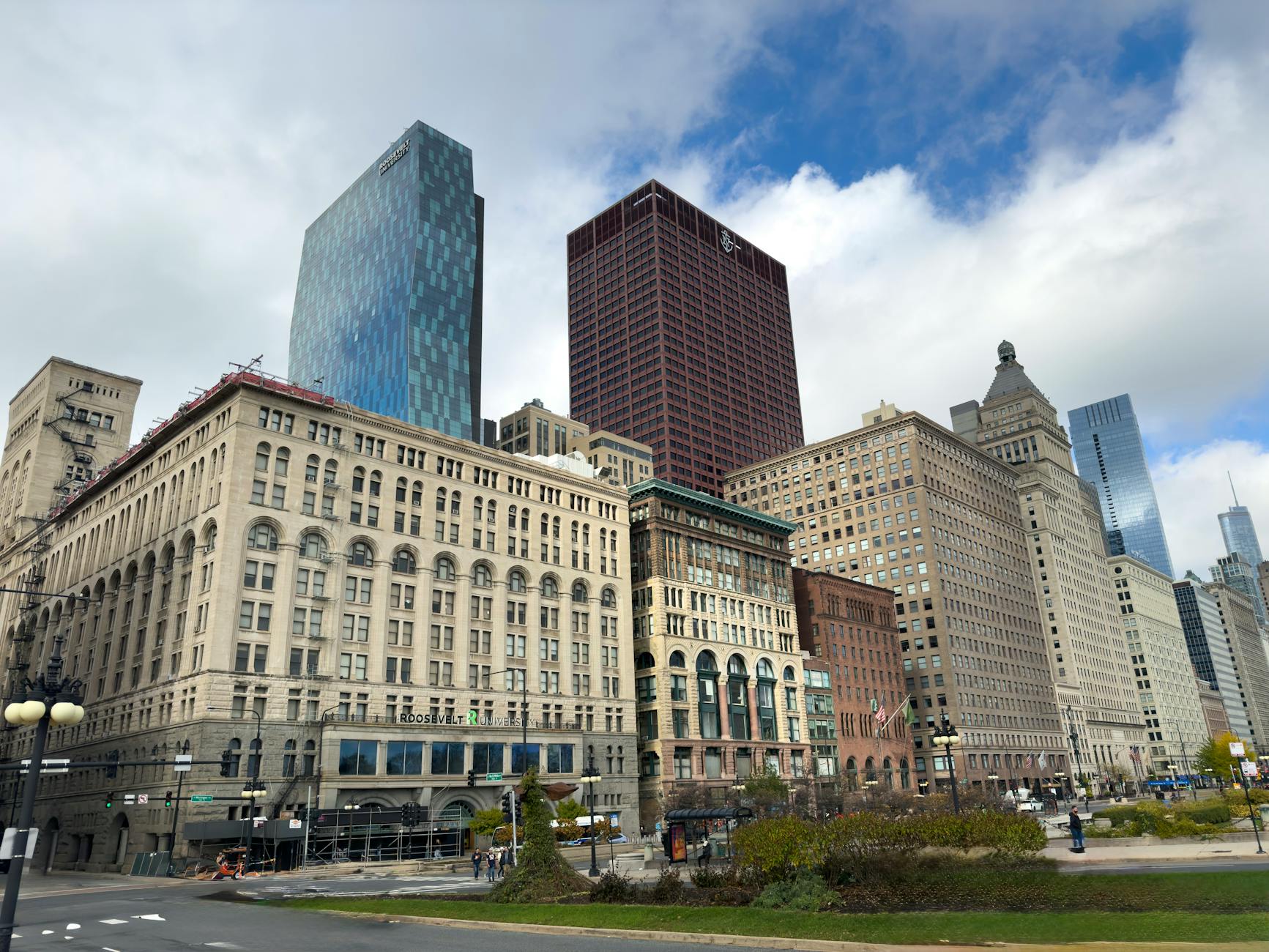
Photo by Yusuf Mahammed on Pexels.com

The vacancy rate in the Loop was 24.7% in the second quarter of 2025 — a record high, according to research from commercial real estate firm Bradford Allen. That’s up 1.3% from the first quarter, and a 2.7% increase compared to the second quarter of 2024.

The firm said the second quarter was also one of the weakest periods for overall office demand since the beginning of 2024. Direct net absorption, a measure of space that’s been leased versus vacated over a period of time, hit negative 1.5 million square feet. That means more companies vacated than leased office space in the second quarter…

But it’s reassuring to see more foot traffic in the Loop, and he said more companies are requesting office tours for larger spaces, signaling strong interest in the Loop. He also said his firm is doing more office and retail deals downtown.

Leasing activity is starting to return after companies pulled back on signing larger leases during the pandemic. There’s a lot of larger tenants in the office market right now, and it feels promising, DeMoss said.

Each time I teach Urban Sociology, we consider the famous concentric circles map of Chicago produced by the Chicago School. At the middle of the map is the Loop, the central business district. For decades, it has been an economic center for the city. With its placement at the center, it represents the importance of economic activity in the big cities of today.

But what if the Loop became something else? The vacancy rate cited above suggests about one-quarter of the office space is empty. In a setting where there is a lot of office space overall, this adds up to a lot of space. What if this space was used differently?

This could be a shift toward more residential units in the Loop. Mixed-use development is popular in many places as it can help create a 24-hour vibrancy that can be lacking in places primarily consisting of office space used during workday hours.

But it could also mean a shift toward other land uses. More food and retail spaces? More recreational and cultural spaces? More community and municipal spaces? Less need for parking spaces?

While the record vacancy rate gets the headlines, it would be interesting to hear more about people and institutions that could help shape the future. What will the Loop be in 10 or 25 years and does this hint at shifts across many American cities?

Record high office vacancies in Chicago suburbs

More suburban Chicago office buildings were empty in 2024:

Photo by Burak The Weekender on Pexels.com

Meanwhile, 2024 brought an increase in suburban office vacancies — an all-time high of 26.3%, up from 25.4% a year earlier.

The suburbs are job centers. For example, the article notes, “Schaumburg is Illinois’ largest hub of economic activity outside of Chicago.” So to have a lot of empty office space is not a good thing. Owners of these buildings would prefer to have full offices as would municipalities who gain tax revenues.

Will upgrades to the buildings make a big difference? That is what the rest of the article suggests as workers and companies seek certain amenities to enhance the workspace and compete well against work from home options.

Also interesting to note is the redevelopment options if there is too much office space. For example:

Schaumburg officials hope to assist the office market by reducing its obsolete properties. This includes buying a 204,000-square-foot building to demolish for the village’s next police station and nearing approval to convert a 45-year-old Class B office building across from Woodfield into a 98-unit high-end apartment complex.

How many suburban communities would be willing to pull the plug on decent office space and go through all the effort it takes to redevelop the same land? If there is not demand for high quality office space, will other land uses bring in similar revenues and have similar levels of prestige? I would guess edge cities are not interested in losing that status but finding the right balance of offices, residences, and other uses could take time.

Regional banks and commercial real estate loans

As companies reduce their office footprint, what institutions hold many commercial real estate loans?

Photo by Andrea Piacquadio on Pexels.com

US banks hold about $2.7 trillion in commercial real estate loans. The majority of that, about 80%, according to Goldman Sachs economists, is held by smaller, regional banks — the ones that the US government hasn’t classified as “too big to fail.”

Much of that debt is about to mature, and, in a troubled market, regional banks might have problems collecting on those loans. More than $2.2 trillion will come due between now and the end of 2027, according to data firm Trepp.

Fears were exacerbated last week when New York Community Bancorp (NYCB) reported a surprise loss of $252 million last quarter compared to a $172 million profit in the fourth quarter of 2022. The company also reported $552 million in loan losses, a significant increase from $62 million the prior quarter. The increase was driven partly by expected losses on commercial real estate loans, it said.

Because I know little about this, this leads to several questions:

If patterns from earlier crises hold up, does this mean that when regional banks suffer difficulties they will be gobbled up by the larger banks?

What do regional banks have more of these loans – is this more of their specialty or they are more familiar with the local markets?

Who exactly decides which financial institutions are too big to fail and at what point might these regional banks qualify?

If these are the losses of just one regional bank, what might we expect throughout the entire US within the next few years?

Skyscrapers happened because real estate was really expensive

A quick history of the Chrysler Building in New York City provides a reminder of a key reason skyscrapers emerged in American cities:

Photo by Following NYC on Pexels.com

Dominating the New York skyline brought prestige and publicity, but tall towers also resolved a more prosaic problem: As land prices climbed, developers had to build upward to turn a profit, pushing their projects as high as engineering, natural light and, eventually, zoning would allow. “Skyscrapers were a self-fulfilling prophecy of the heated real estate market,” writes Neal Bascomb in his 2003 book Higher: A Historic Race to the Sky and the Making of a City. By the 1920s, with Europe in ashes after World War I, these buildings became brash totems of a new world order. Manhattan in particular had become the “harbor of the world, messenger of the new land … of the gold diggers and of world conquest,” wrote the German architect Erich Mendelsohn in his seminal 1926 book Amerika, published the year after New York overtook London as the world’s most populous city.

In a dense space like Manhattan, demand for land pushed prices up. To make more money from the same plot of land, skyscrapers offered more space. The addition of thousands of square feet of office space, even if it could be hard to fill at times, provided profit.

I would be interested to see analysis shows the profits of a skyscraper over a lifetime compared to other options builders, developers, and companies could have pursued. Instead of building up in major cities, here are other options they could have pursued: building underground; building dense and wide buildings (imagine ones that cover several city blocks at a height of ten stories or so); constructing large buildings in other parts of the city and suburbs; and pursuing multiple business districts rather than centralized locations where everyone wants to gather.

Even if there was profit at stake, there is also the matter of the prestige of skyscrapers. Skyscrapers are important symbols in a city skyline. Were skyscrapers both profitable and status-enhancing or did the increased status mean that the absolute numbers did not matter quite as much?

Quickly describing the worst-case scenario of “the urban doom loop”

What might an urban doom loop look like? Here is one brief description:

Photo by Stas Knop on Pexels.com

The worst-case scenario would go like this: With more people working from home, companies from Milwaukee to Memphis are rethinking their leases or pulling out of them altogether. That drives vacancy rates up and makes it harder for landlords to attract new tenants or sell buildings for a healthy price.

Then property owners might struggle to pay off their mortgages or clear other debt. Business districts would dry up, stifling tax revenue from commercial properties or employee wages. Shoppers and tourists would have fewer reasons to venture downtown to eat or shop, choking off spending and forcing layoffs at restaurants and retail stores.

“Once those offices are empty, there are few alternatives and not a lot of life after hours,” said Stijn Van Nieuwerburgh, a professor of real estate and finance at Columbia University’s Graduate School of Business who is one of the authors of a paper that coined the “urban doom loop” phrase. Midsize cities “have a much bigger chasm to cross than what New York City has to go through. The situation is worse in those places with so little else in place.” He added, “It is a train wreck in slow motion.”

Once the primary use of a district starts disappearing, it can be hard to reverse the pattern. This is true in downtowns where much of the space is used for offices. It can be true for other uses as well, such as when retail dries up at shopping malls or a particular industrial activity slows down in a one industry place.

Is the primary way of addressing this right now simply to hope it the doom loop does not get too far? Are there any interventions that could help protect against worsening conditions? This could be an interesting time for experimentation across American cities as places and firms adjust to less need for permanent office space.

The Chicago suburbs have 99 million square feet of office space

The suburbs are not just places where people live. The Chicago suburbs have a lot of office space:

Photo by 500photos.com on Pexels.com

While higher-end properties are outperforming less expensive options among the suburbs’ 99 million square feet of office space, they still saw a decline in the year’s second quarter, ending a yearlong run of gains, according to data collected by the Chicago-based firm.

The Pentagon has 6,500,000 square feet of space so the suburban office space is over 15 times that of the Pentagon. The Willis Tower in Chicago has roughly 4,000,000 square feet of space so the suburbs have roughly 25 times more space. A football field is 57,600 square feet is the office space covers over 1,718 football fields. If the average new American home is about 2,500 square feet, this office space is nearly 40,000 new average homes.

Note: another website suggests the Chicago suburbs have 162 million square feet of office space, putting the Chicago suburbs behind the Washington D.C. suburbs, the Dallas-Forth Worth suburbs, the Bay Area suburbs, and the New Jersey suburbs.

Whichever number is correct, it is hard to put this much space in perspective. The suburbs may be primarily about single-family homes but they have plenty of space for business.

Office vacancies in Chicago suburbs hit record high

The Chicago suburbs are also experiencing high levels of office vacancies:

Photo by Marc Mueller on Pexels.com

The office vacancy rate in the suburbs has ticked up again and is now at a record high. Real estate services firm Jones Lang LaSalle says the suburban office vacancy rose to 28.9% in the second quarter, up from 28.5% in the first quarter. A year ago it was 27.1% and at the beginning of 2020 it was 22.1%. The data is further evidence that companies are still shrinking office footprints as remote work continues. JLL says the suburbs have lost more than 3 million square feet of office space since 2020, nearly the same amount that was lost during the Great Recession that started in 2008.

If these office spaces are lost permanently, here are several things suburban communities would lose:

  1. Property tax revenue. These payments contribute to municipal budgets and might help reduce property tax burdens for residents.
  2. Prestige. Having office space and big corporations is a source of civic pride. Not all suburbs have this. These are visible symbols of economic success.
  3. Jobs within the suburb. Even if a majority of employees come from outside of the particular suburb in which the offices are located, communities and leaders can tout the number of jobs located in the suburb.

On the flip side, if a number of these jobs permanently move to people’s residences, particularly single-family homes, this might help redefine what the suburban single-family home includes. The suburban home might no longer be a strong, private refuge from the outside world, but instead be a combination workplace and home.

How much would empty urban office buildings affect municipal tax revenues?

With talk of empty urban office buildings leading to a decline in property values, how might this affect tax revenues collected by cities? Here is one estimate:

Photo by Bekir Du00f6nmez on Pexels.com

Municipal governments have even more to worry about. Property taxes underpin city budgets. In New York City, such taxes generate approximately 40 percent of revenue. Commercial property—mostly offices—contributes about 40 percent of these taxes, or 16 percent of the city’s total tax revenue. In San Francisco, property taxes contribute a lower share, but offices and retail appear to be in an even worse state.

These are not huge numbers but they do contribute to the overall local budget picture. Office or commercial buildings in cities that are not being used or are being turned over to lenders or are prospects for building conversions will not generate as much tax revenue as they might when demand for such properties is higher.

How will cities address this? It will be interesting to see different approaches that could be affected by local real estate markets, housing needs, and budget specifics. If there are a few cities that are able to limit the revenue damage, they might serve as models for others.

(This is also a problem for suburbs with large amounts of office and commercial space.)

How empty are American offices right now?

A headline of an analysis of office space and vacancies in the United States suggests “American offices are half-empty.” Is this true? Here is how the analysis starts:

Photo by Pixabay on Pexels.com

From Dallas and Minneapolis to New York and Los Angeles, offices sit vacant or underused, showing the staying power of the work-from-home era. But cleardesks and quiet break rooms aren’t just a headache for bosses eager to gather teams in person.

Investors and regulators, on high alert for signs of trouble in the financial system following recent bank failures, are now homing in on the downturn in the $20 trillion US commercial real estate market.

After detailing the economic effects of this, particularly how banks might be affected, here is some evidence for the headline:

Office properties have been getting hammered the hardest. Hybrid work remains popular, affecting the rents many building owners can charge. Average occupancy of offices in the United States is still less than half March 2020 levels, according to data from security provider Kastle.

And then it is back to the possible fallout, including:

Trouble may build as the economy slows. Hill thinks US commercial property valuations could fall roughly 20% to 25% this year. For offices, declines could be even steeper, topping 30%.

The headline suggests half of offices are empty. The primary piece of evidence in the article says that average office occupancy “is still less than half March 2020 levels.” Does that mean average office occupancy was 100% in March 2020? Does this mean half of office buildings have no people in them? Even if the real figure about empty offices is 30% or 40%, this would be a big number with lots of ramifications.

An earlier article on the same site had a similar headline and evidence. From early March 2023, the headline: “Offices are more than 50% filled for the first time since the pandemic started.” The evidence:

Office occupancy across 10 major US cities crossed 50.4% of pre-pandemic levels for the first time since early 2020, according to security swipe tracker Kastle Systems. That marks the first time occupancy has crossed the 50% mark since March 2020, when many offices sent workers home because of Covid.

Again, the comparison is pre-COVID levels, not necessarily 50% of total possible occupancy. Again, this is a significant change that is a little different than claiming offices are more than 50% filled.

This all might be pedantic, but, if we should pay attention to offices, working from home, and the consequences of changes to commercial real estate, what are the actual figures regarding how much office space is occupied and/or leased?

The multiple barriers to converting office space into housing units

Henry Grabar details the many issues in switching office space to living space:

Photo by M&W Studios on Pexels.com

What’s going on? One problem is simply with the shape of office buildings: Their deep floor plates mean it’s hard for natural light to reach most of the space once it’s divided up into rooms. Their utilities are centralized, which requires extensive work to bring plumbing and HVAC into new apartments. Either way, they require significant architectural intervention. The older stock of prewar offices, which are better suited for residential units, have often already been converted in cities like Chicago and Philadelphia. Another issue is with zoning codes that bar housing from office districts. A third obstacle is the building code: Early residential conversions, like those in SoHo’s lofts, were usually illegal, sometimes for complicated reasons that seem less important than mandating a window in every bedroom.

What’s more, business districts don’t empty out building by building but with vacancies here and there across the skyline. You wouldn’t convert Twitter’s building, since it’s partially occupied by workers. So, in one sense, Musk’s bed stunt is an example of his already innovating at Twitter. Very mixed-use! “You’re not going to run into a building that’s 100 percent empty, ready to be converted,” said Anjali Kolachalam, a researcher with Up for Growth. She recently ran office space in downtown Denver through a filter to find good conversion targets—tall buildings with high vacancy rates and small floor plates built before 2010. She wound up with just 4 office buildings, out of the 208 total.

Finally, converting buildings to residential use is expensive. Couple that with the fact that office rents are higher per square foot than residential rents are, and you see why developers aren’t champing at the bit to get new projects underway. Van Nieuwerburgh gave me an example from San Francisco, where Juul’s old headquarters—down the block from Twitter’s improvised dormitory—is for sale for $150 million. That’s a lot less than the $397 million the embattled nicotine vape company paid for it in 2019. But at $400 a square foot to buy and another $400 a square foot to renovate, he said, the conversion would still produce a building with rents too high even for San Francisco. In other words, offices may be down, but they’ll have to fall a lot further before adaptive reuse becomes a bargain.

While the challenges are present, I wonder if someone has this figured out – this could be a company, developer, or community. Are there ways to quickly address the issues listed above or does it require a sustained effort? Imagine someone figures this out and there is a way to make some cool conversion from an exciting work space (if this is possible) or name to an interesting housing unit. If this can happen for churches and religious buildings, why not for office buildings?

If this does not work easily now, could we anticipate new buildings that could more easily switch between uses? There are ways to plan, zone, and build with more flexibility in mind so that adjustments could be made given needs and market conditions. Would it cost more to construct a building in this way? If so, perhaps the possible higher occupancy rates and the ability to adjust could bring in more money in the long term.