Taylor Swift’s The Life of a Showgirl album is off to a sparkling start in the United States. On its first day of release, Oct. 3, the set sold 2.7 million copies in traditional album sales (physical and digital purchases) across all versions of the album, according to initial reports to data tracking firm Luminate. That marks Swift’s biggest week ever, and the second-largest sales week for any album in the modern era — since Luminate began electronically tracking data in 1991. The only larger sales week in that span of time was registered by the opening frame of Adele’s 25, which sold 3.378 million copies in its first week in 2015…
The sales of The Life of a Showgirl will increase in the coming days, with the current tracking week ending on Thursday, Oct. 9. The album’s final first-week sales number is expected to be announced on Sunday, Oct. 12, along with its assumed large debut on the multi-metric Billboard 200 albums chart (dated Oct. 18). If The Life of a Showgirl debuts atop the Billboard 200, it will mark Swift’s 15th No. 1 album, lifting her past Drake and JAY-Z for the most No. 1 albums among soloists, and becoming the sole act with the second-most No. 1s ever. She is currently tied with Drake and JAY-Z with 14 No. 1s each, and only The Beatles, with 19 No. 1s, have more, dating to when the chart began publishing on a regular, weekly basis in 1956.
So maybe it is not just the album we should be thinking about here; Taylor Swift is a rare artist who consistently sells albums. She has lots of fans and they consistently push her album to #1.
Thinking as a sociologist, here are questions I have moving forward:
At what point does this sales record decline or the support not become as fervent from fans?
What is it exactly about Swift’s music and persona that cuts through this fragmented media landscape? I recently saw some figures about what is popular these days to watch on cable TV; it is basically live sports and cable news as other programming does not draw large audiences. How is she so successful in this particular music and cultural landscape?
Are labels and artists trying to replicate what Swift does – doing what she does for even one or two albums might make for a very successful artist – or do they acknowledge she is a singular artist?
What will we remember about Swift with these massive sales and #1 record after #1 record? What narratives will emerge and how might these differ across different storytellers?
In a recent interview, the Newburyport, Massachusetts, native said he’s “excited” to get back to Chicago, where he studied theater at DePaul University.
Besides performing at Lollapalooza, he said he has plans to catch up with old friends and may even hit up Allende Restaurant, just steps away from the Lincoln Park campus. And at the top of his mind is a dip into Lake Michigan at Montrose Beach…
The last time the Sun-Times spoke with Keery, “End of Beginning” was one of the most popular sounds on TikTok. Though the song was released in 2022, fans made edits using the popular verse: “And when I’m back in Chicago, I feel it.”
It’s a song about closing the chapter on his life in Chicago before moving to New York City.
On one hand, the song seems to speak of good experiences in Chicago. The artist says he is looking forward to being in Chicago.
On the other hand, Chicago is the place before going to the real place of success: New York City. The singer may like Chicago but he finds fame elsewhere. One of Chicago’s nicknames is “The Second City” and this may have originated in its status behind New York. But now, those in acting or entertainment may need to go to New York or Hollywood/Los Angeles to make it big. Chicago might be a place to be when you are young but these larger coastal cities have a ability to launch you into the stratosphere.
For a number of American places, you could put together interesting playlists that speak to the character and music of a community. Add this song to the list of songs about Chicago and I am always interested in songs that namecheck specific places.
Wilson’s legacy includes dozens of hit singles with the Beach Boys, including three Number One singles (“I Get Around,” “Help Me, Rhonda,” and “Good Vibrations”). In the 1960s, the Beach Boys were not only the most successful American band, but they also jockeyed for global preeminence with the Beatles. And on albums such as Pet Sounds, Wilson’s lavish, orchestral production techniques dramatically expanded the sonic palette of rock & roll and showed how the recording studio could be an instrument by itself.
Born June 20, 1942, Brian Wilson grew up in Hawthorne, California, a modest town next to the Los Angeles Airport. Brian was the eldest of three brothers; his younger brothers were Dennis and Carl. Their father, Murry, was an aspiring songwriter and a tyrant. “Although he saw himself as a loving father who guided his brood with a firm hand, he abused us psychologically and physically, creating wounds that never healed,” Wilson wrote in his 1991 autobiography, Wouldn’t It Be Nice: My Own Story.
Wilson grew up playing sports and obsessing over music, teaching his brothers to harmonize with him. Music was his sustenance and his solace, he said: “Early on, I learned that when I tuned the world out, I was able to tune in a mysterious, God-given music. It was my gift, and it allowed me to interpret and understand emotions I couldn’t articulate.”
In 1961, Brian, Dennis, and Carl formed a band with their cousin Mike Love and their friend Al Jardine, managed by Murry Wilson; Brian played bass, took many of the lead vocals, and wrote the songs. Signed to Capitol Records and named the Beach Boys, they started to roll out hits like convertible Thunderbirds coming off an assembly line: “Surfin’ U.S.A.” (with music borrowed from Chuck Berry’s “Sweet Little Sixteen”), “Surfer Girl,” “Be True to Your School,” “Fun, Fun, Fun.” Those Brian Wilson compositions all sounded like insanely catchy jingles for the California teenage lifestyle — surfboards, hamburger stands, pep rallies — but on the flip side of the good times was a real sense of melancholy. Sometimes that was apparent in the lyrics — the lonesome “In My Room,” for example — and sometimes it was expressed nonverbally, with the Beach Boys’ heartbreaking multipart harmonies.
Two connections to the suburbs to note:
Hawthorne, California was a small community in the early 1940s – over 8,000 residents – southwest of downtown Los Angeles and a few miles from the beach. Today, the community houses nearly 90,000 people. The suburb was home to a number of aerospace companies over the years and Mattel was started there in 1945. It grew as the sprawling Los Angeles area grew in the postwar era.
Many of the songs of the The Beach Boys reflect features of suburban life, particularly for teenagers. Numerous early songs discuss driving. Los Angeles became a driving capital in the postwar era and Hawthorne is bordered by multiple interstates. A teenager driving in the early 1960s could easily access the beach, fast roads, fast food, shopping malls, and new subdivisions and communities. Do this all in the sunshine and you might be regularly going in “American Dream mode.” There is also the theme of family. The group includes Wilson’s two brothers and his cousin. Wilson writes and sings about relationships. In the suburbia of the 1950s and 1960s, nuclear families were emphasized. The Brady Bunch, set not that far from Hawthorne, purported to show wholesome family life. That the group and songs involved family life, even amid clear themes of teenager individualism, is not surprising given the suburban context.
Thomas and Wilson met four years ago in Nashville when the producer was recording Stars and Stripes, a country tribute to the Beach Boys. They are an unlikely pair — Wilson the fragile artist and Thomas the beefy Midwesterner who wears cowboy boots and a mullet haircut. But in 1996, their wives bought sprawling homes next to each other in the rolling countryside of St. Charles, Illinois, and a studio was installed in Wilson’s basement to record Imagination.
The Wilsons chose St. Charles almost by chance. “Joe and Brian were in the studio in Chicago one day, so Chris [Thomas’ wife] and I went shopping, because they were looking for a house,” explains Melinda, 51, sitting with Brian in a small, comfortable room off the studio in St. Charles. “We saw this place with a basement that was unfinished, and we thought, ‘Why not?’
“It’s good to get out somewhere, away from everything, where you can work,” she says. “It doesn’t matter about the weather, doesn’t matter about traffic. If Brian doesn’t want to work, he just goes upstairs, and when he feels like it, he comes down. Most artists are not people who can do a nine-to-five trip.”…
Later, over dinner, Wilson feels differently, and he admits that he misses L.A.: “It’s home, where I’ve always recorded, and there’s just something about the vibe there. I like the L.A. vibe.”
After living in St. Charles, Wilson moved back to Los Angeles.
I do not know of a genre of music that would exclusively identify with the suburbs. As Americans moved to the suburbs in large numbers in the twentieth century for numerous reasons, music changed in the United States as well. This included new genres, new methods for playing and hearing music, and new audiences. And all of this happened on a mass scale; music could be produced, played, and listened to for and by millions of people.
Hot adult contemporary (hot AC) radio stations play a wide range of popular music that appeals towards the 18–54 age group;[43] it serves as a middle ground between the youth-oriented contemporary hit radio (CHR) format, and adult contemporary formats (such as “mainstream” and soft AC) that are typically targeted towards a more mature demographic. They generally feature uptempo hit music from the last 25 years with wide appeal, such as pop and pop rock songs, while excluding more youth-oriented music such as hip-hop.[42][41] Older music featured on hot AC stations usually reflects familiar and youthful music that adults had grown up with.[44][41] Likewise, material from legacy pop acts such as the Backstreet Boys, Jason Mraz, John Mayer, and Pink is prominent within the format.[41][40]f
Pop music of the last few decades for 18 to 54 year olds is suburban music? Maybe more so than some other formats.
(The other part of this station’s tag line is that they broadcast from the ‘burbs. This contrasts with the majority of the radio stations in the area that identify with the big city.)
The priest who permitted Sabrina Carpenter to film her music video for “Feather” has been stripped of his duties.
On Monday, Nov. 18, Monsignor Jamie Gigantiello was relieved of his role after church officials determined that an investigation revealed other evidence of mismanagement, per the Associated Press.…
Last November, just days after Carpenter, 25, released the visual for “Feather,” Gigantiello was disciplined and stripped of his administrative duties because of the video, per The New York Times.
The Diocese of Brooklyn shared a statement with the Catholic News Agency stating that Bishop Robert Brennan was “appalled at what was filmed at Annunciation of the Blessed Virgin Mary Church in Brooklyn.”
According to the outlet, the Diocese claimed that the Blessed Virgin Mary Church did not follow policy when it came to approving what gets filmed on Church property, and it was Gigantiello who gave Carpenter’s team permission to film the video.
As a researcher who has written about church buildings, I wondered how many churches or congregations would allow a music artist to film within their building. Would it matter what kind of music the video involved? Or if the artist had a personal connection with the faith tradition or the particular building? I would guess many religious congregations would hesitate before approving the filming of a music video in their space.
Religious buildings often work to separate profane – everyday – activities from sacred – transcendent – activities. How this is done can vary across religious traditions and spaces. If a congregation is renting space in a high school for services or is meeting in what used to be an Army barracks, how do they do this (see Chapter 6 in Building Faith for these examples and several others)? Or some religious traditions might mark religious spaces by distinct architecture and design while others argue they can do this in a multifunction space that can be a sanctuary at one moment, a gym the next, and a wedding reception space after that.
If this church had turned down the music video filming, where might they have gone next? Another religious building or a sound stage?
Music critics are especially ashamed of love songs. Ninety percent of pop songs are about love, as critic Dave Hickey pointed out, but critics prefer to write about the other ten percent.
I would be interested to see quantitative data for this claim. Love is a popular theme – but nine out of every ten songs? Does this mainly involve hit songs, works from major artists and labels and everyone else, and does the pattern hold across time periods? Would the music-selecting algorithms choose love songs across genres and artists? Text analysis of lyrics could look at the presence of certain words and sentiments. Analysis of music could consider whether the musical patterns in songs involving love are unique or follow particular patterns. (And then what is so different in lyrics and/or music in the other ten percent of songs?)
I enjoyed thinking this week about pop and rock music about the suburbs. As I considered the music of Malvina Reynolds, the Beatles, Ben Folds, Arcade Fire, and Olivia Rodrigo, several thoughts come to mind:
These genres do not often write directly about the suburbs. They may tell stories about people and situations based in suburbia but the role of suburban places is minimized. Many popular songs do not say anything about where they take place geographically.
Finding songs that portray suburbia in a positive light is difficult. Surely they exist. Perhaps they do not become as well-known? Perhaps music artists tend to associate suburbia with negative traits? Perhaps other genres do this differently?
At the same time, there is plenty about suburban life that could make for compelling music. Millions of Americans, including many musicians, have experience this life. The songs profiled this week included looks at houses, daily routines, remembering childhood, listening to music, driving, and relationships. For all the reasons Americans love suburbs, why not tackle those themes? (I realize it might be hard to write about suburban local government but I am guessing it could be – and probably already has – been done.)
I will keep listening for music that references and is about specific places. This includes the suburbs but also cities and rural areas as place could be a fascinating topic for a new single or album or bonus track.
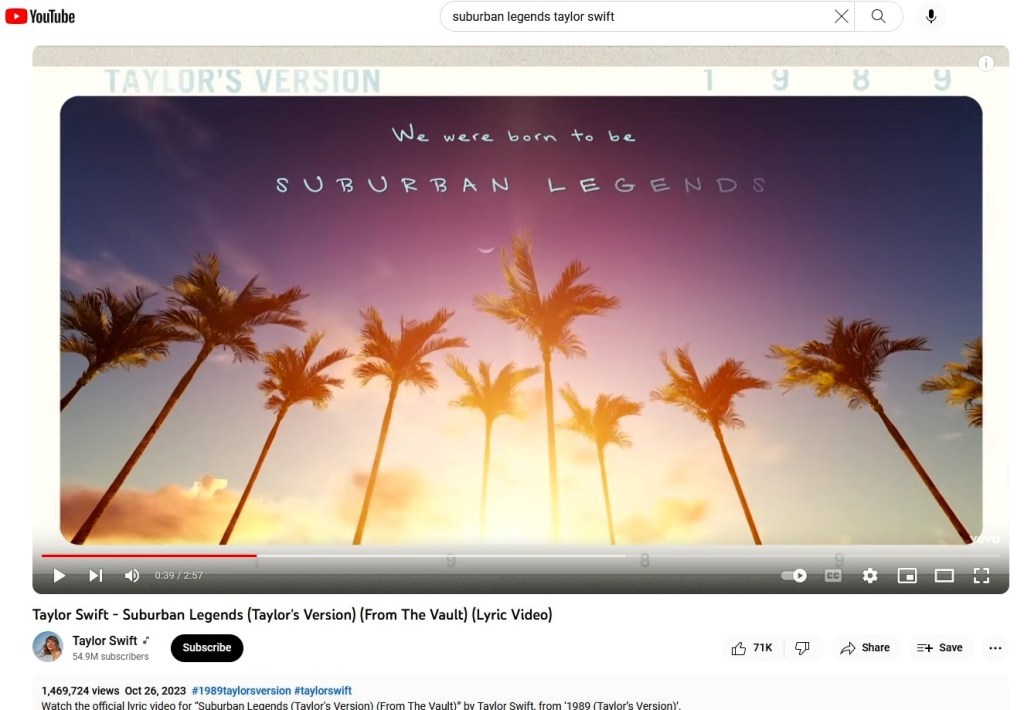
On her latest release, 1989 (Taylor’s Release), Taylor Swift has a new song involving suburban life:
Here are the lyrics from the second time through the chorus:
I didn’t come here to make friends We were born to be suburban legends When you hold me, it holds me together And you kiss me in a way that’s gonna screw me up forever I know that you still remember We were born to be national treasures When you told me we’d get back together And you kissed me in a way that’s gonna screw me up forever
The song describes an ill-fated suburban romance. The main character imagines walking into a high school reunion and surprising former classmates with the person they are with.
What exactly makes the song suburban? This is less clear. A powerful romance that ends in heartbreak and wistfulness could take place in a number of American settings, including suburbs. Is this connected to suburban youth? It is about suburbanites looking back on a more exciting time of life? Does a flashy young romance in a suburb make them suburban legends?
Given that more than 50% of Americans live in suburbs, perhaps there are many people who could identify with these sentiments and certainly plenty of suburbanites who like Taylor Swift.
On May 25, 1991—30 years ago Tuesday—Billboard started using Nielsen SoundScan data to build its album chart, with all of its charts, including singles hub The Hot 100, eventually following suit. Meaning, the magazine started counting album sales with scanners and computers and whatnot, and not just calling up record stores one at a time and asking them for their individual counts, often a manual and semi-accurate and flagrantly corrupt process. This is the record industry’s Moneyball moment, its Eureka moment, its B.C.-to-A.D. moment. A light bulb flipping on. The sun rising. We still call this the SoundScan Era because by comparison the previous era might as well have been the Dark Ages.
First SoundScan revelation: Albums opened like movies, so for anything with an established fan base, that first week is usually, by far, the biggest. First beneficiary: Skid Row. And why not? “Is Skid Row at the height of their imperial period?” Molanphy asks of this ’91 moment. “For Skid Row, yes. But Skid Row is not Michael Jackson, Whitney Houston, Bruce Springsteen, or Stevie Wonder. Skid Row is a middle-of-the-road hair-metal band at the peak of their powers, relatively speaking. So it’s not as if they are commanding the field. It’s just the fans all showed up in week no. 1, and it debuts at no. 1. And then we discover, ‘Oh, this is going to happen every week. This is not special anymore.’”
Next SoundScan revelation: Hard rock and heavy metal were way more popular than anybody thought. Same deal with alternative rock, R&B, and most vitally, rap and country. In June 1991, N.W.A’s second album, Efil4zaggin, hit no. 1 after debuting at no. 2 the previous week. That September, Garth Brooks’s third album, the eventually 14-times-platinum Ropin’ the Wind, debuted at no. 1, the week after Metallica’s eventually 16-times-platinum self-titled Black Album debuted there. In early January 1992, Nirvana’s Nevermind, released in September ’91, replaced MJ’s Dangerous in the no. 1 spot, a generational bellwether described at the time by Billboard itself as an “astonishing palace coup.”
Virtually overnight, SoundScan changed the rules on who got to be a mega, mega superstar, and the domino effect—in terms of magazine covers, TV bookings, arena tours, and the other spoils of media attention and music-industry adulation—was tremendous, if sometimes maddeningly slow in coming. Garth, Metallica, N.W.A, Nirvana, and Skid Row were already hugely popular, of course. But SoundScan revealed exactly how popular, which of course made all those imperial artists exponentially more popular.
This is all about measurement – boring measurement! – but it is a fascinating story. Thinking from a cultural production perspective, here are three things that stand out to me:
This was prompted in part by a technology change involving computers, scanners, and inventory systems. The prior system of calling some record sales and getting their sales clearly has problems. But, how to get to all music being sold? This requires some coordination and technology across many settings.
The change in measurement led to changes in how people understood the music industry. What genres are popular? What artists are hot? How often do artists have debut #1 albums as opposed to getting discovered by the public and climbing the charts? Better data changed how people perceived music.
The change in measurement not only changed perceptions; it had cascading effects. The Matthew Effect suggests small initial differences can lead to widening outcomes when actors are treated differently in those early stages. When the new measurement system highlighted different artists, they got more attention.
Summary: some might say that good music is good music but how we obtain data and information about music and then act upon that information influences what we music we promote and listen to.
With all the very real problems we’re facing as a nation, right — violence against women and children in communities of color, the collapse of the public education system, ongoing poverty and wealth stratification — it’s a convenient distraction to say that a barely post-teen girl or woman is a moral apocalypse. So on one hand, it’s a convenient distraction.
On the other hand, I think that the things that get people so incensed about Miley are the same reasons that I’m trying to teach this course — to help people deconstruct and better understand media, systems of representation, and ideas of power and privilege in the contemporary U.S…
All the best, most inflammatory stuff — all of the pearl-clutching about “Oh, the liberal arts are a cesspool; oh the social sciences are a cesspool! Can you believe that someone would do something so silly!” — is more grist for the mill. It’s more data about why we need to rigorously study media and representation. If you look at the flyer for my class that got tweeted, and if you look at the content of that, this is, you know, serious sociology. This is rigorous stuff, looking at understanding the world. So in some senses, all of the hubbub in the blogosphere sort of proves the need for a class like this…
I mean, officially, anything that lets me remind people why sociology as a discipline is a rigorous and relevant, why this is useful, why what happens in a liberal arts school is helpful to society? That’s great. I can talk about that all the live-long day.
This is not new criticism – courses about Jay-Z and other parts of popular culture draw similar attention – but it misses the point. Sociologists study social behavior and interaction so theoretically anything is fair game for sociological instruction. Classes can work even better when using current examples, like the attention Miley Cyrus gets for her actions, to illustrate important sociological points. In this case, it sounds like the course will look at how the media presents celebrities and women, to think about how all that media (roughly 11 hours a day for American adults) affect our viewpoints of the world and reflect power dynamics between different groups. The purpose of a sociology course isn’t to psychoanalyze Miley Cyrus or to judge the morality of her actions but rather to think through what she represents and what it reveals about American society.