The National Public Housing Museum now has a building and tours of recreated residences

Chicago has a long history of public housing and now a museum devoted to public housing in the United States has a building and unique exhibits:

Photo by Alfin Auzikri on Pexels.com

The Hatches’ time machine comes courtesy of the National Public Housing Museum, the only museum of its kind in the country. The museum opened its first brick-and-mortar space last week after years of being “a museum in the streets,” in the words of board chair Sunny Fischer.  Between now and the museum’s incorporation in 2007, Fischer — a former executive of the Richard H. Driehaus Foundation and a child of a Bronx public housing project herself — says the museum hosted education programs, walking tours and pop-up exhibitions “wherever they would let us,” including an early installation at the Merchandise Mart.

The museum’s new space offers a permanent home for its roving presentations — now free of charge to visitors — which trace the history of public housing from its origins in the New Deal to the present day. But unlike the typical museum, the National Public Housing Museum offers a deeper, more personal engagement through $25 tours of its recreated apartment spaces. The Hatch family apartment is one of two recreated units in the new museum, with the other, representing the Jewish Turovitz family, who were among the Addams Homes’ earliest tenants in the 1930s. A third unit has been transformed into a presentation on redlining, with visuals by local shadow-puppet theater Manual Cinema and a script by Princeton University scholar Keeanga-Yamahtta Taylor.

The National Public Housing Museum was profoundly inspired by New York City’s Tenement Museum, a cluster of well-preserved and partially recreated tenement apartments on the city’s Lower East Side. That museum, which National Public Housing Museum Executive Director Lisa Yun Lee considers a “sister” institution, also incorporates oral histories from tenement residents and their descendants.

But the interactivity of the Chicago experience is largely without precedent. Tour-goers are invited to sample Jackson’s peanut brittle recipe, held in a cookie tin in the Hatch family kitchen. And visitors who tour the Turovitz unit next week will notice an empty space above the sink: the family’s gefilte fish bowl, on display there most of the year, will have been pulled off the shelf for their present-day Passover celebrations. Elsewhere, visitors can spin vinyl records and learn more about the public housing pasts of famous musicians in a “rec room” curated by DJ Spinderella, of Salt-N-Pepa fame, or listen to archival interviews in a studio named for late Chicago historian Dr. Timuel Black Jr.

Two thoughts in response:

  1. Chicago makes a lot of sense for a long-term museum regarding public housing. Because of the city’s size, its central location in the United States, and the particular history of public housing in Chicago with threads of location, race, local government, and public perception, this could be an important institution for the city and country for years to come.
  2. As someone who likes museums, I remember as a kid a different era where more material in museums involved reading text, outdated displays, and limited interaction. Those days seem to be gone and museum attendees have more ways to connect with exhibits, artifacts, and history. It would interesting to see how visitors respond to the interactive elements described above and what this might lead to regarding collective memory of public housing.


The many people still on public housing waiting lists in Chicago

Many Chicagoans are on public housing waiting lists:

Photo by Artyom Kulakov on Pexels.com

There are 164,000 unique applicants across CHA waitlists, a CHA spokesperson said.

Americans on the whole may not like public housing but that does not mean there is not a need for it. Chicago, like many major cities, has long provided some public housing but what was provided did not adequately meet the housing needs (and created other issues). And the CHA waiting lists historically were long and did not open often for people to join.

Who has a plan to reduce the waiting lists and provide housing? Large-scale public housing is probably not in the works, but small-scale projects and scattered-site projects often only make small dents in the waiting lists and the larger need for housing.

Tackling housing at a metropolitan scale would be helpful. If Chicago does not want to or cannot address these housing needs, what other communities can or will? Or what if housing was viewed as an opportunity for the whole region to collectively address a pressing need?

A possible shift in American policy: encouraging more housing overall, not just housing for those with limited resources

One commentator notes that two possibilities for creating more housing in the United States could represent a shift in emphasis:

Photo by David McBee on Pexels.com

How’s that going to happen? Tax incentives for builders, perhaps an expansion of the low-income housing tax credit, but mostly, a $40 billion fund that would “empower local governments to fund local solutions to build housing [and] support innovative methods of construction financing.”

It’s not clear exactly what an innovation fund entails. Maybe the closest antecedent is a new, $85 million HUD program called “Pathways to Removing Obstacles to Housing,” or PRO Housing, which this summer issued 17 grants of a few million dollars each. The projects that got money include buying land for affordable housing in Rhode Island, retooling a digital application process in New York City, and hiring staff to fast-track affordable housing proposals in Denver.

It was a super competitive process, with $13 in requests for every $1 in award. Which raises the question: What can an annual outlay of $100 million (the PRO budget for next year) do to solve a problem as big as a deficit of 3 million homes? “State and local governments look at each other all the time, so those little examples can bear a lot of fruit,” said Chris Herbert, director of the Joint Center for Housing Studies at Harvard and a fan of the program. “There’s not a lot of money out there, but these grants can become an example for other places.”

Note what those two programs share: A focus on more housing, period, even if it’s not necessarily restricted to low-income Americans. That’s a subtle, crucial shift in federal priorities that reflects the growing sense that Washington must intervene to create more housing at all price points, not just for the poorest households with the most urgent housing needs.

Focusing on more housing overall could have several benefits:

  1. It could be popular across residents who might be feeling the need for more and cheaper housing. Promoting such programs could garner more widespread public support.
  2. Could fit the theory that providing more housing overall will help moderate prices across the housing spectrum.
  3. As noted later in the article, the public may have a negative opinion of public housing based on prior efforts.

At the same time, it is not entirely clear that such an approach would lead to the outcomes politicians and residents want. Do people generally want more housing (or is this limited to particular places)? Will reduced prices in housing brought on by increasing the supply reach the people who need the most housing help? What large-scale programs can help increase housing and flexibility even as different jurisdictions and locales approach housing differently at the local level?

All of this might just need to be worked out. Perhaps the shift above reflects an ongoing frustration among at least a few that not enough is happening regarding promoting housing.

Extended settlement to Gautreaux case addressing Chicago public housing discrimination

Public housing discrimination has a long history in Chicago. The courts just granted an extension to the settlement to a 1966 case addressing the issue:

Photo by Kayley on Pexels.com

The case, Gautreaux v. Chicago Housing Authority, was a class-action lawsuit brought on behalf of public housing resident and community organizer, Dorothy Gautreaux, and it sought to end systemic racial discrimination in Chicago’s public housing. The lawsuit alleged CHA discriminated by concentrating poor black residents in high-rises in segregated communities and not allowing them the opportunity to move into public housing communities in white neighborhoods. The case went all the way to the U.S. Supreme Court, which sided with the residents and determined that they were being isolated to specific neighborhoods.

Attorneys for both sides negotiated a settlement in 2019, with CHA agreeing to continue developing scattered site housing and engage in discussions on how to improve the housing voucher mobility program. The settlement also called for CHA to provide a detailed schedule to complete mixed-income housing complexes, and create early learning childhood development programs at four existing public housing developments. The original settlement was to last for five years, and if CHA failed on its promises, it could return to court. 

Both CHA and the plaintiffs returned to court recently , as they agreed there were outstanding requirements to be met at six development projects, according to a joint motion filed with the court on Tuesday…

According to the new terms of the settlement agreement, CHA will have one to three years, depending on the project, to complete certain development plans, including for Altgeld Gardens, Lakefront Properties, Madden/Wells, Rockwell Gardens, Stateway Gardens and Robert Taylor Homes. Both parties did agree, however, that CHA had met its obligations to build public housing in areas outside segregated Black neighborhoods, so the housing authority will no longer be subject to court oversight for that part of the agreement.

In a country pretty opposed to public housing, I hope the extension leads to more housing opportunities.

This is also a reminder of the long legacies of housing discrimination and residential segregation. The kind of housing discrimination in public housing experienced in Chicago in the mid-twentieth century may not be legal now but it has effects nearly six decades later. And court orders and settlements may be the most direct ways to lead to change. (See also the Mount Laurel case in New Jersey) compared to legislation (see difficulties in Illinois and other states).

Depicting Chicago’s public housing residents on a 1970s sitcom

Set in Chicago’s Cabrini-Green public housing project, the TV show Good Times first aired fifty years ago:

Photo by Huu1ef3nh u0110u1ea1t on Pexels.com

This year marks the 50th anniversary of the groundbreaking Good Times sitcom on CBS, which ran until 1979. Mike Evans, who played Lionel Jeffferson in The Jeffersons, and Chicago native Eric Monte created the television show, which the legendary Norman Lear developed.

The opening credits showed an aerial view of the red towers with Chicago’s skyline in the background as its iconic gospel-tinged theme song played. Good Times was an honest depiction of a loving Black family trapped in poverty. The show never shied away from racism — whether taking on crooked Chicago politicians, critiquing the lack of jobs in African American communities or being unapologetic about racial pride. And the youngest son, endearingly dubbed the “militant midget,” aspired to be on the U.S. Supreme Court.

White American sitcoms often depicted a sanitized version of real life, a la Father Knows Best, The Donna Reed Show and The Adventures of Ozzie and Harriet. By contrast, Good Times did not…

While the show has been lauded, it also has taken in criticism over the way the family was depicted in a never-ending cycle of keeping their heads above water. Walker’s character, J.J., became the breakout character, but some saw his portrayal as playing to a negative stereotype with his signature “dynomite” line. Amos has said he was fired from the show because he spoke out against some of the stereotypical elements of the show.

Public housing is not generally popular in the United States. More popular is the ideal of owning a single-family home in the suburbs. TV networks and producers have put together an endless stream of shows depicting families living in suburban homes; fewer shows portray life in public housing. To depict people living in public housing on a show that was popular is a feat in itself.

Today, a low percentage of people in the United States live in public housing. According to the U.S Department of Housing and Urban Development, there are roughly 970,000 public housing households. What would a Good Times type show in 2024 look like in terms of depicting their experiences? In a more fractured media landscape, could such a show find a decent-sized audience?

25% of Parisian residents live in public housing; hard to imagine this in the United States

A sizable portion of Paris residents live in public housing:

Photo by Chris Molloy on Pexels.com

This summer, when the French capital welcomes upward of 15 million visitors for the Olympic Games, it will showcase a city engineered by government policies to achieve mixité sociale — residents from a broad cross-section of society. One quarter of all Paris residents now live in public housing, up from 13 percent in the late 1990s. The mixité sociale policy, promoted most forcefully by left-wing political parties, notably the French Communist Party, targets the economic segregation seen in many world cities.

“Our guiding philosophy is that those who produce the riches of the city must have the right to live in it,” said Ian Brossat, a communist senator who served for a decade as City Hall’s head of housing. Teachers, sanitation workers, nurses, college students, bakers and butchers are among those who benefit from the program.

Making the philosophy a reality is increasingly hard — the wait list for public housing in Paris is more than six years long. “I won’t say this is easy and that we have solved the problem,” Mr. Brossat said…

City Hall has a direct hand in the types of businesses that take root and survive in Paris because it is the landlord, through its real estate subsidiaries, of 19 percent of the city’s shops. Nicolas Bonnet-Oulaldj, the city counselor who oversees the city’s commercial landholdings, said his office is constantly studying neighborhoods to maintain a balance of essential shops and limit the number of chains, which can usually pay higher rent.

Three related reasons come to mind for why this would not happen in an American city, even with significant needs for housing:

  1. A supposed free market approach to housing. Americans prioritize policies and programs for single-family homes, not denser urban housing with subsidized rents. Why should public housing take up valuable real estate that would go for much higher prices on the open market?
  2. Many Americans think public housing has already failed in the United States. The story might go like this: the limited project that began in the first few decades of the twentieth century led to disastrous high-rise public housing projects in big cities and a subsequent retreat from public housing (shifting to providing housing vouchers).
  3. Less interest in centralized planning and government control. Would Americans want the government choosing housing and business opportunities in major cities? You mean Paris is not organically developed?

Overall, American cities pursue market approaches to social issues.

29 years on a waiting list to access a housing voucher in Chicago

A Chicago alderwoman shared that she had received the opportunity to apply for a public housing voucher – 29 years after joining the waiting list:

Photo by Krizjohn Rosales on Pexels.com

Jeanette Taylor applied for an affordable housing voucher in Chicago in 1993, nearly three decades ago. But on Tuesday Taylor revealed that she received a letter dated May 20 informing her that she was on the top of the waiting list and could begin the “application for eligibility” process…

However, demand for the vouchers typically far exceeds their supply: about a quarter of the low-income tenants who need federal rental assistance actually receive it, according to the Center on Budget and Policy Priorities, a progressive think tank. Waiting lists, which sometimes stop accepting new applicants for several years at a time, are typical. Landlords don’t always want to work with Section 8 renters, either.

“Everyone is shocked but this is pretty standard,” Courtney Welch, a council member in Emeryville, California, said in a post responding to Taylor’s thread on Twitter. “Twenty-nine years is exceptionally long, but I know two people personally that were on the section 8 wait list for over a decade. One got it after 11 years, the other after 13. They both signed up at age 18.”…

In 2020, though, the suburban Housing Authority of Cook County reopened its Housing Choice Voucher waiting list for the first time since 2001, with at least 10,000 people applying right away, according to the Chicago Tribune. In March, the nearby Oak Park Housing Authority also reopened its waiting list to applications for the first time since 2004.

Lengthy bureaucratic lines for public housing and housing vouchers may be normal but my sense from Chicago’s track record is that residents of the city wait longer than most.

In a related question, can a city or government really claim to offer something when the waiting list spans decades?

Finally, Americans have consistently showed that they do not particularly like the idea of public housing. Instead, more resources and effort go toward encouraging mortgages and homeownership. This could be one consistent way to signal this displeasure: do not provide enough funding and vouchers to meet the need present in many places.

Chicago aldermen and affordable housing, public housing

HUD is examining the connection between the power of Chicago aldermen over zoning and development in their wards and affordable housing in the city:

Photo by Chait Goli on Pexels.com

Housing activists and lawyers filed a complaint over aldermanic prerogative with HUD in 2018, alleging that allowing aldermen de facto veto power over most development proposals in their wards promotes housing discrimination by keeping low-income minorities from moving into affluent white neighborhoods.

The complaint against the city alleges that “aldermanic prerogative” helps residents who fear racial change pressure aldermen to block affordable housing projects by publicly raising concerns over school overcrowding, declining property values and other “camouflaged racial expressions.”

HUD officials continue investigating the matter and sent a letter to aldermen Dec. 1 asking them a series of questions about aldermanic prerogative, including how they define the term.

This reminded me of how aldermen helped shape the locations of public housing projects after World War Two. From the Encyclopedia of Chicago:

When Congress passed the Housing Act of 1949, which provided substantial funding for public housing, CHA was ready with a map of proposed sites for projects to be built on open land throughout the city, but the city council rejected this map altogether. White aldermen rejected plans for public housing in their wards. CHA’s policy thereafter was to build family housing only in black residential areas or adjacent to existing projects. This rejection explains the concentration of public housing in the city center on the South and West Sides.

In a city marked by residential segregation, numerous methods for keeping Black residents out of white neighborhoods, and white flight away from the city, the protection of certain areas has been a major emphasis. Affordable housing and public housing are typically viewed as unattractive land uses in whiter and wealthier communities with residents and leaders expressing concerns about property values, safety, and other matters with a sometimes stated and sometimes not underlying factor of race and ethnicity.

The need for affordable housing is great in Chicago, as it is in a number of major cities. But, who will compel neighborhoods or communities to accept that affordable housing should something everyone should bear responsibility for? Outside of some court cases and occasional legislative (Illinois and California as examples) or executive branch rumblings, the deck is stacked against affordable housing for multiple reasons. This includes an American emphasis on local government, particularly concerning local zoning and land use which is often set up to protect single-family homes. Americans often elect local representatives with the idea that they will protect the voter’s neighborhood and way of life.

Less clear from this article is what exactly HUD or others would if they find aldermen restricted affordable housing in the city.

Housing for tenants, housing for landlords?

Who is housing for? The expiration of the national rent moratorium highlights competing interests in American housing:

Photo by Laura Tancredi on Pexels.com

The eviction wave is expected to hit population centers across the country. Housing advocates point to renters in Ohio, Texas and parts of the Southeast — where tenant protections are generally low, housing costs are high and economic problems from the pandemic linger — as particularly at risk. Even though it has its own ban in place through August, New York is also a concern, because it has been especially slow at distributing rental assistance funds to the hundreds of thousands of tenants in the state who are behind on their rent.

The last-minute gridlock between President Joe Biden and Democrats in Congress that resulted in the demise of the eviction ban this week threatens to impose new economic burdens on state and local governments. The officials will have to respond to mass evictions triggered by landlords — including many struggling financially themselves because of lost revenue — who are poised to kick out tenants who fell behind on their bills during the pandemic. The renter safety net is severely weakened, with fewer than a dozen state eviction bans in place and state and local governments having disbursed only a fraction of the $46.5 billion in rental assistance that Congress authorized over the past year.

About 7.4 million adult tenants reported they were behind on rent in the latest U.S. Census Bureau survey, which was taken during the last week of June and the first week of July. About 3.6 million tenant households said they were “somewhat likely” or “very likely” to face eviction over the next two months.

The lapse of the eviction ban, which was first imposed by the Centers for Disease Control and Prevention in September as a Covid-19 safety measure, comes after landlords warned that it cost them billions of dollars each month. Industry groups including the National Association of Realtors lobbied against extending the moratorium this week and made the case to lawmakers that it “unfairly shifts economic hardships to the backs of housing providers who have jeopardized their own financial futures to provide essential housing to renters across the country.”

In addition to tenants and landlords, there are more actors involved including builders, developers, real estate agents, mortgage providers, local officials, and more. But, ultimately, whose interests should win out in times of trouble?

The era of COVID-19 is a very unusual time. But, the US has faced severe housing issues before. The housing bubble of the late 2000s. The Great Depression. A housing shortage after World War Two. In the United States, the logic regarding housing tends to default to free markets – people can access what they have resources for and there is much money to be made in housing – plus homeownership. With both, interventions from actors, like the federal government, may be necessary in times of crisis or for people with very limited means. In non-crisis times, interventions can favor developers and homeowners.

In contrast, there is less support for public housing or seeing housing as a right. Housing is needed for a variety of reasons – health, stability, accessing jobs and services, personal space, etc. – but not guaranteed.

If any city or local government truly wanted to distinguish itself as a people-oriented location rather than a market-oriented community, guaranteed housing would be one way to stand out.

The architectural view of Chicago’s Plan for Transformation for public housing

In an interview for Chicago, former architecture critic of the Chicago Tribune Blair Kamin responded to a question about how public housing in Chicago has turned out:

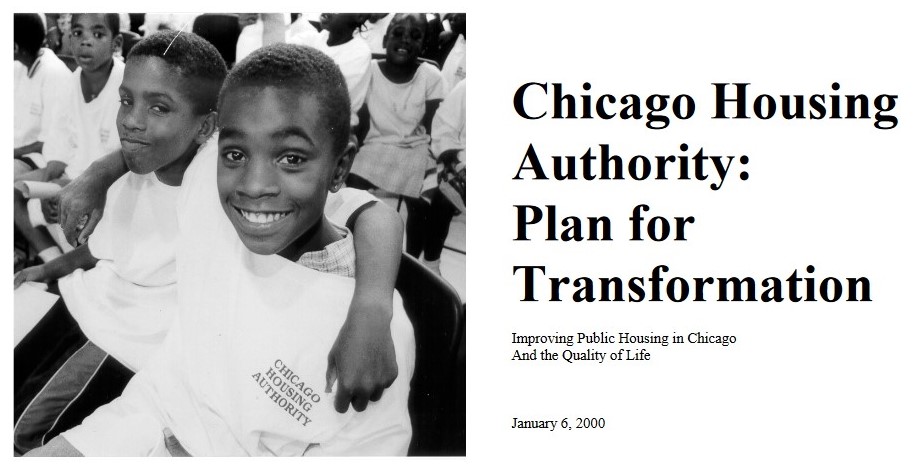
Cover of the 2000 report on the Plan for Transformation.

Overall, though, I would say the Plan for Transformation has been a disappointment. It took far too long. It built too little housing. The overall aim of integrating very poor people into their communities and the city at large has not been fully achieved. The continued segregation of Chicago by race and class continues. I guess you could say that the series helped set the agenda or some of the reforms that occurred, but I’m sure not satisfied with the outcome.

For low-income housing to succeed, it doesn’t need to be an architectural showplace. It just needs to do the basics, right. It needs to provide shelter, it needs to provide community, it needs to provide integration into the broader society, so [that] people can climb the ladder, economically and socially, if they want to. It doesn’t need to win a design award, although good design certainly can be a part of its success.

I do think it’s really important to say that design is not deterministic. In other words, better buildings will not make better people. Design is part of the equation of integrating the very poor into the city. But it can’t do it all by itself. It’s naive to think that. It needs to be combined with social service programs, and other things – schools, families that are supportive – in order for it to succeed. Design can open the door to success, but it cannot achieve that on its own.

And the corollary is true, too. You can’t blame bad design for the failures completely. You can’t completely blame bad design for the failures of high-rise public housing. The failure has had to do as much withe federal policy that was well intentioned, but foolish. Concentrating lots of very poor people and a vast high rise development, like the Robert Taylor Homes or Stateway Gardens, was an invitation to disaster. In a way, it doesn’t matter how the buildings are designed. The design simply accentuated the social problem these high concentrations of poverty.

Kamin highlights multiple important elements at play: how much replacement housing was actually created, the larger social issues still very present in Chicago (“segregation…by race and class”), and the role of design. I’ll comment briefly on each.

First, this was one of the fears of public housing residents as the Plan for Tranformation was getting underway: if high-rises are torn down, will they be replaced and by what? The Plan for Transformation has not delivered on the number of units promised. The issue of the high-rises may have been addressed but the issues simply morphed into different issues.

Second, is the issue really public housing or is it ongoing inequality in Chicago? As luxury buildings keep going up, conditions in many Chicago neighborhoods have not improved. Public housing has never been particularly popular in the United States but neither has actually acknowledging and addressing the deeper issues of why some city residents might have a need for public housing or why affordable housing is in short supply.

Third, considering the full set of forces at work in a particular context – design, social forces and processes, relationships, power dynamics, the organizations and institutions involved – is very important. If segregation by race and class is present in Chicago, certain institutional actors have particular vested interests, and the design all need to be considered, how might this change constructing buildings in the first place?

With all this said, I hope conversations about public housing and affordable housing in Chicago are not solely relegated to discussions of past decisions and poor outcomes.