Skokie is one of more than thirty Chicago-area suburbs that have shifted from majority-white communities to majority non-white ones in the past two decades, according to a WBEZ analysis of demographic data for nearly 300 suburbs in Cook County and the five collar counties from 2005 to 2024…
Between 2015 and 2024, 18 suburbs flipped from majority-white to majority non-white, up from 12 during the prior 10-year period spanning 2005 through 2014.
Many suburbs today are no longer the white, middle-class enclaves of the mid-20th century, said Willow Lung, an associate professor of urban studies and planning and director of the Small Business Anti-Displacement Network at the University of Maryland…
Overall, an increase of more than 600,000 nonwhite suburban residents over the last two decades completely offset the region’s loss of white suburban residents.
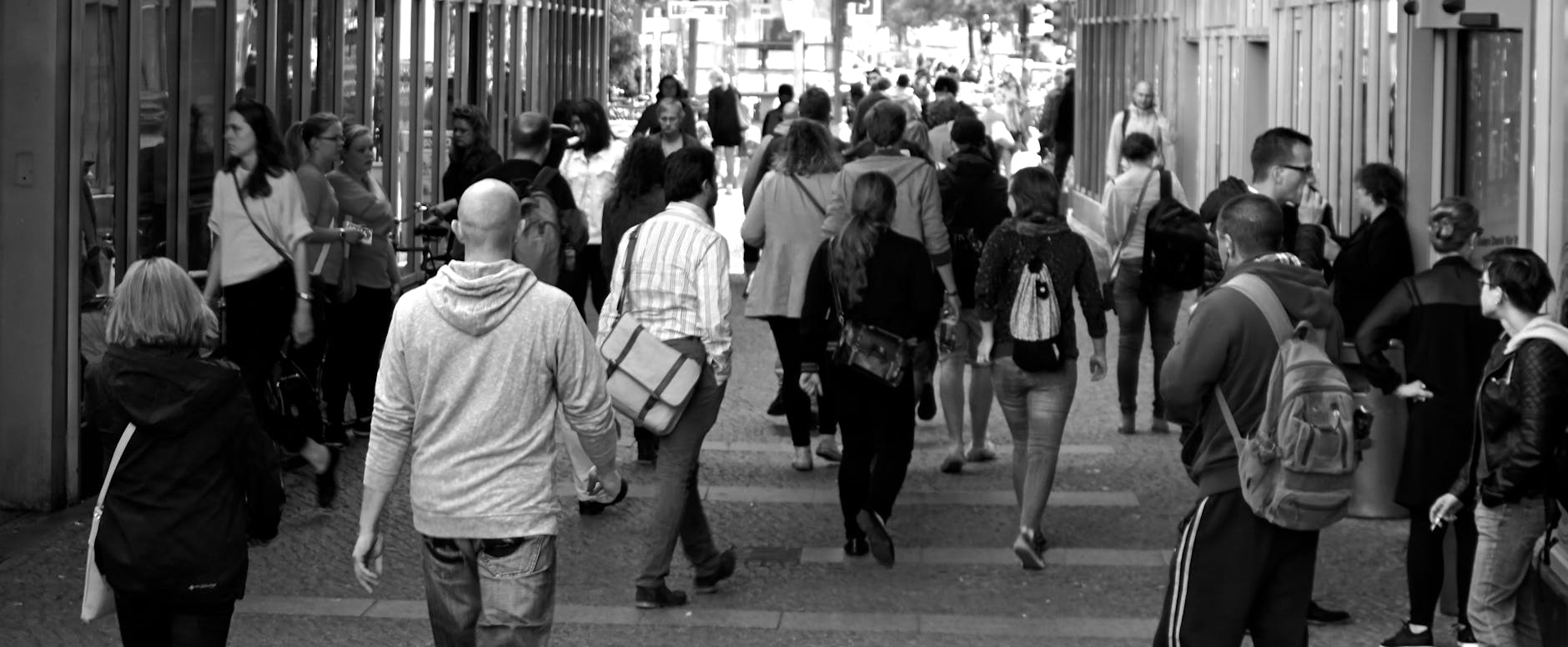
This is part of a nationwide trend where suburbs are increasingly diverse by race, ethnicity, and social class.
At the same time, the final paragraph cited above hints at another change; white suburbanites in the Chicago region leaving for elsewhere. What happens then in these suburbs as populations change? The article describes broad patterns but there are likely also interesting stories of what communities have become as their residents change. This could affect how a community sees itself, amid other possible reactions.
Will these patterns continue in the coming years in the Chicago region with more suburbs becoming majority non-white? And will white residents continue to leave for other suburbs or move out of the region all together? If both continue, how long until the image of “white, middle-class enclaves” of suburbia is no longer common?
By 1870 Chicago’s five thousand black residents lived in every ward of the city as well as numerous suburbs. Chicago had instituted some progressive policies during Reconstruction, including a civil rights law and, in 1874, an officially desegregated school system. After the collapse of Reconstruction, many blacks who had held political office in southern states relocated to Chicago in what observers called “the Migration of the Talented Tenth.” By 1893 Chicago’s black population was fifteen thousand, still just a small fraction of the more than million Chicagoans. Some blacks settled north of Chicago, near domestic service jobs in the suburb of Evanston, as well as on the near West Side. Many gathered in the neighborhood around Clark and Harrison Streets, on the south fringe of Chicago’s business district, an area that escaped the Great Fire of 1871 but was completely burned in 1874.
During the 1880s and 1890s, pushed by racism and pulled by their own preferences for living near black-led institutions, new black migrants were increasingly limited to Chicago’s Black Belt on the South Side. Extending just two blocks west and east of State Street, stretching south to Thirty-fifth Street and eventually Fifty-fifth, this narrow strip contained 56 percent of Chicago’s blacks in 1900, 78 percent, and 90 percent by 1930. (152-153)
This mirrors national trends. W. E. B. Du Bois discusses this in The Souls of Black Folkwhere he looks at what was possible during Reconstruction and then quickly disappears once that period ends. James Loewen argues in Sundown Townsthat after the movement of Black residents all over the United States after the Civil War, many communities in the United States by the late 1800s restricted Black people and other people of color from staying or living in their towns.
And Chicago is a particularly noteworthy example of this because of how strong these geographic lines become. By the early 1900s, violence, formal and informal policies, and social interactions reinforce these boundaries in such a way that Chicago is one of the most racially segregated cities in the United States by the end of the century.
But these boundaries were not always there. They do not have to be there in the future. Lewinnek argues they were the result of particular actions and conditions, including the efforts of working-class homeowners.
What made Willingboro different was the existence of strong anti-discrimination state laws and courts willing to enforce them. Neither New York nor Pennsylvania had such laws when their Levittowns were being built. The New Jersey laws forced Levitt to drop his whites-only policy, and he decided that since integration was going to happen, it should unfold as smoothly as possible. Above all, Levitt wanted to avoid another situation like the one that greeted the Myerses in his Pennsylvania development, which had given Levitton a bad name both among white segregationists, who now saw Levittown’s whites-only promise as unreliable, and more liberal-minded people unwilling to live in a community known for racial antagonism. (156-157)
In his previous two communities, pressure brought by organizations and individuals was not enough to push Levitt to allow Black residents. But the conditions were different in New Jersey: the state had already acted. And the way it sounds above, Levitt wanted to both work with the different context and avoid bad publicity.
Earlier in the book, Berenson describes how Levitt said he limited his communities to whites because he was worried about how potential white buyers would respond to integrated communities. He might have been looking out for his bottom line but state legislation or policies could take a different or broader view.
In August Wilson’s 1979 play Jitney, one of the Pittsburgh characters is working to buy a suburban home for his young family. In the opening scene of Act 2, Youngblood describes where the home is:
I asked Peaches if she would go with me to look at houses, cause I wanted to surprise you. I wanted o pull a truck up to the house and say, “Come on, baby, we moving.” And drive on out to Penn HIlls and pull that truck up in front of one of them houses and say, “This is yours. This is your house baby.”
And a little later in the same conversation:
Wait till you see it. It’s real nice. It’s all on one floor . . . it’s got a basement . . . like a little den. we can put the TV down there. I told myself Rena’s gonna like this. Wait till she see I bought her a house.
In this conversation, the home in Penn Hills is part of achieving the American Dream: a pleasant place where a family can settle in and children can achieve.
Later in the same scene, the older character Becker hears of the potential move and approves of the community:
Good! They got some nice houses out there. That’s a smart move, Youngblood. I’m glad to see you do it. Ain’t nothing like like owning some property.
The vision of a suburban property contrasts sharply with the fate of the jitney station as the city will soon board up the property with some vague notion of redeveloping the land in the future.
But there are also hints that Penn Hills might not be a paradise. In the final scene (Act Two Scene 4), another character comments on Penn Hills:
They ain’t as nice as the houses in Monroeville. Most people don’t even buy houses in Penn Hills no more. They go out to Monroeville.
Reading this reminded me of Benjamin Herold’s book Disillusionedthat includes Penn Hills as part of the argument of how the American Dream of suburban living did not extend beyond white families. Penn Hills grew quickly after World War Two, increasing from over 15,000 residents in 1940 to over 62,000 in 1970. But since then white families left (as development extended to Monroeville and other places), the population declined, and Black families who moved to the community found a suburb struggling to maintain its tax base and fund local infrastructure.
Penn Hills may have looked in the early 1970s to hold out hope regarding a successful suburban life but Herold suggests it cannot now promise the suburban American Dream. By the late 1970s, it was changing. The struggles of and in Pittsburgh neighborhoods that Wilson describes extended out to Penn Hills. What was a place of hope turned out to be different than depicted.
Neighbors objected, saying they’d prefer condos to apartments. Some said they feared the apartments would turn into Section 8. Others raised the prospect of crime…
Alderman Joe Kenny said then that the building in question would not be an issue if the developer planned condos instead of apartments…
“I felt some of the comments in the emails came off as really derogatory. The tone in those statements, they came off to be kind of racist, and it promoted a level of classism that Darien is not proud of,” said Vaughan, who was the council’s only African American.
In response, a man stormed out of the room. Others denied that race was a factor.
But race was explicitly mentioned in one of the dozens of comments that the city posted to its website.
Across suburban communities, these two reasons are commonly mentioned in opposition to apartments: (1) who will live in the apartments and (2) preference for condos or other forms of residences that require ownership. Regarding the first, sometimes the language is veiled and sometimes it is not. It sounds like those who opposed apartments in Darien were clear about who they did not want in the community. And that building condos instead would address their concerns.
And what is the answer in suburbs to these concerns? Here is one answer given in Darien:
He said The Jade was a “beautiful building,” occupied by young professionals. An alderman said something similar recently.
To assuage the fears of residents, these reasons are often provided: the new apartments will look high-quality and young professionals will live there. These are intended to show that these apartments will be occupied by people residents will find acceptable in the community.
This is a way that suburban exclusion continues. I have found similar discussions happening for decades for Chicago area suburbs. Another reason sometimes provided by objectors is that apartments will disturb the character of the community. This reason is often related to the two explicitly mentioned above.
Decisions about development are not just about properties and buildings; they are about who community members want in their suburb.
Between 1925 and 1990, the rate of suburbanization differed by Protestant denomination. Some denominations were already more likely to be in the suburbs (their suburban presence predated mass suburbanization), some moved to the suburbs in increasing numbers, and some hardly moved at all. The general pattern among these groups was an increasing percentage of their churches in suburban locations, a process that was underway by the 1930s and 1940s and continued after World War II…
In this study, churches were influenced by settlement patterns in the Chicago region and the presence of numerous churches already existing in suburban communities. In addition, the racial and ethnic identity of some denominations helped dictate their choices for new suburban locations.
This article built on important work by multiple scholars about white flight in the Chicago area. Mark Mulder in Shades of White Flightlooked at how The Christian Reformed Church and The Reformed Church in America churches, both Dutch Reformed denominations, moved to the suburbs. Irving Cutler in The Jews of Chicago examined how Jews moved to suburban communities. Eileen McMahon in What Parish Are You From?analyzed how one Catholic parish responded to changing neighborhood populations, including moving to the suburbs.
As the story is told of American suburbanization, particularly after World War Two, the story should include the role religious institutions and adherents played in supporting white flight. I say more about the ways this played out with evangelicals in Sanctifying Suburbia.
Pope Leo XIV grew up in Dolton, Illinois, a suburb just south of the city of Chicago. Is this a story not just of the first American pope but a pope who grew up in the changing American suburbs? Over the years, what happened in his suburban community that had its first white settlers in the 1830s? First from the Encyclopedia of Chicago:
The mixture of railroads and the Little Calumet River proved to be a good site for industry. Dolton grew as a center for truck farming and manufacturing. It has produced bakery equipment, brass castings, shipping containers, cement, furniture, agricultural equipment, steel tanks, and chemicals. This diverse activity attracted an ethnically varied workforce. In the 1960s the Calumet Expressway (now the Bishop Ford Freeway) improved automobile and truck access to Chicago by two interchanges serving Dolton. In recent years large numbers of African Americans have moved to Dolton. The 2000 census reported a population of 25,614 with 14 percent white, 82 percent black, and 3 percent Hispanic.
According to a table on this page, Dolton was 99.9% white in 1960, 58.1% white in 1990, and 14.3% white in 2000. According to the Census Bureau, Dolton is now 4.9% white.
This is the story of how one small town became trapped in a downward spiral that poverty experts say follows a well-worn pattern of deindustrialization that leads to a disenfranchised economic class. Communities of color inherit a legacy of decline and then lack the resources, both financial and political, needed to turn things around.
The focus is Dolton, but it just as easily could be Riverdale, Harvey, Dixmoor, Posen, Calumet City or other nearby suburbs that once were powered by steel and other industry but over time slowly coalesced into a broad swath of economic distress. In other parts of Illinois, such as North Chicago to the north or Maywood to the west, the details change but the problems are often much the same.
It was no one single thing, but a cascade of events that changed the fortunes of Dolton and its neighbors. The decline of manufacturing led to a loss of job and pay opportunities, which in turn fed a wave of white flight as longtime residents left and were replaced by African-American city dwellers lured by better, yet not too expensive, housing.
But luring new investment to now majority black communities proved a challenge and housing values began to fall, taking down with them the tax revenues needed to keep up public services. Next came widespread foreclosures and an invasion of real estate scavengers who bought houses on the cheap, transforming a community of homeowners with a deep financial stake in their town into one of renters with looser bonds.
All the while, the political fabric vital to turning things around continued to fray. Government stumbled amid patronage and gridlock, rendering even more challenging the task of drawing needed new investment.
His parents had been living in a 1,200-square-foot brick house on East 141st Place in Dolton. They bought it new in 1949, paying a $42 monthly mortgage.
His father Louis Prevost was superintendent of the south suburban schools in District 169. News clippings from 1945 show he served as a Navy lieutenant in the Mediterranean in WWII. He had graduated from the old Central Y.M.C.A. College in 1943 while living in Hyde Park.
The new pope’s mother, Mildred Martinez Prevost, studied library science at DePaul University. Her death notice, in 1990, said she and her husband started the St. Mary’s library in the basement of the old school building and mentions jobs she had in the libraries at Holy Name Cathedral, Von Steuben High School on the North Side and at Mendel from 1969 to 1975.
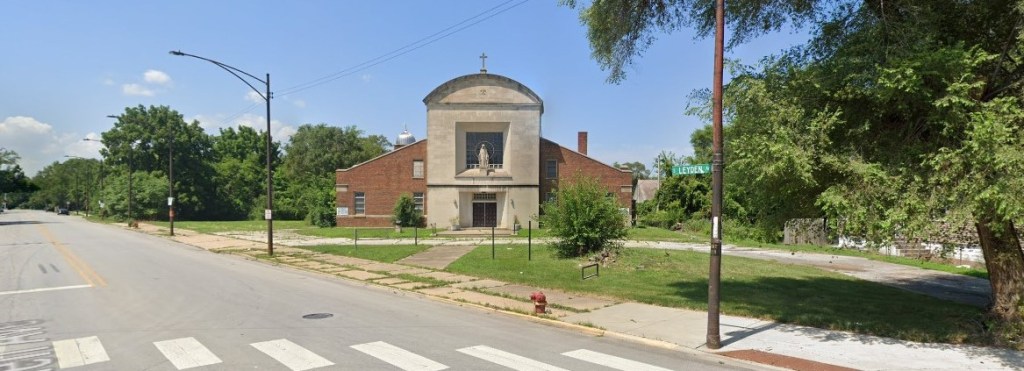
The Prevosts attended a Catholic parish – St. Mary of the Assumption – just inside the southern borders of Chicago and next to the suburbs of Dolton and Riverdale. Here is what the property looked like as of July 2024:
Like St. Mary’s, other Catholic institutions that helped shape the future cardinal are long gone, closed over the past several decades as the Catholic population around where he grew up and elsewhere plummeted. Among those bygone institutions:
• Mendel College Prep High School, where Prevost and his mother worked.
• St. Augustine Seminary High School in Michigan.
• Tolentine College in Olympia Fields, the suburb where he briefly lived.
• Mount Carmel Elementary School in Chicago Heights, where his father was principal.
Several of these communities mentioned – Olympia Fields, Chicago Heights – experienced racial change similar to that of Dolton.
If white Catholic residents indeed left Dolton and other communities on the South Side of Chicago and its southern suburbs and American suburbia became more complex, where did they move to? How did this shape the ministry of Pope Leo XIV?
Just as there was nothing natural about the processes that prompted suburban decline, there was nothing natural about the vast funds poured into these communities to make redevelopment happen. County and state governments led the way through planning, policies, and public investments meant to entice private investment. As Silver Spring and Wheaton vividly revealed, their efforts were layered and robust: enterprise zones, urban and art districts, eminent domain, tax breaks, parcel assemblage, parking regulations, new transit investments and infrastructure. Public agencies created new market pressures that directed and enabled profitable private development. They served as the promotional arm of private corporations, advertising new suburban downtowns as safe for middle-class consumers and residents. They were critical actors in creating displacement pressures and were, as many activists argued, responsible for their redress.
But for the millions of dollars in tax breaks, incentives and assistance that developers were given, what was asked in return for those who lost their homes, businesses and sense of community? What was gained for those who had lived with broken sidewalks and run-down playgrounds for decades? Were they the beneficiaries of this progress – or was the development, as many suspected, for someone else?
As visions for new suburban downtowns emerged, long-standing communities could scarcely see themselves in the sketches of shiny new plazas and pedestrian streets. As in downtown Silver Spring, these images projected futures that allowed for the comfortable return of the white middle classes, catering to their tastes and preferences for what an authentic and safe urban experience looked and felt like. They did not honor marginalized groups’ deep histories, struggles or valued places. If suburban boosters dared to look back at all, their visions sugarcoated the past in ways that did not trouble their present plans.
Even diversity became a selling point. In Wheaton, multicultural festivals crowded the downtown plaza and colorful art displays featured faces from across the world. Yet many wondered whether its fragile diversity was simply a transition to a future in which they no longer existed.
This is gentrification — and it is suburban. While the language of retrofitting or renaissance may be much more genteel, their processes are no less brutal nor disruptive. They affect the lives and livelihoods of countless neighborhoods and threaten the sense of place that people of color and new immigrants have fought to establish and protect, sometimes with, but largely in the absence of, white neighbors and public support.
This sounds similar to what studies of urban gentrification find: the promises of new development and growth can have negative consequences for residents already there.
I wonder if resisting gentrification in the suburbs might be harder for two reasons:
Growth is good in the United States. This is true across numerous American communities but might even be more baked into the idea of suburbia. Suburbs are meant to grow. To resist growth is to resist a higher status. (An exception might be that communities that are already well-off and exclusive can resist growth.)
The new suburbia emerged as a crucial site where people of different backgrounds, races, classes, and identities coexisted as neighbors, where people were trying to figure out how to live together in difference.
Building on decades of ideology, policy, and patterns in social relations, the American suburbs that grew quickly immediately after World War Two were often single-family home communities with white and middle-class and above residents. But as suburbs changed, particularly in more recent decades, they have become a different landscape. They are more diverse in terms of race and ethnicity and social class. They include numerous immigrants. They can contain different kinds of housing. Suburbanites live in a variety of communities distributed across a metropolitan landscape. Los Angeles is a good place to see these changes in action but this has happened in numerous metropolitan areas across the United States. All of this has led to a more complex suburbia.
Given the quote above, I also wonder if suburbs then can end up being places where Americans do “figure out how to live in difference.” Suburban history is full of examples of exclusion by race and social class. Do suburbanites on a whole today work together to address issues they all care about? Are the suburbs as a whole welcoming places? Can local tensions be resolved effectively? What places and/or groups can help bridge differences in suburbs? Or are suburbs a patchwork of exclusion and different kinds of development that holds together under the place category of suburbs?
Disparities across groups are stark. According to the study, data collected in 2022 showed Chicago’s white families have the highest median net wealth ($210,000), while typical Black families report no wealth ($0). Chicago’s U.S.-born Mexican families have 19% ($40,500) of a typical white family’s wealth, while foreign-born Mexican families have 3% ($6,000) and Puerto Rican families have 11% ($24,000).
As for median asset values, Black families have $20,000, foreign-born Mexican families have $26,000 and white families have $325,500.
The study also found Black families had the lowest estimated rate of home ownership at 34%, while white families had the highest at 72%, reflecting the city’s historic discrimination against people of color through redlining, racial covenants, a lack of checking or savings accounts, and payday lending, where unsecured loans with high interest rates are used as emergency financing that keeps borrowers in a cycle of long-term debt.
The researchers asked people about possible interventions:
“The Color of Wealth in Chicago” study also surveyed people about potential policy proposals for addressing structural economic disparities. Data shows that public support for interventions on local and federal levels would have a meaningful impact on racial wealth inequities. Wealth-building options such as guaranteed income projects, a Medicare for All program, and baby bonds, which are government-issued trust accounts for newborns, garnered support from the bulk of respondents, including families at or above the median net worth.
Wealth matters because it affects all kinds of life chances, including where people live, access to education and medical care, and nearby jobs.






 Legally Sociable